
 Welcome to Cell-ACDC!
A GUI-based Python framework for segmentation, tracking, cell cycle annotations and quantification of microscopy data


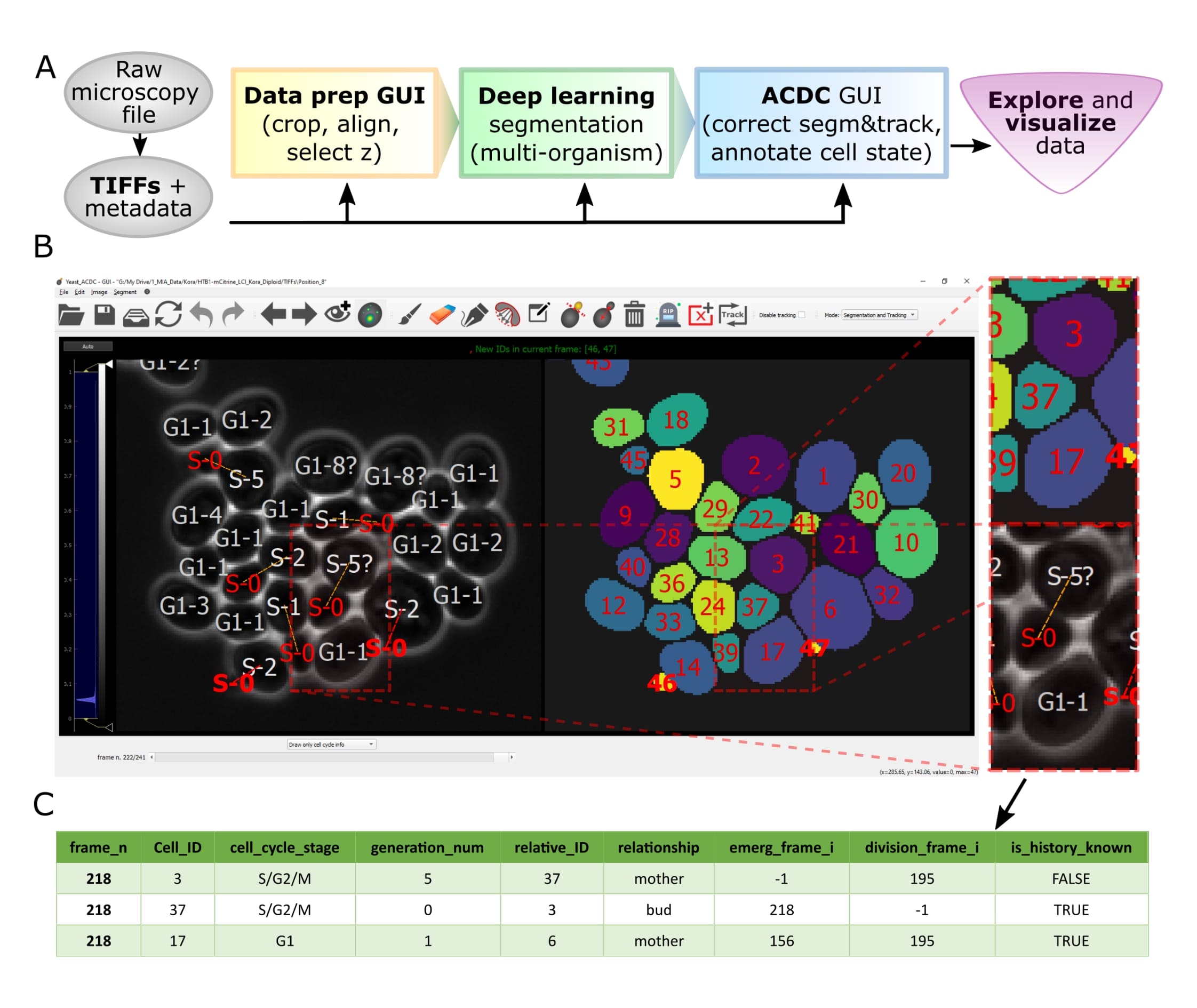
Overview of pipeline and GUI
Overview
Let’s face it, when dealing with segmentation of microscopy data we often do not have time to check that everything is correct, because it is a tedious and very time consuming process. Cell-ACDC comes to the rescue! We combined the currently best available neural network models (such as Segment Anything Model (SAM), YeaZ, cellpose, StarDist, YeastMate, omnipose, delta, DeepSea, etc.) and we complemented them with a fast and intuitive GUI.
We developed and implemented several smart functionalities such as real-time continuous tracking, automatic propagation of error correction, and several tools to facilitate manual correction, from simple yet useful brush and eraser to more complex flood fill (magic wand) and Random Walker segmentation routines.
See the table below how it compares to other popular tools available (Table 1 of our publication).
Feature |
Cell-ACDC |
YeaZ |
Cell-pose |
Yeast-Mate |
Deep-Cell |
Phylo-Cell |
Cell-Profiler |
ImageJ Fiji |
Yeast-Spotter |
Yeast-Net |
Morpho-LibJ |
|---|---|---|---|---|---|---|---|---|---|---|---|
Deep-learning segmentation |
✅ |
✅ |
✅ |
✅ |
✅ |
❌ |
✅ |
✅ |
✅ |
✅ |
❌ |
Traditional segmentation |
✅ |
❌ |
❌ |
❌ |
❌ |
✅ |
✅ |
✅ |
❌ |
❌ |
✅ |
Tracking |
✅ |
✅ |
❌ |
❌ |
✅ |
✅ |
✅ |
✅ |
❌ |
❌ |
❌ |
Manual corrections |
✅ |
✅ |
✅ |
✅ |
✅ |
✅ |
✅ |
✅ |
❌ |
❌ |
✅ |
Automatic real-time tracking |
✅ |
❌ |
❌ |
❌ |
❌ |
❌ |
❌ |
❌ |
❌ |
❌ |
❌ |
Automatic propagation of corrections |
✅ |
❌ |
❌ |
❌ |
❌ |
✅ |
❌ |
❌ |
❌ |
❌ |
❌ |
Automatic mother-bud pairing |
✅ |
❌ |
❌ |
✅ |
❌ |
✅ |
❌ |
❌ |
❌ |
❌ |
❌ |
Pedigree annotations |
✅ |
❌ |
❌ |
✅ |
✅ |
✅ |
✅ |
✅ |
❌ |
❌ |
❌ |
Cell division annotations |
✅ |
❌ |
❌ |
❌ |
❌ |
✅ |
✅ |
✅ |
❌ |
❌ |
❌ |
Downstream analysis |
✅ |
❌ |
❌ |
❌ |
✅ |
✅ |
✅ |
✅ |
❌ |
❌ |
❌ |
3D z-stacks |
✅ |
❌ |
✅ |
❌ |
✅ |
❌ |
✅ |
✅ |
❌ |
❌ |
✅ |
Multiple model organisms |
✅ |
❌ |
✅ |
❌ |
✅ |
❌ |
✅ |
✅ |
❌ |
❌ |
✅ |
Bio-formats |
✅ |
❌ |
❌ |
❌ |
❌ |
❌ |
✅ |
✅ |
❌ |
❌ |
✅ |
User manual |
✅ |
✅ |
✅ |
✅ |
✅ |
❌ |
✅ |
✅ |
✅ |
✅ |
✅ |
Open source |
✅ |
✅ |
✅ |
✅ |
✅ |
✅ |
✅ |
✅ |
✅ |
✅ |
✅ |
Does not require a licence |
✅ |
✅ |
✅ |
✅ |
✅ |
❌ |
✅ |
✅ |
✅ |
✅ |
✅ |
Is it only about segmentation?
Of course not! Cell-ACDC automatically computes several single-cell numerical features such as cell area and cell volume, plus the mean, max, median, sum and quantiles of any additional fluorescent channel’s signal. It even performs background correction, to compute the protein amount and concentration.
You can load and analyse single 2D images, 3D data (3D z-stacks or 2D images over time) and even 4D data (3D z-stacks over time).
Finally, we provide Jupyter notebooks to visualize and interactively explore the data produced.
Scientific publications where Cell-ACDC was used
Check here for a list of the scientific publications where Cell-ACDC was used.
Resources
Publication of Cell-ACDC
Image.sc Forum to ask any question. Make sure to tag the Topic with the tag cell-acdc
GitHub issues for reporting issues, request a feature or ask questions
Scientific publications where Cell-ACDC was used
Citing Cell-ACDC and the available models
If you find Cell-ACDC useful, please cite it as follows:
Padovani, F., Mairhörmann, B., Falter-Braun, P., Lengefeld, J. & Schmoller, K. M. Segmentation, tracking and cell cycle analysis of live-cell imaging data with Cell-ACDC. BMC Biology 20, 174 (2022). DOI: 10.1186/s12915-022-01372-6
Alternatively, you can also use Cite this repository button on the right ribbon of the GitHub page.
IMPORTANT: when citing Cell-ACDC make sure to also cite the paper of the segmentation models and trackers you used! See here for a list of models currently available in Cell-ACDC.
Contact
Do not hesitate to contact us here on GitHub (by opening an issue) or directly at the email padovaf@tcd.ie for any problem and/or feedback on how to improve the user experience!
Contributing
At Cell-ACDC we encourage contributions to the code! Please read our contributing guide to get started.


Release files for cellacdc 1.9.0
For a detailed explanation of source distributions (sdists) and built distributions (wheels), please see the package formats documentation.
Source distribution (sdist)
| File | Size | Uploaded | Provenance | Actions |
|---|---|---|---|---|
| cellacdc-1.9.0.tar.gz | 27.0 MB | Without provenance | Details for cellacdc-1.9.0.tar.gz |
Built distribution (wheel)
| File | Interpreter | ABI | Platform | Actions Reset |
|---|---|---|---|---|
| cellacdc-1.9.0-py3-none-any.whl | Python 3 | none | any | Details for cellacdc-1.9.0-py3-none-any.whl |
Total release size: 49.5 MB
Release files / cellacdc-1.9.0.tar.gz
| Download URL | cellacdc-1.9.0.tar.gz |
|---|---|
| Size | 27.0 MB |
| Tags | Source |
|
SHA-256 checksum How to use checksums |
b5e3811b242b2ab5d40005e9e408561db41dc27e0b82adc21db697ef60eef44c
|
|
BLAKE2b-256 checksum How to use checksums |
b644c38996cd28b4a368e8498dae400fcabc9d4d90e8c0156f5b74563e646cc4
|
| Upload date | |
|
Uploaded using Trusted Publishing? What is trusted publishing? |
No |
| Uploaded via |
twine/6.2.0 CPython/3.12.12
|
Release files / cellacdc-1.9.0-py3-none-any.whl
| Download URL | cellacdc-1.9.0-py3-none-any.whl |
|---|---|
| Size | 22.4 MB |
| Tags | Python 3 |
|
SHA-256 checksum How to use checksums |
6c86b7be6ddc216d942f181c5b615a1ec706573b8dce14c597797e2dd6432778
|
|
BLAKE2b-256 checksum How to use checksums |
c2c9ec4924cdbb516b8ff69208bf0d35516cbcf928e3efd1bacdbd4aea88d1ba
|
| Upload date | |
|
Uploaded using Trusted Publishing? What is trusted publishing? |
No |
| Uploaded via |
twine/6.2.0 CPython/3.12.12
|
Security for cellacdc 1.9.0
Provenance
Provenance describes where a file came from. On PyPI, provenance is shared via attestations, which provide a verifiable record of the build or publishing details. View details, limitations and caveats.
No provenance found
None of the files in this release were uploaded with provenance metadata.
A note on package security
PyPI is a repository for distributing packages, not a service for auditing them. While third-party security researchers and our staff do their best to detect and remove malicious packages, PyPI cannot guarantee the quality, security or suitability of any given package.
To learn more about protecting yourself from malicious actors, visit our package security documentation.














