ChemoMAE: 1D Spectral Masked Autoencoder + Hyperspherical Clustering Toolkit
Project description
ChemoMAE
ChemoMAE: A research-oriented PyTorch toolkit for 1D spectral representation learning, hypersphere-aware augmentation, and hyperspherical clustering .
Why ChemoMAE?
Traditional chemometrics has long relied on linear methods such as PCA and PLS. While these methods remain foundational, they often struggle to capture the nonlinear structures and high-dimensional variability present in modern spectral datasets.
ChemoMAE is motivated by the geometry induced by Standard Normal Variate (SNV) preprocessing. SNV centers each spectrum and scales it to unit variance, making the L2 norm essentially constant across samples. This means that sample-wise magnitude is no longer a meaningful degree of freedom after preprocessing; what remains informative is primarily the relative spectral shape, or direction, on the normalized spectral manifold. ChemoMAE is therefore designed to learn latent representations that emphasize directional structure while avoiding unnecessary dependence on latent norm.
1. Extending Chemometrics with Deep Learning
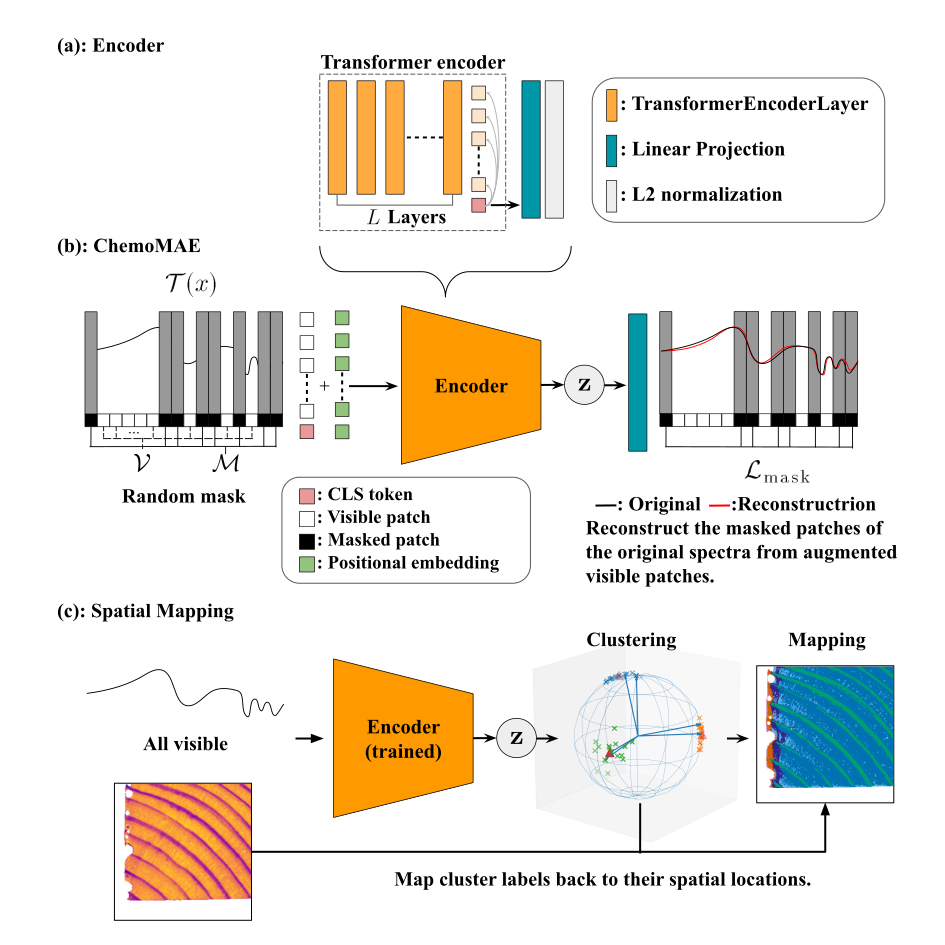
ChemoMAE introduces a Transformer-based Masked Autoencoder (MAE) specialized for 1D spectra .
- spectra are divided into contiguous patches
- masking is applied patch-wise
- reconstruction loss is computed only on the masked spectral regions
- the encoder produces latent representations
zthat are naturally compatible with cosine similarity
[!NOTE] The latent embedding
zcan be L2-normalized to unit norm (latent_normalize=True, default). Disable this (latent_normalize=False) if you prefer unconstrained embeddings.
This architecture aligns naturally with the hyperspherical geometry induced by SNV, making the learned representations well suited for cosine-based clustering , retrieval, and downstream analysis.
2. Hypersphere-Aware Augmentation
ChemoMAE also provides a spectral augmenter designed specifically for SNV-normalized spectra.
Instead of applying unconstrained Euclidean perturbations, SpectraAugmenter applies weak spectral perturbations while maintaining the geometry induced by SNV preprocessing. In particular, the augmenter can re-center each augmented spectrum to zero mean and re-normalize it to the original per-spectrum L2 norm.
The current implementation supports:
- fractional shift small wavelength-axis perturbation using interpolation
- tangent Gaussian noise random local perturbation constructed in the tangent space of the hypersphere
Fractional shift is controlled by the shift amount in channel-index units, while tangent Gaussian noise is controlled by a geodesic angle range in degrees.
These augmentations are intended as auxiliary regularization for masked reconstruction, not as a strong contrastive multi-view augmentation pipeline.
3. Hyperspherical Geometry Toolkit
The latent embeddings, when L2-normalized, reside on a unit hypersphere . Built-in clustering modules — Cosine K-Means and vMF Mixture — leverage this geometry directly and are therefore more appropriate than Euclidean clustering when the signal is primarily directional spectral variation .
Quick Start
Install ChemoMAE:
pip install chemomae
ChemoMAE Example
Example
1. SNV Preprocessing
Import SNVScaler.
SNV standardizes each spectrum to have zero mean and unit variance. This removes baseline and scaling effects while preserving spectral shape. After SNV, all spectra have the same L2 norm:
\lVert x_{\mathrm{snv}} \rVert_2 = \sqrt{L - 1}
For example, for 256-dimensional spectra,
\lVert x_{\mathrm{snv}} \rVert_2 = \sqrt{255} \approx 15.97
Hence, SNV maps spectra onto a constant-radius hypersphere.
from chemomae.preprocessing import SNVScaler
# X_*: reflectance data (np.ndarray)
# Expected shape: (N, 256)
preprocessed = []
for X in [X_train, X_val, X_test]:
sc = SNVScaler()
X_snv = sc.transform(X)
preprocessed.append(X_snv)
X_train_snv, X_val_snv, X_test_snv = preprocessed
2. Dataset and DataLoader Preparation
Convert NumPy arrays into PyTorch tensors and build DataLoaders.
from chemomae.utils import set_global_seed
import torch
from torch.utils.data import DataLoader, TensorDataset
set_global_seed(42)
train_ds = TensorDataset(torch.as_tensor(X_train_snv, dtype=torch.float32))
val_ds = TensorDataset(torch.as_tensor(X_val_snv, dtype=torch.float32))
test_ds = TensorDataset(torch.as_tensor(X_test_snv, dtype=torch.float32))
train_loader = DataLoader(train_ds, batch_size=1024, shuffle=True, drop_last=False)
val_loader = DataLoader(val_ds, batch_size=1024, shuffle=False, drop_last=False)
test_loader = DataLoader(test_ds, batch_size=1024, shuffle=False, drop_last=False)
3. Model, Optimizer, and Scheduler Setup
Define ChemoMAE and a standard optimization pipeline.
from chemomae.models import ChemoMAE
from chemomae.training import build_optimizer, build_scheduler
model = ChemoMAE(
seq_len=256,
d_model=256,
nhead=4,
num_layers=4,
dim_feedforward=1024,
dropout=0.1,
latent_dim=16,
latent_normalize=True,
decoder_num_layers=2,
n_patches=32,
n_mask=16,
)
opt = build_optimizer(
model,
lr=1.0e-3,
weight_decay=0.05,
betas=(0.9, 0.95),
)
sched = build_scheduler(
opt,
steps_per_epoch=max(1, len(train_loader)),
epochs=500,
warmup_epochs=10,
min_lr_scale=0.1,
)
4. Optional Spectral Augmentation
Define a hypersphere-aware augmenter for SNV-normalized spectra.
from chemomae.training import SpectraAugmenter, SpectraAugmenterConfig
aug_cfg = SpectraAugmenterConfig(
shift_prob=0.5,
shift_delta_range=(-2.0, 2.0),
noise_prob=0.5,
noise_angle_deg_range=(0.5, 3.0),
shuffle_order_per_batch=True,
recenter_after_each_op=True,
renorm_to_input_norm=True,
)
augmenter = SpectraAugmenter(aug_cfg)
The model input is augmented, but the reconstruction target remains the original spectrum.
This provides weak denoising-style regularization while preserving the SNV-compatible geometry of the input spectra.
5. Training Setup (Trainer + Config)
Trainer orchestrates the fixed-budget self-supervised training loop with:
- AMP (Automatic Mixed Precision)
- EMA (Exponential Moving Average of model weights)
- optional
SpectraAugmenter - gradient clipping
- checkpointing / resume
- JSON logging
- final weights export
ChemoMAE does not use validation-loss-based early stopping or best-checkpoint selection. Training is controlled by a predefined epoch / step budget, and the final model is selected by an explicit rule such as EMA-last weights.
from chemomae.training import TrainerConfig, Trainer
trainer_cfg = TrainerConfig(
out_dir="runs",
device="cuda",
amp=True,
amp_dtype="bf16",
enable_tf32=False,
grad_clip=1.0,
use_ema=True,
ema_decay=0.999,
loss_type="mse",
reduction="mean",
resume_from="auto",
)
trainer = Trainer(
model,
opt,
train_loader,
scheduler=sched,
augmenter=augmenter,
cfg=trainer_cfg,
)
result = trainer.fit(epochs=500)
print(result["final_model"]) # "ema_last_model.pt" if EMA is enabled
During training, ChemoMAE produces the following outputs under out_dir:
runs/
├── training_history.json
│ ↳ Per-epoch records:
│ [
│ {
│ "epoch": 1,
│ "train_loss": ...,
│ "lr": ...,
│ "time_sec": ...
│ },
│ ...
│ ]
│
├── last_model.pt
│ ↳ Final raw model weights at the end of training
│
├── ema_last_model.pt
│ ↳ Final EMA weights at the end of training
│ (saved only when EMA is enabled)
│
└── checkpoints/
└── last.pt
↳ Full checkpoint for resume:
model + optimizer + scheduler + scaler + EMA + history
6. Evaluation (Tester + Config)
The Tester evaluates masked reconstruction loss on a dataset.
It supports:
- masked-only reconstruction loss
- AMP (
bf16/fp16) - optional fixed visible masks
- optional
SpectraAugmenter - JSON logging to a test-history file
from chemomae.training import TesterConfig, Tester
tester_cfg = TesterConfig(
out_dir="runs",
device="cuda",
amp=True,
amp_dtype="bf16",
loss_type="mse",
reduction="mean",
fixed_visible=None,
log_history=True,
history_filename="test_history.json",
)
tester = Tester(
model,
tester_cfg,
augmenter=None,
)
test_loss = tester(test_loader)
print(f"Test Loss: {test_loss:.6f}")
When augmenter is provided, the Tester applies augmentation to the model input while keeping the reconstruction target as the original spectrum:
tester = Tester(
model,
tester_cfg,
augmenter=augmenter,
)
This evaluates reconstruction robustness under input perturbations.
7. Latent Extraction (Extractor + Config)
Extract latent embeddings from a trained ChemoMAE using all-visible encoding.
By default, Extractor does not use ChemoMAE masking. It directly calls the encoder with an all-visible mask, so the full spectrum is used for latent feature extraction.
from chemomae.training import ExtractorConfig, Extractor
extractor_cfg = ExtractorConfig(
device="cuda",
amp=True,
amp_dtype="bf16",
save_path=None,
return_numpy=False,
)
extractor = Extractor(
model,
extractor_cfg,
augmenter=None,
)
latent_test = extractor(test_loader)
When augmenter is provided, the Extractor applies augmentation before encoder inference:
extractor = Extractor(
model,
extractor_cfg,
augmenter=augmenter,
)
latent_test_aug = extractor(test_loader)
Without an augmenter, latent extraction is deterministic with respect to ChemoMAE masking because all positions are treated as visible. With an augmenter, extracted embeddings may vary due to stochastic spectral shift/noise augmentation.
8. Clustering with Cosine K-Means
Cluster latent vectors using cosine geometry.
from chemomae.clustering import CosineKMeans, elbow_ckmeans
k_list, inertias, K, idx, kappa = elbow_ckmeans(
CosineKMeans,
latent_test,
device="cuda",
k_max=50,
chunk=5_000_000,
random_state=42,
)
ckm = CosineKMeans(
n_components=K,
tol=1e-4,
max_iter=500,
device="cuda",
random_state=42,
)
ckm.fit(latent_test, chunk=5_000_000)
ckm.save_centroids("runs/ckm.pt")
labels = ckm.predict(latent_test, chunk=5_000_000)
9. Clustering with vMF Mixture
Probabilistic hyperspherical clustering.
from chemomae.clustering import VMFMixture, elbow_vmf
k_list, scores, K, idx, kappa = elbow_vmf(
VMFMixture,
latent_test,
device="cuda",
k_max=50,
chunk=5_000_000,
random_state=42,
criterion="bic",
)
vmf = VMFMixture(
n_components=K,
tol=1e-4,
max_iter=500,
device="cuda",
random_state=42,
)
vmf.fit(latent_test, chunk=5_000_000)
vmf.save("runs/vmf.pt")
labels = vmf.predict(latent_test, chunk=5_000_000)
Library Features
chemomae.preprocessing
SNVScaler
SNVScaler performs row-wise mean subtraction and variance scaling . Each spectrum is centered and divided by its unbiased standard deviation (ddof=1).
It is a stateless transformer supporting both NumPy and PyTorch , preserving the original framework, device, and dtype .
When transform_stats=True, it returns (Y, mu, sd), where sd already includes eps and can be directly used for inverse reconstruction.
After SNV, all rows have zero mean and unit variance , producing a constant L2 norm of sqrt(L - 1), thereby mapping spectra onto a constant-radius hypersphere — ideal for cosine-based clustering.
import numpy as np
from chemomae.preprocessing import SNVScaler
X = np.array([[1.0, 2.0, 3.0],
[4.0, 5.0, 6.0]], dtype=np.float32)
scaler = SNVScaler()
Y = scaler.transform(X)
scaler = SNVScaler(transform_stats=True)
Y, mu, sd = scaler.transform(X)
X_rec = scaler.inverse_transform(Y, mu=mu, sd=sd)
Key Features
- unbiased standard deviation (
ddof=1, with automatic fallback forL=1) - numerically stable
epshandling - float64 internal computation
- Torch-compatible device and dtype preservation
When to Use
- Standard preprocessing for NIR spectra
- Before cosine-based modeling or clustering
cosine_fps_downsample
cosine_fps_downsample performs Farthest-Point Sampling (FPS) under hyperspherical geometry , selecting spectra that are maximally diverse in direction .
Internally, all rows are L2-normalized for selection, but the returned subset is drawn from the original-scale input X.
It supports both NumPy and PyTorch inputs and automatically leverages CUDA when available.
import numpy as np
from chemomae.preprocessing import cosine_fps_downsample
X = np.random.randn(1000, 128).astype(np.float32)
X_sub = cosine_fps_downsample(X, ratio=0.1, seed=42)
Key Features
- internal normalization for cosine-based selection
- output kept in original scale
- device-aware Torch support
When to Use
- diversity-driven subsampling
- reducing redundancy in large spectral datasets
chemomae.models
ChemoMAE
ChemoMAE is a Masked Autoencoder for 1D spectra.
It adopts a patch-token formulation , where contiguous spectral bands are grouped into patches and masking is performed at the patch level . The encoder processes only the visible patch tokens together with a CLS token, and the decoder reconstructs the full spectrum using a lightweight MLP decoder .
The CLS output is projected to a latent_dim vector and may be L2-normalized, yielding embeddings naturally suited to cosine similarity and hyperspherical clustering.
import torch
from chemomae.models import ChemoMAE
mae = ChemoMAE(
seq_len=256,
d_model=256,
nhead=4,
num_layers=4,
dim_feedforward=1024,
decoder_num_layers=2,
latent_dim=8,
latent_normalize=True,
n_patches=32,
n_mask=16,
)
x = torch.randn(8, 256)
x_rec, z, visible = mae(x)
Key Features
- patch-wise masking
- Transformer encoder over visible tokens
- lightweight MLP decoder
- optional L2-normalized latent
- cosine-friendly embeddings
When to Use
- learning geometry-aware spectral representations
- downstream clustering, visualization, or supervised fine-tuning
chemomae.training
build_optimizer & build_scheduler
Utility functions for a standardized Transformer-style optimization pipeline.
build_optimizercreates grouped AdamWbuild_schedulercreates linear warmup → cosine decay
from chemomae.models import ChemoMAE
from chemomae.training import build_optimizer, build_scheduler
model = ChemoMAE(seq_len=256)
optimizer = build_optimizer(model, lr=1.0e-3, weight_decay=0.05)
scheduler = build_scheduler(
optimizer,
steps_per_epoch=len(train_loader),
epochs=100,
warmup_epochs=5,
)
SpectraAugmenterConfig & SpectraAugmenter
SpectraAugmenter provides SNV-geometry-aware augmentation for SNV-normalized spectra.
After SNV preprocessing, each spectrum is approximately mean-centered and has a fixed per-spectrum norm.
Instead of applying unconstrained Euclidean perturbations, SpectraAugmenter applies weak spectral perturbations and optionally projects the result back toward the SNV-compatible geometry by:
- re-centering each spectrum to mean zero
- re-normalizing each spectrum to the original per-spectrum L2 norm
The current implementation supports two augmentations:
-
fractional shift A small wavelength-axis perturbation implemented by interpolation.
-
tangent Gaussian noise A random local perturbation constructed by projecting Gaussian noise onto the tangent space and rotating the spectrum by a sampled angle.
Fractional shift is controlled by shift_delta_range, while tangent Gaussian noise is controlled by noise_angle_deg_range.
from chemomae.training import SpectraAugmenter, SpectraAugmenterConfig
aug_cfg = SpectraAugmenterConfig(
shift_prob=0.5,
shift_delta_range=(-2.0, 2.0),
noise_prob=0.5,
noise_angle_deg_range=(0.5, 3.0),
shuffle_order_per_batch=True,
recenter_after_each_op=True,
renorm_to_input_norm=True,
eps=1.0e-8,
)
augmenter = SpectraAugmenter(aug_cfg)
augmenter.train()
x_aug = augmenter(x)
Key Features
- SNV-compatible spectral augmentation
- fractional wavelength-axis shift
- tangent-space Gaussian perturbation
- probability-controlled operation application
- delta-controlled fractional shift
- angle-controlled tangent Gaussian noise
- optional random ordering of shift/noise operations
- optional re-centering to zero mean after each operation
- optional re-normalization to the input L2 norm after each operation
- implemented as
nn.Module, so it supports.to(device) - automatically inactive in
eval()mode
Mode Behavior
SpectraAugmenter applies augmentation only in train() mode.
augmenter.train()
x_aug = augmenter(x) # augmentation is applied
augmenter.eval()
x_same = augmenter(x) # input is returned unchanged
This behavior is important when using the augmenter outside the Trainer.
For example, Extractor and Tester temporarily set the augmenter to train() when augmentation is explicitly requested, while keeping the ChemoMAE model itself in eval() mode.
When to Use
- during ChemoMAE pretraining on SNV-normalized spectra
- when you want denoising-style pretraining, where the model receives weakly perturbed spectra but reconstructs the original spectra
- when evaluating reconstruction robustness under controlled spectral perturbations
- when extracting augmented latent representations for robustness checks or test-time augmentation style analysis
- when perturbations should remain compatible with cosine-based or hyperspherical downstream analysis
TrainerConfig & Trainer
TrainerConfig and Trainer form the core training engine of ChemoMAE.
They provide a fixed-budget training loop for masked reconstruction, with support for:
- AMP (
bf16/fp16) - optional TF32
- EMA parameter tracking
- optional
SpectraAugmenter - gradient clipping
- checkpointing and resume
- weights-only export for final model variants
- JSON history logging
ChemoMAE does not use validation-loss-based early stopping or best-checkpoint selection. Training is controlled by a predefined epoch / step budget, and the final model is selected by an explicit rule such as EMA-last weights.
from chemomae.models import ChemoMAE
from chemomae.training import (
Trainer,
TrainerConfig,
SpectraAugmenter,
SpectraAugmenterConfig,
build_optimizer,
build_scheduler,
)
model = ChemoMAE(seq_len=256, latent_dim=16, n_patches=32, n_mask=24)
cfg = TrainerConfig(
out_dir="runs",
device="cuda",
amp=True,
amp_dtype="bf16",
enable_tf32=False,
grad_clip=1.0,
use_ema=True,
ema_decay=0.999,
loss_type="mse",
reduction="mean",
resume_from="auto",
)
aug_cfg = SpectraAugmenterConfig(
shift_prob=0.5,
shift_delta_range=(-2.0, 2.0),
noise_prob=0.5,
noise_angle_deg_range=(0.5, 3.0),
shuffle_order_per_batch=True,
recenter_after_each_op=True,
renorm_to_input_norm=True,
)
augmenter = SpectraAugmenter(aug_cfg)
optimizer = build_optimizer(model, lr=1.0e-3, weight_decay=0.05)
epochs = 800
scheduler = build_scheduler(
optimizer,
steps_per_epoch=len(train_loader),
epochs=epochs,
warmup_epochs=40,
)
trainer = Trainer(
model,
optimizer,
train_loader,
scheduler=scheduler,
augmenter=augmenter,
cfg=cfg,
)
_ = trainer.fit(epochs=epochs)
Key Features
- automatic device and precision handling
- fixed epoch / fixed step SSL pretraining
- EMA tracking after each optimizer step
- EMA-consistent final export behavior:
- final raw weights →
last_model.pt - final EMA weights →
ema_last_model.ptif EMA is enabled
- final raw weights →
checkpoints/last.ptstores the full resumable training state- optional train-time spectral augmentation
- batch-wise scheduler stepping
- atomic JSON history logging
Outputs
runs/
├── training_history.json
│ ↳ Per-epoch records:
│ [
│ {
│ "epoch": 1,
│ "train_loss": ...,
│ "lr": ...,
│ "time_sec": ...
│ },
│ ...
│ ]
│
├── last_model.pt
│ ↳ Final raw model weights at the end of training
│
├── ema_last_model.pt
│ ↳ Final EMA weights at the end of training
│ (saved only when EMA is enabled)
│
└── checkpoints/
└── last.pt
↳ Full checkpoint for resume:
model + optimizer + scheduler + scaler + EMA + history
When to Use
- fixed-budget masked reconstruction pretraining for ChemoMAE
- validation-free SSL pretraining
- training runs where model selection is handled by an explicit final rule, such as EMA-last weights
TesterConfig & Tester
Tester provides a lightweight evaluation loop for trained ChemoMAE models.
It computes masked reconstruction loss (SSE/MSE) over a DataLoader, with AMP support, optional fixed visible masks, optional SpectraAugmenter, and JSON logging.
from chemomae.training import Tester, TesterConfig
cfg = TesterConfig(
out_dir="runs",
device="cuda",
amp=True,
amp_dtype="bf16",
loss_type="mse",
reduction="mean",
fixed_visible=None,
log_history=True,
history_filename="test_history.json",
)
tester = Tester(
model,
cfg,
augmenter=None,
)
avg_loss = tester(test_loader)
print("Test loss:", avg_loss)
When augmenter is provided, Tester evaluates reconstruction from augmented inputs while keeping the reconstruction target as the original spectrum.
tester = Tester(
model,
cfg,
augmenter=augmenter,
)
When to Use
- evaluating masked reconstruction loss
- comparing reconstruction behavior under fixed visible masks
- evaluating robustness to weak spectral perturbations
- logging test losses separately from training history
ExtractorConfig & Extractor
Extractor provides a latent extraction pipeline from trained ChemoMAE models in all-visible mode.
It directly calls the encoder with an all-visible mask, so ChemoMAE masking is not used during extraction. Without an augmenter, this gives deterministic latent embeddings with respect to masking.
It supports AMP inference, Torch/NumPy return types, optional saving, and optional SpectraAugmenter.
from chemomae.training import Extractor, ExtractorConfig
cfg = ExtractorConfig(
device="cuda",
amp=True,
amp_dtype="bf16",
save_path=None,
return_numpy=True,
)
extractor = Extractor(
model,
cfg,
augmenter=None,
)
Z = extractor(loader)
When augmenter is provided, Extractor applies augmentation before encoder inference.
extractor = Extractor(
model,
cfg,
augmenter=augmenter,
)
Z_aug = extractor(loader)
With an augmenter, extracted embeddings may vary across calls because spectral shift/noise augmentation can be stochastic.
When to Use
- extracting latents for clustering
- visualization
- downstream analysis
- robustness checks using augmented latent embeddings
chemomae.clustering
CosineKMeans & elbow_ckmeans
CosineKMeans implements hyperspherical k-means with cosine similarity.
import torch
from chemomae.clustering import CosineKMeans, elbow_ckmeans
X = torch.randn(10_000, 64)
ckm = CosineKMeans(n_components=12, device="cuda", random_state=42)
ckm.fit(X)
labels = ckm.predict(X)
When to Use
- clustering unit-sphere embeddings
- model selection of
Kunder cosine geometry
VMFMixture & elbow_vmf
VMFMixture fits a von Mises–Fisher mixture model on the unit hypersphere.
import torch
from chemomae.clustering import VMFMixture, elbow_vmf
X = torch.randn(10000, 64, device="cuda")
vmf = VMFMixture(n_components=16, device="cuda", random_state=42)
vmf.fit(X)
labels = vmf.predict(X)
When to Use
- probabilistic clustering of unit-sphere embeddings
- BIC / NLL-based model selection under cosine geometry
silhouette_samples_cosine_gpu & silhouette_score_cosine_gpu
Cosine-based GPU-accelerated silhouette metrics for clustering evaluation.
import numpy as np
from chemomae.clustering import silhouette_score_cosine_gpu
X = np.random.randn(100, 16).astype(np.float32)
labels = np.random.randint(0, 4, size=100)
score = silhouette_score_cosine_gpu(X, labels, device="cpu")
print(score)
chemomae.utils
set_global_seed
Unified seeding for Python, NumPy, and PyTorch, with optional CuDNN determinism.
from chemomae.utils import set_global_seed
set_global_seed(42)
When to Use
- at the start of any experiment
- before training, testing, clustering, or extraction
License
ChemoMAE is released under the Apache License 2.0, a permissive open-source license that allows both academic and commercial use with minimal restrictions.
You are free to:
- use the code
- modify it
- distribute modified or unmodified versions
provided that the original copyright notice and license text are preserved.
The software is provided “as is”, without warranty of any kind.
For complete terms, see the official license text: https://www.apache.org/licenses/LICENSE-2.0
Project details
Release history Release notifications | RSS feed
Download files
Download the file for your platform. If you're not sure which to choose, learn more about installing packages.
Source Distribution
Built Distribution
Filter files by name, interpreter, ABI, and platform.
If you're not sure about the file name format, learn more about wheel file names.
Copy a direct link to the current filters
File details
Details for the file chemomae-0.2.0.tar.gz.
File metadata
- Download URL: chemomae-0.2.0.tar.gz
- Upload date:
- Size: 77.6 kB
- Tags: Source
- Uploaded using Trusted Publishing? No
- Uploaded via: twine/6.1.0 CPython/3.13.12
File hashes
| Algorithm | Hash digest | |
|---|---|---|
| SHA256 |
63a37c7a6ea23816b0fdfbbb2ab9a8de0ea850fa3d3a1878f46ba07ce2377ab8
|
|
| MD5 |
15ec866a7d9413b6db5f79d4bb602040
|
|
| BLAKE2b-256 |
d4928a12b61293bf9668f3c126a5d60aac24497e7cf65266c3c4a65988f77ef4
|
File details
Details for the file chemomae-0.2.0-py3-none-any.whl.
File metadata
- Download URL: chemomae-0.2.0-py3-none-any.whl
- Upload date:
- Size: 78.9 kB
- Tags: Python 3
- Uploaded using Trusted Publishing? No
- Uploaded via: twine/6.1.0 CPython/3.13.12
File hashes
| Algorithm | Hash digest | |
|---|---|---|
| SHA256 |
e948a685b8edfd9b54fccc3ca595f55d27f166a6da7f91ba9624e34555154c82
|
|
| MD5 |
b3f44afcbf7e20d6f92c8fa6c2ed6c7c
|
|
| BLAKE2b-256 |
827cfbd3d177dc1c962642ad55db59a3b47375805584b0fe1fbc3ee82cd2e06d
|