
CJE — Causal Judge Evaluation
LLM-judge scores are cheap, plentiful, and miscalibrated. In our benchmark, naive 95% confidence intervals built on raw judge scores contained the true value 0% of the time. CJE calibrates your judge against a small slice of ground truth (5–25% of samples), evaluates your policies at scale, and reports uncertainty you can defend — including telling you when not to trust the result.








60 seconds
pip install cje-eval
Generate responses from each candidate policy on a shared prompt set, judge everything, and attach ground-truth labels (oracle_label) to the slice you can afford — human raters, expert review, a downstream KPI. Any bounded scale works (0–1, 0–100, Likert). CJE needs at least 10 labeled rows pooled across policies — they can all come from one policy, and even that policy doesn't need labels on every row:
from cje import analyze_dataset

# One policy carries the oracle slice — CJE learns the judge→oracle mapping
# once and applies it to every unlabeled response, in any policy. Coverage
# is never required to be complete: gpt-5.6 has 20 responses with labels on
# only 10 (oracle_label=None means unlabeled); fable-5 has no labels at all.
labeled = [(0.62, 0.55), (0.68, 0.60), (0.72, 0.70), (0.76, 0.74), (0.79, 0.75),
           (0.83, 0.80), (0.85, 0.90), (0.88, 0.92), (0.91, 0.88), (0.95, 0.97)]
unlabeled = [0.64, 0.69, 0.73, 0.77, 0.80, 0.84, 0.87, 0.89, 0.92, 0.94]
judge_only = [0.70, 0.74, 0.75, 0.78, 0.81, 0.83, 0.86, 0.90, 0.93, 0.94]

results = analyze_dataset(
    fresh_draws_data={
        "gpt-5.6": [
            {"prompt_id": f"q{i:02d}", "judge_score": s, "oracle_label": y}
            for i, (s, y) in enumerate(labeled + [(u, None) for u in unlabeled])
        ],
        "fable-5": [
            {"prompt_id": f"q{i:02d}", "judge_score": s}
            for i, s in enumerate(judge_only)
        ],
    }
)

for policy, estimate, (lo, hi) in zip(
    results.metadata["target_policies"], results.estimates, results.ci()
):
    print(f"{policy:15s} {estimate:.3f}  95% CI [{lo:.3f}, {hi:.3f}]")
fable-5         0.811  95% CI [0.751, 0.873]
gpt-5.6         0.784  95% CI [0.589, 0.844]
fable-5 gets a calibrated estimate and an honest CI without a single label of its own, and gpt-5.6's ten unlabeled rows are covered by the same transfer — labels are a pooled budget, not a per-row requirement. That transfer is what the labels-under-every-policy workflow wastes money re-buying.
And when the data can't support an answer, CJE says so instead of handing you a confident number. Here a candidate policy's judge scores land mostly outside the range where the calibrator saw oracle labels — the run emits the paper's coverage badge and refuses level claims for that policy:
REFUSE-LEVEL for policy 'candidate': 88.3% of fresh-draw judge scores fall
outside the oracle calibration range [0.161, 0.595]. Do not ship level
(absolute) claims for this policy; rankings may stand. Collect oracle labels
covering the missing score range.
The cje analyze CLI takes the same gates into account before crowning a winner:
⚠️ Best by point estimate: candidate (UNRELIABLE — see diagnostics)
🏆 Best reliable policy: baseline
→ Runnable Colab with real data · Full docs
Is CJE the right tool?
| Your situation | Use |
|---|---|
| Rank/compare policies using an LLM judge, with some ground-truth labels | CJE |
| One dataset, labels sampled from it, want a CI on its mean | PPI works; CJE's calibrated_mean_ci is the same primitive and adds the transport audit + coverage badge |
| Evaluate many policies without labeling under each — and know when calibration reuse breaks | CJE (the transport audit is the point) |
| Predict how a specific response will score | Not CJE — per-item prediction (conformal methods) |
| Off-policy estimates from logs only (importance weighting / doubly robust) | pip install "cje-eval==0.3.*" — the frozen OPE line; 0.4.x is Direct-mode only (see Notes on 0.4.0) |
How it works
- Calibrate: learn the judge → oracle mapping on the labeled slice (isotonic, two-stage when needed; mean-preserving by construction; cross-fitted).
- Evaluate: score every policy's fresh responses through the calibrated judge and compare policies on the same prompts.
- Audit & refuse: a transport audit per policy (does the calibration still hold on this policy's outputs?) and a coverage badge for level claims (were there oracle labels where this policy's scores live?). Failing gates change the output — they are not footnotes.
Confidence intervals account for the judge being learned from a finite label budget (calibration-aware inference), not just sampling noise.
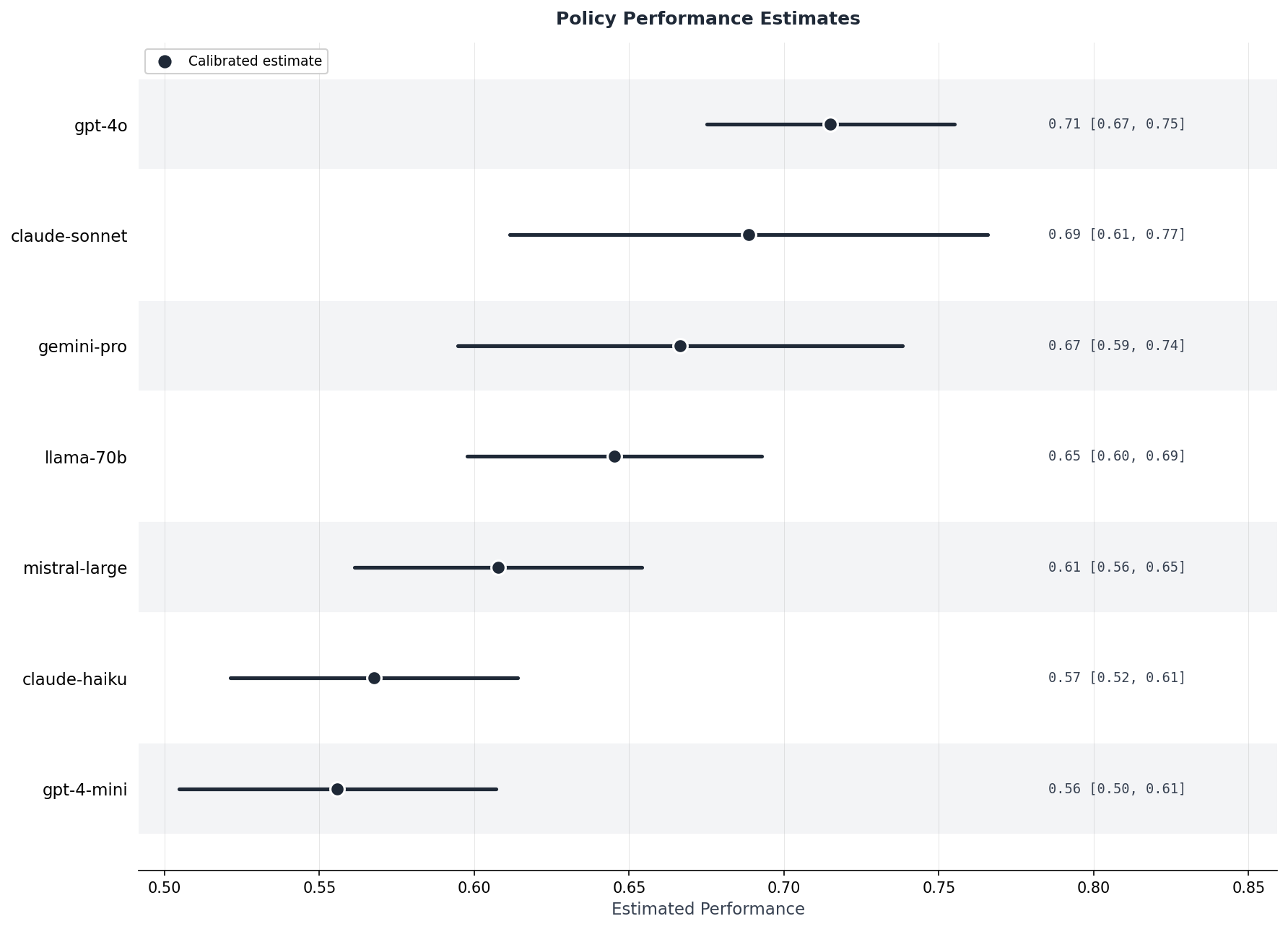
Calibrated estimates with 95% CIs (valid under the calibration and transport checks CJE runs by default)
Validation on real ground truth
- HealthBench (physician labels, n=29,511): two LLM judges were overconfident by 24.5 and 13.0 points and disagreed with each other by up to 73 points on specific criteria categories. Calibrated on 5% physician labels (~1,400 records), both converged to the physician ground truth. Read the full audit →
- Chatbot Arena (4,961 prompts, 5 policies): 99% pairwise ranking accuracy at a 5% oracle fraction — 14× cheaper than labeling everything, with ~95% CI coverage vs 0% for naive judge-score CIs. An adversarial policy that fools the judge is correctly flagged by the transport audit. Paper →
The array API
calibrated_mean_ci is the library's bottom layer — a ppi_py-style primitive that takes plain numpy arrays and returns a calibrated mean with an honest CI. Use it when you have one sample of judge scores and a partial oracle slice; use analyze_dataset for multi-policy comparisons.
import numpy as np
from cje import calibrated_mean_ci

rng = np.random.default_rng(0)
scores = rng.uniform(size=400)                      # judge scores for every sample
labels = np.full(400, np.nan)                       # NaN = unlabeled
labeled = rng.choice(400, size=100, replace=False)  # oracle slice (25%)
labels[labeled] = np.clip(scores[labeled] + rng.normal(0, 0.1, size=100), 0, 1)

result = calibrated_mean_ci(scores, labels)
print(result.summary())
Calibrated mean: 0.5316 (SE 0.0175, CI [0.4965, 0.5649], n=400, n_oracle=100, bootstrap)
result.calibrator is reusable: transport_audit(probe_scores, probe_labels, result.calibrator) checks whether the calibration still holds on a new slice. result.diagnostics["boundary_card"] carries the coverage badge.
Documentation
| Resource | Description |
|---|---|
| Interactive Tutorial | Walk through a complete example in Colab — no setup required |
| CJE in 3 Minutes | Video: why raw judge scores mislead and how CJE fixes it |
| Technical Walkthrough | Video: calibration, evaluation, and transport auditing pipeline |
| Operational Playbook | End-to-end runbook: audits, drift correction, label budgeting |
| Planning Notebook | Optimize your evaluation budget with pilot data |
| Full Docs | Installation, assumptions, API reference, research notes |
Bridges: Already running evals in Promptfoo, TruLens, LangSmith, or OpenCompass? Convert those outputs into CJE format with one command.
Module deep dives: Calibration · Diagnostics · Estimators · Interface/API · Data formats
Use CJE from your AI agent
skills/cje/ is an Agent Skill that teaches Claude Code and similar agents to run CJE correctly — reshape your data, drive the labeling loop, calibrate, compare, and respect the refusal gates — instead of averaging raw judge scores.
- Claude Code (all projects):
mkdir -p ~/.claude/skills/cje && curl -fsSL https://raw.githubusercontent.com/cimo-labs/cje/main/skills/cje/SKILL.md -o ~/.claude/skills/cje/SKILL.md && curl -fsSL https://raw.githubusercontent.com/cimo-labs/cje/main/skills/cje/reference.md -o ~/.claude/skills/cje/reference.md - Project-level:
cp -r skills/cje .claude/skills/from a checkout of this repo. - Other agents: point your agent at
skills/cje/SKILL.md— plain Markdown;reference.mdloads on demand.
Notes on 0.4.0
0.4.0 is a breaking release: CJE is now Direct-mode only. The off-policy machinery — importance-sampling and doubly-robust estimators (calibrated-ips, dr-cpo, mrdr, tmle, stacked-dr), teacher forcing, SIMCal weight stabilization, and the overlap diagnostics — has been removed. Our own paper's results drove the cut: for realistic LLM policy pairs, importance weighting failed even when ESS looked healthy (target-typicality coverage 0.19–0.49, far below the 0.70 gate), and the best DR stack merely matched Direct mode's accuracy at ~12× the compute. Direct mode — fresh draws, calibrated judge, audits — is what the evidence supports, so it is now the whole product.
- Need IPS/DR from logged propensities? Pin the frozen OPE line:
pip install "cje-eval==0.3.*"(maintained on the0.3.xbranch; docs at thev0.3.0tag; requires Python <=3.12 — on 3.13 use a 3.12 env for OPE). - Have old logged data with
judge_score+oracle_label? It still works as the calibration source:analyze_dataset(fresh_draws_dir=..., calibration_data_path="logged.jsonl"). - Removed entry points raise migration errors that say exactly this.
Full details in the CHANGELOG.
Development
git clone https://github.com/cimo-labs/cje.git
cd cje && poetry install && make test
Citation
If you use CJE in your research, please cite:
@misc{landesberg2025causaljudgeevaluationcalibrated,
  title={Causal Judge Evaluation: Calibrated Surrogate Metrics for LLM Systems},
  author={Eddie Landesberg},
  year={2025},
  eprint={2512.11150},
  archivePrefix={arXiv},
  primaryClass={stat.ME},
  url={https://arxiv.org/abs/2512.11150},
}
License
MIT — See LICENSE for details.
1 maintainer

Metadata
1 maintainer
Release files for cje-eval 0.5.2
For a detailed explanation of source distributions (sdists) and built distributions (wheels), please see the package formats documentation.
Source distribution (sdist)
| File | Size | Uploaded | |
|---|---|---|---|
| cje_eval-0.5.2.tar.gz | 156.1 kB | Details |
Built distribution (wheel)
| File | Interpreter | ABI | Platform | Reset |
|---|---|---|---|---|
| cje_eval-0.5.2-py3-none-any.whl | Python 3 | none | any | Details |
Total release size: 331.3 kB
Release files / cje_eval-0.5.2.tar.gz
| Download URL | cje_eval-0.5.2.tar.gz |
|---|---|
| Size | 156.1 kB |
| Tags | Source |
|
SHA-256 checksum How to use checksums |
e50508ac8587d30790da0b8b219b2b57b5db32a5a6b619a8807e6c1195f36b44
|
|
BLAKE2b-256 checksum How to use checksums |
9ddec5ffd1d18691dfbbf8e1873f2cfd7bdd69048db2cb16d27522359b76c70e
|
| Upload date | |
|
Uploaded using Trusted Publishing? What is trusted publishing? |
Yes |
| Uploaded via |
twine/7.0.0 CPython/3.13.14
|
Provenance
Provenance describes where a file came from. On PyPI, provenance is shared via attestations, which provide a verifiable record of the build or publishing details. View details, limitations and caveats.


PyPI Publish Attestation
PyPI verified that this artifact, at this checksum, originated from the publisher listed below.
Signed by GitHub Actions, verified by PyPI on Oct 9, 2026.
Transparency logRelease files / cje_eval-0.5.2-py3-none-any.whl
| Download URL | cje_eval-0.5.2-py3-none-any.whl |
|---|---|
| Size | 175.2 kB |
| Tags | Python 3 |
|
SHA-256 checksum How to use checksums |
7938583df0d07675934edb1cff8edcf4b2c2d654c0064e13de7f9da2a9749ac5
|
|
BLAKE2b-256 checksum How to use checksums |
b7c3410e0827a96be527798304d59d7669165799aabf664328e4d0112f1d49a5
|
| Upload date | |
|
Uploaded using Trusted Publishing? What is trusted publishing? |
Yes |
| Uploaded via |
twine/7.0.0 CPython/3.13.14
|
Provenance
Provenance describes where a file came from. On PyPI, provenance is shared via attestations, which provide a verifiable record of the build or publishing details. View details, limitations and caveats.
PyPI Publish Attestation
PyPI verified that this artifact, at this checksum, originated from the publisher listed below.
Signed by GitHub Actions, verified by PyPI on Oct 9, 2026.
Transparency log













