
Lightweight Covariance Matrix Adaptation Evolution Strategy (CMA-ES) implementation for Python 3.


Project description
CMA-ES
Lightweight Covariance Matrix Adaptation Evolution Strategy (CMA-ES) [1] implementation.
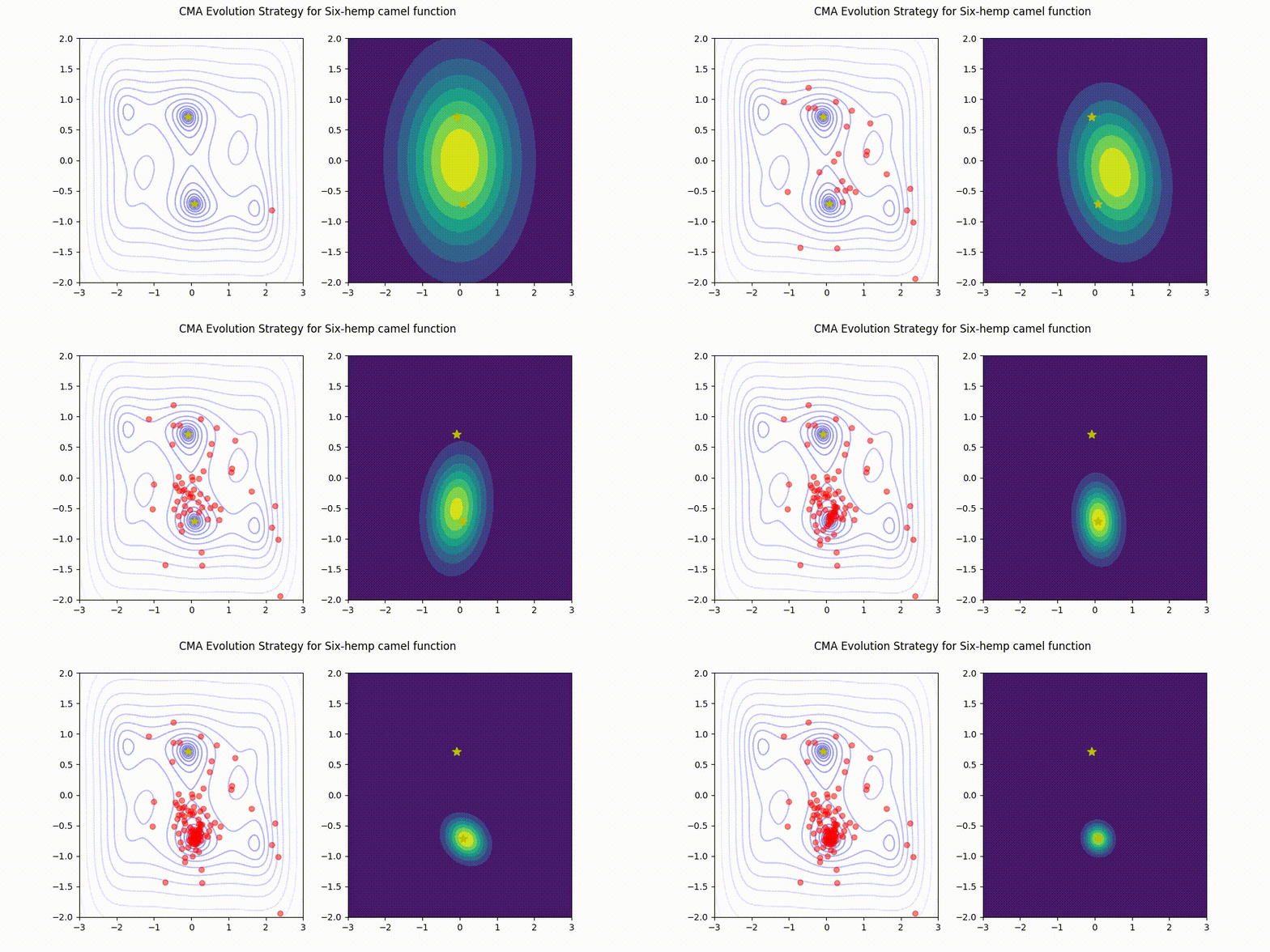
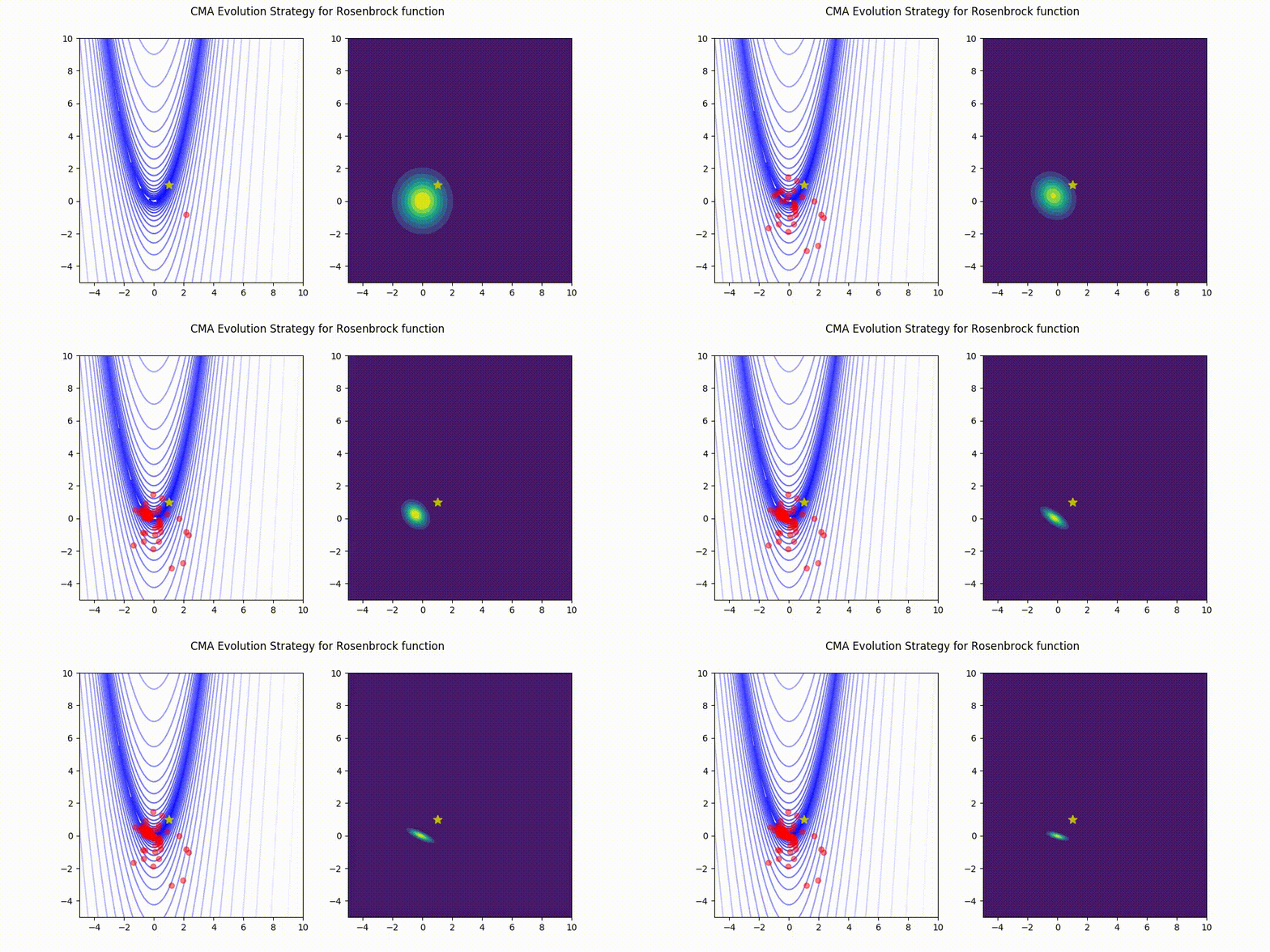
Rosenbrock function.
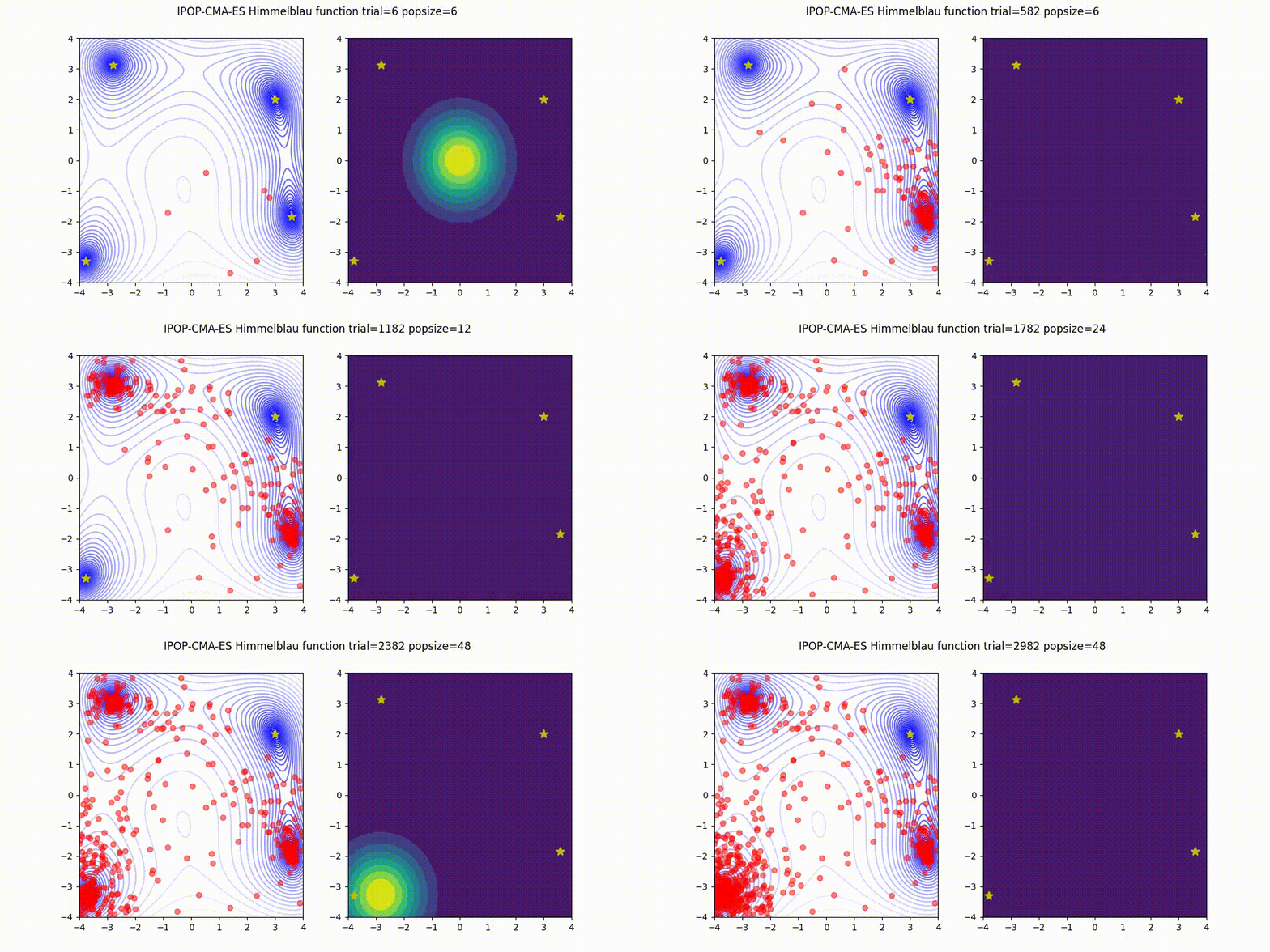
IPOP-CMA-ES on Himmelblau function.
BIPOP-CMA-ES on Himmelblau function.
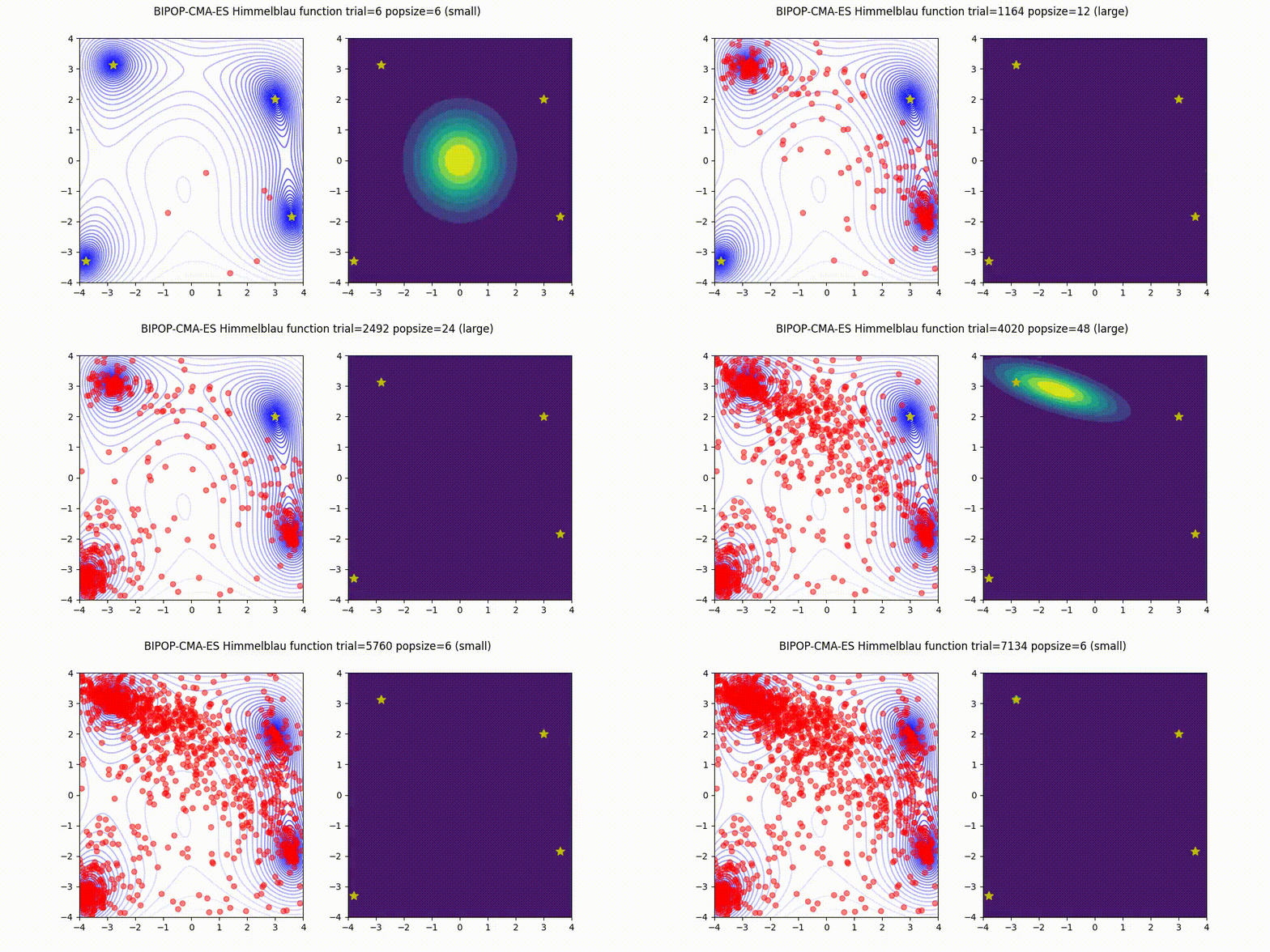
These GIF animations are generated by visualizer.py.
Installation
Supported Python versions are 3.5 or later.
$ pip install cmaes
Or you can install via conda-forge.
$ conda install -c conda-forge cmaes
Usage
This library provides an "ask-and-tell" style interface.
import numpy as np
from cmaes import CMA

def quadratic(x1, x2):
    return (x1 - 3) ** 2 + (10 * (x2 + 2)) ** 2

if __name__ == "__main__":
    optimizer = CMA(mean=np.zeros(2), sigma=1.3)

    for generation in range(50):
        solutions = []
        for _ in range(optimizer.population_size):
            x = optimizer.ask()
            value = quadratic(x[0], x[1])
            solutions.append((x, value))
            print(f"#{generation} {value} (x1={x[0]}, x2 = {x[1]})")
        optimizer.tell(solutions)
And you can use this library via Optuna [2]. Optuna is an automatic hyperparameter optimization framework. A sampler based on this library is available from Optuna v1.3.0. See the documentation for more details.
import optuna

def objective(trial: optuna.Trial):
    x1 = trial.suggest_uniform("x1", -4, 4)
    x2 = trial.suggest_uniform("x2", -4, 4)
    return (x1 - 3) ** 2 + (10 * (x2 + 2)) ** 2

if __name__ == "__main__":
    sampler = optuna.samplers.CmaEsSampler()
    study = optuna.create_study(sampler=sampler)
    study.optimize(objective, n_trials=250)
Example of IPOP-CMA-ES [3]
You can easily implement IPOP-CMA-ES which restarts CMA-ES with increasing population size.
import math
import numpy as np
from cmaes import CMA

def ackley(x1, x2):
    # https://www.sfu.ca/~ssurjano/ackley.html
    return (
        -20 * math.exp(-0.2 * math.sqrt(0.5 * (x1 ** 2 + x2 ** 2)))
        - math.exp(0.5 * (math.cos(2 * math.pi * x1) + math.cos(2 * math.pi * x2)))
        + math.e + 20
    )

if __name__ == "__main__":
    bounds = np.array([[-32.768, 32.768], [-32.768, 32.768]])
    lower_bounds, upper_bounds = bounds[:, 0], bounds[:, 1]

    mean = lower_bounds + (np.random.rand(2) * (upper_bounds - lower_bounds))
    sigma = 32.768 * 2 / 5  # 1/5 of the domain width
    optimizer = CMA(mean=mean, sigma=sigma, bounds=bounds, seed=0)

    for generation in range(200):
        solutions = []
        for _ in range(optimizer.population_size):
            x = optimizer.ask()
            value = ackley(x[0], x[1])
            solutions.append((x, value))
            print(f"#{generation} {value} (x1={x[0]}, x2 = {x[1]})")
        optimizer.tell(solutions)

        if optimizer.should_stop():
            # popsize multiplied by 2 (or 3) before each restart.
            popsize = optimizer.population_size * 2
            mean = lower_bounds + (np.random.rand(2) * (upper_bounds - lower_bounds))
            optimizer = CMA(mean=mean, sigma=sigma, population_size=popsize)
            print(f"Restart CMA-ES with popsize={popsize}")
Example of BIPOP-CMA-ES [4]
Here is an example of BIPOP-CMA-ES which applies two interlaced restart strategies, one with an increasing population size and one with varying small population sizes.
import math
import numpy as np
from cmaes import CMA

def ackley(x1, x2):
    # https://www.sfu.ca/~ssurjano/ackley.html
    return (
        -20 * math.exp(-0.2 * math.sqrt(0.5 * (x1 ** 2 + x2 ** 2)))
        - math.exp(0.5 * (math.cos(2 * math.pi * x1) + math.cos(2 * math.pi * x2)))
        + math.e + 20
    )

if __name__ == "__main__":
    bounds = np.array([[-32.768, 32.768], [-32.768, 32.768]])
    lower_bounds, upper_bounds = bounds[:, 0], bounds[:, 1]

    mean = lower_bounds + (np.random.rand(2) * (upper_bounds - lower_bounds))
    sigma = 32.768 * 2 / 5  # 1/5 of the domain width
    optimizer = CMA(mean=mean, sigma=sigma, bounds=bounds, seed=0)

    n_restarts = 0  # A small restart doesn't count in the n_restarts
    small_n_eval, large_n_eval = 0, 0
    popsize0 = optimizer.population_size
    inc_popsize = 2

    # Initial run is with "normal" population size; it is
    # the large population before first doubling, but its
    # budget accounting is the same as in case of small
    # population.
    poptype = "small"

    for generation in range(200):
        solutions = []
        for _ in range(optimizer.population_size):
            x = optimizer.ask()
            value = ackley(x[0], x[1])
            solutions.append((x, value))
            print(f"#{generation} {value} (x1={x[0]}, x2 = {x[1]})")
        optimizer.tell(solutions)

        if optimizer.should_stop():
            n_eval = optimizer.population_size * optimizer.generation
            if poptype == "small":
                small_n_eval += n_eval
            else:  # poptype == "large"
                large_n_eval += n_eval

            if small_n_eval < large_n_eval:
                poptype = "small"
                popsize_multiplier = inc_popsize ** n_restarts
                popsize = math.floor(
                    popsize0 * popsize_multiplier ** (np.random.uniform() ** 2)
                )
            else:
                poptype = "large"
                n_restarts += 1
                popsize = popsize0 * (inc_popsize ** n_restarts)

            mean = lower_bounds + (np.random.rand(2) * (upper_bounds - lower_bounds))
            optimizer = CMA(
                mean=mean,
                sigma=sigma,
                bounds=bounds,
                population_size=popsize,
            )
            print("Restart CMA-ES with popsize={} ({})".format(popsize, poptype))
Benchmark results
| Rosenbrock function | Six-Hump Camel function |
|---|---|
 |
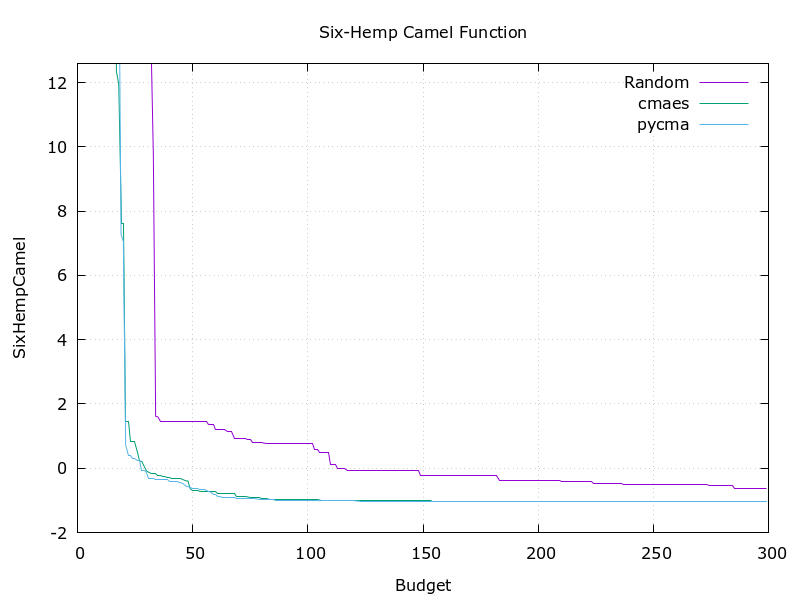 |
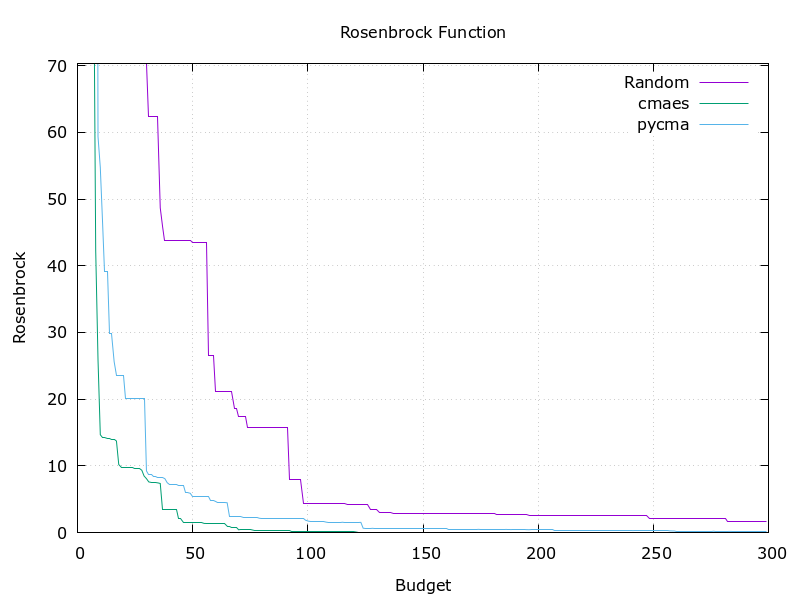
This implementation (green) stands comparison with pycma (blue). See benchmark for details.
Links
Other libraries:
I respect all libraries involved in CMA-ES.
- pycma : Most famous CMA-ES implementation by Nikolaus Hansen.
- libcmaes: Multithreaded C++11 library with Python bindings.
- cma-es : A Tensorflow v2 implementation.
References:
- [1] N. Hansen, The CMA Evolution Strategy: A Tutorial. arXiv:1604.00772, 2016.
- [2] Takuya Akiba, Shotaro Sano, Toshihiko Yanase, Takeru Ohta, Masanori Koyama. 2019. Optuna: A Next-generation Hyperparameter Optimization Framework. In The 25th ACM SIGKDD Conference on Knowledge Discovery and Data Mining (KDD ’19), August 4–8, 2019.
- [3] Auger, A., Hansen, N.: A restart CMA evolution strategy with increasing population size. In: Proceedings of the 2005 IEEE Congress on Evolutionary Computation (CEC’2005), pp. 1769–1776 (2005a)
- [4] Hansen N. Benchmarking a BI-Population CMA-ES on the BBOB-2009 Function Testbed. In the workshop Proceedings of the Genetic and Evolutionary Computation Conference, GECCO, pages 2389–2395. ACM, 2009.
Release history Release notifications | RSS feed


Download files
Download the file for your platform. If you're not sure which to choose, learn more about installing packages.
Source Distribution
Built Distribution
Filter files by name, interpreter, ABI, and platform.
If you're not sure about the file name format, learn more about wheel file names.
Copy a direct link to the current filters
File details
Details for the file cmaes-0.6.0.tar.gz.
File metadata
- Download URL: cmaes-0.6.0.tar.gz
- Upload date:
- Size: 12.4 kB
- Tags: Source
- Uploaded using Trusted Publishing? No
- Uploaded via: twine/3.1.1 pkginfo/1.5.0.1 requests/2.23.0 setuptools/49.2.0 requests-toolbelt/0.8.0 tqdm/4.45.0 CPython/3.8.2
File hashes
| Algorithm | Hash digest | |
|---|---|---|
| SHA256 |
0eb3a395aedc4d7fa229819ca9b18fe3a314f956aa387a7a7e7c08ffe9d4ab2b
|
|
| MD5 |
aa3ba3d7b272bcc5740c807cfff1448d
|
|
| BLAKE2b-256 |
3a4de32d058d94c6cc0db2d8d636cc2019a8a371967d7f2f84d5896af734c69f
|
File details
Details for the file cmaes-0.6.0-py3-none-any.whl.
File metadata
- Download URL: cmaes-0.6.0-py3-none-any.whl
- Upload date:
- Size: 9.6 kB
- Tags: Python 3
- Uploaded using Trusted Publishing? No
- Uploaded via: twine/3.1.1 pkginfo/1.5.0.1 requests/2.23.0 setuptools/49.2.0 requests-toolbelt/0.8.0 tqdm/4.45.0 CPython/3.8.2
File hashes
| Algorithm | Hash digest | |
|---|---|---|
| SHA256 |
1afb10785f8d5540e5f99e2b1fc7cf017e2ee59c43896a5c89152592d3291e2f
|
|
| MD5 |
079ee788200f65698ec236970cd0298b
|
|
| BLAKE2b-256 |
6388d5e9b78151dce671d7e78ee4cc8905d83208254caa2a386b163ae0ab0027
|






