
Crewplane
Agents do the work. You own the workflow.
Crewplane is an open-source workflow runner for reviewable, resumable coding-agent workflows. Define the whole process in Markdown — the prompts, stages, agents, handoffs, and rules for what happens next. Crewplane runs your coding-agent CLIs. Review becomes a gate, completed work survives failure, and every handoff stays on disk.
Works with:










Watch the workflow run. Keep the full record after the terminal closes. Click the dashboard for the walkthrough.
⭐ If this is how you think coding-agent workflows should work, click Star in the top-right to keep Crewplane in your toolbox — and help more developers find it.
Try it without API keys · Inspect a real 8-agent run · Read the documentation
Your agents are automated. Your workflow usually isn't.
Coding-agent CLIs can plan, write, test, and review code. But the process around them often still lives across prompts, terminal tabs, copy-paste, and memory.
You decide what runs next. You carry plans and findings between tools. You make sure review actually happens. When a later step fails, you reconstruct what already worked.
Crewplane turns that manual coordination into a workflow your repository owns. Make review a gate, not a promise buried in a prompt. If a later stage fails, Crewplane keeps the completed work it can validate instead of making you start over.
| Without Crewplane | With Crewplane |
|---|---|
| Prompts, sessions, and terminal habits define the process | Versioned Markdown defines the process |
| You relay plans, findings, and context between agents | Each stage receives explicit, saved handoffs |
| One session or provider tends to own the whole chain | Assign the right CLI to each stage |
| Parallel work and review happen ad hoc | Fan work out, then bring it back through review and bounded fixes |
| A late failure makes you replay work that already passed | Resume from completed stages Crewplane can validate |
| Terminal scrollback becomes the history | Keep a readable record of every stage, handoff, finding, and result |
Eight agents. One comparison. Every receipt.
Crewplane Lab publishes reproducible experiments with the workflow definition, generated responses, comparison output, telemetry, manifests, and provider logs.
Eight Codex model and reasoning configurations. One algorithm challenge. Watch them work it in parallel—then follow every saved output into a dedicated comparison stage.
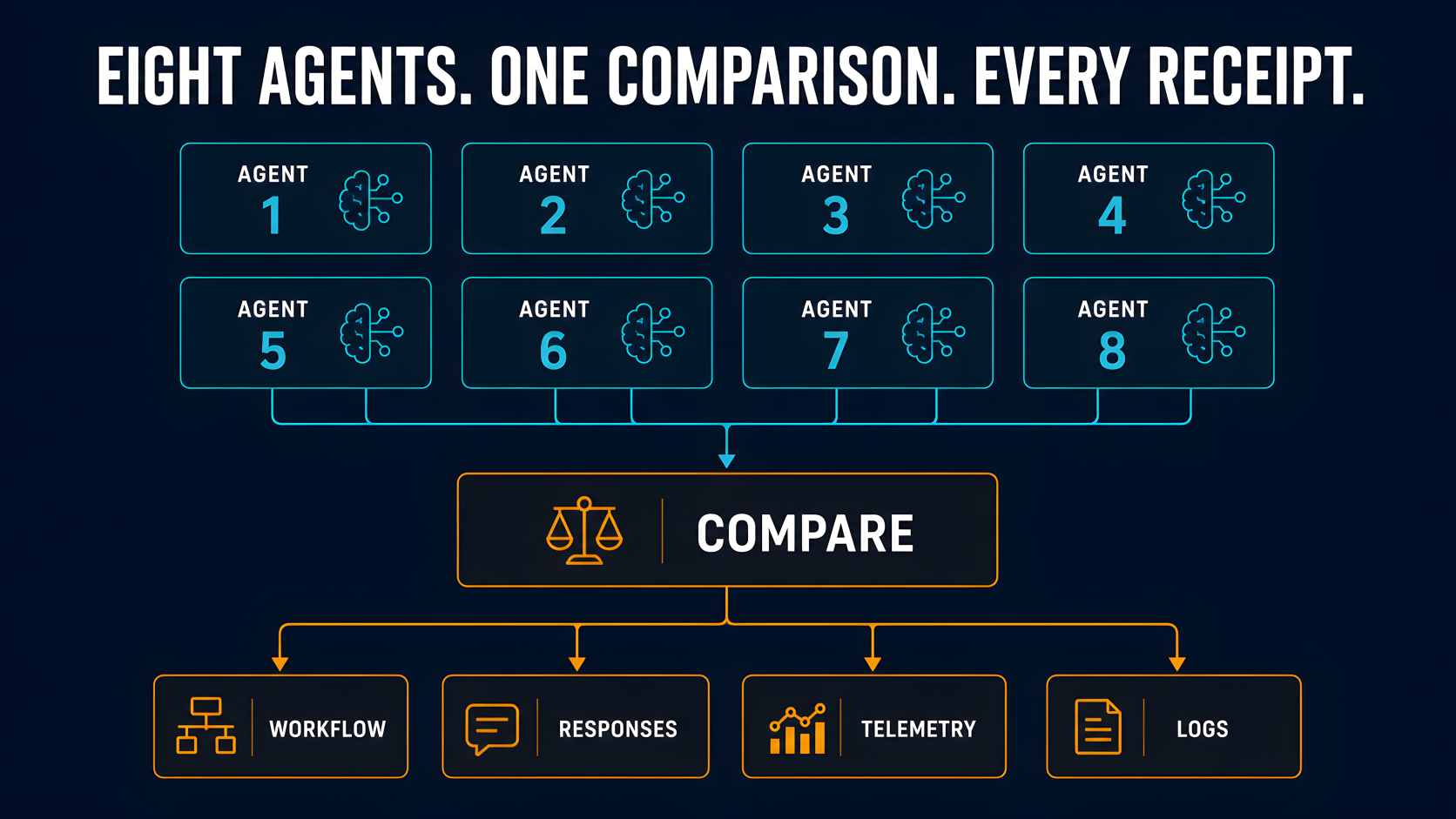
Explore the complete recorded experiment →
Inspect the evidence: workflow · eight responses · comparison · complete run record
Quick start
Install Crewplane and run the generated workflow inside any project. The first run lets you see the workflow and its run record before spending a token:
uv tool install crewplane

cd path/to/your-project
crewplane init
crewplane validate
crewplane run
Inspect the resulting run record:
.crewplane/
├── execution-results/<run-key>/   # findings and final results
└── execution-stages/<run-key>/    # inputs, outputs, logs, events, and manifests
The output is mocked. The workflow machinery is not. The run-record structure is the same one used for provider-backed workflows, so you can see how Crewplane validates stages, passes work forward, and records the run before connecting a real agent.
Ready to put the CLIs already installed on your machine behind the workflow?
crewplane onboarding
crewplane run
crewplane onboarding finds the supported provider CLIs already installed on
your machine, lets you choose one or more, and configures Crewplane to use them.
Crewplane does not install provider software or manage provider credentials.
See exactly what your first run creates and keeps
crewplane init creates .crewplane/config.yml, a default workflow, and
additional example templates under .crewplane/workflows/example-templates/.
When output is attached to a terminal and tmux is available, Crewplane opens
the compact live dashboard for DAG progress, node status, and live log tails.
Note: install
tmuxviabrew install tmuxon macOS orsudo apt install tmuxon Ubuntu/Debian.
Pass
--no-livewhen you want to omit the live dashboard.
After the first run, the full artifact layout looks like:
.crewplane/
├── execution-results/                  # final outputs you care about
│   └── <run-key>/
│       ├── review.project-findings.md  # findings from the review node
│       └── review.project-result.md    # final result from the review node
├── execution-stages/                   # per-stage raw artifacts
│   └── <run-key>/
│       ├── preflight/                  # plan, dependency graph, render plans
│       ├── logs/                       # events.ndjson, summary
│       └── review.project/             # per-node rendered input, output, logs
├── workflows/                          # your workflow definitions, preloaded with example workflows
│   └── single-agent-review.task.md
└── config.yml                          # provider wiring and settings
These files are the same shape you will see with real providers: each step has rendered inputs, outputs, logs, manifests, and final results you can inspect or diff with normal tools.
Because the first run already wrote a successful result, a later identical run
may print Identical context detected (Crewplane reuses the saved result for
identical inputs). Use crewplane run --force to start fresh.
Prefer to watch? Jump to the full demo walkthrough →
Build the workflow your work actually needs
Crewplane does not prescribe a lifecycle. It gives yours a home in the repository, whether that means one focused stage or a longer workflow with several agents and checkpoints.
For example:
-
Deliver a change with independent checks. Brief → plan → implement → test → review → handoff.
-
Compare approaches before choosing one. Ask several agents to explore the problem in parallel, then bring their proposals together for comparison and approval.
-
Audit a codebase from several angles. Combine security, performance, architecture, and maintainability reviews into one consolidated result.
-
Carry a complex change through controlled checkpoints. Inventory → design → migrate → validate → report.
-
Turn a recurring team process into a reusable workflow. Keep the stages, agent assignments, handoffs, and review rules in the repository instead of rebuilding the process from terminal history.
These are examples, not built-in stages. Name the steps yourself, use one agent throughout, or assign different CLIs wherever their strengths fit best.
What a workflow looks like
A Crewplane workflow is Markdown you can read in a code review: YAML frontmatter declares the execution graph, and ordinary Markdown defines the instructions for each stage.
This is the real thing, not a hello-world toy: one file, three stages, explicit handoffs, and a review loop you can rerun.
---
schema_version: "1.0"
name: "Feature Delivery"
description: "Plan, implement, review, and prepare a final handoff."

nodes:
  - id: plan
    mode: parallel
    providers: [claude, codex]

  - id: implement
    mode: sequential
    needs: [plan]
    providers:
      - provider: codex
        role: executor
      - provider: claude
        role: reviewer

  - id: handoff
    mode: parallel
    needs: [implement]
    providers: [gemini]
---

## plan

Turn the request into a concrete plan with scope, risks, and validation steps.

## implement

Use the plan:

{{plan.output}}

<!-- crewplane:executor -->
Implement the change and run the relevant checks.
<!-- /crewplane:executor -->

<!-- crewplane:reviewer -->
Review the candidate for correctness, regressions, and missing validation.
<!-- /crewplane:reviewer -->

## handoff

Prepare a concise handoff from the reviewed implementation:

{{implement.output}}
In this example:
needsdefines which stages wait for upstream work.providersassigns configured agents to each stage.{{plan.output}}creates an explicit handoff rather than relying on hidden session context.- The sequential executor/reviewer node can approve the candidate or send blocking feedback into a bounded fix attempt.
- The final stage receives the reviewed result, not an informal summary carried between terminal sessions.
plan, implement, and handoff are examples — not built-in lifecycle stages.
Rename them, add more nodes, remove stages, fan work out, compose another
workflow, or route every stage to the same CLI.
See the workflow syntax reference for the complete authoring contract.
Every run leaves receipts
A final answer tells you what an agent said. A run record tells you how the work actually happened. Crewplane keeps the answers to questions that disappear when the process lives only inside terminal sessions:
See what Crewplane records for every run
- Which workflow and compiled execution plan ran?
- Which agent, role, and rendered context handled each stage?
- What output and findings did each stage produce?
- Which reviewers approved or blocked the candidate?
- Which nodes succeeded, failed, were skipped, resumed, or reused?
- Which provider-reported usage totals were available?
Check the results for each node:
.crewplane/execution-results/<run-key>/
When needed, inspect the run-level records:
.crewplane/execution-stages/<run-key>/
See where the tokens went
At the end of a workflow, Crewplane displays the total token consumption in the run summary. It also records each node's consumption in the runtime logs, so you can see both the overall usage and where the tokens went. These figures appear whenever the provider reports them.
See:
Where Crewplane fits
Crewplane is the control plane around your coding-agent CLIs.
It does not replace their models, tools, sessions, permissions, credentials, or native execution behavior. It controls the process around them: what runs, in what order, with which context, under which review rules, and what remains afterward.
┌──────────────────────────────────────────────┐
│ Workflow owned by your repository            │
│ Markdown · instructions · policies · inputs  │  ← Markdown defines the workflow.
└──────────────────────────────────────────────┘
                    ↓
┌──────────────────────────────────────────────┐
│ Crewplane                                    │
│ validate · render · route · review           │
│ resume · observe · record                    │  ← Crewplane enforces the workflow.
└──────────────────────────────────────────────┘
                    ↓
┌──────────────────────────────────────────────┐
│ Provider-native coding-agent CLIs            │
│ Claude Code · Codex · Copilot CLI · Gemini   │  ← Agents execute the stages.
└──────────────────────────────────────────────┘
                    ↕
┌──────────────────────────────────────────────┐
│ Repository · filesystem · CI                 │
│ source · tests · logs · manifests · results  │  ← Artifacts stay on disk.
└──────────────────────────────────────────────┘
The agents do the work. Crewplane runs the declared process. Your repository remains the system of record.
Installation and updates
The recommended installation is:
uv tool install crewplane
Update the active installation and confirm its version:
crewplane --update
crewplane --version
Other supported installation paths include pip, pipx, Homebrew, the install script, an npm wrapper, and a local source checkout. See the installation guide for exact commands, update behavior, troubleshooting, and removal.
Demo walkthrough
Watch the demo below for the full setup flow: install Crewplane, initialize a project, run the first mock workflow, inspect artifacts, and onboard a real provider.
Documentation and examples
The full documentation starts at docs/index.md.
Just getting started? → follow the First Project Path to install Crewplane, run the mock workflow, inspect artifacts, and prepare a real provider.
Guided tour: → use the Guided Tutorial Track to walk through workflow runs, run records, authoring, provider roles, review loops, composition, validation, troubleshooting, and cleanup.
Run the full examples without starting provider CLIs
Want to see Crewplane at full strength? → start with one of the generated workflows:
example-templates/code-review-example.task.mdfor parallel agent review and reviewer loops.example-templates/feature-implement-example.task.mdfor brief → plan → build → review → handoff.example-templates/composition/review-fix-composed-example.task.mdfor reusable workflow composition.
With settings.integrations.invoker.implementation: "mock", Crewplane validates
those agent profiles but still writes deterministic mock output and does not
start provider CLIs. Switch the invoker to cli only when you want real provider
runs.
-
Uncomment the agents in the generated config (i.e. lines 22-148), keep the
settings.integrations.invoker.implementationasmockso the workflow runs with mock. See how to turn mock on and off for details. -
Copy and run any one of these commands:
crewplane run --tasks .crewplane/workflows/example-templates/code-review-example.task.md
crewplane run --tasks .crewplane/workflows/example-templates/feature-implement-example.task.md
crewplane run --tasks .crewplane/workflows/example-templates/composition/review-fix-composed-example.task.md
Ready to hook up a real provider? Run crewplane onboarding, or follow the
provider setup guide.
Find the right guide for what you want to do next
Here is a quick reference table:
| Goal | Start here |
|---|---|
| Complete the first project | First Project Path |
| Follow the guided tutorial | Guided Tutorial Track |
| Learn workflow authoring | Workflow syntax |
| Choose sequential or parallel execution | Node modes and provider roles |
| Add executor/reviewer behavior | Review loops |
| Configure real provider CLIs | Provider setup |
| Inspect stored execution records | Inspecting artifacts |
| Inspect a published provider-backed run | Crewplane Lab |
| Try generated workflows | Examples guide |
| Browse all documentation | Documentation home |
| Review changes between releases | Changelog |
Contributing
Contributions, workflow ideas, and real-world failure cases are welcome.
- Read Contributing.
- Set up a local checkout with the development guide.
- Ask questions or propose workflow patterns in GitHub Discussions.
Have a coding-agent workflow that you do not want to leave to a free-running loop? Describe it in Discussions and we can all work together on it.
Agents do the work. You own the workflow.
⭐ Have a coding-agent process worth making repeatable? Click Star in the top-right to keep Crewplane in your toolbox.
1 maintainer

Release files for crewplane 0.3.3
For a detailed explanation of source distributions (sdists) and built distributions (wheels), please see the package formats documentation.
Source distribution (sdist)
| File | Size | Uploaded | |
|---|---|---|---|
| crewplane-0.3.3.tar.gz | 555.4 kB | Details |
Built distribution (wheel)
| File | Interpreter | ABI | Platform | Reset |
|---|---|---|---|---|
| crewplane-0.3.3-py3-none-any.whl | Python 3 | none | any | Details |
Total release size: 1.4 MB
Release files / crewplane-0.3.3.tar.gz
| Download URL | crewplane-0.3.3.tar.gz |
|---|---|
| Size | 555.4 kB |
| Tags | Source |
|
SHA-256 checksum How to use checksums |
b1e511f003d90c1f70005341e40c5c68e1bcf93ffdae64fc8e84e8a7c1e3a2f9
|
|
BLAKE2b-256 checksum How to use checksums |
0b0b58a24c5fc6139616ea6c04a861d92813512087782b19ee2c5dd992e63abc
|
| Upload date | |
|
Uploaded using Trusted Publishing? What is trusted publishing? |
No |
| Uploaded via |
twine/7.0.0 CPython/3.13.14
|
Release files / crewplane-0.3.3-py3-none-any.whl
| Download URL | crewplane-0.3.3-py3-none-any.whl |
|---|---|
| Size | 830.6 kB |
| Tags | Python 3 |
|
SHA-256 checksum How to use checksums |
5e55985927e68fcc5826700e5ceda08e7420401a72cb50c14896ae7d006b8198
|
|
BLAKE2b-256 checksum How to use checksums |
94e1d1ef891f4aaae62d262ced04f58985c99e8b790378d09e6e83c21a2644b8
|
| Upload date | |
|
Uploaded using Trusted Publishing? What is trusted publishing? |
No |
| Uploaded via |
twine/7.0.0 CPython/3.13.14
|














