
Interactive terminal viewer/editor for tabular data

Project description
DataFrame Textual
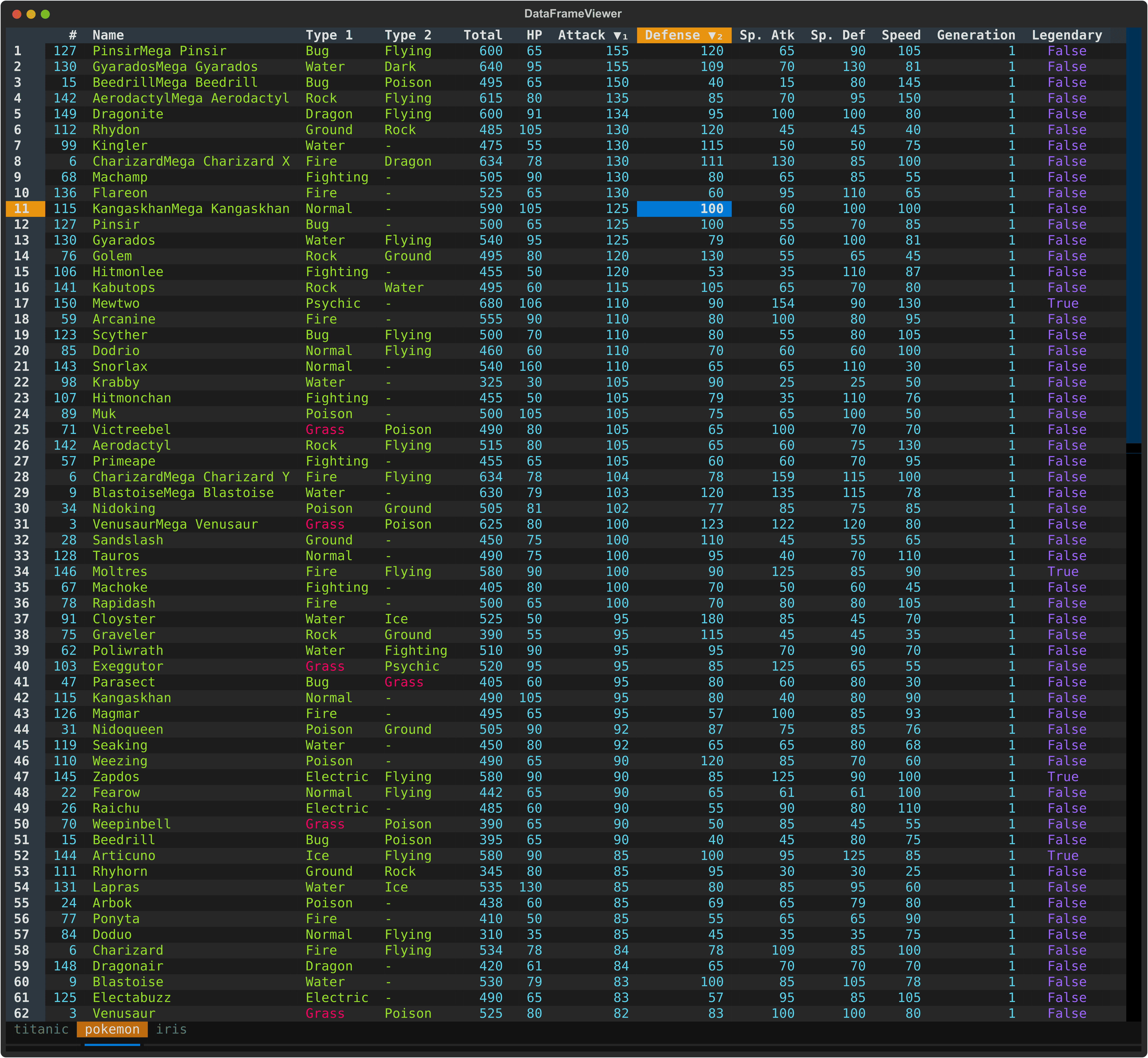
A powerful, interactive terminal-based viewer/editor for CSV/TSV/Excel/Parquet/JSON/NDJSON built with Python, Polars, and Textual. Inspired by VisiData, this tool provides smooth keyboard navigation, data manipulation, and a clean interface for exploring tabular data directly in terminal with multi-tab support for multiple files!
Features
Data Viewing
- 🚀 Fast Loading - Powered by Polars for efficient data handling
- 🎨 Rich Terminal UI - Beautiful, color-coded columns with various data types (e.g., integer, float, string)
- ⌨️ Comprehensive Keyboard Navigation - Intuitive controls
Skip first 5 lines (comments, metadata)
dv -l 5 data_with_metadata.csv
Skip 1 row after header (e.g., units row)
dv -a 1 data_with_units.csv
Complex CSV with comments and units row
dv -l 3 -a 1 -I messy_scientific_data.csv
Combine all options: skip lines, skip after header, no header, no inference, gzipped
dv -l 2 -a 1 -H -I complex_data.csv.gz
Process compressed data from stdin with line skipping
zcat compressed_data.csv.gz | dv -f csv -l 2editing, and manipulating data
- 📊 Flexible Input - Read from files and/or stdin (pipes/redirects)
- 🔄 Smart Pagination - Lazy load rows on demand for handling large datasets
Data Manipulation
- 📝 Data Editing - Edit cells, delete rows, and remove columns
- 🔍 Search & Filter - Find values, highlight matches, and filter selected rows
- ↔️ Column/Row Reordering - Move columns and rows with simple keyboard shortcuts
- 📈 Sorting & Statistics - Multi-column sorting and frequency distribution analysis
- 💾 Save & Undo - Save edits back to file with full undo/redo support
Advanced Features
- 📂 Multi-File Support - Open multiple files in separate tabs
- 🔄 Tab Management - Seamlessly switch between open files with keyboard shortcuts
- 📌 Freeze Rows/Columns - Keep important rows and columns visible while scrolling
- 🎯 Cursor Type Cycling - Switch between cell, row, and column selection modes
- 🔗 Link Column Creation - Generate clickable URLs using template expressions with placeholder support
Installation
Using pip
# Install from PyPI
pip install dataframe-textual

# With Excel support (fastexcel, xlsxwriter)
pip install dataframe-textual[excel]
This installs an executable dv.
Then run:
dv <csv_file>
Using uv
# Quick run using uvx without installation
uvx https://github.com/need47/dataframe-textual.git <csvfile>

# Clone or download the project
cd dataframe-textual
uv sync --extra excel  # with Excel support

# Run directly with uv
uv run dv <csv_file>
Development installation
# Clone the repository
git clone https://github.com/need47/dataframe-textual.git
cd dataframe-textual

# Install from local source
pip install -e .

# Or with development dependencies
pip install -e ".[excel,dev]"
Usage
Basic Usage - Single File
# After pip install dataframe-textual
dv pokemon.csv

# Or if running from source
python main.py pokemon.csv

# Or with uv
uv run python main.py pokemon.csv

# Read from stdin (auto-detects format; defaults to TSV if not recognized)
cat data.tsv | dv
dv < data.tsv

# Gzipped files are supported
dv data.csv.gz
dv large_dataset.tsv.gz

# Specify format for gzipped stdin
zcat data.csv.gz | dv -f csv
Multi-File Usage - Multiple Tabs
# Open multiple files in tabs
dv file1.csv file2.csv file3.csv

# Open multiple sheets in tabs in an Excel file
dv file.xlsx

# Mix files and stdin (read from stdin, then open file)
dv data1.tsv < data2.tsv

# Mix regular and gzipped files
dv data1.csv data2.csv.gz data3.tsv.gz
When multiple files are opened:
- Each file appears as a separate tab at the top
- Switch between tabs using
>(next) or<(previous) - Open additional files with
Ctrl+O - Close the current tab with
Ctrl+W - Each file maintains its own state (edits, sort order, selections, history, etc.)
Command Line Options
usage: dv [-h] [-f {csv,excel,tsv,parquet,json,ndjson}] [-H] [-I] [-E] [-c COMMENT_PREFIX] [-q QUOTE_CHAR] [-l SKIP_LINES] [-a SKIP_ROWS_AFTER_HEADER] [-u NULL [NULL ...]] [files ...]

Interactive terminal based viewer/editor for tabular data (e.g., CSV/Excel).

positional arguments:
  files                 Files to view (or read from stdin)

options:
  -h, --help            show this help message and exit
  -f, --format {csv,excel,tsv,parquet,json,ndjson}
                        Specify the format of the input files
  -H, --no-header       Specify that input files have no header row
  -I, --no-inferrence   Do not infer data types when reading CSV/TSV
  -E, --ignore-errors   Ignore errors when reading CSV/TSV
  -c, --comment-prefix COMMENT_PREFIX
                        Comment lines are skipped when reading CSV/TSV (default: skip none)
  -q, --quote-char QUOTE_CHAR
                        Quote character for reading CSV/TSV (default: "; use None to disable)
  -l, --skip-lines SKIP_LINES
                        Skip lines when reading CSV/TSV (default: 0)
  -a, --skip-rows-after-header SKIP_ROWS_AFTER_HEADER
                        Skip rows after header when reading CSV/TSV (default: 0)
  -u, --null NULL [NULL ...]
                        Values to interpret as null values when reading CSV/TSV
CLI Examples
# View CSV file without header row
dv -H data_no_header.csv

# Disable type inference for faster loading
dv -I large_data.csv

# Ignore parsing errors in malformed CSV
dv -E data_with_errors.csv

# Skip first 3 lines of file (e.g., comments, metadata)
dv -l 3 data_with_comments.csv

# Skip 1 row after header (e.g., units row)
dv -a 1 data_with_units.csv

# Treat specific values as null/missing (e.g., 'NA', 'N/A', '-')
dv -u NA N/A - data.csv

# Multiple null values with different formats
dv -u NULL NA "" "Not Available" messy_data.csv

# Disable quote character processing for TSV with embedded quotes
dv -q "" data.tsv

# Use different quote character (e.g., single quote for CSV)
dv -q "'" data.csv

# Complex CSV with comments and units row
dv -l 3 -a 1 -I messy_scientific_data.csv

# Combine all options: skip lines, skip after header, no header, no inference, gzipped
dv -l 2 -a 1 -H -I complex_data.csv.gz

# Process compressed data from stdin with line skipping
zcat compressed_data.csv.gz | dv -f csv -l 2

# CSV with custom null values and no header
dv -H -u NA "N/A" "-" raw_data.csv

# Skip lines, specify null values, and disable type inference
dv -l 5 -u NA "" data_with_metadata.csv

# TSV file with problematic quotes in data fields
dv -q None data.tsv

# CSV with comment lines and custom null values
dv -c "#" -u NA "N/A" commented_data.csv
Keyboard Shortcuts
App-Level Controls
File & Tab Management
| Key | Action |
|---|---|
Ctrl+O |
Open file in a new tab |
Ctrl+W |
Close current tab |
Ctrl+A |
Save all open tabs to Excel file |
> or b |
Move to next tab |
< |
Move to previous tab |
B |
Toggle tab bar visibility |
q |
Quit the application |
View & Settings
| Key | Action |
|---|---|
F1 |
Toggle help panel |
k |
Cycle through themes |
Table-Level Controls
Navigation
| Key | Action |
|---|---|
g |
Jump to first row |
G |
Jump to last row (loads all remaining rows) |
↑ / ↓ |
Move up/down one row |
← / → |
Move left/right one column |
Home / End |
Jump to first/last column in current row |
Ctrl + Home / Ctrl + End |
Jump to top/bottom in current page |
PageDown / PageUp |
Scroll down/up one page |
Ctrl+F |
Page down |
Ctrl+B |
Page up |
Viewing & Display
| Key | Action |
|---|---|
Enter |
View full details of current row in modal |
F |
Show frequency distribution for column |
s |
Show statistics for current column |
S |
Show statistics for entire dataframe |
K |
Cycle cursor type: cell → row → column → cell |
~ |
Toggle row labels |
_ (underscore) |
Expand column to full width |
Data Editing
| Key | Action |
|---|---|
Double-click |
Edit cell or rename column header |
delete |
Clear current cell (set to NULL) |
e |
Edit current cell (respects data type) |
E |
Edit entire column with expression |
a |
Add empty column after current |
A |
Add column with name and value/expression |
@ |
Add a link column from template expression |
- (minus) |
Delete current column |
x |
Delete current row |
X |
Delete current row and all rows below |
Ctrl+X |
Delete current row and all rows above |
d |
Duplicate current column (appends '_copy' suffix) |
D |
Duplicate current row |
h |
Hide current column |
H |
Show all hidden rows/columns |
Searching & Filtering
| Key | Action |
|---|---|
\ |
Search in current column using cursor value and select rows |
| (pipe) |
Search in current column with expression and select rows |
/ |
Find in current column with cursor value and highlight matches |
? |
Find in current column with expression and highlight matches |
n |
Go to next match |
N |
Go to previous match |
{ |
Go to previous selected row |
} |
Go to next selected row |
' |
Select/deselect current row |
t |
Toggle selected rows (invert) |
T |
Clear all selected rows and/or matches |
" (quote) |
Filter to selected rows only |
v |
View only rows by selected rows and/or matches or cursor value |
V |
View only rows by expression |
SQL Interface
| Key | Action |
|---|---|
l |
Simple SQL interface (select columns & WHERE clause) |
L |
Advanced SQL interface (full SQL queries) |
Find & Replace
| Key | Action |
|---|---|
; |
Find across all columns with cursor value |
: |
Find across all columns with expression |
r |
Find and replace in current column (interactive or replace all) |
R |
Find and replace across all columns (interactive or replace all) |
Sorting
| Key | Action |
|---|---|
[ |
Sort current column ascending |
] |
Sort current column descending |
Reordering
| Key | Action |
|---|---|
Shift+↑ |
Move current row up |
Shift+↓ |
Move current row down |
Shift+← |
Move current column left |
Shift+→ |
Move current column right |
Type Conversion
| Key | Action |
|---|---|
# |
Cast current column to integer (Int64) |
% |
Cast current column to float (Float64) |
! |
Cast current column to boolean |
$ |
Cast current column to string |
Data Management
| Key | Action |
|---|---|
z |
Freeze rows and columns |
, |
Toggle thousand separator for numeric display |
c |
Copy current cell to clipboard |
Ctrl+C |
Copy column to clipboard |
Ctrl+R |
Copy row to clipboard (tab-separated) |
Ctrl+S |
Save current tab to file |
u |
Undo last action |
U |
Redo last undone action |
Ctrl+U |
Reset to initial state |
Features in Detail
1. Color-Coded Data Types
Columns are automatically styled based on their data type:
- integer: Cyan text, right-aligned
- float: Magenta text, right-aligned
- string: Green text, left-aligned
- boolean: Blue text, centered
- temporal: Yellow text, centered
2. Row Detail View
Press Enter on any row to open a modal showing all column values for that row.
Useful for examining wide datasets where columns don't fit on screen.
In the Row Detail Modal:
- Press
vto view the main table to show only rows with the selected column value - Press
"to filter all rows containing the selected column value - Press
qorEscapeto close the modal
3. Search & Filtering
The application provides multiple search modes for different use cases:
Search Operations - Direct value/expression matching in current column:
|- Column Expression Search: Opens dialog to search current column with custom expression\- Column Cursor Search: Instantly search current column using the cursor value
Find Operations - Find by value/expression:
/- Column Find: Find cursor value within current column?- Column Expression Find: Open dialog to search current column with expression;- Global Find: Find cursor value across all columns:- Global Expression Find: Open dialog to search all columns with expression
Selection & Filtering:
'- Toggle Row Selection: Select/deselect current row (marks it for filtering)t- Invert Selections: Flip selection state of all rows at onceT- Clear Selections: Remove all row selections and matches"- Filter Selected: Display only the selected rows and remove othersv- View by Value: Filter/view rows by selected rows or cursor value (others hidden but preserved)V- View by Expression: Filter/view rows using custom Polars expression (others hidden but preserved)
Advanced Matching Options:
When searching or finding, you can use checkboxes in the dialog to enable:
- Match Nocase: Ignore case differences (e.g., "john", "John", "JOHN" all match)
- Match Whole: Match complete value, not partial substrings or words (e.g., "cat" won't match in "catfish")
These options work with plain text searches. Use Polars regex patterns in expressions for more control:
- Case-insensitive matching in expressions: Use
(?i)prefix in regex (e.g.,(?i)john) - Word boundaries in expressions: Use
\bin regex (e.g.,\bjohn\bmatches whole word)
Quick Tips:
- Search results highlight matching rows/cells in red
- Multiple searches accumulate selections - each new search adds to the selections
- Type-aware matching automatically converts values. Resort to string comparison if conversion fails
- Use
uto undo any search or filter
3b. Find & Replace
The application provides powerful find and replace functionality for both single-column and global replacements.
Replace Operations:
r- Column Replace: Replace values in the current columnR- Global Replace: Replace values across all columns
How It Works:
When you press r or R, a dialog opens where you can enter:
- Find term: The value or expression to search for
- Replace term: What to replace matches with
- Matching options:
- Match Nocase: Ignore case differences when matching (unchecked by default)
- Match Whole: Match complete words only, not partial words (unchecked by default)
- Replace option:
- Choose "Replace All" to replace all matches at once (with confirmation)
- Otherwise, review and confirm each match individually
Replace All (r or R → Choose "Replace All"):
- Shows a confirmation dialog with the number of matches and replacements
- Replaces all matches with a single operation
- Full undo support with
u - Useful for bulk replacements when you're confident about the change
Replace Interactive (r or R → Choose "Replace Interactive"):
- Shows each match one at a time with a preview of the replacement
- For each match, press:
Enteror press theYesbutton - Replace this occurrence and move to next- Press the
Skipbutton - Skip this occurrence and move to next Escapeor press theNobutton - Cancel remaining replacements (but keep already-made replacements)
- Displays progress:
Occurrence X of Y(Y = total matches, X = current) - Shows the value that will be replaced and what it will become
- Useful for careful replacements where you want to review each change
Search Term Types:
- Plain text: Exact string match (e.g., "John" finds "John")
- Use Match Nocase checkbox to match regardless of case (e.g., find "john", "John", "JOHN")
- Use Match Whole checkbox to match complete words only (e.g., find "cat" but not in "catfish")
- NULL: Replace null/missing values (type
NULL) - Expression: Polars expressions for complex matching (e.g.,
$_ > 50for column replace) - Regex patterns: Use Polars regex syntax for advanced matching
- Case-insensitive: Use
(?i)prefix (e.g.,(?i)john) - Whole word: Use
\bboundary markers (e.g.,\bjohn\b)
- Case-insensitive: Use
Examples:
Find: "John"
Replace: "Jane"
→ All occurrences of "John" become "Jane"

Find: "john"
Replace: "jane"
Match Nocase: ✓ (checked)
→ "John", "JOHN", "john" all become "jane"

Find: "cat"
Replace: "dog"
Match Whole: ✓ (checked)
→ "cat" becomes "dog", but "catfish" is not matched

Find: "NULL"
Replace: "Unknown"
→ All null/missing values become "Unknown"

Find: "(?i)active"        # Case-insensitive
Replace: "inactive"
→ "Active", "ACTIVE", "active" all become "inactive"
For Global Replace (R):
- Searches and replaces across all columns simultaneously
- Each column can have different matching behavior (string matching for text, numeric for numbers)
- Preview shows which columns contain matches before replacement
- Useful for standardizing values across multiple columns
Features:
- Full history support: Use
u(undo) to revert any replacement - Visual feedback: Matching cells are highlighted before you choose replacement mode
- Safe operations: Requires confirmation before replacing
- Progress tracking: Shows how many replacements have been made during interactive mode
- Type-aware: Respects column data types when matching and replacing
- Flexible matching: Support for case-insensitive and whole-word matching
Tips:
- Use interactive mode for one-time replacements to be absolutely sure
- Use "Replace All" for routine replacements (e.g., fixing typos, standardizing formats)
- Use Match Nocase for matching variations of names or titles
- Use Match Whole to avoid unintended partial replacements
- Use
uimmediately if you accidentally replace something wrong - For complex replacements, use Polars expressions or regex patterns in the find term
- Test with a small dataset first before large replacements
4. Polars Expressions
Complex values or filters can be specified via Polars expressions, with the following adaptions for convenience:
Column References:
$_- Current column (based on cursor position)$1,$2, etc. - Column by 1-based index$age,$salary- Column by name (use actual column names)
Row References:
$#- Current row index (1-based)
Basic Comparisons:
$_ > 50- Current column greater than 50$salary >= 100000- Salary at least 100,000$age < 30- Age less than 30$status == 'active'- Status exactly matches 'active'$name != 'Unknown'- Name is not 'Unknown'
Logical Operators:
&- AND|- OR~- NOT
Practical Examples:
($age < 30) & ($status == 'active')- Age less than 30 AND status is active($name == 'Alice') | ($name == 'Bob')- Name is Alice or Bob$salary / 1000 >= 50- Salary divided by 1,000 is at least 50($department == 'Sales') & ($bonus > 5000)- Sales department with bonus over 5,000($score >= 80) & ($score <= 90)- Score between 80 and 90~($status == 'inactive')- Status is not inactive$revenue > $expenses- Revenue exceeds expenses
String Matching:
$name.str.contains("John")- Name contains "John" (case-sensitive)$name.str.contains("(?i)john")- Name contains "john" (case-insensitive)$email.str.ends_with("@company.com")- Email ends with domain$code.str.starts_with("ABC")- Code starts with "ABC"$age.cast(pl.String).str.starts_with("7")- Age (cast to string first) starts with "7"
Number Operations:
$age * 2 > 100- Double age greater than 100($salary + $bonus) > 150000- Total compensation over 150,000$percentage >= 50- Percentage at least 50%
Null Handling:
$column.is_null()- Find null/missing values$column.is_not_null()- Find non-null valuesNULL- a value to represent null for convenience
Tips:
- Use column names that match exactly (case-sensitive)
- Use parentheses to clarify complex expressions:
($a & $b) | ($c & $d)
5. Sorting
- Press
[to sort current column ascending - Press
]to sort current column descending - Multi-column sorting supported (press multiple times on different columns)
- Press same key twice to remove the column from sorting
6. Frequency Distribution
Press F to see how many times each value appears in the current column. The modal shows:
- Value
- Count
- Percentage
- Histogram
- Total row at the bottom
In the Frequency Table:
- Press
[and]to sort by any column (value, count, or percentage) - Press
vto filter the main table to show only rows with the selected value - Press
"to exclude all rows except those containing the selected value - Press
qorEscapeto close the frequency table
This is useful for:
- Understanding value distributions
- Quickly filtering to specific values
- Identifying rare or common values
- Finding the most/least frequent entries
7. Column & Dataframe Statistics
Press s to see summary statistics for the current column, or press S for statistics across the entire dataframe.
Column Statistics (s):
- Shows calculated statistics using Polars'
describe()method - Displays: count, null count, mean, median, std, min, max, etc.
- Values are color-coded according to their data type
- Statistics label column has no styling for clarity
Dataframe Statistics (S):
- Shows statistics for all numeric and applicable columns simultaneously
- Data columns are color-coded by their data type (integer, float, string, etc.)
In the Statistics Modal:
- Press
qorEscapeto close the statistics table - Use arrow keys to navigate
- Useful for quick data validation and summary reviews
This is useful for:
- Understanding data distributions and characteristics
- Identifying outliers and anomalies
- Data quality assessment
- Quick statistical summaries without external tools
- Comparing statistics across columns
8. Data Editing
Edit Cell (e or Double-click):
- Opens modal for editing current cell
- Validates input based on column data type
Rename Column Header (Double-click column header):
- Quick rename by double-clicking the column header
Delete Row (x):
- Delete all selected rows (if any) at once
- Or delete single row at cursor
Delete Row and Below (X):
- Deletes the current row and all rows below it
- Useful for removing trailing data or the end of a dataset
Delete Row and Above (Ctrl+X):
- Deletes the current row and all rows above it
- Useful for removing leading rows or the beginning of a dataset
Delete Column (-):
- Removes the entire column from view and dataframe
Delete Column and After (_):
- Deletes the current column and all columns to the right
- Useful for removing trailing columns or the end of a dataset
Delete Column and Before (Ctrl+-):
- Deletes the current column and all columns to the left
- Useful for removing leading columns or the beginning of a dataset
9. Hide & Show Columns
Hide Column (h):
- Temporarily hides the current column from display
- Column data is preserved in the dataframe
- Hidden columns are included in saves
Show Hidden Rows/Columns (H):
- Restores all previously hidden rows/columns to the display
This is useful for:
- Focusing on specific columns without deleting data
- Temporarily removing cluttered or unnecessary columns
10. Duplicate Column
Press d to duplicate the current column:
- Creates a new column immediately after the current column
- New column has '_copy' suffix (e.g., 'price' → 'price_copy')
- Duplicate preserves all data from original column
- New column is inserted into the dataframe
This is useful for:
- Creating backup copies of columns before transformation
- Working with alternative versions of column data
- Comparing original vs. processed column values side-by-side
11. Duplicate Row
Press D to duplicate the current row:
- Creates a new row immediately after the current row
- Duplicate preserves all data from original row
- New row is inserted into the dataframe
This is useful for:
- Creating variations of existing data records
- Batch adding similar rows with modifications
12. Column & Row Reordering
Move Columns: Shift+← and Shift+→
- Swaps adjacent columns
- Reorder is preserved when saving
Move Rows: Shift+↑ and Shift+↓
- Swaps adjacent rows
- Reorder is preserved when saving
13. Freeze Rows and Columns
Press z to open the dialog:
- Enter number of fixed rows and/or columns to keep top rows/columns visible while scrolling
13.5. Thousand Separator Toggle
Press , to toggle thousand separator formatting for numeric data:
- Applies to integer and float columns
- Formats large numbers with commas for readability (e.g.,
1000000→1,000,000) - Works across all numeric columns in the table
- Toggle on/off as needed for different viewing preferences
- Display-only: does not modify underlying data in the dataframe
- State persists during the session
14. Save File
Press Ctrl+S to save:
- Save filtered, edited, or sorted data back to file
- Choose filename in modal dialog
- Confirm if file already exists
15. Undo/Redo/Reset
Undo (u):
- Reverts last action with full state restoration
- Works for edits, deletions, sorts, searches, etc.
- Shows description of reverted action
Redo (U):
- Reapplies the last undone action
- Restores the state before the undo was performed
- Useful for redoing actions you've undone by mistake
- Useful for alternating between two different states
Reset (Ctrl+U):
- Reverts all changes and returns to original data state when file was first loaded
- Clears all edits, deletions, selections, filters, and sorts
- Useful for starting fresh without reloading the file
16. Column Type Conversion
Press the type conversion keys to instantly cast the current column to a different data type:
Type Conversion Shortcuts:
#- Cast to integer%- Cast to float!- Cast to boolean$- Cast to string
Features:
- Instant conversion with visual feedback
- Full undo support - press
uto revert - Leverage Polars' robust type casting
Note: Type conversion attempts to preserve data where possible. Conversions may lose data (e.g., float to int rounding).
17. Cursor Type Cycling
Press K to cycle through selection modes:
- Cell mode: Highlight individual cell (and its row/column headers)
- Row mode: Highlight entire row
- Column mode: Highlight entire column
18. SQL Interface
The SQL interface provides two modes for querying your dataframe:
Simple SQL Interface (l)
Select specific columns and apply WHERE conditions without writing full SQL:
- Choose which columns to include in results
- Specify WHERE clause for filtering
- Ideal for quick filtering and column selection
Advanced SQL Interface (L)
Execute complete SQL queries for advanced data manipulation:
- Write full SQL queries with standard SQL syntax
- Support for JOINs, GROUP BY, aggregations, and more
- Access to all SQL capabilities for complex transformations
- Always use
selfas the table name
Examples:
-- Filter and select specific rows and/or columns
SELECT name, age FROM self WHERE age > 30

-- Aggregate with GROUP BY
SELECT department, COUNT(*) as count, AVG(salary) as avg_salary
FROM self
GROUP BY department

-- Complex filtering with multiple conditions
SELECT *
FROM self
WHERE (age > 25 AND salary > 50000) OR department = 'Management'
19. Clipboard Operations
Copies value to system clipboard with pbcopy on macOS and xclip on Linux
Press Ctrl+C to copy:
- Press
cto copy cursor value - Press
Ctrl+Cto copy column values - Press
Ctrl+Rto copy row values (delimited by tab)
20. Link Column Creation
Press @ to create a new column containing dynamically generated URLs using template expressions.
Template Placeholders:
The link template supports multiple placeholder types for maximum flexibility:
-
$_- Current column (the column where cursor was when@was pressed)- Example:
https://example.com/search/$_- Uses values from the current column - Useful for quick links based on the focused column
- Example:
-
$1,$2,$3, etc. - Column by 1-based position index- Example:
https://example.com/product/$1/details/$2- Uses 1st and 2nd columns - Useful for structured templates spanning multiple columns
- Index corresponds to column display order (left-to-right)
- Example:
-
$name- Column by name (use actual column names)- Example:
https://pubchem.ncbi.nlm.nih.gov/search?q=$product_id- Usesproduct_idcolumn - Example:
https://example.com/$region/$city/data- Usesregionandcitycolumns - Useful for readable, self-documenting templates
- Example:
Features:
- Vectorized Expression: All rows processed efficiently using Polars' vectorized operations
- Type Casting: Column values automatically converted to strings for URL construction
- Multiple Placeholders: Mix and match placeholders in a single template
- URL Prefix: Automatically prepends
https://if URL doesn't start withhttp://orhttps:// - PubChem Support: Special shorthand - replace
PCwith full PubChem URL
Examples:
Template: https://example.com/$_
Current column: product_id
Result: https://example.com/ABC123 (for each row's product_id value)

Template: https://database.org/view?id=$1&lang=$2
Column 1: item_code, Column 2: language
Result: https://database.org/view?id=X001&lang=en

Template: https://example.com/$username/profile
Column: username (must exist in dataframe)
Result: https://example.com/john_doe/profile

Template: https://example.com/$region/$city
Columns: region, city
Result: https://example.com/north/seattle

Template: PC/compound/$1
Column 1: pubchem_cid
Result: https://pubchem.ncbi.nlm.nih.gov/compound/12345
Error Handling:
- Invalid column index:
$5when only 3 columns exist → Error message showing valid range - Non-existent column name:
$invalid_column→ Error message with available columns - No placeholders: Template treated as constant → All rows get identical URL
Tips:
- Use descriptive column names for
$nameplaceholders to make templates self-documenting - Test with a small dataset first to verify template correctness
- Use full undo (
u) if template produces unexpected URLs - For complex multi-column URLs, use column names (
$name) for clarity over positions ($1)
Examples
Single File Examples
# View Pokemon dataset
dv pokemon.csv

# Chain with other command and specify input file format
cut -d',' -f1,2,3 pokemon.csv | dv -f csv

# Work with gzipped files
dv large_dataset.csv.gz

# CSV file without header row
dv -H raw_data.csv

# Skip type inference for faster loading
dv -I huge_file.csv

# Skip first 5 lines (comments, metadata)
dv -L 5 data_with_metadata.csv

# Skip 1 row after header (units row)
dv -K 1 data_with_units.csv

# Complex CSV with comments and units row
dv -L 3 -K 1 -I messy_scientific_data.csv

# Combine all options: skip lines, skip after header, no header, no inference, gzipped
dv -L 2 -K 1 -H -I complex_data.csv.gz

# Process compressed data from stdin with line skipping
zcat compressed_data.csv.gz | dv -f csv -L 2
Multi-File/Tab Examples
# Open multiple sheets as tabs in a single Excel
dv sales.xlsx

# Open multiple files as tabs (including gzipped)
dv pokemon.csv titanic.csv large_data.csv.gz

# Start with one file, then open others using Ctrl+O
dv initial_data.csv
Dependencies
- polars: Fast DataFrame library for data loading/processing
- textual: Terminal UI framework
- fastexcel: Read Excel files
- xlsxwriter: Write Excel files
Requirements
- Python 3.11+
- POSIX-compatible terminal (macOS, Linux, WSL)
- Terminal supporting ANSI escape sequences and mouse events
Acknowledgments
Release history Release notifications | RSS feed


Download files
Download the file for your platform. If you're not sure which to choose, learn more about installing packages.
Source Distribution
Built Distribution
Filter files by name, interpreter, ABI, and platform.
If you're not sure about the file name format, learn more about wheel file names.
Copy a direct link to the current filters
File details
Details for the file dataframe_textual-1.5.0.tar.gz.
File metadata
- Download URL: dataframe_textual-1.5.0.tar.gz
- Upload date:
- Size: 151.2 kB
- Tags: Source
- Uploaded using Trusted Publishing? No
- Uploaded via: uv/0.9.7
File hashes
| Algorithm | Hash digest | |
|---|---|---|
| SHA256 |
94dd56243c43cd74d08f22c8fdf27d0b5b127d7bb80d30362c35c0fe1d071e1b
|
|
| MD5 |
582b09b3ff5426d4ac3fb05e77a3f519
|
|
| BLAKE2b-256 |
55e2f3f4a8b3b15583dfb95c2f67036d51881c92d43efd637f7766a511a4d0c6
|
File details
Details for the file dataframe_textual-1.5.0-py3-none-any.whl.
File metadata
- Download URL: dataframe_textual-1.5.0-py3-none-any.whl
- Upload date:
- Size: 64.5 kB
- Tags: Python 3
- Uploaded using Trusted Publishing? No
- Uploaded via: uv/0.9.7
File hashes
| Algorithm | Hash digest | |
|---|---|---|
| SHA256 |
8575ef31f11e0ab103f734131e1d5835057a6a547b36e9b006281451cf9b3b6c
|
|
| MD5 |
01661f20c3c48cbafc5932c565e6e89c
|
|
| BLAKE2b-256 |
924199a6fac096f431c33a881bb06885eeb362de7a95edb69595bb7c7a76b830
|






