
Dethrottled
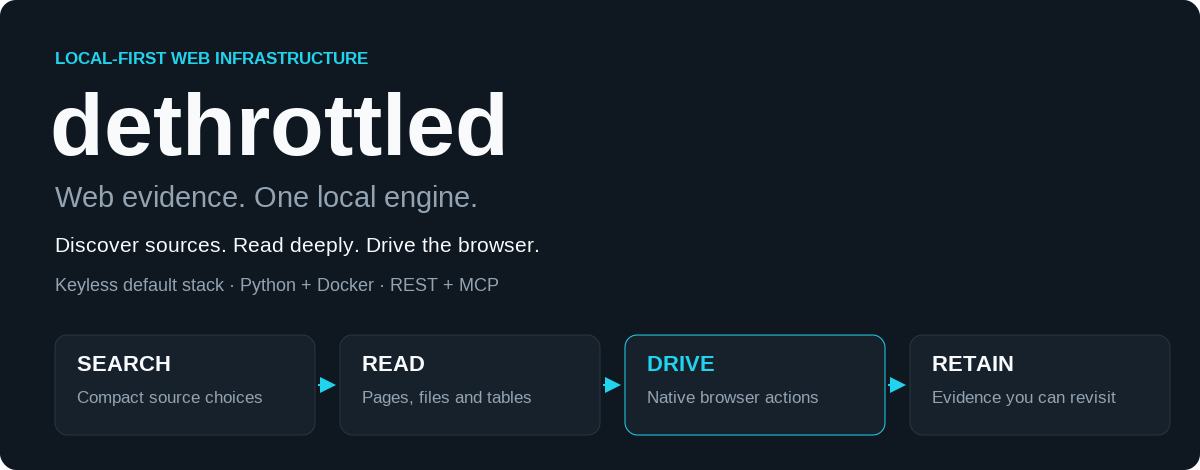
Dethrottled is an open source, self-hosted web retrieval and evidence engine for AI agents, applications and automation. It discovers sources, reads pages and files, operates a real browser, and retains evidence for follow-up. It returns source references, warnings and concrete continuation steps. Your agent or application decides what the evidence supports.
The default stack needs no API key, paid search subscription or model API. It runs on native AMD64 and ARM64 Docker hosts. Public sites can still block requests; retries, queues and storage have limits. Optional paid discovery integrations remain opt-in and are not required by the default workflow.
For a first installation or ordinary script/HTTP use, start with the quick start.
Native HaGeZi ad/tracker filtering is enabled by default in this release, with one switch to disable it. Coverage and measured resource costs are described in that guide.
Start locally
With Docker Engine and Compose installed, run from a checkout:
git clone https://github.com/halonyx-io/dethrottled.git
cd dethrottled
docker compose up -d --build --wait
curl -fsS http://127.0.0.1:8787/health
Try a search after startup:
curl -fsS http://127.0.0.1:8787/v2/search \
  -H 'Content-Type: application/json' \
  -d '{"query":"Python sqlite3 backup documentation","limit":5}'
This starts search, browser rendering and interaction, document reading, corpus and the local reranker. The first build downloads images, dependencies and model weights. See requirements for tested hardware and storage.
Install without a checkout
With Python 3.10+ and Docker Compose available:
python3 -m venv .venv
. .venv/bin/activate
python -m pip install dethrottled
dethrottled stack up
dethrottled stack status
Choose Guided Setup for recommendations based on the machine and expected workload. It saves a Compose override you can review before applying. Speech and advanced PDF layout are selectable worker profiles. For a script processing a list of sources, start with DPR. For an AI client, start with the agent skill.
The raw API listens on 127.0.0.1:8787 and has no caller authentication.
For clients on other devices, set up authenticated REST or MCP.
Follow the evidence
| Capability | What the agent receives |
|---|---|
| Search | Compact source choices: up to ten DDG results, at most three per supplementary engine, fifteen unique URLs total |
| Read | Extracted pages, documents, tables, archives, captions and media; quality and provenance remain attached |
| Recover | Observed publisher alternatives, TLS acquisition, JavaScript rendering and scoped headed-browser interaction |
| Drive | Native controls, frames, tabs, application responses, downloads, screenshots and checkpointed sessions |
| Retain | Document IDs with text, page and table ranges; focused follow-up without fetching the source again |
| Remember | Public Corpus v2 with bounded lexical coverage, sampled semantic retrieval and explicit support/coverage metadata |
| Research | A bounded evidence bundle with explicit coverage gaps; ten sources by default, twenty on request |
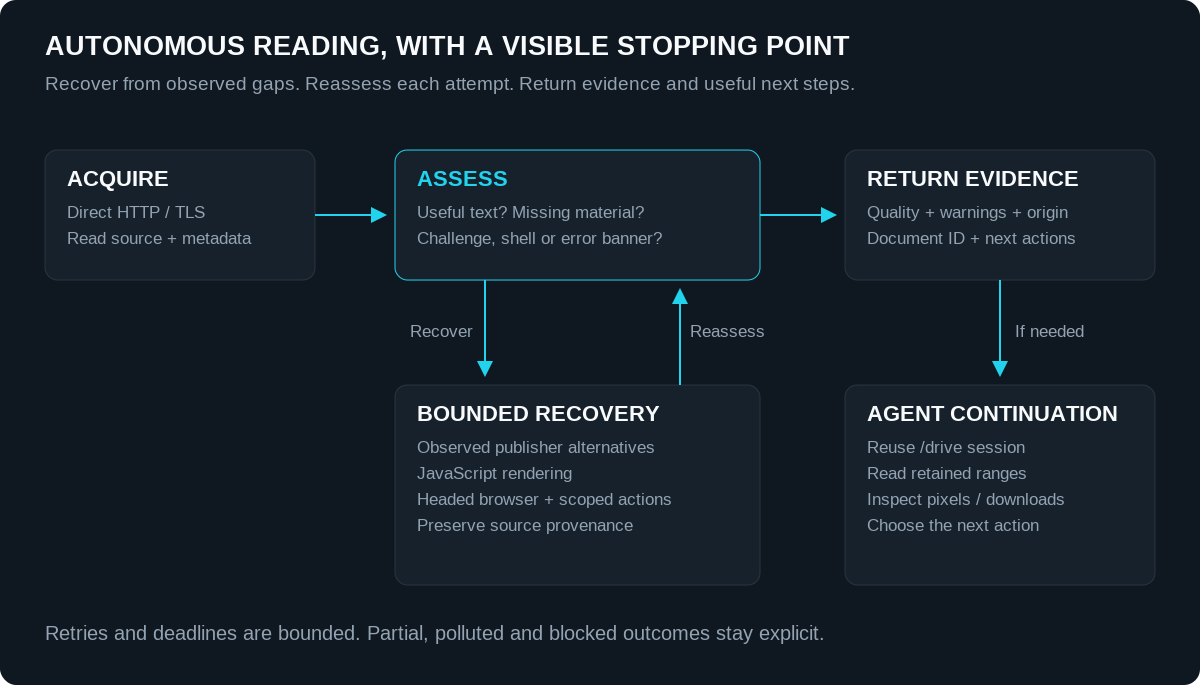
A normal fetch runs the recovery policy automatically. When content remains
incomplete, read_plan and workflow.next_actions expose useful continuations,
including reuse of the same browser session. Agents can also operate /drive
directly. Read the agent client playbook
for tool selection and response contracts. The repository agent skill
provides an installable client workflow covering discovery, extraction, documents,
site mapping, browser control and diagnostics.
curl -sS http://127.0.0.1:8787/fetch \
  -H 'Content-Type: application/json' \
  -d '{"urls":["https://docs.python.org/3/library/sqlite3.html"],"focus":"in-memory database"}'
Preserve quality, warnings, source_partial, truncated, document_id and
continuation metadata. A successful HTTP response is not proof of a complete,
relevant or correct read. OCR and speech may need checking against source pixels
or audio. Interactive challenges can remain unresolved.
Reuse evidence across tasks
Corpus v2 retains eligible public passages for 90 days, with bounded SQLite lexical indexing and representative MiniLM/E5 embeddings. Indexing runs in the background; public document handles can be reopened across agent identities. Private/authenticated reads are excluded from automatic sharing.
Standard retrieval checks source/model corroboration or meaningful query terms.
When evidence is missing, support="broad" exposes additional warned candidates,
including cross-language matches. Neither mode verifies an answer. The
controlled evaluation
records recovered facts and the precision/coverage tradeoff. See
Corpus operation
for budgets, retention, migration and rollback.
Measured on two machines
The current installation and benchmark report compares an ARM64 edge device with an x86_64 mini PC. It preserves installation failures and fixes, controlled browser/document checks, 50 live search questions, 30 fixed fetch targets and six research tasks per device. Fresh acquisition, cache-enabled repeats and optional workers are reported separately. Every plotted value is generated from retained case data.

| Recorded check | ARM64 edge device | x86_64 mini PC |
|---|---|---|
| Browser/document contracts, three runs | 63/63 | 63/63 |
| Controlled format fact retained, eleven fixtures × three runs | 33/33 | 33/33 |
| Worker-restart storage restoration | 3/3 | 3/3 |
| Nonempty live search menus | 50/50 | 50/50 |
Fresh public fetches assessed ok |
26/30 | 27/30 |
The live ok label is the engine's assessment, not verified answer correctness.
The report separately records topic-marker retention, thin results and failures.
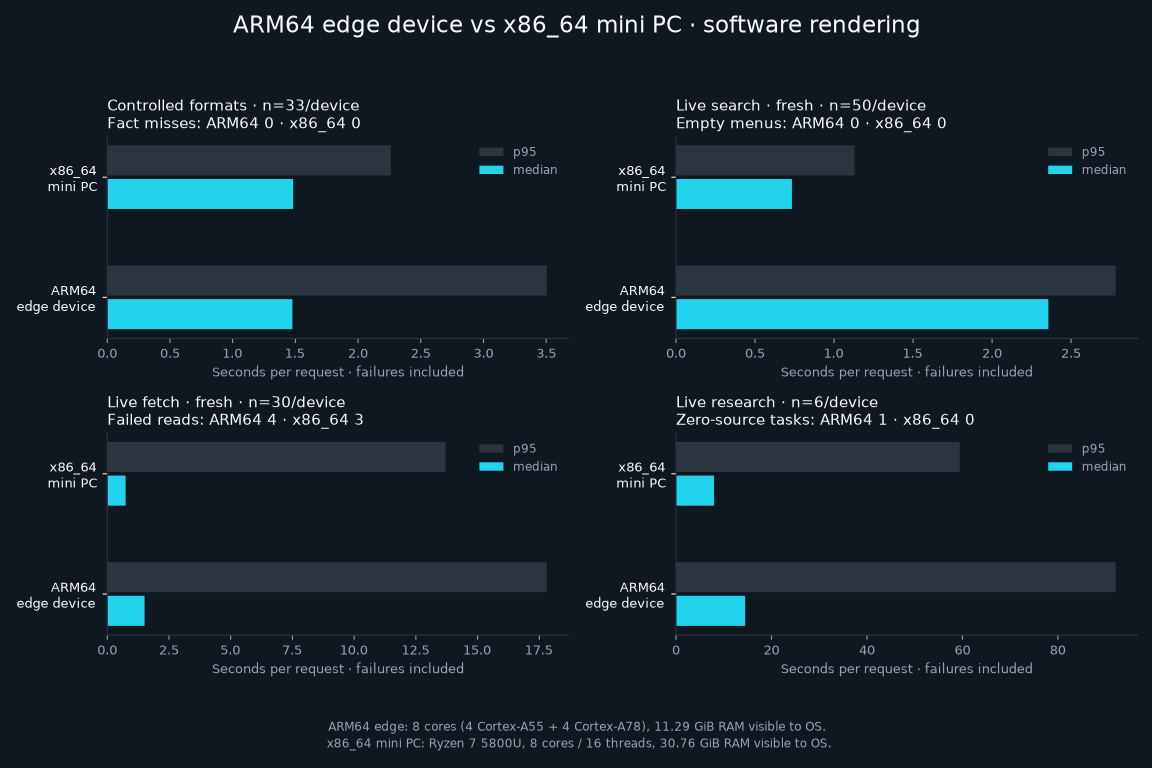
These are observed workloads, not universal minimum requirements or a paid-service superiority claim. Earlier evaluations proved native Reddit interaction and recovery on specific pages; Crunchbase and G2 remained blocked. Current live outcomes, historical reports and limits are linked in the evidence index. Compose enables the local Ettin reranker by default. Standalone Python can opt in.
Current stack
GitHub Compose and the PyPI managed stack both build DNB from bundled source. DNB provides browser discovery, rendering and interaction. Compose generates a signing key in the API data volume and gives DNB the public verifier. DNB launches Chromium through Patchright and runs Crawl4AI extraction in bounded worker processes.
Historical 1.8.0 validation
The release candidate was frozen at commit 735d420 (tag
phase5-candidate-20261109) and then extended with the OCR fixes and the opt-in
Ettin reranker. Candidate images are
dethrottled-dnb:1.8.0-candidate-20261109 (sha256:c6633da3…) and
dethrottled-dnb-api:1.8.0-candidate-20261109 (sha256:bb859007…). The
test-bed API with the OCR improvements is
dethrottled-dnb-api:1.8.0-dev-20261109; the frozen images were not overwritten.
| Layer | 1.8.0 result against the frozen 1.7.1 reference |
|---|---|
| Browser parity | Both sides passed 27 facts, 27 drive actions, exact download, network fact, concurrency and checkpoint restore |
| PDF concise | Same 213 content characters, direct/direct-native, quality ok; reference kept one raw table array, candidate reported native_pdf_table_count=1 and omitted the raw array |
| Office / OCR | PDF, DOCX, XLSX and PPTX facts, quality and tier matched; the frozen baseline OCR returned the same text and warning on both sides, misreading hotel-905 as hote-005 (the test-bed fix below now reads it correctly) |
| Layout / mixed batch | parser=docling, 158 characters and the same two inference warnings; a four-file mixed batch matched |
| Media / speech | Same language en, duration 3.812875 s, transcript and speech-uncertainty warning; one-byte response-length difference |
| HTML ceiling | A 13.7 MB page returned HTTP 200 with html_capture_limit, 300 characters and no post-limit fact on both sides |
| Live / hostile | Two paced passes over the frozen five-URL protocol; controlled hostile routes matched exactly. CarGurus and Expedia remained failed on the repeated pass; no new hostile-source success is claimed |
| Neural rerank | Opt-in Ettin 68M fp32: 0.7930 nDCG@10 / 0.7699 MRR@10 over 100 SciFact queries versus 0.7222/0.6913 for source order; no default change |
| ARM64 | Native build on q6a (aarch64, Docker 29.9.3), reference sha256:b9e0fe2a…, candidate sha256:9fb7c41b…; llvmpipe WebGL, real crawl fact retained, 29/29 focused tests |
| Packaging / install | Wheel and sdist built, twine check and scripts/verify_stack_package.py passed (979 context files, 56 copy sources); the 1.8.0 wheel installed in a clean venv and both CLI entry points ran, while the 1.7.1 PyPI/GitHub routes remain available for rollback |
| Mixed load | 3-minute run: reference 859 requests / 0 failures / 20 ms median; candidate 829 / 0 / 20 ms |
| Soak / crash | 10-minute API memory flat at ~238 MiB, browser 495-619 MiB without restart; injected browser kill caused 33/333 drive requests to fail explicitly while 999/999 fetches succeeded, API stayed healthy, recovery took 4.3 s |
| Rollback | Marker and legacy databases survived reference → candidate → reference; candidate read the reference cache, schema 2 created corpus-v2.sqlite alongside corpus.sqlite, and 1.7.1 read it after rollback |
| Offline suite | 915 passed, 139 skipped, 2 deselected on the host; 1,066 passed, 15 skipped, 2 deselected in the candidate API image |
Known differences and limits: the concise PDF table change is an intentional presentation change, not a capability loss. On the first live pass the candidate returned a readable Crunchbase/Expedia result where 1.7.1 returned a partial or failed result; the reversed second pass matched, so this is recorded as upstream/order variability rather than a claimed improvement. The frozen baseline OCR was identical but wrong on one generated token; the test-bed fix now reads it, and the warning remains. ARM64 used software rendering, not verified hardware acceleration. Package metadata and the Compose user agent are 1.8.0.
The candidate uses roughly 6.8-7.2 CPU-seconds per 10 renders versus 2.4-2.8 for 1.7.1 at similar latency; this is a measured target for improvement, not a speedup claim. Controlled direct extraction is within 3% (0.803 versus 0.780 CPU-seconds per request) and the extraction worker itself is about 0.019 CPU-seconds per request, so the renderer, not the reader, owns that gap. A separate headed non-GL crawl browser cut render CPU from 0.706 to 0.370 CPU-seconds per request at the same latency, while drive keeps verified WebGL and Crunchbase still reads; browser memory rises from about 0.52 to 1.0 GiB.
Test-bed improvements after the freeze are tracked in
CANDIDATE-CHANGES.md.
The first one recovers low-resolution OCR digits (hotel-905, reference read
hote-005) with a bounded 2x upscale for standalone images; PDF page rasters
keep their existing OCR-DPI resolution. The frozen images were not overwritten.
P0 test-bed hardening now also enforces cache expiry/size, closes the idle crawl
browser, adds CID-corrupted PDF OCR, warns on long login/paywall/access-denied
pages, and offers a six-tool MCP profile. P1 adds date/source/page signals,
fetch relevance, decoy-bucket filtering, normalized search cache identity, token
estimates and boundary-aware truncation. See
P0-BUGS-EFFICIENCY.md
and P1-AGENT-SIGNALS.md.
P2 keeps search fan-out, neural rerank, semantic cache, persistent search
profiles and provider key/proxy rotation opt-in. The 1.8.0 prototype supports one
neural reranker, Ettin 68M fp32, at 512 tokens, title+text up to 3,000
characters and the top 30 candidates. On 100 SciFact queries it reached 0.7930
nDCG@10 and 0.7699 MRR@10 versus 0.7222/0.6913 for source order, but it remains
opt-in. Results are in
P2-EXPLORATORY.md.
The full record is in PHASE-6.md,
and the next layer-by-layer comparison is in
CANDIDATE-BENCHMARK-PLAN.md.
No release or deployment happens without fresh approval.
Explore the engine
| Guide | Purpose |
|---|---|
| Documentation home | Find the right integration or operations guide |
| Architecture | Service boundaries, search, reading, research and corpus |
| HTTP API | Routes, examples and generated request reference |
| Browser operation | Actions, scope, sessions, checkpoints and downloads |
| Requirements and measurements | Tested hardware, memory, disk and optional-profile costs |
| Configuration | Workers, models, profiles and workload controls |
| Operations | Updates, backups, verification and remote deployment |
The default API image includes native document readers, Tesseract and MiniLM/E5
corpus models. Mutable evidence, jobs, cache and corpus use a named data volume;
browser checkpoints and optional model caches have their own volumes. GPU access
is optional. No .env file or worker URL is required for the default stack.
The fetch ladder does not consult robots.txt. Raw API access to trusted LAN
targets requires care; public adapters enforce narrower policies, alongside
operator-provided network isolation. See operations.
This checkout is 1.8.3. Check /health and /v2/capabilities on the service you
actually use; deployed services and remote plugins can differ from a checkout.
MIT license · Maintained by Halonyx
1 maintainer

Metadata
1 maintainer
Release files for dethrottled 1.8.3
For a detailed explanation of source distributions (sdists) and built distributions (wheels), please see the package formats documentation.
Source distribution (sdist)
| File | Size | Uploaded | Provenance | Actions |
|---|---|---|---|---|
| dethrottled-1.8.3.tar.gz | 12.5 MB | With provenance | Details for dethrottled-1.8.3.tar.gz |
Built distribution (wheel)
| File | Interpreter | ABI | Platform | Actions Reset |
|---|---|---|---|---|
| dethrottled-1.8.3-py3-none-any.whl | Python 3 | none | any | Details for dethrottled-1.8.3-py3-none-any.whl |
Total release size: 25.0 MB
Release files / dethrottled-1.8.3.tar.gz
| Download URL | dethrottled-1.8.3.tar.gz |
|---|---|
| Size | 12.5 MB |
| Tags | Source |
|
SHA-256 checksum How to use checksums |
0350f3f3058ad2eabf152ce40fef18387a51b0ab521f71a1dd59550fd673fb32
|
|
BLAKE2b-256 checksum How to use checksums |
fb9823a1e3b77ffee4124597bed54dd7b2d5c32d90e6b0b81ca12df5f221b1ad
|
| Upload date | |
|
Uploaded using Trusted Publishing? What is trusted publishing? |
Yes |
| Uploaded via |
twine/7.0.0 CPython/3.13.16
|
Provenance
Provenance describes where a file came from. On PyPI, provenance is shared via attestations, which provide a verifiable record of the build or publishing details. View details, limitations and caveats.


PyPI Publish Attestation
PyPI verified that this artifact, at this checksum, originated from the publisher listed below.
Signed by GitHub Actions, verified by PyPI on Nov 12, 2026.
Transparency logRelease files / dethrottled-1.8.3-py3-none-any.whl
| Download URL | dethrottled-1.8.3-py3-none-any.whl |
|---|---|
| Size | 12.5 MB |
| Tags | Python 3 |
|
SHA-256 checksum How to use checksums |
643abc517cfe0574335df30a43221803807b363f0ce2c45765913bb508739838
|
|
BLAKE2b-256 checksum How to use checksums |
8bead2aad46a66eb81c8c9c04423329b7ca33187e5e3d48cf5bd3f2409b65712
|
| Upload date | |
|
Uploaded using Trusted Publishing? What is trusted publishing? |
Yes |
| Uploaded via |
twine/7.0.0 CPython/3.13.16
|
Provenance
Provenance describes where a file came from. On PyPI, provenance is shared via attestations, which provide a verifiable record of the build or publishing details. View details, limitations and caveats.
PyPI Publish Attestation
PyPI verified that this artifact, at this checksum, originated from the publisher listed below.
Signed by GitHub Actions, verified by PyPI on Nov 12, 2026.
Transparency logSecurity for dethrottled 1.8.3
Provenance
Provenance describes where a file came from. On PyPI, provenance is shared via attestations, which provide a verifiable record of the build or publishing details. View details, limitations and caveats.
Full provenance
Both files in this release have been uploaded with provenance metadata.
Attestation for dethrottled-1.8.3.tar.gz
PyPI Publish Attestation
PyPI verified that this artifact, at this checksum, originated from the publisher listed below.
Signed by GitHub Actions, verified by PyPI on Nov 12, 2026.
Transparency logA note on package security
PyPI is a repository for distributing packages, not a service for auditing them. While third-party security researchers and our staff do their best to detect and remove malicious packages, PyPI cannot guarantee the quality, security or suitability of any given package.
To learn more about protecting yourself from malicious actors, visit our package security documentation.














