
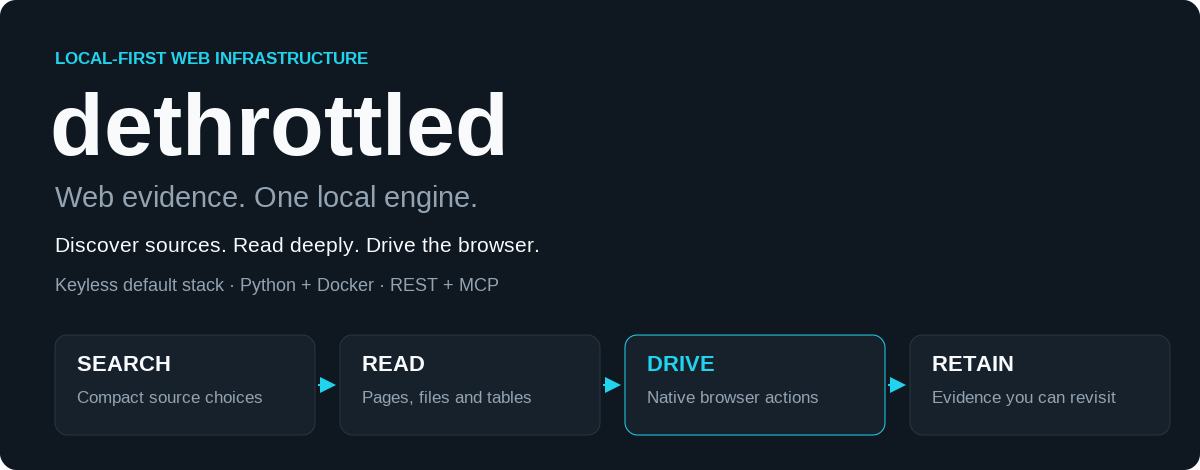




dethrottled
Self-hosted web access for AI agents. No API keys, no quotas, no per-call bill.
Your agent needs the web. dethrottled searches it, reads what it finds (pages, PDFs, spreadsheets, slide decks, scanned images, audio and video), drives a real browser when a site insists on one, and keeps the evidence so the next question starts where the last one stopped. It runs in Docker on your own hardware.
It is also honest about what it got. Every result carries its quality, its warnings, how complete it is and where it came from, plus the concrete next step when something is missing. Your agent can tell a full article from a cookie wall.
Why dethrottled
- Keyless by default. Search, rendering, OCR, speech, embeddings and reranking all run locally. Paid providers exist only as explicit opt-ins.
- Reads the pages simple scrapers can't. Each read starts with a plain request and climbs to TLS impersonation, a JavaScript renderer and finally a real browser, only as far as the page needs.
- Results you can trust to be honest.
quality,warnings, partial and truncated flags, attempt history and source hashes travel with the text. A failed or thin read is reported as one, never dressed up as a success. - Built for agents. An MCP server and REST gateway with per-client tokens and scopes, an installable agent skill, and responses sized for context windows: focused excerpts, token estimates and continuation handles.
- It remembers. Long documents are retained for follow-up reads, public evidence goes into a local searchable corpus for 90 days, and it learns which read steps each site refuses so repeat reads skip straight past them.
Quick start
You need Docker Engine with Compose.
git clone https://github.com/halonyx-io/dethrottled.git
cd dethrottled
docker compose up -d --build --wait
curl -fsS http://127.0.0.1:8787/health
The first build downloads browser, OCR and model assets, so it takes a while. After that, search:
curl -sS http://127.0.0.1:8787/v2/search \
  -H 'Content-Type: application/json' \
  -d '{"query":"sqlite write-ahead logging","limit":5}'
and read a page, keeping only the passages about one topic:
curl -sS http://127.0.0.1:8787/fetch \
  -H 'Content-Type: application/json' \
  -d '{"urls":["https://sqlite.org/wal.html"],"focus":"checkpoint","max_chars":600}'
Prefer not to clone? With Python 3.10+ and Docker:
python3 -m venv .venv && . .venv/bin/activate
python -m pip install dethrottled
dethrottled stack up
dethrottled stack status
What it does
Search
One query fans out to DuckDuckGo plus supplementary engines through a bundled
SearXNG, and comes back as a compact menu of at most fifteen unique sources.
Profiles cover web, news (dated stories first), academic (Crossref,
OpenAlex, arXiv) and a thorough mode. The same page reached under different addresses is merged into
one result that keeps everyone's dates and provenance. A local Ettin reranker
refines the order, and you can restrict, exclude or prefer domains.
Read almost anything
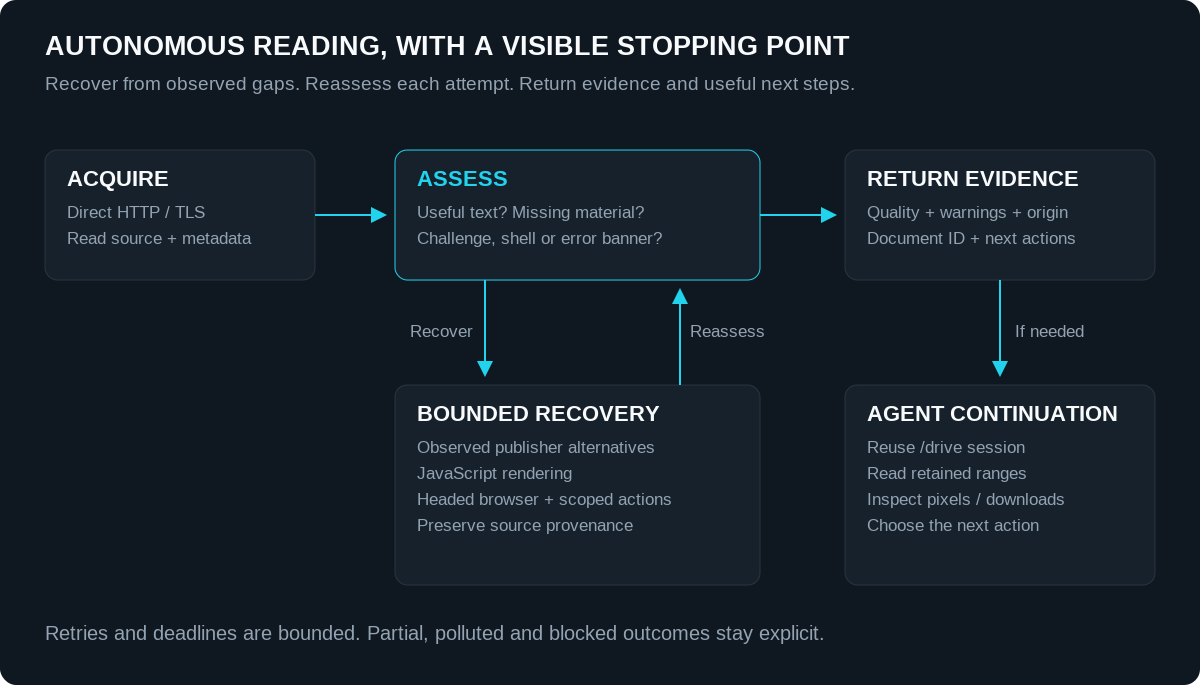
After every attempt the result is assessed. Is there readable text? Is this an app shell waiting for JavaScript, a challenge page, an error banner or a teaser? The read only climbs when it has to. When a page needs more than rendering, a read planner tries the fix it observed: scrolling a feed, expanding collapsed sections, waiting out a loading state, or following the publisher's own alternative format.
The same fetch call reads:
| Source | What you get |
|---|---|
| Web pages | Main text with title, publisher-declared dates and identifiers (DOI, ISBN, package versions) |
| Text layer, detected tables, page ranges and Tesseract OCR for scans; optional Docling layout analysis | |
| Office and OpenDocument | DOCX, PPTX, XLSX, XLS, ODT, ODS, ODP, EPUB, RTF, legacy DOC/PPT, MSG and XLSB |
| Data and text | CSV and TSV row windows, JSON, XML, Markdown, plain text |
| Feeds | RSS and Atom as dated items, newest first |
| Archives and email | ZIP, TAR and GZIP members; EML messages and attachments |
| Media | Captions and subtitles, image OCR, and speech-to-text for audio and video with the optional speech worker |
Drive a real browser
When reading isn't enough, /drive hands your agent a real Chromium session:
snapshot the page's controls, click, fill and submit forms, switch tabs and
frames, capture network responses, download files and take screenshots. Sessions
persist across calls, survive worker restarts through checkpoints, and stay
inside the hosts you allow.
curl -sS http://127.0.0.1:8787/drive \
  -H 'Content-Type: application/json' \
  -d '{"url":"https://example.com/","session":"demo","allowed_hosts":["example.com"],"steps":[{"action":"snapshot","limit":10}]}'
Research in one call
/research takes a question, searches several angles, reads the most promising
sources in parallel and returns an evidence bundle: source excerpts matched to
your question, with the gaps it could not cover. Mirrors and duplicate copies are
collapsed so the bundle contains distinct sources. No model writes an answer;
your agent does that with the evidence in hand.
curl -sS http://127.0.0.1:8787/research \
  -H 'Content-Type: application/json' \
  -d '{"question":"How does Python sqlite3 create an in-memory database?","max_sources":4}'
Keep and reuse evidence
- Retained documents. Every read gets a
document_id. Page through a long PDF, jump to a table's rows or, where supported, view the source page as an image, all without fetching it again. - A shared corpus. Public reads are indexed in the background, lexically and
with local MiniLM/E5 embeddings, and kept for 90 days.
corpus_searchfinds passages across everything read before, in any language the models cover.
And more
- Bulk jobs. DPR takes up to 500 URLs per job from a CSV or text file, survives restarts and exports JSONL, CSV or extracted files.
- Site mapping and crawling. Read a sitemap or follow links within one site, with explicit page and path bounds.
- Field extraction. Named CSS selectors pull exact values out of a page without a model.
- Ad and tracker blocking. HaGeZi Multi PRO filtering is on by default across every fetcher and browser.
- Guided Setup. Guided Setup recommends settings for your machine and workload, and saves a plan you can review before applying it.
What a result looks like
A real fetch response, trimmed:
{
  "url": "https://sqlite.org/wal.html",
  "quality": "ok",
  "tier": "direct/trafilatura",
  "content_status": "complete",
  "page_type": "article",
  "published": "2026-08-25",
  "date_source": "page",
  "content": "In its default configuration, SQLite will checkpoint the WAL file at the conclusion of any transaction when the WAL file is more than 1000 pages long...",
  "content_chars": 30118,
  "truncated": true,
  "document_id": "doc_8a903f5c0b48492fb6fcf21d236245fc",
  "warnings": [],
  "tokens_estimated": 150
}
truncated is true because focus returned only the matching passages; the full
30,118-character text is retained under document_id. When a read is incomplete,
workflow.next_actions names the exact tool call to make next.
Connect your agent
| You use | Connect with |
|---|---|
| An MCP client (Claude, Codex, Cursor and others) | The MCP adapter: Streamable HTTP at /mcp with a bearer token |
| Your own code | The HTTP API, or the Python package |
| A coding agent that reads skills | The agent skill and the client playbook |
| A shell script | The dethrottled CLI and DPR for batches |
Honest limits
- Some sites block automated access whatever the client. Those reads fail, and say so.
- Search quality depends on upstream engines, which rate-limit and change.
- "Readable" is not "correct". OCR and speech can misread, and a page can be wrong. dethrottled reports evidence; it does not verify claims.
- The fetch ladder does not consult
robots.txt. You are responsible for how you use it. Use the authenticated adapters and network isolation when anyone else can reach it.
Documentation
| Start here | For |
|---|---|
| Quick start | Install, first requests, everyday use |
| Client playbook | How agents should call each tool and read each field |
| HTTP API | Routes, examples and the request reference |
| Browser operation | Actions, sessions, scope, checkpoints and downloads |
| Reading and evidence | Formats, OCR, layout, spreadsheets and continuation |
| Configuration | Workers, profiles, models and tuning |
| Requirements | Hardware, memory and disk |
| Operations | Upgrades, backups and releases |
| All documentation | Everything else |
Contributing
Read AGENTS.md before changing code. It sets out the rules contributors (human or AI) follow here, and the checks a change must pass.
This checkout is 1.8.7. A running service reports its own version at /health.
License
dethrottled's own code is MIT. The default Docker stack also runs third-party software under its own licences, including two AGPL-3.0 libraries in the API image (PyMuPDF for PDFs, EbookLib for EPUB) and SearXNG in its own container. Running it for yourself adds no obligations. If you modify it and let other people use it over a network, or redistribute the images, read third-party notices first.
This product includes software developed by UncleCode (https://x.com/unclecode) as part of the Crawl4AI project (https://github.com/unclecode/crawl4ai).
Maintained by Halonyx
1 maintainer

Metadata
1 maintainer
Release files for dethrottled 1.8.7
For a detailed explanation of source distributions (sdists) and built distributions (wheels), please see the package formats documentation.
Source distribution (sdist)
| File | Size | Uploaded | Provenance | Actions |
|---|---|---|---|---|
| dethrottled-1.8.7.tar.gz | 12.6 MB | With provenance | Details for dethrottled-1.8.7.tar.gz |
Built distribution (wheel)
| File | Interpreter | ABI | Platform | Actions Reset |
|---|---|---|---|---|
| dethrottled-1.8.7-py3-none-any.whl | Python 3 | none | any | Details for dethrottled-1.8.7-py3-none-any.whl |
Total release size: 25.2 MB
Release files / dethrottled-1.8.7.tar.gz
| Download URL | dethrottled-1.8.7.tar.gz |
|---|---|
| Size | 12.6 MB |
| Tags | Source |
|
SHA-256 checksum How to use checksums |
5720eb2948be75fe3fc9ec5912b8584ee142cbfc5eba409436121d1e3ee2293f
|
|
BLAKE2b-256 checksum How to use checksums |
eeaf26282b0283262c606a07661515dce9e73489c92e1549835c1ec7c781a804
|
| Upload date | |
|
Uploaded using Trusted Publishing? What is trusted publishing? |
Yes |
| Uploaded via |
twine/7.0.0 CPython/3.13.16
|
Provenance
Provenance describes where a file came from. On PyPI, provenance is shared via attestations, which provide a verifiable record of the build or publishing details. View details, limitations and caveats.


PyPI Publish Attestation
PyPI verified that this artifact, at this checksum, originated from the publisher listed below.
Signed by GitHub Actions, verified by PyPI on Nov 14, 2026.
Transparency logRelease files / dethrottled-1.8.7-py3-none-any.whl
| Download URL | dethrottled-1.8.7-py3-none-any.whl |
|---|---|
| Size | 12.6 MB |
| Tags | Python 3 |
|
SHA-256 checksum How to use checksums |
9200c1e5b215caffed943ab29c93352bc040afda5a419ecfc718e9cfed7e1b71
|
|
BLAKE2b-256 checksum How to use checksums |
3e85b247ed5a78509ad018ac673ba99ed4d64de711149439a77ef8d3aca2b598
|
| Upload date | |
|
Uploaded using Trusted Publishing? What is trusted publishing? |
Yes |
| Uploaded via |
twine/7.0.0 CPython/3.13.16
|
Provenance
Provenance describes where a file came from. On PyPI, provenance is shared via attestations, which provide a verifiable record of the build or publishing details. View details, limitations and caveats.
PyPI Publish Attestation
PyPI verified that this artifact, at this checksum, originated from the publisher listed below.
Signed by GitHub Actions, verified by PyPI on Nov 14, 2026.
Transparency logSecurity for dethrottled 1.8.7
Provenance
Provenance describes where a file came from. On PyPI, provenance is shared via attestations, which provide a verifiable record of the build or publishing details. View details, limitations and caveats.
Full provenance
Both files in this release have been uploaded with provenance metadata.
Attestation for dethrottled-1.8.7.tar.gz
PyPI Publish Attestation
PyPI verified that this artifact, at this checksum, originated from the publisher listed below.
Signed by GitHub Actions, verified by PyPI on Nov 14, 2026.
Transparency logA note on package security
PyPI is a repository for distributing packages, not a service for auditing them. While third-party security researchers and our staff do their best to detect and remove malicious packages, PyPI cannot guarantee the quality, security or suitability of any given package.
To learn more about protecting yourself from malicious actors, visit our package security documentation.














