
df2tables: Pandas and Polars DataFrames to Interactive DataTables

Project description
df2tables - Pandas & Polars DataFrames to Interactive HTML Tables

df2tables is a Python utility for exporting Pandas and Polars DataFrames into interactive HTML tables using DataTables - a powerful JavaScript library.
It’s built to embed seamlessly into Flask, Django, FastAPI, or any web framework.
By rendering tables directly from JavaScript arrays, this tool delivers fast performance and compact file sizes, enabling smooth browsing of large datasets while maintaining full responsiveness.
Minimal dependencies: only pandas or polars (you don’t need pandas installed if using polars).
Converting a DataFrame to an interactive table takes just one function call:
render(df, **kwargs)
# or for web frameworks:
render_inline(df, **kwargs)
Features
- Converts
pandasandpolarsdataframes interactive standalone HTML tables - Web Framework Ready: Specifically designed for easy embedding in Flask, Django, FastAPI, and other web frameworks
- Browse large datasets using filters and sorting
- Works independently of Jupyter or live server (though notebook rendering is supported)
- Useful for training dataset inspection and feature engineering: Quickly browse through large datasets, identify outliers, and data quality issues interactively
- Customization: Configuring DataTables from Python (new)
Screenshots
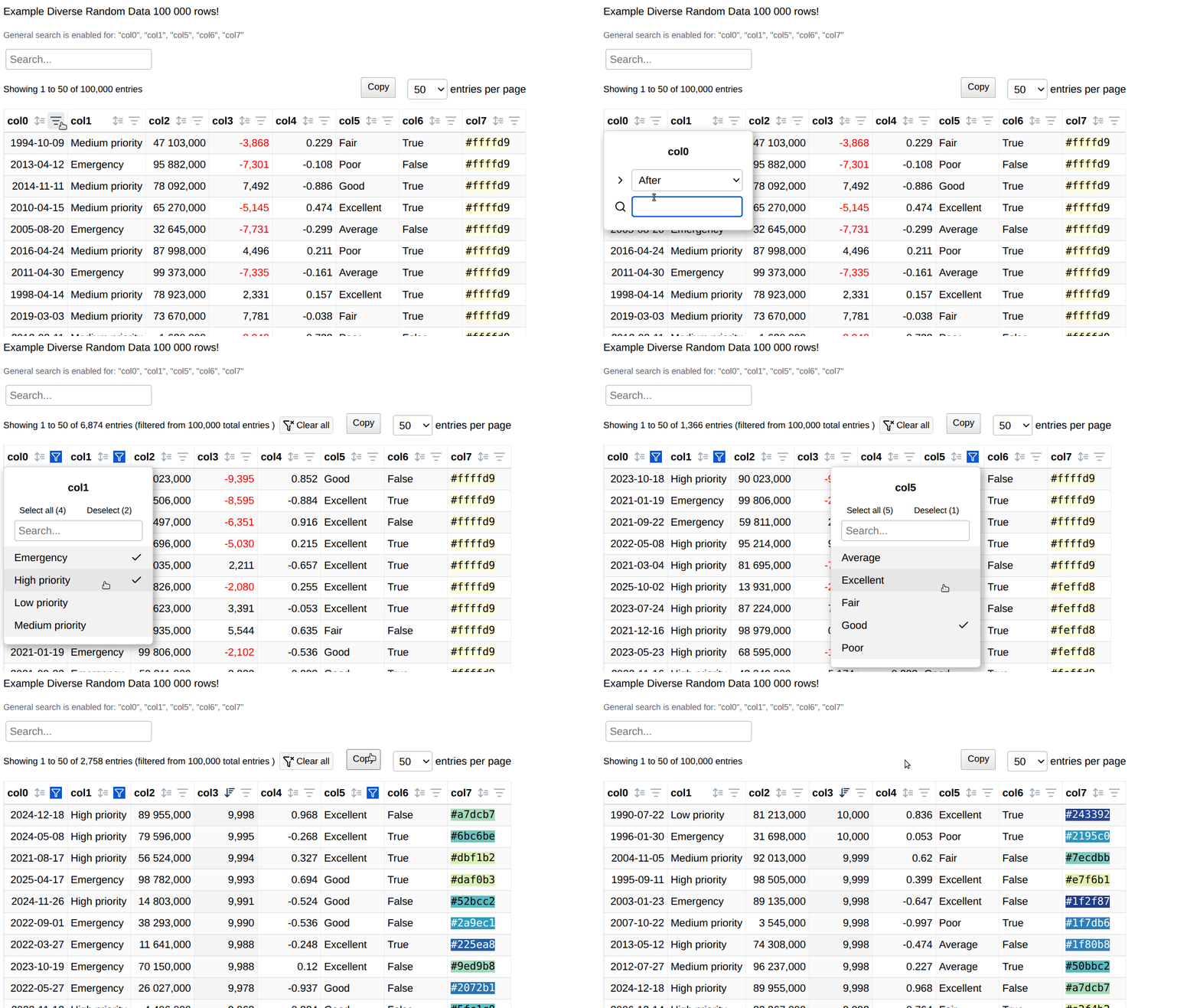
A standalone HTML file containing a JavaScript array as data source for DataTables has several advantages. For example, you can browse quite large datasets locally.
The column control feature provides dropdown filters for categorical data and search functionality for text columns, enhancing data exploration capabilities through the excellent DataTables Column Control extension.
Note: By default, filtering is enabled for all non-numeric columns.
Quick Start
The simplest function call with default arguments is:
df2tables.render(df, to_file='df.html')
Installation
pip install df2tables
Sample DataFrame
#render sample DataFrame
html_string = df2t.render_sample_df(to_file="sample_table.html")
Rendering in notebook
from df2tables import  render_nb

render_nb(df) #show interactive table in jupyter notebook
Note: Notebook rendering is currently supported in Jupyter, VS Code notebooks and marimo
Main Functions
render
df2t.render(
    df: pd.DataFrame,
    to_file: Optional[str] = None,
    title: str = "Title",
    precision: int = 2,
    num_html: List[str] = None,
    startfile: bool = True,
    templ_path: str = TEMPLATE_PATH,
    load_column_control: bool = True,
    js_opts: Optional[dict] = None,
    display_logo: bool = True
) -> Union[str, file_object]
Parameters:
df: Input pandas DataFrameto_file: Output HTML file path. If None, returns HTML string instead of writing filetitle: Title for the HTML tableprecision: Number of decimal places for floating-point numbersnum_html: List of numeric column names to render with color-coded HTML formatting (negative values in red)startfile: If True, automatically opens the generated HTML file in default browsertempl_path: Path to custom HTML template (uses default if not specified)load_column_control: If True, integrates the DataTables Column Control extension programmatically for enhanced filtering and search capabilities (default: True)js_opts: Dictionary of DataTables configuration options to customize table behavior (e.g., pagination, scrolling, layout, language).(default: None)display_logo: If True, displays DataTables logo (default: True)
Returns:
- HTML string if
to_file=None - File object if
to_fileis specified
render_inline
df2t.render_inline(
    df: pd.DataFrame,
    table_attrs: Dict = None,
    **kwargs
) -> str
Parameters:
This function is designed for integration with web applications and has the following characteristics:
- Returns only the
<table>markup and the associated JavaScript - Excludes
<html>,<head>, and<body>tags - Useful for pages with multiple tables, as you can assign unique IDs via the
table_attrsdictionary (e.g.,{'id': 'my-unique-table'}) - Important: This function does not include jQuery or DataTables library dependencies. You must include them manually in your host HTML page for the table to function correctly
Some key arguments are not applicable, such as title or display_logo, because the returned HTML contains only the table and JavaScript.
The new additional table_attrs argument accepts a dictionary of HTML table attributes, such as an ID or CSS class. This is especially useful for multiple tables on a single page (each must have a different ID).
See an example of multiple tables with different configuration options placed in separate tabs (jQuery UI Tabs): flask_multiple_tables_tabs.py
Minimal Flask Example
Here's a complete, minimal working Flask application that demonstrates how to properly embed a DataTable with all required dependencies:
import df2tables as df2t
from flask import Flask, render_template_string

app = Flask(__name__)

@app.route("/")
def home():
    # Generate sample data (or use your own DataFrame)
    df = df2t.get_sample_df()
    df_title = "DataFrame Rendered as DataTable inline in <strong>Flask</strong>"

    string_datatable = df2t.render_inline(df)

    # Embed in a complete HTML template with all required dependencies
    return render_template_string(
        """
        <!DOCTYPE html>
        <html>
        <head>
            <title>Flask Data Dashboard</title>
            <meta name="viewport" content="width=device-width, initial-scale=1">

            <script src="https://code.jquery.com/jquery-3.7.1.min.js"></script>
            <link href="https://cdn.datatables.net/2.3.4/css/dataTables.dataTables.min.css" rel="stylesheet">
            <script src="https://cdn.datatables.net/2.3.4/js/dataTables.min.js"></script><!--[column_control-->
            <link href="https://cdn.datatables.net/columncontrol/1.1.0/css/columnControl.dataTables.min.css" rel="stylesheet">
            <script src="https://cdn.datatables.net/columncontrol/1.1.0/js/dataTables.columnControl.min.js"></script><!--column_control]-->

            <!-- Optional: PureCSS for styling -->
            <link rel="stylesheet" href="https://cdn.jsdelivr.net/npm/purecss@3.0.0/build/pure-min.css">
        </head>
        <body style="background-color: #f4f4f4;">
            <div style="background-color: #fff; padding: 20px; margin: 20px;">
                <h1>My Flask Data Dashboard</h1>
                {{ inline_datatable | safe }}
            </div>
        </body>
        </html>
        """,
        inline_datatable=string_datatable,
    )

if __name__ == "__main__":
    app.run(debug=True)
Note: Pandas DataFrame indexes are not rendered by default. If you want to enable indexes in an HTML table, simply call df2tables.render(df.reset_index(), args...)
Customization: Configuring DataTables from Python
You can now customize DataTables behavior directly from Python by passing configuration options through the new js_opts parameter. This allows you to control DataTables options and features without modifying the HTML template.
Basic Usage
Simply pass a dictionary of DataTables options to the js_opts parameter in the render or render_inline function.
Examples
1. Customize Layout and Language
Rearrange control elements (such as the search bar and info display) using the layout option, or localize text:
custom_cfg = {
    "language": {
        "searchPlaceholder": "Search in all text columns"
    },
    "pageLength": 25, # number of table rows showing
    "layout": {
        "topStart": "info",
        "top1Start": "pageLength",
        "topEnd": "search",
        "bottomEnd": "paging"
    }
}
df2t.render(df, js_opts=custom_cfg, to_file="localized_table.html")
2. Replace Paging with Scrolling
Disable pagination and enable vertical and horizontal scrolling for easier navigation of large datasets.
Note: Using scrollY with disabled paging can be slow for large DataFrames.
scroll_cfg = {
    "paging": False, # slow for large tables
    "scrollCollapse": False,
    "scrollY": '50vh',
    "scrollX": "70vw"
}
df2t.render(df, js_opts=scroll_cfg, to_file="scrolling_table.html")
Error Handling
Invalid keys are ignored by DataTables, so malformed or non-existent options usually will not break table rendering.
Note: While invalid keys should be ignored, using a valid key with an incorrect value type may still cause an error in the browser's JavaScript console.
Available Configuration Options
Important Notes
Some configuration options require additional DataTables extensions or plugins (e.g., Buttons, FixedHeader). At this time, such plugin-dependent options are not yet supported.
For best results, start with core features such as layout or language options before exploring more advanced configurations.
For a complete list of available settings, refer to the official DataTables documentation and: https://datatables.net/examples/
It’s best to start with the core DataTables Features before adding advanced configurations.
Column Name Formatting
For better readability in table headers, df2tables automatically converts underscores to spaces in column names. This improves word wrapping and prevents excessively wide columns.
To disable this automatic word wrapping behavior, add the following CSS to your custom template:
span.dt-column-title {
    white-space: nowrap;
}
Bulk Dataset Processing
For exploratory data analysis across multiple datasets, you can generate tables programmatically. The example below uses the vega_datasets package, which provides easy access to a variety of sample datasets commonly used in data visualization and analysis.
Note: Install vega_datasets with pip install vega_datasets to run this example.
Quick Browse First 10 Vega Datasets
Error Handling
The module includes error handling for:
- JSON serialization: Custom encoder handles complex pandas or Python data types
- Column compatibility: Automatically converts problematic column types to string representation
Offline Usage
Note: "Offline" viewing assumes internet connectivity for CDN resources (DataTables, jQuery, PureCSS, DataTables Column Control extension). For truly offline usage, modify the template to reference local copies of these libraries instead of CDN links.
Appendix: Template Customization
Templates use comnt, a minimal markup system based on HTML/JS comments.
Custom Templates
Copy and modify datatable_templ.html to apply custom styling or libraries, then pass the new template path to templ_path.
Handle Pandas MultiIndex Columns (Experimental)
MultiIndex columns are automatically flattened with underscore separation.
License
MIT License
© Tomasz Sługocki
Release history Release notifications | RSS feed


Download files
Download the file for your platform. If you're not sure which to choose, learn more about installing packages.
Source Distribution
Built Distribution
Filter files by name, interpreter, ABI, and platform.
If you're not sure about the file name format, learn more about wheel file names.
Copy a direct link to the current filters
File details
Details for the file df2tables-0.1.9.tar.gz.
File metadata
- Download URL: df2tables-0.1.9.tar.gz
- Upload date:
- Size: 18.1 kB
- Tags: Source
- Uploaded using Trusted Publishing? No
- Uploaded via: twine/6.1.0 CPython/3.12.3
File hashes
| Algorithm | Hash digest | |
|---|---|---|
| SHA256 |
413ac160c17b43c840b8912ba557273df80bc5e595f673fed40171964ff473ac
|
|
| MD5 |
d76512d8b70c9fb847f8aee28442ff55
|
|
| BLAKE2b-256 |
d780a176a07062a9580f5fb669b3f7387d2ff99d3d4a3a39d2cb43a9ffe81923
|
File details
Details for the file df2tables-0.1.9-py2.py3-none-any.whl.
File metadata
- Download URL: df2tables-0.1.9-py2.py3-none-any.whl
- Upload date:
- Size: 21.3 kB
- Tags: Python 2, Python 3
- Uploaded using Trusted Publishing? No
- Uploaded via: twine/6.1.0 CPython/3.12.3
File hashes
| Algorithm | Hash digest | |
|---|---|---|
| SHA256 |
d58a7bf2cc2d1326a9905177599b69ad9c63ce51f120043c5a008f68885d5f11
|
|
| MD5 |
3e18ef86b83a5af027d376bcb47a5417
|
|
| BLAKE2b-256 |
3125e84d37c73da61677e4279d41163b9cc4506c99dbe6f63464a96ba666f594
|






