
Differentiable Model Predictive Excitation (DMPE):
This repository implements an algorithm for the excitation of systems with unknown (usually non-linear) dynamics. The inner workings and lines of thought are outlined within the corresponding publication. If you found this repository useful for your research, please cite the current preprint version as:
@Article{Vater2024,
  author      = {Vater, Hendrik and Wallscheid, Oliver},
  title       = {Differentiable Model Predictive Excitation: Generating Optimal Data Sets for Learning of Dynamical System Models},
  journal     = {TechRxiv preprint},
  year        = {2024},
  doi         = {10.36227/techrxiv.172840381.16440835/v1},
}
Installation:
If you are specifically interested in reproducing the results from the
Vater2024publication, you are kindly referred to: https://pypi.org/project/dmpe/0.1.3/
Else, if you are specifically interested in reproducing the results from the
TBDrelated publication, you are kindly referred to: https://pypi.org/project/dmpe/0.2.1/
Otherwise, the simplest way is using Python >= 3.11:
pip install dmpe
- Intended for a Linux system using an NVIDIA GPU where CUDA is set up
- Theoretically, it can be used without a GPU and also on Windows, but performance will likely be suboptimal and the results are not exactly reproducible with the GPU/Linux results.
- Depends on
exciting_environments - As of now, the requirements/dependencies are strict. It is likely that other versions work as well, but the given setup has been used extensively. (The requirements will likely be extended in the future.)
- As this repository is actively being worked on, it is possible that a more recent version is accessible in the
DMPEGitHub repository.
Alternative installation:
Download the current state of the exciting_environments repository, e.g.:
git clone git@github.com:ExcitingSystems/exciting-environments.git
and install it in your python environment by moving to the downloaded folder and running pip install ..
Then, download the DMPE source code, e.g.:
git clone git@github.com:ExcitingSystems/DMPE.git
Afterwards, install it from within the repository folder via pip install -e . for an editable version or with pip install . if you do not plan to make changes to the code.
Structure:
The repository is structured as follows:
data/is used to store the experiment results (can be created manually or via a script located atevaluation/scripts/create_exp_directories.py)dmpe/contains the source code for the DMPE algorithm, for the GOATS algorithms from the related work, and the scripts to run experiments.examples/contains some examples to get started that are regularly updated to reflect the momentary state of the repo.fig/contains example images (e.g., for the README)notebooks/evalcontains jupyter notebooks that are intended for evaluation of experiments (generally not maintained and only updated when needed).notebooks/dev/contains jupyter notebooks that are intended for development on the repository (generally not maintained and only updated when needed).
Basic Usage:
To apply the algorithms onto a system, the systems structure must comply to a specific API (Naturally, this can be adapted in the future. Please open an issue or write an e-mail to vater@lea.uni-paderborn.de, if you are interested in discussing this). Example environments following this API can be found in the exciting_environments repository.
Using the algorithm for such an environment is as simple as:
import jax.numpy as jnp
import diffrax

import exciting_environments as excenvs
from dmpe.models.models import NeuralEulerODEPendulum
from dmpe.algorithms.algorithms import excite_with_dmpe
from dmpe.algorithms.algorithm_utils import default_dmpe_parameterization


env = excenvs.make(
    env_id="Pendulum-v0",
    batch_size=1,
    action_normalizations = {"torque": excenvs.utils.MinMaxNormalization(min=-5, max=5)},
    static_params={"g": 9.81, "l": 1, "m": 1},
    solver=diffrax.Tsit5(),
    tau=2e-2,
)

def featurize_theta(obs):
    """Transform angle information with sin() and cos()."""
    feat_obs = jnp.stack([jnp.sin(obs[..., 0] * jnp.pi), jnp.cos(obs[..., 0] * jnp.pi), obs[..., 1]], axis=-1)
    return feat_obs

# get default parameterization
exp_params, proposed_actions, loader_key, expl_key = default_dmpe_parameterization(
    env, seed=0, featurize=featurize_theta, model_class=NeuralEulerODEPendulum
)
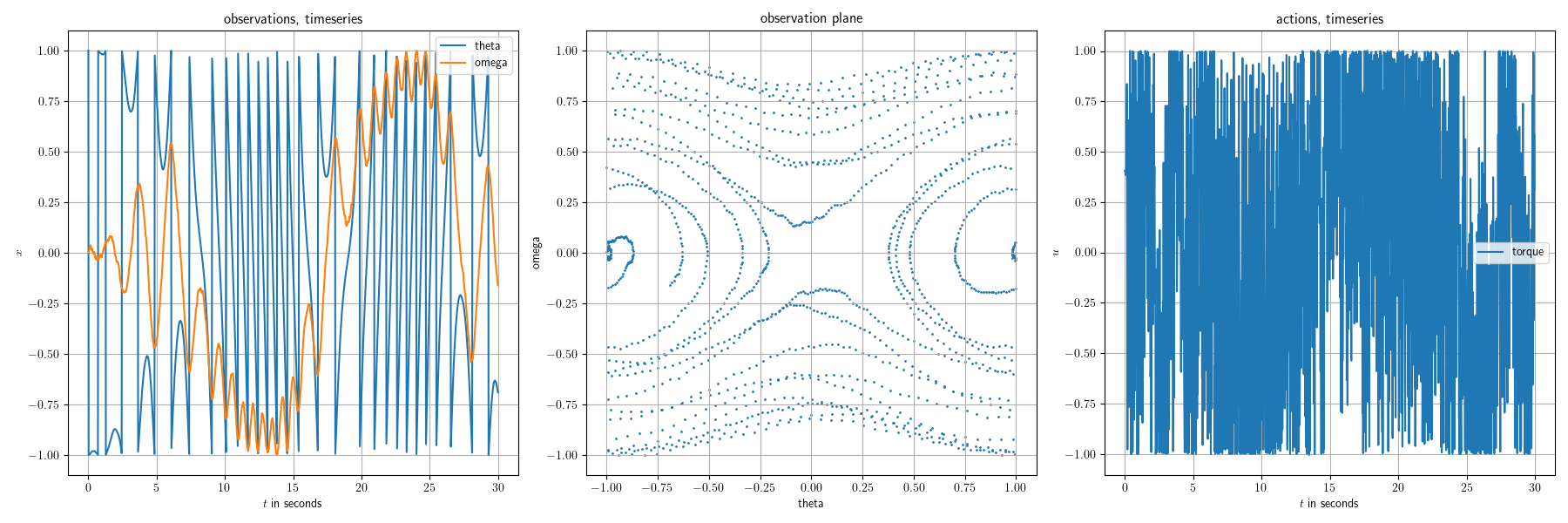
exp_params["n_time_steps"] = 1500  # reduce number of timesteps to N=1500

# run excitation
observations, actions, model, density_estimate, losses, proposed_actions, _ = excite_with_dmpe(
    env,
    exp_params,
    proposed_actions,
    loader_key,
    expl_key,
)

# visualize
from dmpe.evaluation.plotting_utils import plot_sequence
import matplotlib.pyplot as plt
import matplotlib as mpl
mpl.rcParams['text.usetex'] = True
mpl.rcParams.update({'font.size': 10})
mpl.rcParams['text.latex.preamble']=r"\usepackage{bm}\usepackage{amsmath}"

fig = plot_sequence(observations, actions, env.tau, env.obs_description, env.action_description)
plt.show()
Further Examples:
Additional examples can be found in the examples/ folder.
There, the CartPole and PMSM are excited using DMPE.
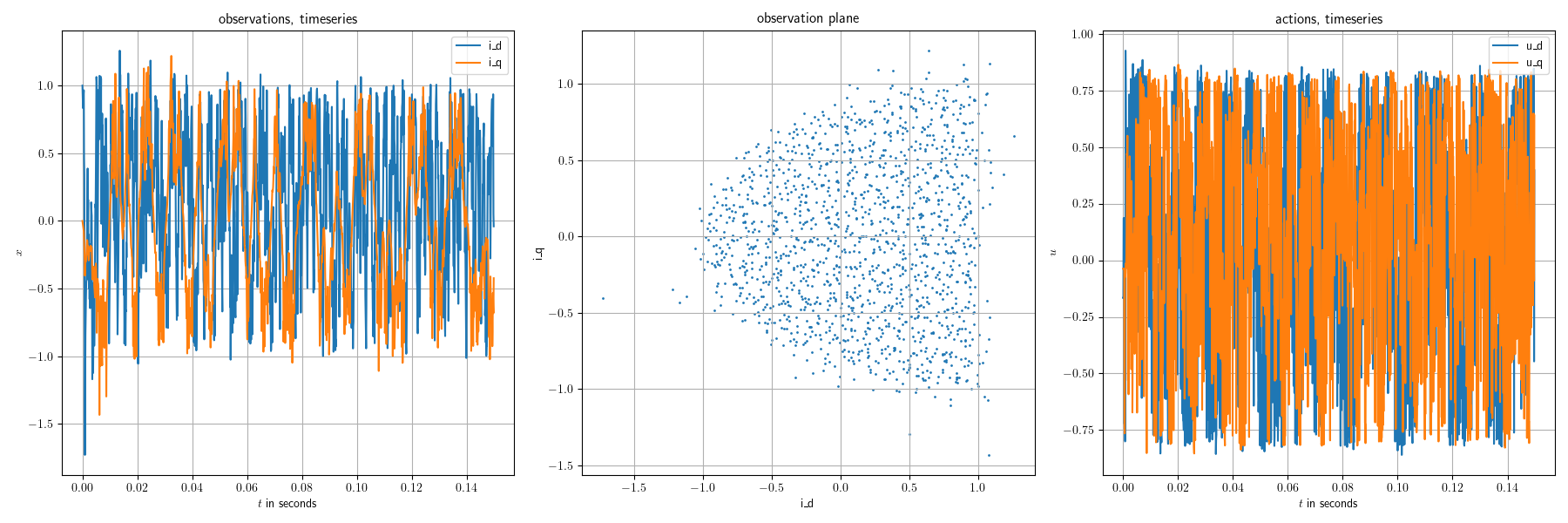
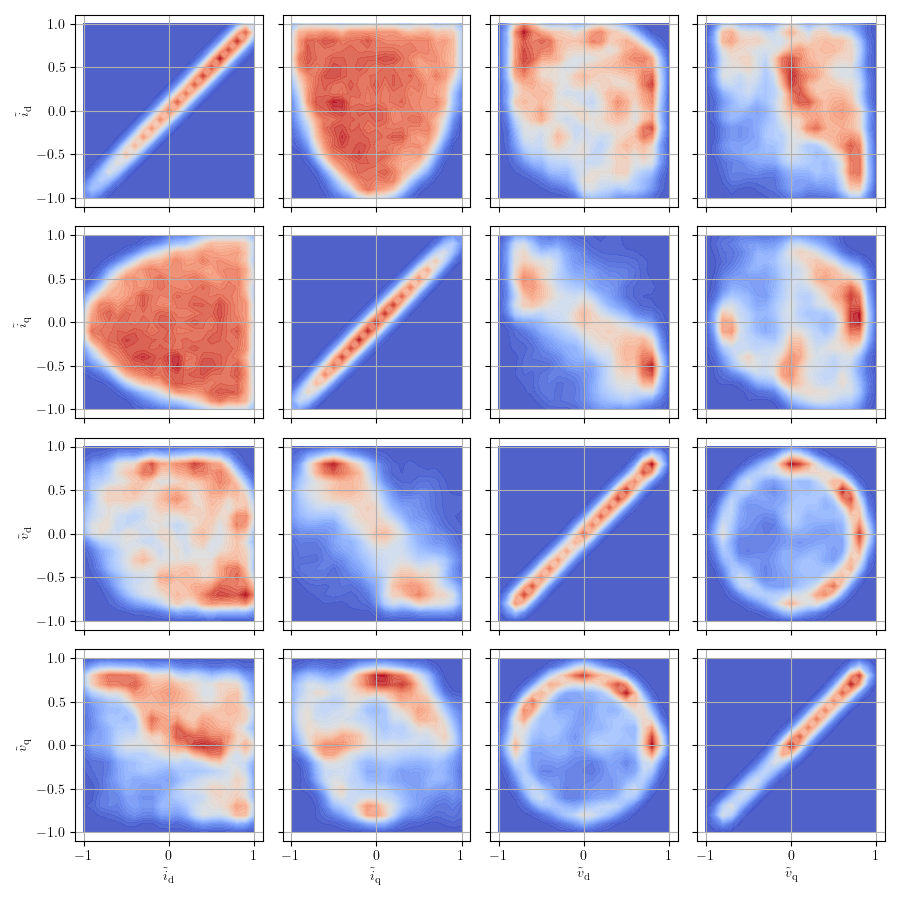
Exemplary PMSM results at $n = 5000 , \mathrm{min}^{-1}$:
- Exemplary acquired trajectory (without considering the action distribution):
- feature-space coverage of the resulting data (without considering the action distribution):
1 maintainer

Metadata
1 maintainer
Release files for dmpe 0.2.4
For a detailed explanation of source distributions (sdists) and built distributions (wheels), please see the package formats documentation.
Source distribution (sdist)
| File | Size | Uploaded | |
|---|---|---|---|
| dmpe-0.2.4.tar.gz | 68.6 kB | Details |
Built distribution (wheel)
| File | Interpreter | ABI | Platform | Reset |
|---|---|---|---|---|
| dmpe-0.2.4-py3-none-any.whl | Python 3 | none | any | Details |
Total release size: 158.0 kB
Release files / dmpe-0.2.4.tar.gz
| Download URL | dmpe-0.2.4.tar.gz |
|---|---|
| Size | 68.6 kB |
| Tags | Source |
|
SHA-256 checksum How to use checksums |
f97f40acd0fcda5dd60ff83759858493d463d04ab202c2bd7e37125a82cc3e7f
|
|
BLAKE2b-256 checksum How to use checksums |
ed370af0e735bc7e4494f64d050d3cd075ff4452e0a926692cf949f755da6b22
|
| Upload date | |
|
Uploaded using Trusted Publishing? What is trusted publishing? |
No |
| Uploaded via |
twine/6.1.0 CPython/3.11.11
|
Release files / dmpe-0.2.4-py3-none-any.whl
| Download URL | dmpe-0.2.4-py3-none-any.whl |
|---|---|
| Size | 89.4 kB |
| Tags | Python 3 |
|
SHA-256 checksum How to use checksums |
81ba0c3bd6e683758c6d69162d7f9d1759f8585fbf81055386374dc7dbd17177
|
|
BLAKE2b-256 checksum How to use checksums |
b856c81d74c12303eaacb4e2b15860368aa22d6fb8b16e6fffa9c76790ff7d0f
|
| Upload date | |
|
Uploaded using Trusted Publishing? What is trusted publishing? |
No |
| Uploaded via |
twine/6.1.0 CPython/3.11.11
|














