

Try it now
uvx dyva

Dyva is a dynamic proxy that routes to Ollama, vLLM, LM Studio, LocalAI, SGLang, KTransformers, MLX, llama.cpp, ds4 (DwarfStar), Colibrì, Fooocus, Strata, A1111 (stable-diffusion-webui), Gradio, and ComfyUI hosts from Shodan, ZoomEye, Censys, hunter.how and FOFA with graceful failover, context-window scaling, and honeypot detection.
Capable of text generation, embeddings, systemone (JEV) decision models, vision, tool calling, image generation and editing, video generation, TTS, and music generation in a unified interface with state of the art, real-time tunable router providing sub 1s latency.
Dyva supports unified workflows for stable diffusion, MiniMax H3, Z-image, LTX 2.2, 2.3, 2.5, Qwen-Image, loras, iris, Flux.1, 2 and 3, including the Klein variations, and much more. You can just chat with the agent and have it do it for you.
Use the demo server or run it yourself with a few keystrokes on Linux, Windows, Mac, and even Android.
uvx dyva
No uv? If you have git and Python 3.10+, one line clones it, builds a virtualenv, installs the deps, and starts it up:
curl -fsSL https://9ol.es/dyvash | bash
It installs to ~/free-ollama; start it again anytime with ~/free-ollama/start.sh (any dyva flags pass straight through). macOS note: the built-in python3 is 3.9, which is too old — install a newer one first with brew install python or from python.org.
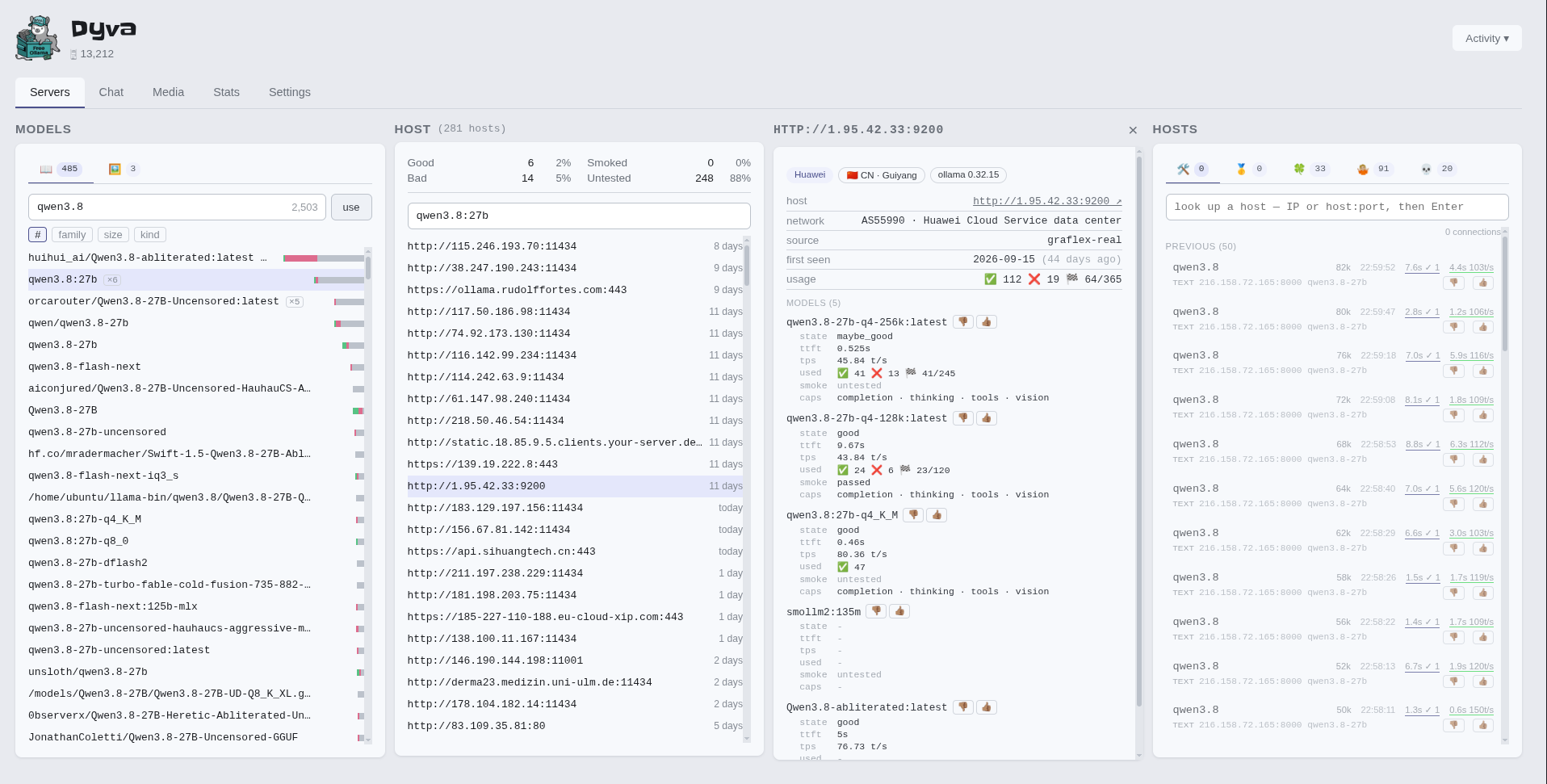
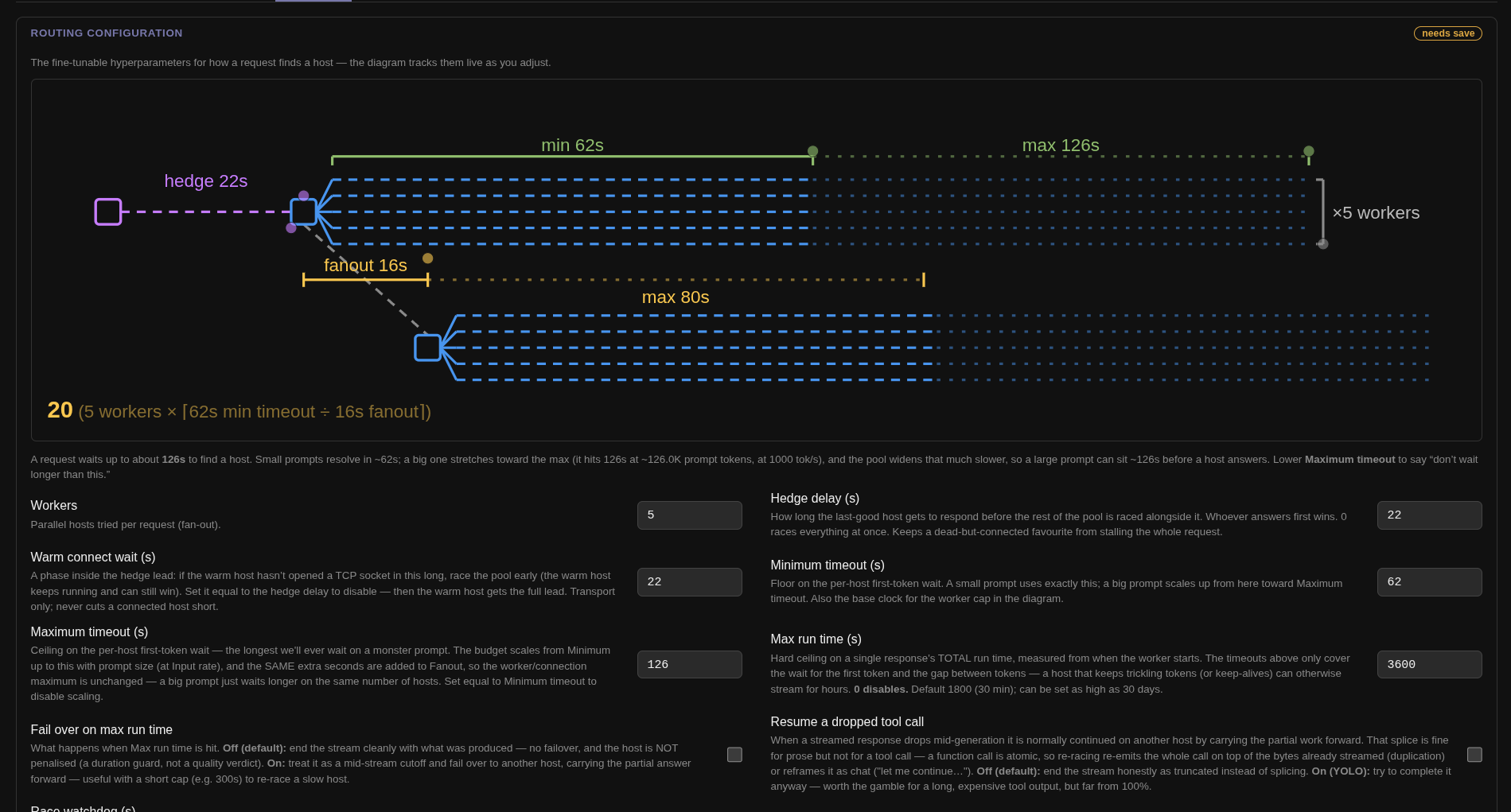
Along with being so ollama-compatible the ollama client doesn't know the difference, dyva has a feature-rich front-end with chat that includes image generation, web search, sub-agents, documents, host drilldown and exploration, video generation, tts, stats, geomaps, and even graphically tweaking the routing algorithm.
Memory footprint is under 1GB. Has both light and dark mode. Out of whim and mischief you toggle it by clicking on the D in the logo. what do the letters do? Find out!
Querying for models
The varieties of models and heterogeneity of installations are unified through a model query syntax which allows any tool to leverage any subslice of the pool by specifying the query as the model to use.
This is designed so you can slice and dice the pool in any application.
For instance * means use any model. >2026 means anything released after 2026, qwen>2026>10gb,gemma4 means 'use any qwen released in 2026 over 10gb and fallback to Gemma4 if you can't find any"
The details:
- Specified as partial strings or globs such as
qwen*27bor evenabliteratedfor the times you want to slip into something more comfortable. - As fallbacks with a comma such as
gemma3,qwen3.6(try the first, fall back to the second) - By size like
qwen >10gb - By release date like
qwen>2026.
They can be stacked so qwen>2026>5gb means the newer large qwens. You can also slice by many other fields.
Finding new hosts
You can multi-source host lists or bring your own. There's a separate survey tool called graflex.
That means dyva can sit on top of your own infrastructure as well as strangers from the Internet.
There's also a simple command line.
Notes
Is this dangerous?
Not really. The pool is truly international and dyva only uses idle machines listed in public search engines. It's arguably below the level of Napster, torrents and Tor.
Does this expose me?
Not really. Other dyva servers get flagged and excluded from the survey so this will not just become a hall of mirrors. You can avoid getting picked up by other scanners in the wild by adding a base_path, this is configurable in settings on the dash.
What about honeypots?
Yes! This one is real. Running dyva might get you blocked temporarily (~4 days) from numerous sites on CDNs such as Cloudflare. This includes IoT networks, imdb, huggingface, cloud storage, all kinds of stuff... even banks. The public surveys have honeypots with tripwires that get the srcaddr (you) put in some temporary ban pool with an expiry merely by a tcp_connect(). These are also called canaries in the literature.
However, there's a rich testing and probing harness in dyva to block these machines based on an ensemble of techniques. Canary tripping is effectively solved and I haven't seen it in months. But of course, absence of evidence doesn't mean much.
You can also sweep and mark based on model queries to quarantine them but it's a slightly moving target because a static list of honeypots defeats the purpose. There is a protocol called gossiper that's intended to mostly mitigate this. YMMV. Also see the survey for more notes.
You can also disable all the public surveys in the dash and just use your own list of hosts if you want this to be an enterprise SAAS product. Go put on a tie I guess...

1 maintainer

Metadata
1 maintainer
Release files for dyva 0.6.7
For a detailed explanation of source distributions (sdists) and built distributions (wheels), please see the package formats documentation.
Source distribution (sdist)
| File | Size | Uploaded | Provenance | Actions |
|---|---|---|---|---|
| dyva-0.6.7.tar.gz | 892.3 kB | Without provenance | Details for dyva-0.6.7.tar.gz |
Built distribution (wheel)
| File | Interpreter | ABI | Platform | Actions Reset |
|---|---|---|---|---|
| dyva-0.6.7-py3-none-any.whl | Python 3 | none | any | Details for dyva-0.6.7-py3-none-any.whl |
Total release size: 1.7 MB
Release files / dyva-0.6.7.tar.gz
| Download URL | dyva-0.6.7.tar.gz |
|---|---|
| Size | 892.3 kB |
| Tags | Source |
|
SHA-256 checksum How to use checksums |
9bdfbe333509d914ef7f28ff3c5a2599fbbf1d3c5cc7d41ae433085ae447dcaa
|
|
BLAKE2b-256 checksum How to use checksums |
63b1ed24bc9d14dc4a87ba7d39d6e5742c5ba4d1851c09b59bb6f783f67735df
|
| Upload date | |
|
Uploaded using Trusted Publishing? What is trusted publishing? |
No |
| Uploaded via |
twine/7.0.0 CPython/3.11.11
|
Release files / dyva-0.6.7-py3-none-any.whl
| Download URL | dyva-0.6.7-py3-none-any.whl |
|---|---|
| Size | 838.4 kB |
| Tags | Python 3 |
|
SHA-256 checksum How to use checksums |
c48f4a431e2db95c3a66481bd9cff5701996b57db53e9177ad6087eb38460500
|
|
BLAKE2b-256 checksum How to use checksums |
8f98727bba3b9b3d945a42d466e7cf5084e04e2e85c004ec85b75428aa23c180
|
| Upload date | |
|
Uploaded using Trusted Publishing? What is trusted publishing? |
No |
| Uploaded via |
twine/7.0.0 CPython/3.11.11
|
Security for dyva 0.6.7
Provenance
Provenance describes where a file came from. On PyPI, provenance is shared via attestations, which provide a verifiable record of the build or publishing details. View details, limitations and caveats.
No provenance found
None of the files in this release were uploaded with provenance metadata.
A note on package security
PyPI is a repository for distributing packages, not a service for auditing them. While third-party security researchers and our staff do their best to detect and remove malicious packages, PyPI cannot guarantee the quality, security or suitability of any given package.
To learn more about protecting yourself from malicious actors, visit our package security documentation.














