
This release is a pre-release and may not be stable for production use.
EDJAS: Extract Data in JSON from Any Spreadsheet
- Sources at https://github.com/holdenweb/edjas
- Demonstration code at https://github.com/holdenweb/edjas-demo
This project is an attempt to help organisations that insist on managing their businesses, or major aspects thereof, using spreadsheets. Many articles have been written on the limitations of spreadsheet technology. If you have any doubts then look at the "The Problem with Spreadsheets" section of this LinkedIn article. Some large organisations are now providing advice — although in many cases better advice might be: stop using spreadsheets for that!
Rather than try to change the way people do business (imagine "If I Ruled the World" playing softly in the background), EDJAS is intended to help people extract that locked-up data more effectively, in simple and easy-to-understand ways that don't affect existing workflows.
EDJAS leaves your spreadsheet completely untouched. Instead of adding anything to the workbook, you write a small specification file — a TOML document — describing what to extract. One spec can serve many workbooks, and one workbook can have many specs, each tailored to a different audience.
The specification file
A spec is a TOML file with an [extract] table mapping the output keys you want to
the values to pull from the spreadsheet:
[extract]
title  = "Summary!B2"                    # a single cell   -> scalar
hours  = "{Hours}"                        # a 2-column range -> object
prices = "{Prices | int}"                 # object, values coerced to int
sales  = "[Sales | records]"              # a table -> list of objects
people = "[Grid | transpose | records]"   # a pipeline of transforms
Each value is an extraction expression. There are three forms:
ref(a plain reference) — the value of a single cell.[ref]— the range as a JSON list, or a list of row-lists if it is two-dimensional.{ref}— a two-column range as a JSON object (left column names, right column values).
A ref is either a named range or an A1-style cell range (D3:E9), optionally
qualified with a sheet name (Summary!D3:E9). Named ranges are recommended: they
survive layout changes, whereas bare cell references do not.
A worked example
The repository ships a sample workbook and a spec exercising every construct described here. Run them together:
edjas examples/example.xlsx examples/example.toml
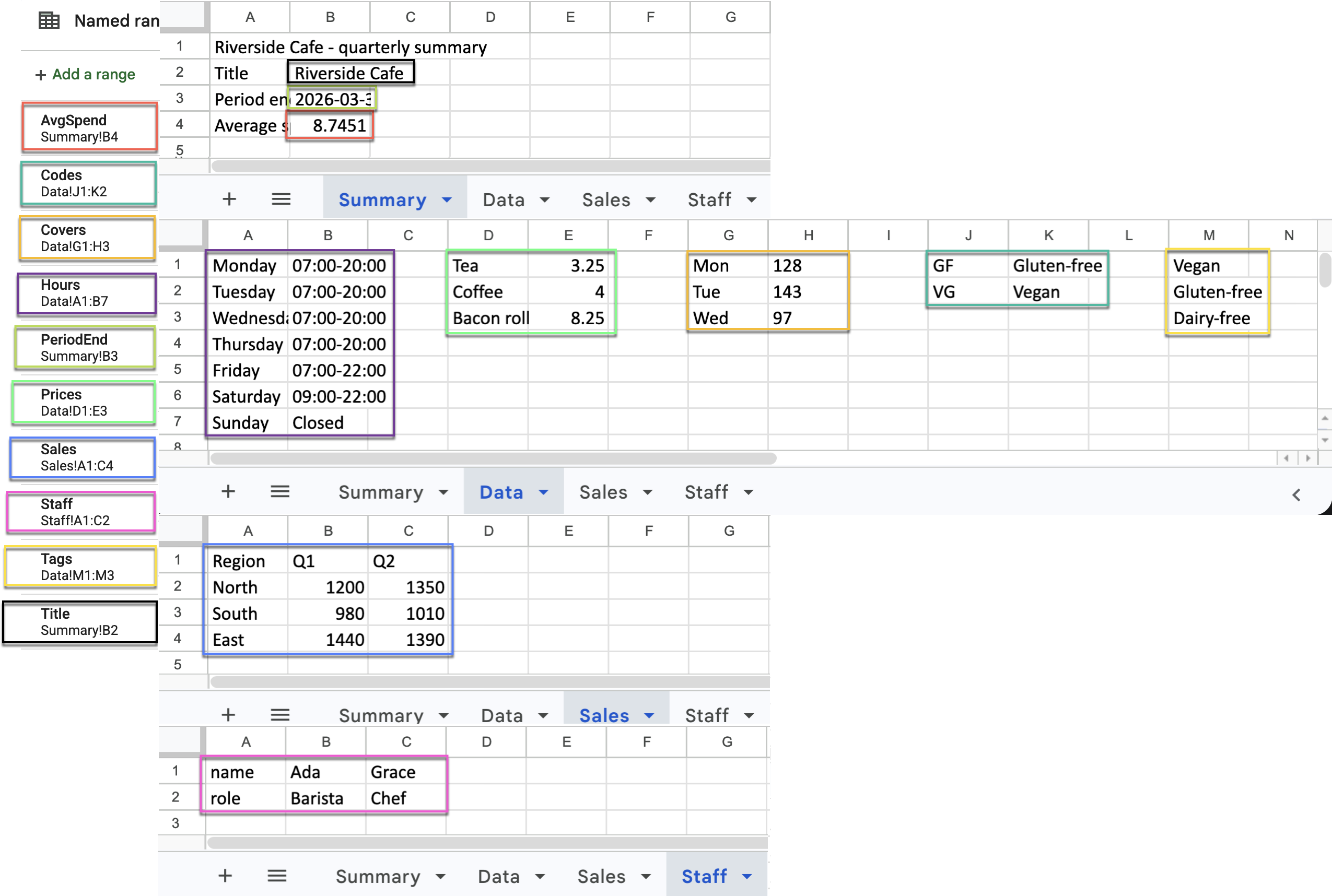
examples/example.xlsx is a small café report spread over four sheets:
| Named range | Where | Shape |
|---|---|---|
Title, PeriodEnd, AvgSpend |
Summary!B2:B4 |
single cells |
Hours, Prices, Covers, Codes |
Data |
two-column name/value ranges |
Tags |
Data!M1:M3 |
a single column |
Sales |
Sales!A1:C4 |
a table with a heading row |
Staff |
Staff!A1:C2 |
one field per row, so it needs transposing |
The three forms, against that workbook (comments show the JSON produced):
title = "Title"      # "Riverside Cafe"
tags  = "[Tags]"     # ["Vegan", "Gluten-free", "Dairy-free"]
hours = "{Hours}"    # {"Monday": "07:00-20:00", ... "Sunday": "Closed"}
and the same three ways of writing a reference:
title_again = "B2"             # an A1 cell on the active sheet
prices      = "{Data!D1:E3}"   # a sheet-qualified A1 range
tags        = "[Tags]"         # a named range
Here's a dump of the spreadsheet with the named ranges marked in the same colors as the referenced cells.
Transforming values with functions
Any expression may append a pipeline of functions, separated by |, applied left
to right after extraction — so [Grid | transpose | records] transposes the range,
then builds objects from it. Functions come from a fixed, built-in registry (no
arbitrary code runs). The built-ins:
| Function | Typical input | Result |
|---|---|---|
records |
[table] |
first row is headings; remaining rows become a list of objects |
columns |
[table] |
first row is headings; columns become a {heading: [values]} object |
transpose |
[table] |
swaps rows and columns |
flatten |
[table] |
flattens nested rows into a single list |
keys / values / items |
{object} |
the object's keys, values, or [key, value] pairs |
invert |
{object} |
swaps keys and values |
int / float / str |
any | coerces every value to that type |
round |
any | rounds every floating-point value; takes the number of decimal places (default 2) |
isodate |
any | formats date/time values as ISO-8601 strings |
Each of them against the sample workbook, with the JSON they produce:
sales_rows       = "[Sales]"                       # [["Region","Q1","Q2"], ["North",1200,1350], ...]
sales_records    = "[Sales | records]"             # [{"Region":"North","Q1":1200,"Q2":1350}, ...]
sales_columns    = "[Sales | columns]"             # {"Region":["North","South","East"], "Q1":[1200,980,1440], ...}
sales_transposed = "[Sales | transpose]"           # [["Region","North","South","East"], ["Q1",1200,980,1440], ...]
staff_flat       = "[Staff | flatten]"             # ["name","Ada","Grace","role","Barista","Chef"]
staff            = "[Staff | transpose | records]" # [{"name":"Ada","role":"Barista"}, {"name":"Grace","role":"Chef"}]
price_list       = "{Prices | keys}"               # ["Tea","Coffee","Bacon roll"]
price_values     = "{Prices | values}"             # [3.25, 4, 8.25]
price_items      = "{Prices | items}"              # [["Tea",3.25], ["Coffee",4], ["Bacon roll",8.25]]
code_names       = "{Codes | invert}"              # {"Gluten-free":"GF", "Vegan":"VG"}
covers           = "{Covers | int}"                # {"Mon":128, "Tue":143, "Wed":97}
prices_as_text   = "{Prices | str}"                # {"Tea":"3.25", "Coffee":"4", "Bacon roll":"8.25"}
average_spend    = "AvgSpend | round 2"            # 8.75   (the cell holds 8.7451)
spend_whole      = "AvgSpend | round 0"            # 9.0
period_ending    = "PeriodEnd | isodate"           # "2026-03-31"
Covers holds its numbers as text, which is why int is worth applying. A date-only
cell is stored as midnight, and both isodate and the automatic serialisation render
it as a plain date rather than 2026-03-31T00:00:00; a genuine time of day is kept.
Function arguments
A function may take arguments after its name, separated by spaces. An argument is a
number (2), a double-quoted string (", "), or a bare word, which is
read as another range reference. The extracted value is always passed as the first
argument, so [Price | round 2] means round(Price, 2). (Grouping parentheses are
reserved for a possible future extension and are not yet supported.)
round is the built-in that takes an argument; the same mechanism serves functions
you supply yourself:
from edjas import read_spec
read_spec("examples/example.xlsx", "examples/example.toml",
          functions={"join": lambda v, sep: sep.join(v)})
With that in place a spec entry of tag_line = '[Tags | join ", "]' yields
"Vegan, Gluten-free, Dairy-free".
Usage
From the command line — pass the spreadsheet and the spec; JSON goes to standard output:
edjas data.xlsx report.toml
As a library, read_spec returns the extracted data as a Python dict. Pass
functions={...} to add your own functions to (or override) the built-ins; each
receives the extracted value first, then any arguments:
from edjas import read_spec
data = read_spec("data.xlsx", "report.toml",
                 functions={"join": lambda v, sep: sep.join(v)})
# ... lets the spec use:  tags = "[Tags | join \", \"]"
Date and time cells are serialised as ISO-8601 strings automatically.
Architecture
Four diagrams describe how EDJAS is put together, zooming in a level at a time.
Each is a self-contained SVG that can be viewed in the browser or downloaded from
the images/ directory.
- C4 system context — the setting: the spreadsheet maintainer who carries on as before, the analyst who authors specs, and the systems the extracted JSON feeds.
- C4 container diagram — one level in: the command-line and library containers, the files they read, and where the JSON ends up.
- C4 component diagram — inside the library: the spec loader, expression evaluator, pipeline parser, workbook reader, pipeline executor and function registry, and the calls between them.
- Internal structure — down at the code: the modules that make up the package, and how a single extraction run flows through them from the spec and workbook to standard output.
A demonstration of the system can be found at https://github.com/holdenweb/edjas-demo.
This is particularly useful for audiences that have an interest in only a limited number of features from a possibly quite large spreadsheet. More generally, JSON is such a widely used format that spreadsheet data can be re-used in a wide range of systems as appropriate.
1 maintainer

Download files
Download the file for your platform. If you're not sure which to choose, learn more about installing packages.
Source Distribution
Built Distribution
Filter files by name, interpreter, ABI, and platform.
If you're not sure about the file name format, learn more about wheel file names.
Copy a direct link to the current filters
File details
Details for the file edjas-0.7.1a2.tar.gz.
File metadata
- Download URL: edjas-0.7.1a2.tar.gz
- Upload date:
- Size: 474.2 kB
- Tags: Source
- Uploaded using Trusted Publishing? No
- Uploaded via:
uv/0.10.7 {"installer":{"name":"uv","version":"0.10.7","subcommand":["publish"]},"python":null,"implementation":{"name":null,"version":null},"distro":{"name":"macOS","version":null,"id":null,"libc":null},"system":{"name":null,"release":null},"cpu":null,"openssl_version":null,"setuptools_version":null,"rustc_version":null,"ci":null}
File hashes
| Algorithm | Hash digest | |
|---|---|---|
| SHA256 |
0cba0276832a4ddb1337d7699d8664ad7400f7e750ee2540b9bec670564fb49d
|
|
| MD5 |
109092297f7a31b3402bbd28577a4bd0
|
|
| BLAKE2b-256 |
5d80fe2f20bb7cce2806715defb73fa7741844d7533a976bf53b212f2a38a39e
|
File details
Details for the file edjas-0.7.1a2-py3-none-any.whl.
File metadata
- Download URL: edjas-0.7.1a2-py3-none-any.whl
- Upload date:
- Size: 12.9 kB
- Tags: Python 3
- Uploaded using Trusted Publishing? No
- Uploaded via:
uv/0.10.7 {"installer":{"name":"uv","version":"0.10.7","subcommand":["publish"]},"python":null,"implementation":{"name":null,"version":null},"distro":{"name":"macOS","version":null,"id":null,"libc":null},"system":{"name":null,"release":null},"cpu":null,"openssl_version":null,"setuptools_version":null,"rustc_version":null,"ci":null}
File hashes
| Algorithm | Hash digest | |
|---|---|---|
| SHA256 |
ad1d68b13fc3ec81de9f26d42cff6913e6791cadd375c65ce8fbc5def31a6681
|
|
| MD5 |
04f187a0468b1042915506e840102d01
|
|
| BLAKE2b-256 |
f62edb22da04e927e2414c2fcb0c08bdf950cd5ec04a79c89d5ad120bbf0adc2
|

















