
ehrdata


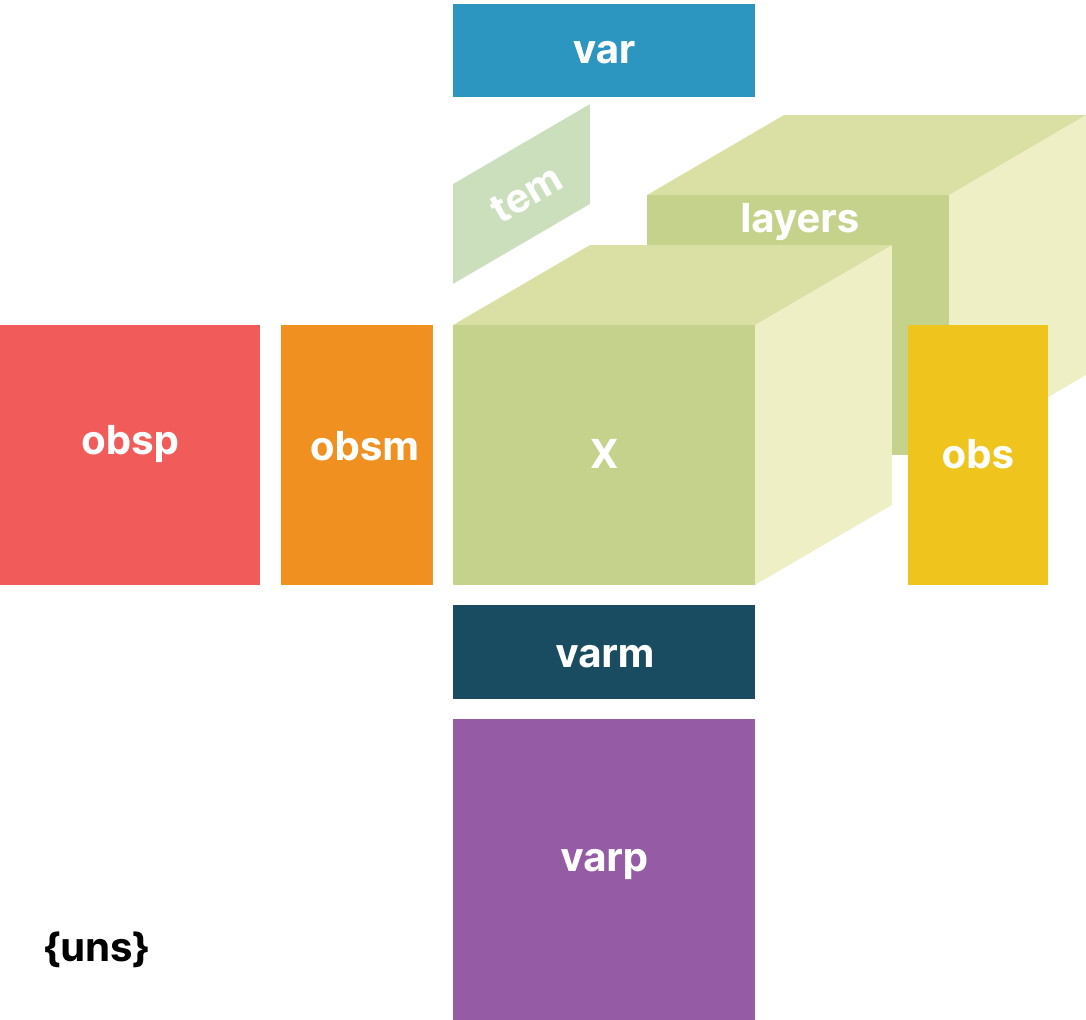
EHRData is a data framework that comprises a FAIR storage format and a collection of Python libraries for performant access, alignment, and processing of uni- and multi-modal electronic health record datasets.
This repository contains the core ehrdata library, which has the EHRData class at its heart.
See the ehrapy package for an analysis package that uses ehrdata to enable the analysis of electronic health record datasetes.
Getting started
EHRData extends AnnData to represent data of n observations × d variables × t time points — a natural fit for the time-resolved measurements found in electronic health records.
import ehrdata as ed

# Load the PhysioNet 2019 sepsis-prediction challenge dataset
# (downloaded and cached on first use)
edata = ed.dt.physionet2019()
edata
EHRData object with n_obs × n_vars × n_t = 40336 × 35 × 48
    obs: 'Age', 'Gender', 'Unit1', 'Unit2', 'HospAdmTime', 'training_Set'
    var: 'Parameter'
    tem: '0', '1', '2', ..., '45', '46', '47'
    shape of .X: (40336, 35, 48)
The 35 clinical parameters are stored over 48 hourly time steps in a single three-dimensional array, with patient- and variable-level metadata aligned alongside. You can slice across all three axes at once — for example, the 48-hour trajectory of the sepsis label for one patient:
edata[edata.obs.index == "p020378", edata.var_names == "SepsisLabel"].X
For more, please refer to the documentation, in particular the API documentation.
Disclaimer
ehrdata is under heavy construction, and its API not stable.
If you find it potentially interesting for your work, reach out to us via the scverse zulip platform!
We can help you using it and will be able to stabilize things you need.
If you have inputs on features, please do not hesitate to open an issue on our issue tracker!
Installation
You need to have Python 3.12 or newer installed on your system. If you don't have Python installed, we recommend installing Mambaforge.
There are several alternative options to install ehrdata:
- Install the latest release of
ehrdatafrom PyPI:
pip install ehrdata
- Install the latest development version:
pip install git+https://github.com/theislab/ehrdata.git@main
Release notes
See the changelog.
Contact
For questions and help requests, you can reach out in the scverse discourse. If you found a bug, please use the issue tracker.
Citation
t.b.a


Release files for ehrdata 0.4.0
For a detailed explanation of source distributions (sdists) and built distributions (wheels), please see the package formats documentation.
Source distribution (sdist)
| File | Size | Uploaded | |
|---|---|---|---|
| ehrdata-0.4.0.tar.gz | 4.2 MB | Details |
Built distribution (wheel)
| File | Interpreter | ABI | Platform | Reset |
|---|---|---|---|---|
| ehrdata-0.4.0-py3-none-any.whl | Python 3 | none | any | Details |
Total release size: 4.3 MB
Release files / ehrdata-0.4.0.tar.gz
| Download URL | ehrdata-0.4.0.tar.gz |
|---|---|
| Size | 4.2 MB |
| Tags | Source |
|
SHA-256 checksum How to use checksums |
ef4546cba5cd0e2d00ec6457aa1cf52eb44bef97e065306e2111d30ed3456643
|
|
BLAKE2b-256 checksum How to use checksums |
f2e6212e634e00f5c1d90f43b14bb4191ca34b664f2c9263f26c37af63ea8618
|
| Upload date | |
|
Uploaded using Trusted Publishing? What is trusted publishing? |
Yes |
| Uploaded via |
twine/6.1.0 CPython/3.13.12
|
Provenance
Provenance describes where a file came from. On PyPI, provenance is shared via attestations, which provide a verifiable record of the build or publishing details. View details, limitations and caveats.


PyPI Publish Attestation
PyPI verified that this artifact, at this checksum, originated from the publisher listed below.
Signed by GitHub Actions, verified by PyPI on Jul 17, 2026.
Transparency logRelease files / ehrdata-0.4.0-py3-none-any.whl
| Download URL | ehrdata-0.4.0-py3-none-any.whl |
|---|---|
| Size | 85.2 kB |
| Tags | Python 3 |
|
SHA-256 checksum How to use checksums |
f323efac6a6bdc196edc1876e5e082c8dc9f79fdbe682368fade90baaa3b50a3
|
|
BLAKE2b-256 checksum How to use checksums |
5a72e89f776e9a6b4f9b1967f8227798000d7f5482c85347b2cc04bd82093329
|
| Upload date | |
|
Uploaded using Trusted Publishing? What is trusted publishing? |
Yes |
| Uploaded via |
twine/6.1.0 CPython/3.13.12
|
Provenance
Provenance describes where a file came from. On PyPI, provenance is shared via attestations, which provide a verifiable record of the build or publishing details. View details, limitations and caveats.
PyPI Publish Attestation
PyPI verified that this artifact, at this checksum, originated from the publisher listed below.
Signed by GitHub Actions, verified by PyPI on Jul 17, 2026.
Transparency log













