
Engram
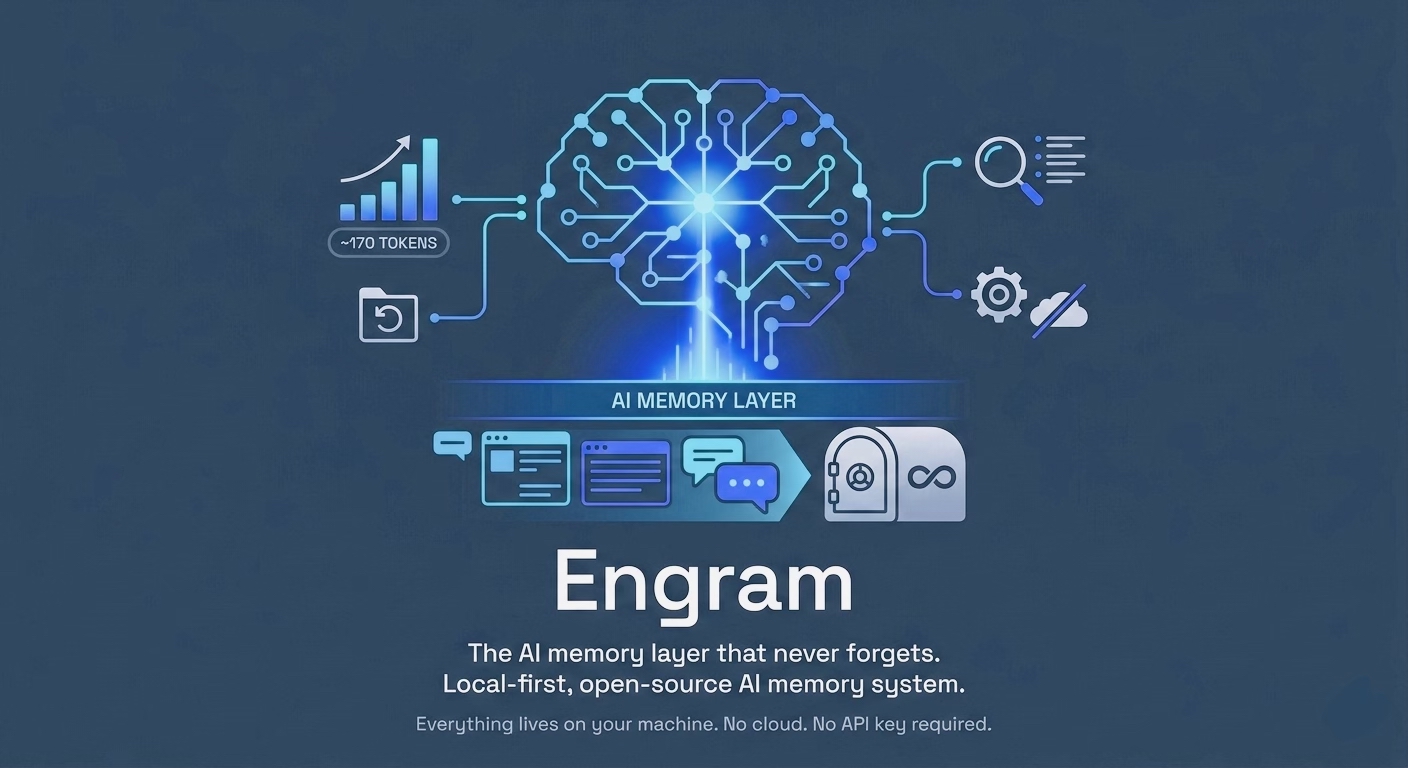
Your AI forgets everything when the chat ends. Engram helps it remember. Free, private, runs on your own computer, and keeps every word exactly as you wrote it.


The problem
On Monday you spend an hour with Claude working out why the login system leaks memory, and you decide to switch libraries. On Friday you open a new chat and ask "why did we drop Passport again?"
It has no idea. The conversation is gone, and so is the reasoning.
The same thing happens with everything you tell an AI: your sister's birthday, the bug you already fixed, the reason a setting is the way it is. Every new chat starts from zero.
Engram is a memory that outlasts the chat. It saves your notes, files and conversations, and when you ask a question later, it finds the right one, even if you phrase it completely differently.
See it work
Two ordinary notes go in:
notes/decisions.md   We switched from Passport to Lucia on March 3 because
                     Passport sessions kept leaking memory under load.
notes/personal.md    My sister Maya's birthday is June 14. She loves anything
                     with sunflowers.
engram mine notes --wing life
Days later, ask in your own words. None of these questions share a sentence with the notes:
$ engram search "why did we change the auth library"
  1   life/notes   We switched from Passport to Lucia on March 3 because
                   Passport sessions kept leaking memory under load.

$ engram search "gift idea for Maya"
  1   life/notes   My sister Maya's birthday is June 14. She loves anything
                   with sunflowers.
Hook it up to Claude and it does this by itself: Claude looks things up in Engram when it needs them, and Engram saves your Claude Code sessions automatically.
Try it in 2 minutes
You need Python 3.9 or newer (3.11 to 3.14 is best). Check with python3 --version.
1. Install
pip install engram-chateau
On PyPI the package is called
engram-chateau, but the command you type is justengram. (A different, unrelated package already owns the nameengram.)
2. Give it something to remember
engram mine ~/Documents/notes --wing notes # any folder of notes, docs or code
The first run downloads a small language model (about 80 MB) that lets Engram understand meaning. After that, everything works offline.
3. Ask it something
engram search "what did I decide about the database"
That's all you need to try it.
Connect it to Claude
Claude Code (one line, then restart Claude Code):
claude mcp add engram -- engram-mcp
Claude now has 26 engram_* tools: search, remember, correct an outdated memory, recall a topic's history, a knowledge graph of people and facts, and more. Ask "remember that we use tabs in this repo", "what did we decide about auth?" or "we moved to PostgreSQL, update that".
Recommended: let Claude remember on its own.
engram install-hooks --apply # then restart Claude Code
This adds three Claude Code hooks to ~/.claude/settings.json (your existing settings are kept, with a backup):
- Auto-recall. Each time you send Claude a message, Engram searches your memory first. If something clearly relevant turns up, Claude gets a short note with up to 3 memories before it answers, current versions first and outdated ones labelled. You ask "why did we drop Passport?" in a brand-new chat, and Claude already knows. Nothing is added when nothing is relevant, a memory isn't repeated within a session, and it takes about a second.
- Project-aware. Memories are filed under the project you're working in (the git repo or folder name), and recall shows that project's memories first; other projects' notes only appear when they match very closely.
- Auto-save. Every file Claude edits is saved.
- Save before compacting. The conversation is saved before Claude Code compacts it.
Preview what auto-recall would hand Claude with engram recall "your message". Run engram install-hooks without --apply to see the settings instead of applying them, or add --no-recall to skip auto-recall.
Claude Desktop: add this to claude_desktop_config.json (macOS: ~/Library/Application Support/Claude/, Windows: %APPDATA%\Claude\) and restart the app:
{
  "mcpServers": {
    "engram": { "command": "engram-mcp" }
  }
}
If Claude Desktop can't find engram-mcp, use its full path (which engram-mcp prints it).
Other apps that speak MCP (Cursor, Windsurf, Zed and so on) work the same way: the command is engram-mcp.
Prefer uv, pipx or a guided setup?
uv tool install engram-chateau     # or: pipx install engram-chateau
engram init ~/myproject            # guided setup: your AI's identity, a default wing, then saves the project
Both put engram and engram-mcp on your PATH without touching your system Python.
Who it's for
🧑💻 Developers using Claude Code. Engram quietly saves the files Claude touches and the conversations behind them. Months later, "why is the retry limit 7?" brings back the actual discussion, not a guess.
🤖 People building an AI companion or agent. Give your bot a memory of its own: what it has learned about you, a diary, and a knowledge graph of people and facts ("Kai works on Orion, since June"). It all runs offline in a few lines of Python. Engram started life as exactly this, the memory of a personal companion app.
📚 Writers, researchers and note-takers. Point it at a folder of notes, an Obsidian vault, or Notion or Linear exports, and search across all of it by meaning: "that idea I had about pricing tiers".
Why Engram is different
- 🔒 It's yours. Everything lives in one folder on your computer (
~/.engram/). No account, no cloud, no API key, no tracking. - 📝 It keeps your words. Most AI memory tools have an LLM rewrite your conversations into short "facts" and throw the original away. Engram stores the original text and finds it again. Nothing gets lost in a summary.
- 🧠 It understands what you mean. It finds "we switched from Passport to Lucia" when you ask about "changing the auth library". It also matches exact names and numbers (
INV-20931), and understands time: "two weeks ago", "in June", "on May 8". - 💸 It's free to run. It needs no LLM to save or search, so there are no per-message costs and nothing to rate-limit.
- 🎯 It's accurate. On the two standard tests of AI memory, it beats the best published no-LLM results (numbers below).
- 📖 You can read all of it. About 8,400 lines of plain Python, MIT licensed. If you want to know exactly what happens to your data, you can.
- 🔄 It knows when it's out of date. When a decision changes, the new memory is marked as replacing the old one. Search gives you the current answer first, and the old one stays below it as history, with when and why it changed.
- 🔑 It can hide secrets for you. Turn on
redact_secretsand API keys, tokens and passwords are blanked out before anything is written to disk.
How it works
Engram files memories the way you'd organise a big house: one wing per person or project, a room per topic, a hall per kind of memory, and inside, drawers holding the original text.
Wing   – a person or project        ("myapp", "life")
└── Room  – a topic                 ("auth-migration")
    └── Hall – the kind of memory   (facts, events, discoveries, preferences, advice)
        └── Drawer – your original text, word for word
You don't have to manage any of this; Engram sorts things as it saves them. When you search, it weighs several clues together:
| Clue | What it does |
|---|---|
| Meaning | Finds text that means the same thing, even in different words |
| Exact words | A full-text index catches names, numbers and rare words the meaning search misses |
| Time | "What did I buy two weeks ago?" or "what happened in June?" favours memories from then |
| Passing remarks | Notices things you mentioned in passing ("I've been sleeping badly") so later questions find them |
| Recency | Leans slightly toward newer memories; pinned ones never fade |
| Reranker (optional) | A small local model re-reads the top 20 and puts the best one first |
At the start of a session, Engram can also hand the AI a tiny "wake-up" note (who it is plus key facts, about 170 tokens), so it never starts completely cold.
When things change
In March you note that the app stores everything in SQLite. In April you move to PostgreSQL. Most memory tools now hold two contradicting notes and return whichever matches the question best.
In Engram, you (or Claude, or your agent) record the change once:
engram correct file-05aa607a "We migrated the app from SQLite to PostgreSQL on April 9" --reason "SQLite locked under concurrent writes"
From then on, search puts the current answer first and keeps the old one, clearly labelled, right below it:
$ engram search "which database does the app use"
  1  c6e0b7b4       [current, replaces file-05aa607a] We migrated the app from SQLite to PostgreSQL on April 9…
  2  file-05aa607a  [outdated → c6e0b7b4] Decision: the app stores everything in SQLite because…
engram history file-05aa607a shows the whole story: what it said, what replaced it, when, and why. Nothing is ever silently deleted. Old evidence stays searchable, and a mistaken correction can be undone with engram supersede <id> --undo.
Engram never decides by itself that one note contradicts another. Deciding what is true is the job of whoever is using it. When Claude saves a memory, Engram points out existing memories it might update, and Claude decides.
Backups. engram export backup.json.gz puts every memory, correction, knowledge-graph fact and diary into one file. engram import backup.json.gz restores it on another computer, after checking the whole file first: if anything is wrong, nothing is changed. The format is documented in docs/backup-format.md.
How good is it?
Researchers test AI memory with two public benchmarks. Each gives the system long chat histories and asks questions whose answers are buried somewhere inside. The score is how often the system finds the right conversation.
| Engram (default, no LLM) | MemPalace (best without an LLM) | |
|---|---|---|
| LongMemEval: 500 questions, right conversation in the top 5 | 98.8% | 98.4% |
| LoCoMo: 1,986 questions, answer's sessions in the top 10 | 92.1% | 88.9% |
In plain terms: ask Engram 500 questions about months of chat history, and for 494 of them the right conversation is in its top 5 results. It gets there with a small model that runs on a laptop, no LLM and no API.
The fine print
- Both systems use the same small local embedding model (all-MiniLM-L6-v2).
- Engram indexes the assistant's replies as well as yours; MemPalace's raw mode indexes only yours.
- MemPalace tuned its LongMemEval hybrid on 50 questions and scored the other 450. Engram's settings were written as general rules, scored on all 500, then used unchanged on LoCoMo.
- One LongMemEval question is worth 0.2 points, so small differences are a question or two.
- With an LLM reranker (which needs an API key), MemPalace reports 99%+. Engram doesn't offer that, by design.
- Everything is reproducible from this repo. Full per-question-type results, earlier versions and the exact commands are in benchmarks/BENCHMARKS.md.
Should you use Engram?
There are several good memory tools. Here's an honest guide.
| If you want… | Use |
|---|---|
| Memory for Claude Code or Claude Desktop that's private, free and just works | Engram |
| A memory library for your own AI app, companion or agent, offline with no per-call costs | Engram |
| To read and trust every line of code that touches your data | Engram |
| The biggest feature set in a local memory system: LLM reranking, a hub shared across machines, Docker | MemPalace, the project Engram's design comes from |
| Memory for a multi-user product in the cloud, with a dashboard and an API | A hosted service such as Mem0, Zep or Supermemory (usually needs an account, an API key and an LLM) |
| Just a few standing rules ("use tabs", "my name is…") | Claude's built-in memory or a CLAUDE.md file |
Use it in your own app
from engram.agents import AgentDiary
from engram.backends import get_backend
from engram.chateau import Chateau
from engram.knowledge_graph import KnowledgeGraph
from engram.searcher import Searcher

memory = Chateau()                                   # your memory folder (~/.engram/chateau)
searcher = Searcher(get_backend("chromadb"), memory)

for hit in searcher.search("what music does Maya like", n=5):
    print(hit["text"], hit["final_score"])

AgentDiary("my-assistant").write("Helped plan the week")               # an agent's diary
KnowledgeGraph().add(subject="Maya", predicate="likes", obj="jazz")    # facts about people and things
These calls are pinned by tests/test_public_api.py, so apps built on them keep working across releases. For the full default search (exact-word index included), build the backend with engram.backends.backend_from_config(engram.config.load_config()).
Everyday commands
# Save things
engram mine ~/project --wing myapp                 # a folder of files
engram mine ~/Downloads/claude-export --mode convos --wing myapp   # a Claude, ChatGPT or Slack export
engram watch ~/project --wing myapp                # keep saving as files change

# Find things
engram search "auth decisions" --wing myapp
engram answer "What did we decide about the database?"   # a written answer (needs Ollama)
engram replay --room auth-migration                # a topic's history, in order

# Fix and keep things
engram correct <id> "the new, correct version"     # replace an outdated memory (old one kept as history)
engram history <id>                                # what replaced what, when and why
engram export backup.json.gz                       # back up everything to one file
engram import backup.json.gz                       # restore it (checked first; safe to repeat)

# Look after it
engram status                                      # what's in your memory
engram wake-up                                     # the short start-of-session note
engram audit --fix                                 # health check and safe fixes
The ID is the short code in the first column of engram search results.
Full command reference
Setup
engram init <dir>                              # guided setup
engram install-hooks --apply                   # Claude Code hooks: auto-recall, auto-save, save before compacting
engram recall "a message"                      # preview what auto-recall would give Claude
engram setup-reranker                          # download the reranker model (90 MB) and turn it on
engram setup-reranker --disable                # turn the reranker off
Saving
engram mine <dir>                              # project files
engram mine <dir> --mode convos                # conversation exports (Claude, ChatGPT, Slack, Claude Code)
engram mine <dir> --wing myapp --room auth     # choose the wing and room
engram mine <dir> --since 2026-01-01           # skip older files
engram mine <dir> --plugin obsidian            # also: notion, linear
engram watch <dir> --wing myapp                # auto-save on change
engram split <dir> [--dry-run]                 # split concatenated transcripts
engram remember-type "Prefer SQLite for local dev" preference --wing myapp
engram remember-type --list                    # the 13 memory types
Searching
engram search "query" [--wing W] [--room R] [--results 20]
engram search "query" --no-decay               # ignore recency
engram search "query" --no-hybrid              # meaning only
engram search "query" --rerank / --no-rerank   # force the reranker on or off for one search
engram answer "question" [--wing W] [--model llama3.2] [--chunks 8]
Context, history and graph
engram wake-up [--wing W] [--rebuild]
engram replay --room R [--wing W] [--type decision] [--since 2026-06-01] [--min-confidence 0.8]
engram kg query "Kai" [--all]
engram kg add "Kai" works_on "Orion" --from 2025-06-01
engram kg invalidate "Kai" works_on "Orion" --ended 2026-03-01
engram kg timeline "auth-migration"
engram graph [--wing W] [--output file.png]   # needs: pip install "engram-chateau[viz]"
Corrections and backups
engram correct <id> "new text" [--reason "why"]  # save a correction that replaces <id>
engram supersede <old-id> <new-id> [--reason R]  # mark an existing memory as replacing another
engram supersede <old-id> --undo                 # make <old-id> current again
engram history <id>                              # status and full replacement history
engram export <file>[.gz]                        # back up everything to one file
engram import <file> [--dry-run] [--overwrite]   # restore; the whole file is checked first
Maintenance
engram status
engram audit [--fix]
engram conflicts                               # resolve contradicting knowledge-graph facts
engram compress [--wing W] [--room R]          # rebuild short summaries (ES)
engram provenance <drawer-id> [--history]
engram provenance --summary
engram ui                                      # local notes app at http://127.0.0.1:7741
Settings
Everything works out of the box. If you want to tweak things, settings live in ~/.engram/config.json. Every key is optional, and the defaults are the benchmarked setup.
| Setting | Default | What it does |
|---|---|---|
redact_secrets |
false |
Blank out API keys, tokens and passwords ([REDACTED:…]) before anything is saved |
reranker |
false |
Local reranker; turn on with engram setup-reranker. While off, nothing extra is downloaded |
recall |
true |
Auto-recall in Claude Code (needs engram install-hooks); false turns it off |
recall_max / recall_min_relevance |
3 / 0.35 |
At most this many memories per message, and how closely they must match (0 to 1) |
recall_exclude_wings |
["library"] |
Wings auto-recall never shows |
recall_other_min_relevance |
0.55 |
How closely another project's memories must match to be shown |
projects |
{} |
Map folders to wings when the folder name isn't what you want, e.g. {"~/code/app": "billing"} |
keyword_search |
true |
Exact-word index searched alongside meaning (SQLite, no download), built from your existing memories the first time it runs |
vector_backend |
chromadb |
Search engine: chromadb, faiss or sqlitevec (no compiled parts) |
hybrid_weight |
0.3 |
Boost for results sharing your exact words; 0 turns it off |
temporal_weight |
0.4 |
Boost for memories near a time the question names; 0 turns it off |
preference_summaries |
true |
Index a short summary of preferences and concerns mentioned in passing |
rerank_top |
20 |
How many top results the reranker reorders |
decay_factor / decay_max_days |
0.005 / 90 |
How much newer memories are favoured, and for how long |
chateau_path |
~/.engram/chateau |
Where memories are stored |
ENGRAM_VECTOR_BACKEND=sqlitevec engram … switches the backend for one run. ~/.engram/identity.txt holds the short identity that starts each wake-up note.
Troubleshooting
engram: command not foundafter installing. pip put it somewhere not on your PATH. Usepython3 -m pip install --user engram-chateau, or install withuv tool install engram-chateau/pipx install engram-chateau, which handle PATH for you.pip: command not found. Trypip3orpython3 -m pip. Inside auvvirtual environment, useuv pip install ….- Moving to a new computer. Run
engram export backup.json.gzon the old one, install Engram on the new one, thenengram import backup.json.gz. Search indexes are rebuilt during the import. - Claude doesn't show the engram tools. Restart Claude Code or Claude Desktop after adding the server. If the app can't find
engram-mcp, give it the full path fromwhich engram-mcp. - "ChromaDB failed to load". ChromaDB's compiled parts don't match your Python. Try
pip install --force-reinstall --no-cache-dir chromadb, or set"vector_backend": "sqlitevec", which needs no compiled parts. Then runengram mineagain, because each backend keeps its own index. - Python 3.15 or newer. ChromaDB can't install there yet, so Engram falls back to
sqlitevec, which matches words rather than meaning. For meaning-based search, use Python 3.11 to 3.14. - "No such command" after updating from GitHub. Run
git pull origin main, thenpip install -e .(oruv pip install -e .) in your Engram folder. - The search Relevance column shows
<0.001. The reranker found nothing that really answers that question; try a more specific one.
Under the hood: shorthand, memory layers, web UI, code map
Engram Shorthand (ES)
A compact text form any LLM can read without a decoder. It's used only for the short context Engram loads into a model; your drawers always keep the original text. ES drops filler words, saving about 1.6× on prose and 1.1× on code.
from engram.shorthand import compress
compress("The authentication module is a critical component that has a dependency on the database.")
# → "auth module=★★ component +dep on db."
Memory layers
| Layer | Content | Size | Loaded |
|---|---|---|---|
| L0 | Identity: who the AI is | ~50 tokens | Always |
| L1 | Key facts, in shorthand | ~120 tokens | Always |
| L2 | The current topic's memories | On demand | When the topic comes up |
| L3 | Full search | On demand | When asked |
Web UI
engram ui opens a local notes app at http://127.0.0.1:7741, with a graph of linked notes, tags, pinned notes, a daily journal and Markdown editing. It keeps its notes in your browser for now, and doesn't yet show the memories in ~/.engram/; use engram search or the MCP tools for those.
Code map
| File | What it does |
|---|---|
engram/chateau.py |
Wings, rooms, halls and drawers on disk |
engram/searcher.py |
Search: meaning, keywords, time, recency, reranking |
engram/keyword_index.py |
Exact-word index (SQLite FTS5) merged with meaning search |
engram/indexing.py |
Splits long text into chunks for the index |
engram/temporal.py |
Understands "two weeks ago", "in June", "on May 8" |
engram/preferences.py |
Spots preferences and concerns in messages |
engram/redact.py |
Optional secret redaction |
engram/reranker.py |
Optional local reranker (ONNX) |
engram/miner.py, engram/convo_miner.py |
Saving files and conversations |
engram/lineage.py |
Corrections: which memories are current, which were replaced, and why |
engram/backup.py |
engram export / engram import |
engram/recall.py |
Auto-recall hook for Claude Code |
engram/mcp_server.py |
MCP server (26 tools), run as engram-mcp |
engram/layers.py, engram/shorthand.py |
Wake-up note and ES shorthand |
engram/knowledge_graph.py, engram/agents.py |
Knowledge graph and agent diaries |
engram/backends/ |
ChromaDB (default), FAISS, sqlite-vec |
engram/plugins/ |
Obsidian, Notion, Linear importers |
engram/hooks/ |
Claude Code save and pre-compact hooks |
benchmarks/ |
LongMemEval and LoCoMo runners |
Requirements
- Python 3.9 or newer. 3.11 to 3.14 is recommended for meaning-based search.
- Installed automatically: ChromaDB, typer, rich, watchdog, questionary, pyyaml and requests.
- Optional extras:
engram-chateau[faiss],[sqlitevec],[viz](graph pictures) or[all]. - Optional: Ollama for
engram answer.
Internet use: none, apart from two one-time downloads. The embedding model (about 80 MB) downloads the first time you save or search. The optional reranker (90 MB) downloads only if you run engram setup-reranker. Your memories never leave your machine.
Contributing
Bug reports, ideas and pull requests are welcome.
git clone https://github.com/TushaeBXN/engram && cd engram
pip install -e ".[dev]"
pytest
Releasing (maintainers)
Engram is published to PyPI as engram-chateau from .github/workflows/publish.yml, using PyPI trusted publishing (no stored token; owner TushaeBXN, repository engram, workflow publish.yml, environment pypi).
- Bump
versioninpyproject.tomland__version__inengram/__init__.py, and add aCHANGELOG.mdentry. - Merge to
main. - Create a new GitHub release after the merge, tagged
v<version>with the dots kept (for examplev1.5.1, notv1.51), targetingmain. The workflow checks the tag matches the version, runs the tests, builds and uploads.
Credits and license
Engram's design (wings, rooms, halls, drawers and a temporal knowledge graph) is inspired by MemPalace. Some retrieval ideas (the exact-word index and date understanding) are adapted from Hindsight.
MIT © 2026 Tushae Thomas
If Engram helps you remember something that mattered, a ⭐ helps other people find it.
1 maintainer

Metadata
1 maintainer
Release files for engram-chateau 1.7.1
For a detailed explanation of source distributions (sdists) and built distributions (wheels), please see the package formats documentation.
Source distribution (sdist)
| File | Size | Uploaded | Provenance | Actions |
|---|---|---|---|---|
| engram_chateau-1.7.1.tar.gz | 169.9 kB | With provenance | Details for engram_chateau-1.7.1.tar.gz |
Built distribution (wheel)
| File | Interpreter | ABI | Platform | Actions Reset |
|---|---|---|---|---|
| engram_chateau-1.7.1-py3-none-any.whl | Python 3 | none | any | Details for engram_chateau-1.7.1-py3-none-any.whl |
Total release size: 312.8 kB
Release files / engram_chateau-1.7.1.tar.gz
| Download URL | engram_chateau-1.7.1.tar.gz |
|---|---|
| Size | 169.9 kB |
| Tags | Source |
|
SHA-256 checksum How to use checksums |
428132c609aa23abad2d257dc48d6ec75d44755828559d232092c4f1b1451d71
|
|
BLAKE2b-256 checksum How to use checksums |
ee1ee98e904d92feb7eb0af30f510984c865e5e195796a7a9dadd1aafc68d445
|
| Upload date | |
|
Uploaded using Trusted Publishing? What is trusted publishing? |
Yes |
| Uploaded via |
twine/7.0.0 CPython/3.13.14
|
Provenance
Provenance describes where a file came from. On PyPI, provenance is shared via attestations, which provide a verifiable record of the build or publishing details. View details, limitations and caveats.


PyPI Publish Attestation
PyPI verified that this artifact, at this checksum, originated from the publisher listed below.
Signed by GitHub Actions, verified by PyPI on Oct 20, 2026.
Transparency logRelease files / engram_chateau-1.7.1-py3-none-any.whl
| Download URL | engram_chateau-1.7.1-py3-none-any.whl |
|---|---|
| Size | 142.9 kB |
| Tags | Python 3 |
|
SHA-256 checksum How to use checksums |
31abc07b5be31e41cb231a673415165dd90050a971ffbfbd9a6edb1322bbd2dc
|
|
BLAKE2b-256 checksum How to use checksums |
8dc389ac3078eba59074a43cc7ced38968f3b9e153b8bc444aabae03dbe1b3b6
|
| Upload date | |
|
Uploaded using Trusted Publishing? What is trusted publishing? |
Yes |
| Uploaded via |
twine/7.0.0 CPython/3.13.14
|
Provenance
Provenance describes where a file came from. On PyPI, provenance is shared via attestations, which provide a verifiable record of the build or publishing details. View details, limitations and caveats.
PyPI Publish Attestation
PyPI verified that this artifact, at this checksum, originated from the publisher listed below.
Signed by GitHub Actions, verified by PyPI on Oct 20, 2026.
Transparency logSecurity for engram-chateau 1.7.1
Provenance
Provenance describes where a file came from. On PyPI, provenance is shared via attestations, which provide a verifiable record of the build or publishing details. View details, limitations and caveats.
Full provenance
Both files in this release have been uploaded with provenance metadata.
Attestation for engram_chateau-1.7.1.tar.gz
PyPI Publish Attestation
PyPI verified that this artifact, at this checksum, originated from the publisher listed below.
Signed by GitHub Actions, verified by PyPI on Oct 20, 2026.
Transparency logA note on package security
PyPI is a repository for distributing packages, not a service for auditing them. While third-party security researchers and our staff do their best to detect and remove malicious packages, PyPI cannot guarantee the quality, security or suitability of any given package.
To learn more about protecting yourself from malicious actors, visit our package security documentation.














