

estampo





The build system for reproducible 3D prints.
You can version your Code CAD, STEP and STL files. You can't version your slicer setup easily — estampo fixes that.
Define parts, slicer settings, and the full pipeline in one TOML file, commit it, and run it anywhere. Same repo, same config → same G-code, locally or in CI.
estampo is a thin orchestration layer around slicer CLIs — it wraps OrcaSlicer or CuraEngine (Docker-pinned, CI-friendly, diffable) and doesn't replace them. See the comparison table for what estampo adds over the raw CLIs.
estampo is for you if you use code-CAD (build123d, OpenSCAD, cadquery), want to slice from CI, diff slicer settings in git, or need identical G-code across machines.
It's not for you if you want a GUI slicer with preview, one-click printing, or a tool that manages a single local printer from the couch — use OrcaSlicer or your vendor's app for that. estampo wraps those tools; it doesn't replace them.
Safety: estampo generates G-code from your configuration but does not verify that settings are safe for your specific printer. Incorrect temperatures, speeds, or missing supports can damage your printer or create a fire hazard. Always review sliced output before sending to a printer.
estampo validatechecks config structure and setting names — it does not check print safety. Use at your own risk.
Works with STL, STEP, and 3MF files, and pairs naturally with code-CAD tools like build123d, OpenSCAD, and cadquery — and with AI coding assistants, since the whole workflow is plain text.
Requires Docker and Python 3.11+. estampo runs the slicer (OrcaSlicer or CuraEngine) in a pinned Docker image so every machine produces identical G-code. A local slicer install works as a fallback but is not recommended.
Which engine? Use OrcaSlicer for Bambu Lab printers and CuraEngine for everything else. The bundled profiles reflect this: estampo ships 35 Orca machine profiles (all Bambu Lab — A1, P1P, P1S, X1, X1 Carbon, X1E) and 643 Cura machine profiles (Creality, Prusa, Voron, Ultimaker, Anycubic, Elegoo, etc.). Picking Orca for a non-BBL printer means no bundled machine profile — you'd have to supply your own.
# estampo.toml — a multi-part print with slicer overrides

[[parts]]
file = "enclosure_base.step"
orient = "flat"                 # use "upright" for code-CAD output (build123d, CadQuery, OpenSCAD)
filament = 1                    # AMS slot 1: PETG-CF

[[parts]]
file = "enclosure_lid.step"
orient = "upright"
filament = 1

[[parts]]
file = "button_cap.stl"
copies = 4
filament = 2                    # AMS slot 2: PLA

[slicer]
engine = "orca"
version = "2.3.1"               # pinned for reproducibility

[slicer.orca]
printer = "Bambu Lab P1S 0.4 nozzle"
process = "0.20mm Standard @BBL X1C"   # P1S, P1P, and A1 share process profiles with the X1C
filaments = ["Generic PETG-CF @base", "Generic PLA @base"]
# Match the filament profile to the actual filament loaded, not just the printer brand.
# Vendor-branded profiles (e.g. "Bambu PLA Basic") assume that vendor's own filament;
# using them with generic filament causes under-extrusion. Default to "Generic ...".

[slicer.orca.overrides]
sparse_infill_density = "25%"
enable_support = 1
brim_type = "auto_brim"

[pipeline]
stages = ["load", "arrange", "plate", "slice", "gcode-info", "pack"]

[pack]
command = "bambox repack {sliced_3mf}"
output = "{sliced_3mf}"
estampo run # arrange → slice → pack, one command
  Output → estampo_output/enclosure
✔ Loaded 3 parts
✔ Arranged 3 parts onto plate  (256×256mm)
✔ Plate exported → plate.3mf
✔ Preview exported → plate_preview.3mf
✔ Sliced with OrcaSlicer 2.3.1 in 48s
✔ Print time: 3h 42m, 24.6g filament
✔ Packed → plate_sliced.gcode.3mf
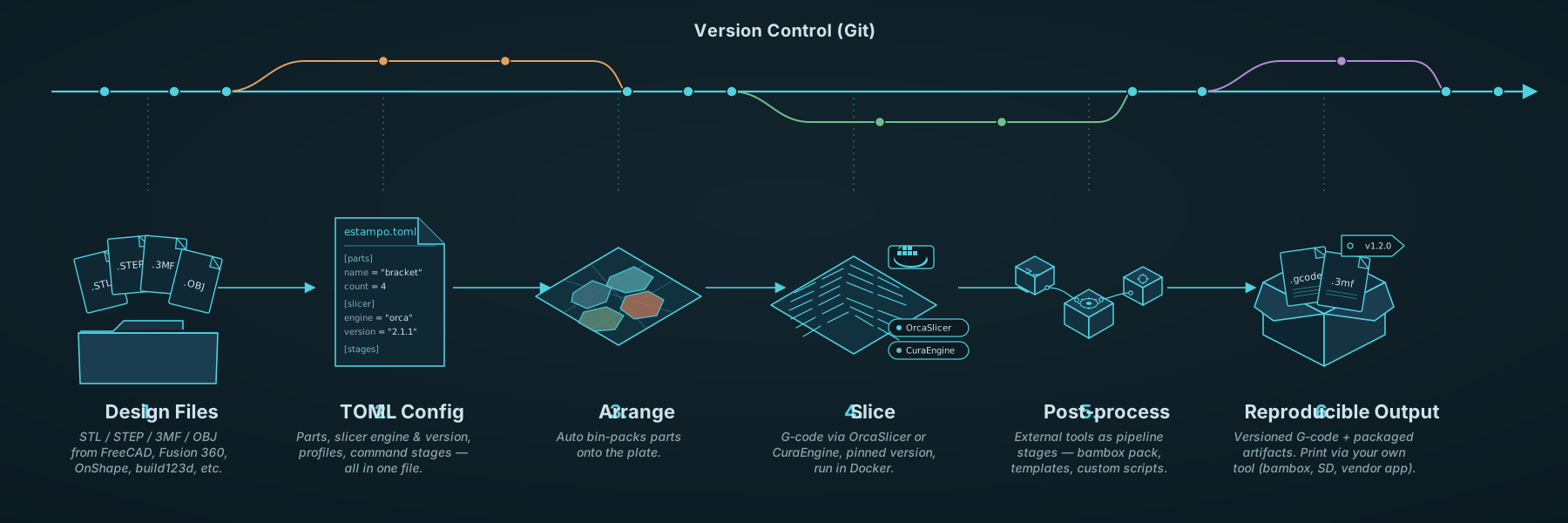
What estampo does

- Define parts + settings in
estampo.toml - Arrange — bin-packs models onto the build plate
- Slice — using a pinned slicer version (via Docker) for identical G-code across machines
- Post-process — run command stages (pack for Bambu via bambox, upload to Klipper via Moonraker, template resolution, etc.). Works with any printer that takes G-code; vendor specifics live in command stages, not in estampo.
Everything is declared in a single TOML file. Lock the slicer version, pin the profiles, and the output is reproducible on any machine or in CI.
Why not just use the slicer CLI directly?
OrcaSlicer and CuraEngine both ship excellent CLIs, and estampo is built on top of them — it shells out to one or the other for the actual slicing work. The goal isn't to replace either tool; it's to give you a reproducible pipeline around them (arrangement, profile pinning, CI, post-processing) without asking you to assemble the full invocation by hand each time.
| What you need to do | OrcaSlicer CLI | CuraEngine CLI | estampo |
|---|---|---|---|
| Load printer/process profiles | --load-settings for each JSON in the chain |
-j printer.def.json + -d search paths for inheritance |
printer = "..." / process = "..." in TOML |
| Set material / quality overrides | Edit JSON or pass inline overrides | Chain of -j files or -s KEY=VALUE per setting |
[slicer.orca.overrides] / [slicer.cura.overrides] |
| Arrange multiple parts | Not supported — prepare the plate yourself | Not supported — manual positioning | Automatic bin-packing |
| Multi-part filament / extruder mapping | Prebuilt 3MF with per-object slot metadata | -g -e0 -l a.stl -g -e1 -l b.stl per mesh group |
filament = 1 per part |
| Reproducible builds | Track slicer binary + profiles yourself | Track all definition JSONs yourself | version = "..." in TOML + pinned Docker image |
| Partial re-runs | Re-slice the whole thing | Re-slice the whole thing | --until plate, --only slice |
| Version control | Shell scripts + scattered JSON overrides | Shell scripts + -s lists + JSON definitions |
Single TOML file — git-diffable, reviewable |
| Run in CI | Install OrcaSlicer manually (needs display on some builds) | Install CuraEngine + definitions manually | uses: estampo/estampo/action@v0 |
| Post-process (e.g. pack for Bambu) | Separate manual step | Separate manual step | [pack] command stage with variable substitution |
| Headless slicing | GUI builds can require an X server | CLI-only already | Docker container pinned to a specific slicer version |
With the slicer CLI alone, your build config ends up spread across shell
scripts, -s flag lists, and JSON definition files — hard to diff, review,
or commit as a coherent unit. estampo replaces that orchestration layer
with a single declarative TOML file; the slicer itself does all the actual
work.
Works with AI assistants
GUI-based slicers require point-and-click interaction that AI assistants cannot drive. estampo's text-based config is different — an AI assistant can read your TOML, understand your print setup, suggest overrides, create CI workflows, and validate the result, all without leaving the conversation.
We provide a ready-to-paste AI setup prompt that gives any AI assistant (Claude, ChatGPT, Copilot) enough context to add estampo to a project from scratch — it scans the repo for model files, asks you a few questions, and generates the config. This isn't an AI feature bolted on — it's an architectural property of using text instead of a GUI.
For Claude Code there is also an installable skill that routes any future "print this" / "slice these parts" request through the correct estampo workflow (engine choice, profile discovery, overrides, reproducibility pinning):
mkdir -p .claude/skills/estampo
curl -fsSL https://estampo.dev/skill -o .claude/skills/estampo/SKILL.md
Best fit
estampo is best suited to:
- Hardware teams keeping CAD and manufacturing inputs in Git
- Engineers who want deterministic slicing in CI
- Teams using AI coding assistants to manage their build and print workflows
- Makers who want a declarative print workflow instead of slicer click-ops
If you mostly want interactive print setup in a GUI, use OrcaSlicer or Cura directly.
Status
- Declarative print config in
estampo.toml - Multi-part arrangement
- Docker-based slicing with pinned slicer versions (OrcaSlicer, CuraEngine)
- Slicing for any printer supported by OrcaSlicer or CuraEngine
- Profile pinning into your repository
- CI slicing and artifact generation
- Printing handled by external tools (e.g. bambox for Bambu Lab) wired in as command stages
Warning: estampo is in active early development. We are moving fast and breaking things — config format, CLI flags, and Python APIs may change between minor versions without deprecation. Pin your version if stability matters to you.
Quick start
Prerequisites: Python 3.11, 3.12, or 3.13 (3.14 is not yet supported) and Docker. Docker is central to estampo — it runs the slicer (OrcaSlicer or CuraEngine) in a container with a pinned version so every machine produces identical G-code. A locally installed slicer can be used as a fallback but is not recommended.
pip install estampo
# or, to install as an isolated CLI tool:
pipx install estampo
# or, with uv:
uv tool install estampo
Generate a config with the interactive wizard, or dump a commented template:
estampo init                       # interactive wizard — discovers profiles and CAD files, creates TOML
estampo init --template            # dump a commented template
Or create estampo.toml by hand (see full config reference):
[pipeline]
stages = ["load", "arrange", "plate", "slice", "pack"]

[plate]
size = [256, 256]       # build plate dimensions in mm
padding = 5.0

[slicer]
engine = "orca"
version = "2.3.1"       # pin OrcaSlicer version for reproducibility

[slicer.orca]
printer = "Bambu Lab P1S 0.4 nozzle"
process = "0.20mm Standard @BBL X1C"   # P1S, P1P, and A1 use @BBL X1C process profiles

[slicer.orca.overrides]  # simple way to define print settings without editing JSON
sparse_infill_density = "30%"       # stronger infill
wall_loops = 3                       # extra wall strength
enable_support = 1
brim_type = "auto_brim"             # help adhesion
curr_bed_type = "Textured PEI Plate"

[[parts]]               # define multiple parts using STEP, STL or 3MF inputs
file = "frame.step"
rotate = [180, 0, 0]    # flip so mounting plate faces down
filament = "Generic PETG-CF @base"

[[parts]]
file = "wheel.stl"
copies = 5
orient = "upright"
filament = "Generic PETG-CF @base"
orient picks a preset ("flat", "upright", "side", "upside-down") and rotate = [rx, ry, rz] takes degrees about X, Y, Z and overrides orient. See Orientation in the config reference for what each preset does and when to use which.
Run it (see full CLI reference):
estampo run                   # run every stage in pipeline.stages
estampo run --until slice     # stop after slicing
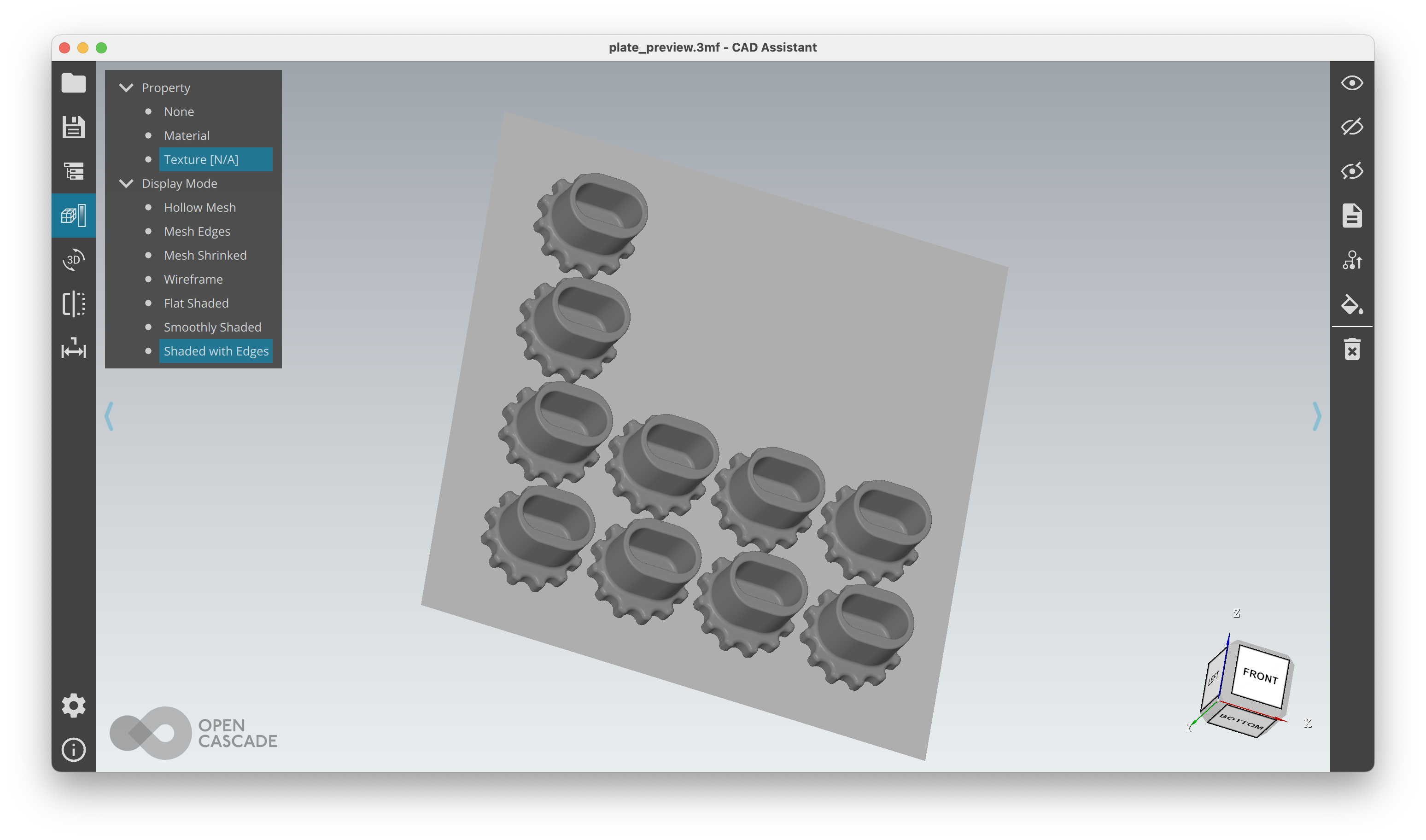
The arrangement (plate) stage generates a plate_preview.3mf — open it in any 3MF viewer to check placement:
Reproducibility
Pin profiles into your repo so builds are identical across machines:
estampo profiles pin          # copies slicer profiles into ./profiles/
git add profiles/              # commit to lock them
Combined with a pinned version in [slicer] (which locks the Docker image), the same config always produces the same gcode.
CuraEngine: pin non-bundled printers. If your config uses a printer definition that isn't shipped with estampo (e.g.
bambox_p1s),estampo profiles pinis required, not optional — the definition only exists inside the Docker image. Without it,estampo run --localfails and a teammate who clones the repo gets an emptyprofiles/directory.estampo initwill remind you when you pick a non-bundled CuraEngine printer.
CI/CD example
Automate slicing in GitHub Actions — push a commit, get G-code as a build artifact with print metrics on your PR:
# .github/workflows/slice.yml
name: Slice
on: [push, pull_request]
jobs:
  slice:
    runs-on: ubuntu-latest
    steps:
      - uses: actions/checkout@v6
      - uses: estampo/estampo/action@v0
The action slices your model, uploads G-code as an artifact, and posts print time / filament stats as a PR comment. See action/README.md for all options.
CLI overview
estampo --version                   # print version
estampo init                        # interactive config wizard
estampo init --template             # dump commented TOML template
estampo init --workflow             # wizard + GitHub Actions workflow
estampo validate                    # check config for issues
estampo info                        # list valid stages, engines, orient values, substitution variables
estampo run                         # full pipeline
estampo run --until plate           # stop after plating
estampo run --only slice            # run just one stage
estampo profiles list               # list available slicer profiles
estampo profiles list --printer "Bambu Lab P1S 0.4 nozzle"   # processes/filaments compatible with a printer
estampo profiles pin                # pin profiles for reproducible builds
Shell completion
estampo ships with Typer's built-in completion support:
estampo --install-completion        # install completion for your current shell (bash/zsh/fish/pwsh)
estampo --show-completion           # print the completion script without installing
After installing, restart your shell — you'll get tab completion for commands, flags, and stage names.
Sending prints to a printer
estampo is printer-agnostic: it produces a sliced .gcode.3mf on disk and
stops there. Packing the output into a vendor-specific format and sending it
to a printer are handled by external CLIs wired into the pipeline as
command stages.
This keeps vendor-specific code out of estampo and lets you swap printer
backends without touching the build system.
bambox (Bambu Lab)
For Bambu Lab printers, the companion CLI is bambox. estampo never imports bambox — you install it separately and call it from your pipeline. Typical wiring:
bambox is pre-installed in the estampo Docker image — no separate install needed for CI.
pip install bamboxis only required for local runs outside the container.
pip install bambox
For OrcaSlicer output, bambox repack regenerates the Bambu settings
in-place so the printer accepts the archive:
[pipeline]
stages = ["load", "arrange", "plate", "slice", "pack"]

[pack]
command = "bambox repack {sliced_3mf}"
output = "{sliced_3mf}"
For CuraEngine output, bambox pack wraps the raw .gcode into a
.gcode.3mf:
[pack]
command = "bambox pack {sliced_dir}/plate.gcode -o {output_dir}/plate.gcode.3mf"
output = "{output_dir}/plate.gcode.3mf"
Other printers
Any CLI that reads a sliced file and does something with it can be a
command stage. If your printer vendor has a CLI, wire it in the same way.
If it doesn't, estampo run already gives you a G-code file — hand it to
your printer however you normally would.
For Klipper-based printers with Moonraker, a one-line curl upload is
enough — no extra tool required:
[pipeline]
stages = ["load", "arrange", "plate", "slice", "send"]

[send]
command = "curl -F 'file=@{sliced_3mf}' -F 'print=true' http://moonraker.local/server/files/upload"
{sliced_3mf} is substituted by estampo with the path to the sliced
file. Set print=false if you want to upload without starting the job.
Documentation
- CLI reference — all commands, flags, and pipeline stages
- Config reference — complete TOML format
- Developing — setup, testing, architecture
Development
estampo's codebase is authored by Claude, Anthropic's AI assistant, under the direction and review of a human maintainer. Architecture decisions, priorities, and acceptance criteria are set by the maintainer; Claude writes the code, tests, documentation, and CI workflows. Every commit is reviewed before merge.
License
Apache 2.0
1 maintainer

Metadata
1 maintainer
Release files for estampo 0.4.5
For a detailed explanation of source distributions (sdists) and built distributions (wheels), please see the package formats documentation.
Source distribution (sdist)
| File | Size | Uploaded | |
|---|---|---|---|
| estampo-0.4.5.tar.gz | 3.6 MB | Details |
Built distribution (wheel)
| File | Interpreter | ABI | Platform | Reset |
|---|---|---|---|---|
| estampo-0.4.5-py3-none-any.whl | Python 3 | none | any | Details |
Total release size: 3.8 MB
Release files / estampo-0.4.5.tar.gz
| Download URL | estampo-0.4.5.tar.gz |
|---|---|
| Size | 3.6 MB |
| Tags | Source |
|
SHA-256 checksum How to use checksums |
7099c2575019edb394893fc886d9dbe38453b8f0f1f553a04bedea8d99e10866
|
|
BLAKE2b-256 checksum How to use checksums |
e73c2d6911465d8f7821030b12678af3f1be80c66ad1770d841766fca069769f
|
| Upload date | |
|
Uploaded using Trusted Publishing? What is trusted publishing? |
Yes |
| Uploaded via |
twine/7.0.0 CPython/3.13.14
|
Provenance
Provenance describes where a file came from. On PyPI, provenance is shared via attestations, which provide a verifiable record of the build or publishing details. View details, limitations and caveats.


PyPI Publish Attestation
PyPI verified that this artifact, at this checksum, originated from the publisher listed below.
Signed by GitHub Actions, verified by PyPI on Aug 30, 2026.
Transparency logRelease files / estampo-0.4.5-py3-none-any.whl
| Download URL | estampo-0.4.5-py3-none-any.whl |
|---|---|
| Size | 173.2 kB |
| Tags | Python 3 |
|
SHA-256 checksum How to use checksums |
16d03b9e5ad52504c904a8b847f53eea312de2154f2f00786d8fa07eab62b54d
|
|
BLAKE2b-256 checksum How to use checksums |
7a65e7c8e814386891dbf6b79506c749f3f5895e385a426a4c881a6652ce98a0
|
| Upload date | |
|
Uploaded using Trusted Publishing? What is trusted publishing? |
Yes |
| Uploaded via |
twine/7.0.0 CPython/3.13.14
|
Provenance
Provenance describes where a file came from. On PyPI, provenance is shared via attestations, which provide a verifiable record of the build or publishing details. View details, limitations and caveats.
PyPI Publish Attestation
PyPI verified that this artifact, at this checksum, originated from the publisher listed below.
Signed by GitHub Actions, verified by PyPI on Aug 30, 2026.
Transparency log













