
A modular framework for evolutionary strategies and neuroevolution.

Project description
EvoLib – A Modular Framework for Evolutionary Computation






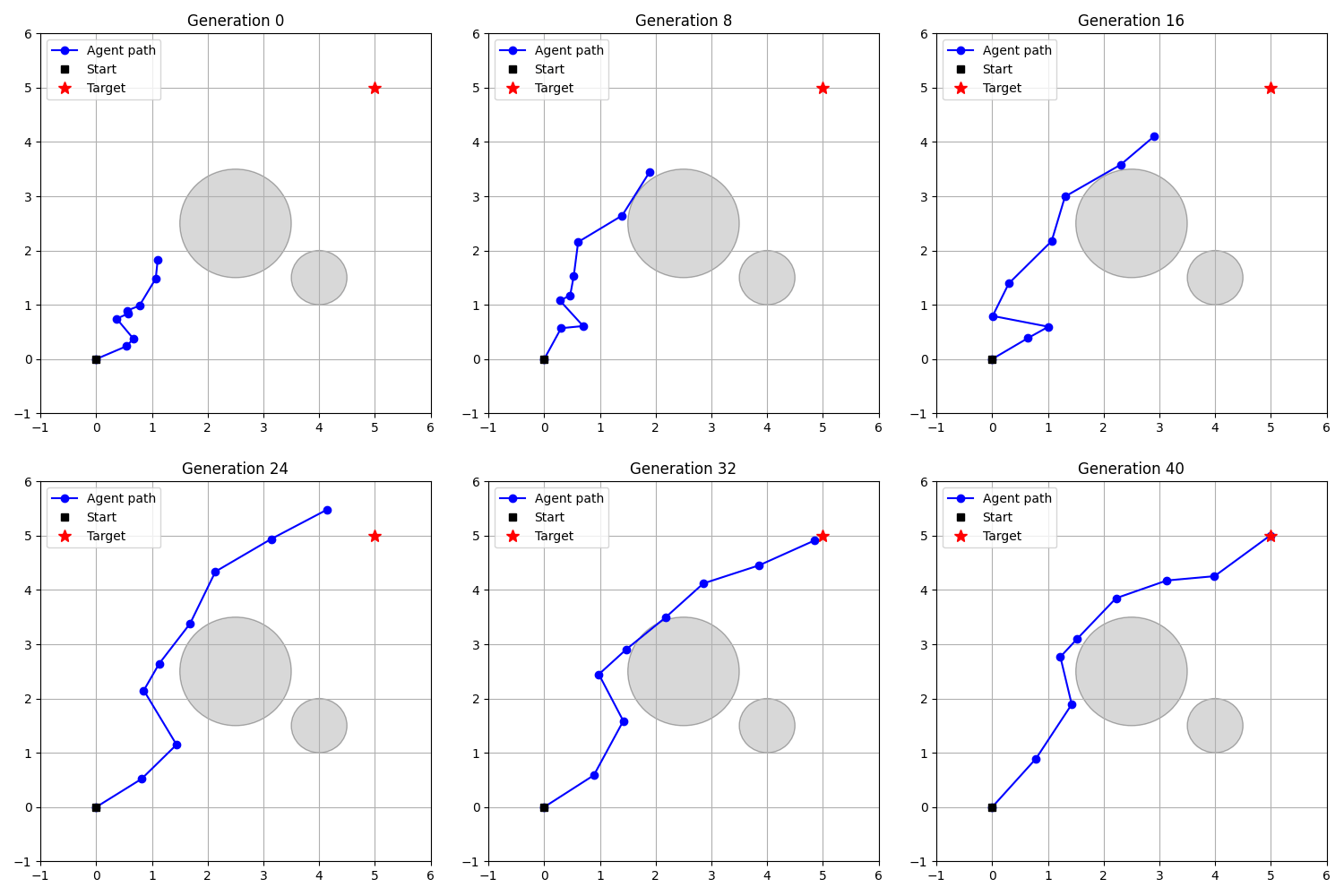
EvoLib is a modular and extensible Python framework for designing, analyzing, and teaching evolutionary algorithms. It supports classical strategies such as (μ, λ) and (μ + λ), with configurable mutation, selection, and crossover operators, as well as neuroevolution.
Key Features
- Configurable Evolution: Define evolutionary strategies via simple YAML files.
- Modular Design: Easily swap mutation, selection, and crossover strategies.
- Built-in Logging: Fitness tracking and history recording out-of-the-box.
- Educational Focus: Includes didactic examples and an extensible code structure.
- Neuroevolution: Structured neural networks (
EvoNet) and evolvable parameter vectors supported. - Type-Checked: With mypy and PEP8 compliance.
⚠️ This project is in alpha stage. APIs and configuration structure may change.
Directory Structure
evolib/
├── core/           # Individual, Population
├── config/         # Typed component configuration (Vector, EvoNet, etc.)
├── interfaces/     # Enums, types, helper protocols
├── initializers/   # Initializer registry and implementations
├── operators/      # Mutation, crossover, selection, etc.
├── registry/       # Strategy and operator registries
├── representation/ # ParaBase + Vector, EvoNet, Composite etc.
├── utils/          # Logging, plotting, math, config loader
└── examples/       # Educational examples and test runs
Installation
pip install evolib
Requirements: Python 3.9+ and packages in requirements.txt.
Example Usage
from evolib import Pop

def my_fitness(indiv):
    # Custom fitness function (example: sum of vector)
    indiv.fitness = sum(indiv.para["main"].vector)

pop = Pop(config_path="config/my_experiment.yaml",
          fitness_function=my_fitness)

# Run the evolutionary process
pop.run()
For full examples, see 📁examples/ – including adaptive mutation, controller evolution, and network approximation.
Configuration Example (YAML)
parent_pool_size: 20
offspring_pool_size: 60
max_generations: 100
num_elites: 2
max_indiv_age: 0

stopping:
  target_fitness: 0.01
  patience: 20
  min_delta: 0.0001
  minimize: true

evolution:
  strategy: mu_comma_lambda

modules:
  controller:
    type: vector
    dim: 8
    initializer: normal_vector
    bounds: [-1.0, 1.0]
    mutation:
      strategy: adaptive_individual
      probability: 1.0
      strength: 0.1

  brain:
    type: evonet
    dim: [4, 6, 2]
    activation: [linear, tanh, tanh]
    initializer: normal_evonet
    mutation:
      strategy: constant
      probability: 1.0
      strength: 0.05

      # Optional fine-grained control
      activations:
        probability: 0.01
        allowed: [tanh, relu, sigmoid]

      structural:
        add_neuron: 0.01
        add_connection: 0.05
        remove_connection: 0.02
        recurrent: local  # none | direct | local | all
        keep_connected: true
Supported Parameter Representations
| Type | Structure | Description |
|---|---|---|
| vector | flat, net, tensor, blocks | Evolvable vectors or neural network encodings |
| evonet | — | Neural networks via EvoNet |
ℹ️ Multiple parameter types (e.g. vector + evonet) can be combined in a single individual. Each component evolves independently, using its own configuration.
Use Cases
EvoLib is designed for both research and education in evolutionary computation. It supports a wide range of applications, including:
- Function optimization: Test and visualize search behavior on standard functions (e.g., Sphere, Ackley)
- Hyperparameter tuning: Use evolutionary strategies to optimize black-box functions.
- Strategy comparison: Test and evaluate different mutation, selection, and crossover methods.
- Educational use: Clear API and examples for teaching evolutionary computation concepts.
- Neuroevolution: Evolve neural networks with weights and structure.
Roadmap
- Adaptive Mutation (global, individual, per-parameter)
- Flexible Crossover Strategies (BLX, intermediate, none)
- Strategy Comparisons via Examples
- Structured Neural Representations (EvoNet)
- Composite Parameters (multi-module individuals)
- Neuroevolution
- Topological Evolution (add/remove neurons, edges)
- Co-Evolution & Speciation Support
- Advanced Visualization Tools
- Ray Support for Parallel Evaluation
- Game Environment Integration (pygame, PettingZoo)
Documentation
Documentation for EvoLib is available at: 👉 https://evolib.readthedocs.io/en/latest/
License
MIT License – see MIT License.
Release history Release notifications | RSS feed


Download files
Download the file for your platform. If you're not sure which to choose, learn more about installing packages.
Source Distribution
Built Distribution
Filter files by name, interpreter, ABI, and platform.
If you're not sure about the file name format, learn more about wheel file names.
Copy a direct link to the current filters
File details
Details for the file evolib-0.1.0.dev31.tar.gz.
File metadata
- Download URL: evolib-0.1.0.dev31.tar.gz
- Upload date:
- Size: 113.0 kB
- Tags: Source
- Uploaded using Trusted Publishing? No
- Uploaded via: twine/6.1.0 CPython/3.12.7
File hashes
| Algorithm | Hash digest | |
|---|---|---|
| SHA256 |
1b9987cebe012ea26c15d751bdfaf9716e0b80f3b45b4be4762cfd2a0800e2b3
|
|
| MD5 |
0ef4e8522f3f1cb3a076b52943db4079
|
|
| BLAKE2b-256 |
a0944eabb148d9768e55da854a2cb2a46fa2224caf18c8c117b853dbffdc4585
|
File details
Details for the file evolib-0.1.0.dev31-py3-none-any.whl.
File metadata
- Download URL: evolib-0.1.0.dev31-py3-none-any.whl
- Upload date:
- Size: 154.2 kB
- Tags: Python 3
- Uploaded using Trusted Publishing? No
- Uploaded via: twine/6.1.0 CPython/3.12.7
File hashes
| Algorithm | Hash digest | |
|---|---|---|
| SHA256 |
25a5625a321adfd3689484d24a21bff3c19f63d94596b74a34d458098141c833
|
|
| MD5 |
a558e32f29a644c6550f718065c8b21c
|
|
| BLAKE2b-256 |
7bfe9670b61ddcf4f85d861a7c25b7e0854a9301fdeb6d8f804ad7018b0d7684
|






