
A modular framework for evolutionary strategies and neuroevolution.

Project description
EvoLib – A Modular Framework for Evolutionary Computation






EvoLib is a lightweight and transparent framework for evolutionary computation, focusing on simplicity, modularity, and clarity — aimed at experimentation, teaching, and small-scale research rather than industrial-scale applications.
Key Features
- Transparent design: configuration via YAML, type-checked validation, and clear module boundaries.
- Modularity: mutation, selection, crossover, and parameter representations can be freely combined.
- Educational value: examples and a clean API make it practical for illustrating evolutionary concepts.
- Neuroevolution support: evolvable neural networks with explicit topology, recurrence, delays, and structural mutation (EvoNet).
- Gymnasium integration: run Gymnasium benchmarks (e.g. CartPole, LunarLander) via a simple wrapper.
- Parallel evaluation (optional): basic support for Ray to speed up fitness evaluations.
- HELI (Hierarchical Evolution with Lineage Incubation)
Runs short micro-evolutions ("incubations") for structure-mutated individuals, allowing new topologies to stabilize before rejoining the main population. - Type-checked: static typing with mypy, PEP8-compliant and consistent code style.
EvoLib is currently in beta. The core API and configuration format are stable, but some features are still under development.
Installation
pip install evolib
Requirements: Python 3.12+ and packages in requirements.txt.
Example Usage
from evolib import Pop

def my_fitness(indiv):
    # Custom fitness function (example: sum of vector)
    indiv.fitness = sum(indiv.para["main"].vector)

pop = Pop(config_path="config/my_experiment.yaml",
          fitness_function=my_fitness)

# Run the evolutionary process
pop.run()
For full examples, see 📁examples/ – including adaptive mutation, controller evolution, and network approximation.
Configuration Example (YAML)
A core idea of EvoLib is that experiments are defined entirely through YAML configuration files. This makes runs explicit, reproducible, and easy to adapt. The example below demonstrates different modules (vector + EvoNet) with mutation, structural growth, and stopping criteria.
parent_pool_size: 20
offspring_pool_size: 60
max_generations: 100
num_elites: 2
max_indiv_age: 0

stopping:
  target_fitness: 0.01
  patience: 20
  min_delta: 0.0001
  minimize: true

evolution:
  strategy: mu_comma_lambda

modules:
  controller:
    type: vector
    dim: 8
    initializer: normal_vector
    bounds: [-1.0, 1.0]
    mutation:
      strategy: adaptive_individual
      probability: 1.0
      strength: 0.1

  brain:
    type: evonet
    dim: [4, 6, 2]
    activation: [linear, tanh, tanh]
    initializer: normal_evonet
    mutation:
      strategy: constant
      probability: 1.0
      strength: 0.05

      # Optional fine-grained control
      activations:
        probability: 0.01
        allowed: [tanh, relu, sigmoid]

      structural:
        add_neuron:
          probability: 0.015
          init_connection_ratio: 0.5
[...]
ℹ️ Multiple parameter types (e.g. vector + evonet) can be combined in a single individual. Each component evolves independently, using its own configuration.
Documentation
Documentation for EvoLib is available at: 👉 https://evolib.readthedocs.io/en/latest/
Archival Record (Zenodo)
EvoLib is archived for long-term reproducibility on Zenodo.
DOI: https://doi.org/10.5281/zenodo.17793862
Use Cases
EvoLib is developed for clarity, modularity, and exploration in evolutionary computation.
It can be applied to:
- Illustrating concepts: simple, transparent examples for teaching and learning.
- Neuroevolution: evolve weights and network structures using EvoNet.
- Multi-module evolution: combine different parameter types (e.g. controller + brain).
- Strategy comparison: benchmark and visualize mutation, selection, and crossover operators.
- Function optimization: test behavior on benchmark functions (Sphere, Ackley, …).
- Showcases: structural XOR, image approximation, and other demo tasks.
- Rapid prototyping: experiment with new evolutionary ideas in a lightweight environment.
Gymnasium Integration
EvoLib provides a lightweight wrapper for Gymnasium environments. This allows you to evaluate evolutionary agents directly on well-known benchmarks such as CartPole, LunarLander, or Pendulum.
- Headless evaluation: returns total episode reward as fitness.
- Visualization: render episodes and save them as GIFs.
- Discrete & continuous action spaces are both supported.
👉 Examples
from evolib import GymEnv

env = GymEnv("CartPole-v1", max_steps=500)
fitness = env.evaluate(indiv)         # run one episode
gif = env.visualize(indiv, gen=10)    # render & save as GIF
Preview: Pygame Integration
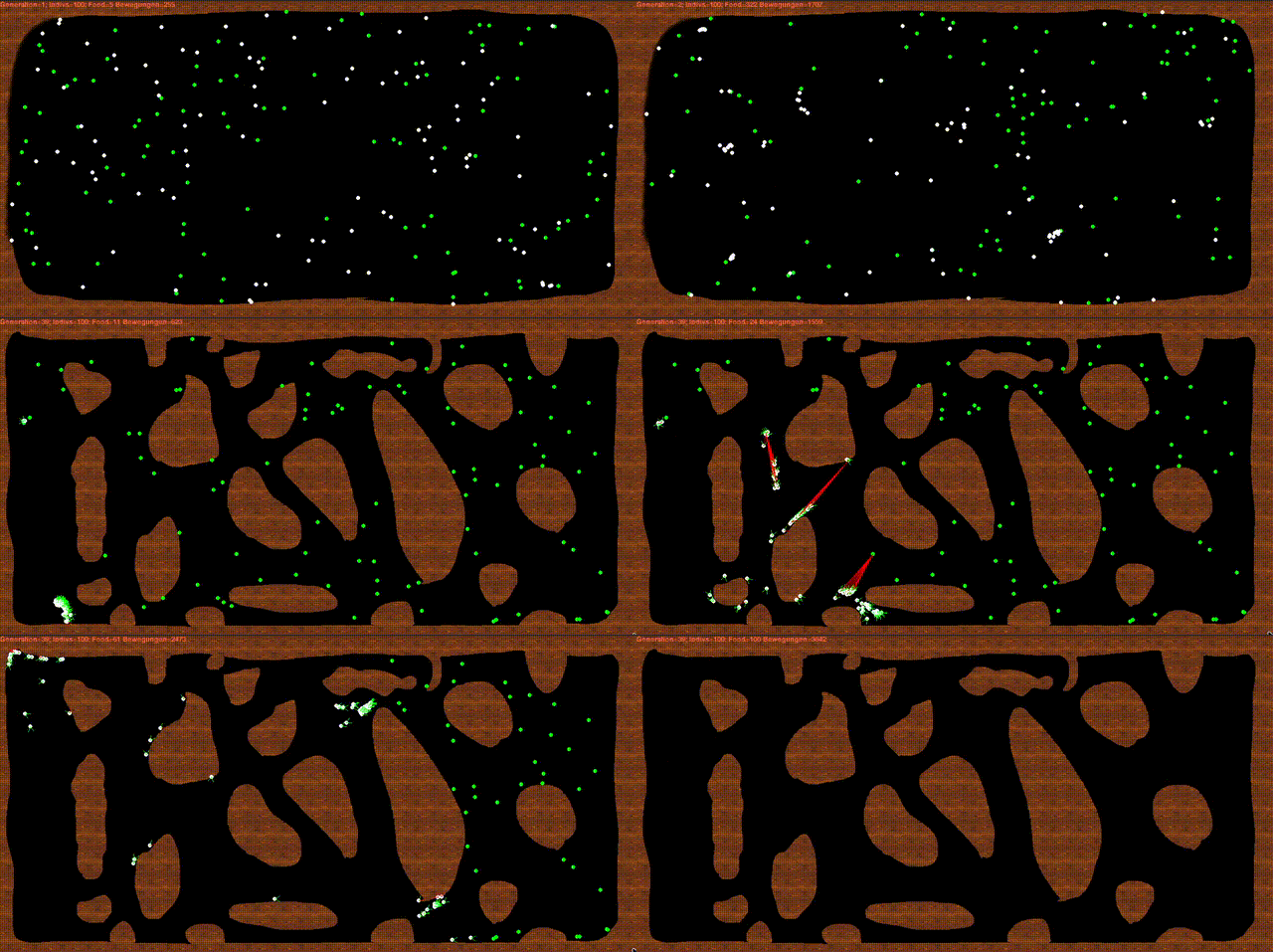
Early prototypes demonstrate how evolutionary algorithms can evolve both neural networks and sensor properties such as number, range, and orientation for agents in 2D worlds built with pygame. This illustrates how networks and sensors co-adapt to dynamic environments with collisions and feedback.
Ant/Food Prototype
In this video, agents use simple sensors to learn how to collect food while avoiding collisions with the environment.
Flappy Bird–style Prototype
Another prototype uses a Flappy Bird–like 2D world, where agents must pass through moving gaps. Both the neural controller and the sensors (number, length, angle) are evolved, allowing perception and action to adapt together. This illustrates how EvoLib can be applied to simple game-like environments, making the joint evolution of sensing and control directly observable.

This video shows the best agent from the final generation rather than the full evolutionary process.
Learn EvoLib in 5 Steps
EvoLib includes a small set of examples that illustrate the core concepts step by step:
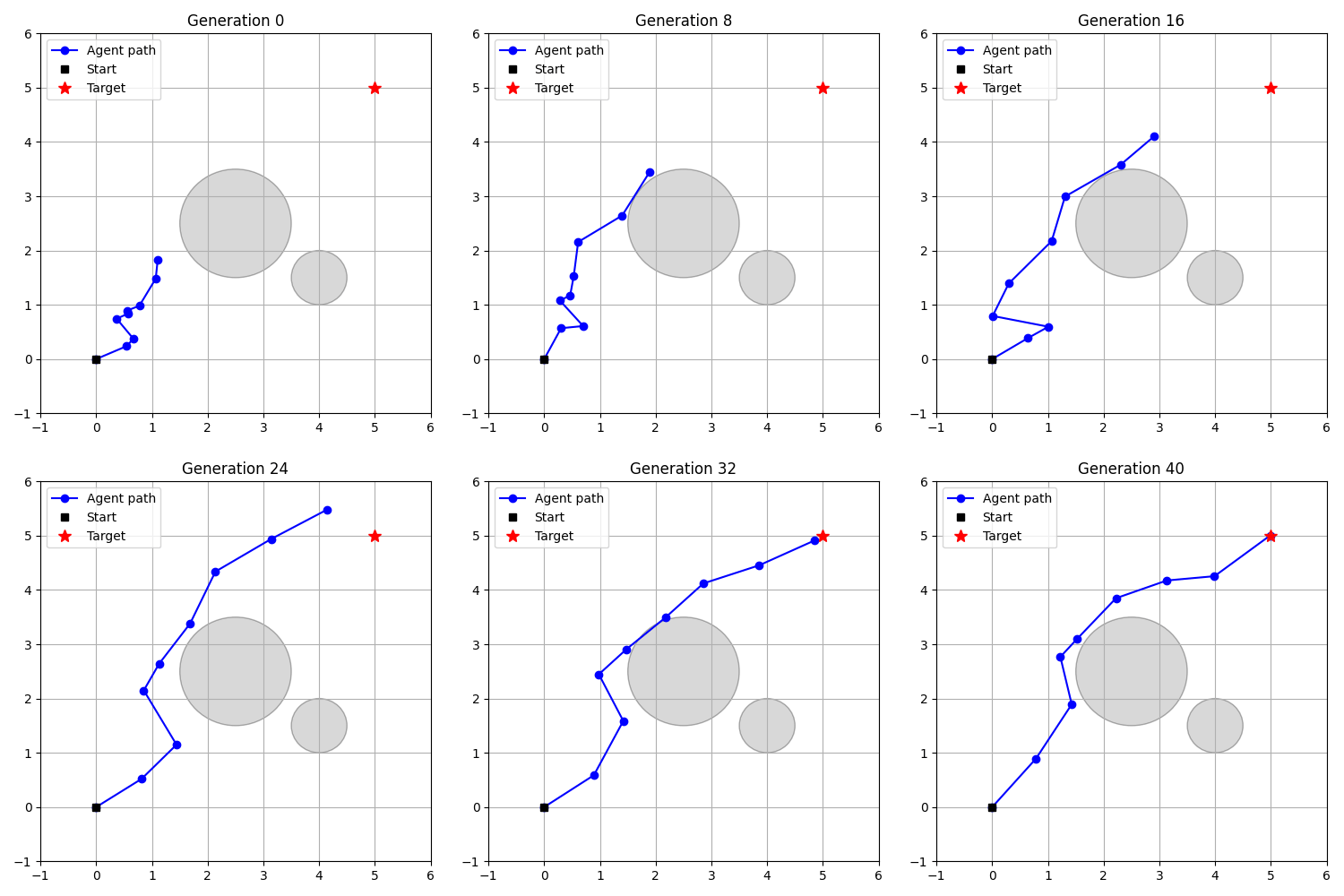
- Hello Evolution – minimal run with a custom fitness function and visible improvement over generations.
- Strategies in Action – (μ + λ) evolution step by step.
- Function Approximation – evolve support points to match a sine curve.
- Evolution as Control – evolve a controller in an environment.
- Neuroevolution with Structural Growth – evolve networks with growing topology.
For deeper exploration, see the full examples directory
Roadmap
- Adaptive Mutation (global, individual, per-parameter)
- Flexible Crossover Strategies (BLX, intermediate, none)
- Structured Neural Representations (EvoNet)
- Composite Parameters (multi-module individuals)
- Neuroevolution
- Topological Evolution (neurons, edges)
- Ray Support for Parallel Evaluation (early prototypes)
- OpenAI Gymnasium / Gym Wrapper
- Advanced Visualization
- Game Environment Integration (pygame, PettingZoo - early prototypes)
Acknowledgement
Parts of the documentation, docstrings, and code refactoring were supported by ChatGPT (OpenAI) for language clarity and consistency. All conceptual design, experiments, and implementation decisions were made by the author.
License
MIT License – see MIT License.
Release history Release notifications | RSS feed


Download files
Download the file for your platform. If you're not sure which to choose, learn more about installing packages.
Source Distribution
Built Distribution
Filter files by name, interpreter, ABI, and platform.
If you're not sure about the file name format, learn more about wheel file names.
Copy a direct link to the current filters
File details
Details for the file evolib-0.2.0b4.dev7.tar.gz.
File metadata
- Download URL: evolib-0.2.0b4.dev7.tar.gz
- Upload date:
- Size: 137.2 kB
- Tags: Source
- Uploaded using Trusted Publishing? No
- Uploaded via: twine/6.1.0 CPython/3.12.7
File hashes
| Algorithm | Hash digest | |
|---|---|---|
| SHA256 |
913a07ac1b64d3be40cd30d436ff0312ec06006cdcb6ec6920e020b7fc3f1f75
|
|
| MD5 |
29ed2ca35f456846a593afd9aa96104e
|
|
| BLAKE2b-256 |
82c0d3b8da7311fe024bce62a6b57c8ed8243e0a154badfc244d390a7c93af51
|
File details
Details for the file evolib-0.2.0b4.dev7-py3-none-any.whl.
File metadata
- Download URL: evolib-0.2.0b4.dev7-py3-none-any.whl
- Upload date:
- Size: 104.8 kB
- Tags: Python 3
- Uploaded using Trusted Publishing? No
- Uploaded via: twine/6.1.0 CPython/3.12.7
File hashes
| Algorithm | Hash digest | |
|---|---|---|
| SHA256 |
f40bc97a81e336284bf4caa811edc7c7e5b10b108984b457ba300fd17a70e954
|
|
| MD5 |
32fbe7090b196bdc2829684580c68e27
|
|
| BLAKE2b-256 |
b97c5e248558bedfa1f106aa06a8d5ec8d4a87533a1559e7ff806bf75647aac6
|






