
This release is a pre-release and may not be stable for production use.
 FactBlock: an open format for claims and their history


Build agent memory that tracks claims, evidence and changes, and lets you query what was known at any point in time.
Represent temporal causal knowledge graphs in portable files, reusable across AI agents, analytics, and visualizations.
"The Team plan includes 10 seats." "We ship SSO in Q3." Who said it, when, on what basis, and did it change? FactBlock keeps that, so you do not build it.
It is files in a folder; factagora.ai hosts the same files when you want to share them (below).
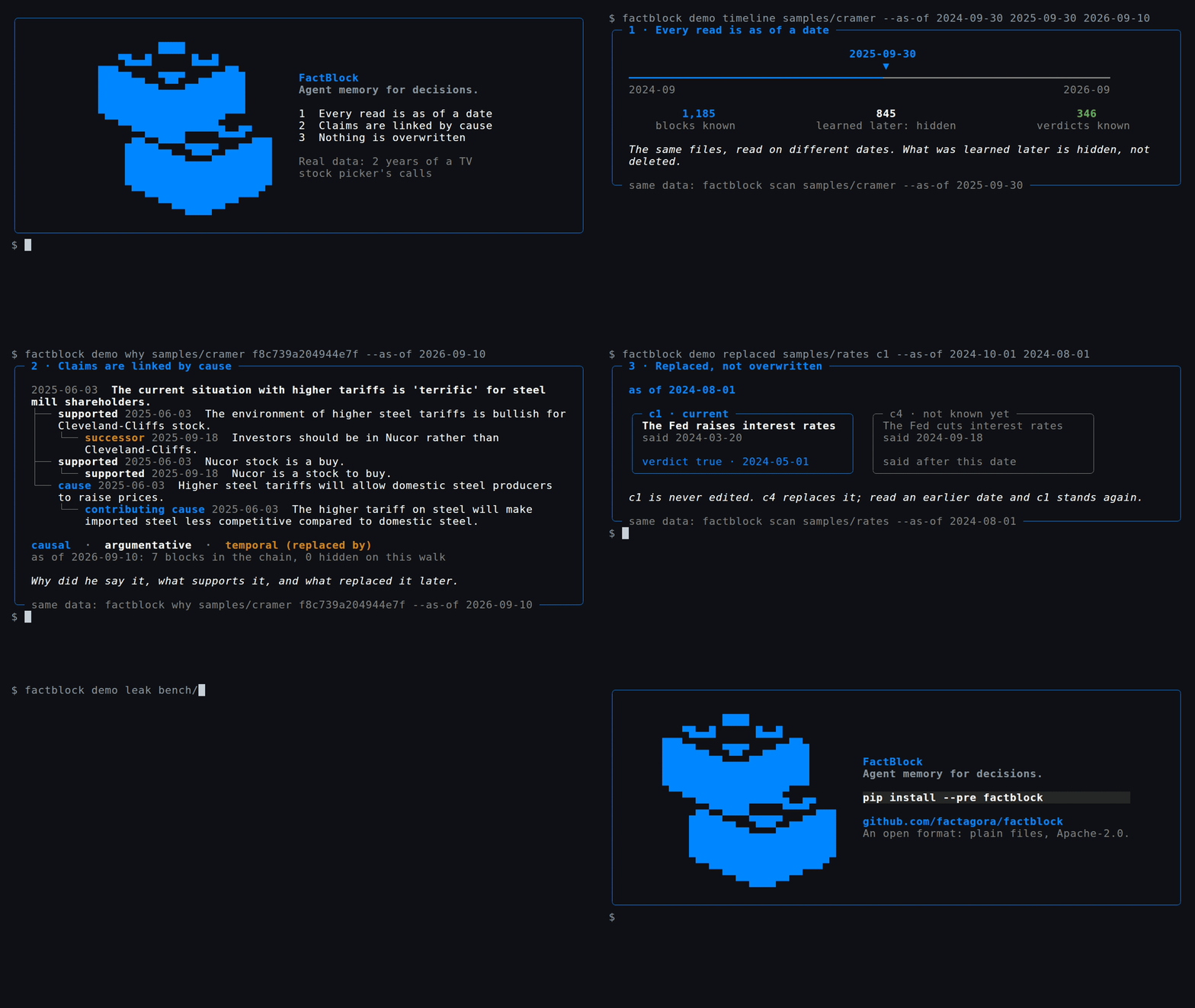
pip install --pre factblock
factblock sample --policies irs/                                 # the IRS business mileage rate, 2022 to 2026, as CSV
factblock import irs/mileage.csv --backfill -o brain/
factblock import irs/mileage-2026-07.csv --backfill -o brain/    # 76 cents from July 1, announced July 13
factblock recall brain/ "mileage rate" --as-of 2026-07-10 --limit 1   # asked July 10: 72.5 (76 not announced yet)
factblock recall brain/ "mileage rate" --as-of 2026-07-20 --limit 2   # asked July 20: 76, and 72.5 marked replaced
irs-2026-01  claim       2025-12-29  The IRS business standard mileage rate is 72.5 cents per mile.
1 of 6 matching   as of 2026-07-10  hidden: 1 node, 1 edge

irs-2026-07  claim       2026-07-13  The IRS business standard mileage rate is 76 cents per mile.
irs-2026-01  claim       2025-12-29  The IRS business standard mileage rate is 72.5 cents per mile.
                           replaced by irs-2026-07 (announced 2026-07-13, in force from 2026-07-01): The IRS business standard mileage rate is 76 cents per mile.
2 of 7 matching   as of 2026-07-20  hidden: nothing
In force from one day, announced on another
A trip on July 5, 2026: the IRS raised the rate to 76 cents from July 1 but announced it on July 13. The day of the trip and the day you ask are two clocks, and a date filter has one. valid_at is the trip, as_of the asking:
import factblock
factblock.context("brain/", "mileage rate", as_of="2026-07-20", valid_at="2026-07-05", limit=2)
# - 2026-07-13: The IRS business standard mileage rate is 76 cents per mile. (in force from 2026-07-01; source: https://www.irs.gov/irb/2026-29_irb)
# - 2025-12-29: The IRS business standard mileage rate is 72.5 cents per mile. (in force from 2026-01-01; source: https://www.irs.gov/newsroom/irs-sets-2026-business-standard-mileage-rate-at-725-cents-per-mile-up-25-cents)
#   replaced by (announced 2026-07-13, in force from 2026-07-01): The IRS business standard mileage rate is 76 cents per mile.
Asked on July 10 with the same valid_at and limit=1, you get 72.5 cents and nothing replacing it. Every rate links to the IRS release it came from.
examples/support-agent asks five support questions of a made-up company on the day they were asked (a price announced before it takes effect, a policy memo that arrived late, a promise and whether it was kept): a date filter puts a stale answer in the prompt on all five, FactBlock on none.
Judged later, counted honestly
git clone https://github.com/factagora/factblock && cd factblock # this sample is in the repository, not the package
$ factblock track-record samples/cramer --as-of 2026-10-01
      judged    right    wrong    mixed     open  overdue      hit
all      779      426      353        0      629       46      55%
on record before it was resolved: 0 of 779; 779 written later from a cited source (checkable)
baseline (779 calls with a return): saying up every time would hit 54%; following the calls made +5.2% a call, +1.4% over SPY
Two years of a TV commentator's market calls (samples/cramer): right about as often as saying "up" every time, yet +1.4% a call over the market (examples/analysis).
Your own rows
Most memory starts as rows, not prose: a pricing table, a policy log, a CRM export. import takes them as they are, no model, and every date comes from your columns.
id,said_at,effective_from,known_at,text,replaces
p1,2026-01-10,,,The Team plan costs $30 per user per month.,
p2,2026-02-20,2026-03-15,,The Team plan costs $36 per user per month.,p1
factblock import plans.csv --backfill -o kb/ writes them. --backfill reads a row without known_at as known when it was said; without it, as known today, so a read of an earlier day does not see it. Your own column names: --map Claim=text,Date=said_at.
said_at (or asserted_at) is when it was said, effective_from (or valid_from, default said_at) when it takes effect, known_at when you learned it, replaces the id it supersedes, based_on the id it rests on (recall then says when that basis was replaced). A row with target, outcome and decided_at is a verdict. Any other column goes into the payload. In Python, any dicts with the format's own names will do:
factblock.write_bundle({"nodes": [{"id": "r1", "kind": "claim", "statement": "Annual plans refund within 30 days.",
                                   "asserted_at": "2026-01-10", "known_at": "2026-01-10"}]}, "brain/", append=True)
write_bundle fills the manifest, declares one batch per known_at, and validates the whole folder before it writes; a bundle that would fail validate raises and is not written.
Prose instead of rows: factblock extract notes.txt --observed-at 2024-03-20 --backfill -o brain/ through your model key (--provider gemini with GEMINI_API_KEY after pip install --pre 'factblock[gemini]', or openai), or --provider fake to see the files without a model.
Dates are UTC days: --as-of 2026-07-10 reads to the end of July 10 in UTC, and a date-only said_at or known_at is midnight UTC. For a local day give the offset, as in --as-of 2026-07-10T23:59:59-07:00. --pre applies to every package on its pip install line, so install DuckDB and other tools in a command of their own.
For coding agents
The whole API in one block. It runs as is; tests/test_readme_agents.py keeps it that way.
pip install --pre factblock
factblock sample --policies irs/
factblock import irs/mileage.csv --backfill -o brain/
factblock import irs/mileage-2026-07.csv --backfill -o brain/
import factblock
print(factblock.context("brain/", "mileage rate", as_of="2026-07-20", limit=2))   # prompt lines, as known that day
r = factblock.recall("brain/", "mileage rate", as_of="2026-07-20", limit=2)       # the same, as dicts
old = r["items"][1]
print(old["statement"], "->", old["superseded_by"]["statement"])                  # what replaced it
That string goes into your agent's prompt. The old rate is still there, marked as replaced. factblock.recall(...) returns the same blocks as dicts with a certificate, and factblock.scan(...) returns everything visible as Arrow tables. Add --json to any read on the command line for the machine form.
Words are matched as written. To match by meaning too, pass embed=factblock.embedder("gemini") (or "openai", or your own function) to recall, context or timeline, or --embed gemini on the command line: "price" then finds a block that says "costs". The vectors are an index cached in brain/.factblock-cache/, not part of the bundle.
Three rules: every read takes as_of (no default, SPEC 4); a change is a new block plus SUPERSEDES, never an edit; known_at is when you learned a row: give it honestly (default now; --backfill means when it was said) and let import, extract or write_bundle declare the batch that attests it. Claude Code users can copy .claude/skills/factblock into their project; other agents read llms.txt.
| If you know | In FactBlock |
|---|---|
Mem0 m.add(messages, user_id=...) |
factblock import for rows, factblock extract for prose; in Python from_records(rows) or extract(text, observed_at=...), then write_bundle(..., append=True); the user is a space |
Mem0 m.search(query, user_id=...) |
recall(bundle, query, as_of=...) or context(...) for the prompt |
Graphiti edge valid_at / invalid_at |
valid_from / valid_to on the block, plus known_at: when you learned it |
Graphiti expired_at (an edge closed later) |
the old block stays; a new block SUPERSEDES it, known from that moment |
| A vector store with a date filter | recall(as_of=..., embed=...) matches by meaning too, and also hides what was learned later, keeps what was replaced (marked), and attaches verdicts. Vectors are an index cached beside the bundle (.factblock-cache/), not part of it |
Charts
factblock timeline brain/ --as-of 2026-10-10 -o mileage.html draws the history from the same files.
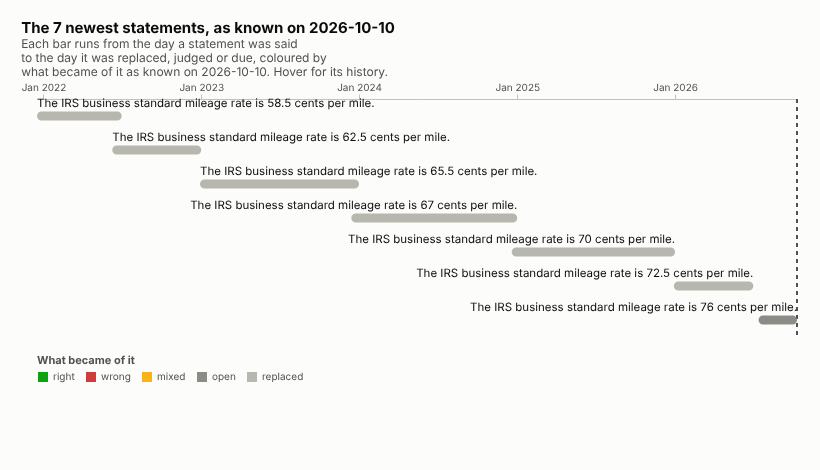
Over a numeric series, inside a chat answer (MCP Apps), and what one statement rests on: docs/timelines.md.
Guides and examples
- Your RAG answers with a rate that changed
- Show what an AI answer rested on, and what changed since
- Evaluate an agent only on what was known at the time:
leakchecks an eval set's evidence against each question's date. On StreamingQA, a recall that ignores time cites a block learned after the question for 79.7% of questions. examples/promises: sales promises from one CSV; open, past due, broken, kept as of any date.examples/analysis: DuckDB and Jupyter oversamples/cramer.- DuckDB:
to-parquet, then loadduckdb/factblock.sql(factblock_nodes(bundle, as_of),factblock_edges,factblock_certificate). The package carries it:factblock.duckdb_sql()is its path. Spark and Databricks read the same files. - Standards:
to-claimreview(schema.org ClaimReview),to-okf(Open Knowledge Format),from-factcheck(Google Fact Check Tools). None of them is the storage format; they are doors. - From an existing graph:
factblock/adapters/graphiti.pyturns a Graphiti graph into a bundle, its timestamps as declared backfill batches.
The three guides run as written on the IRS data above, with expected output and what they do not do.
Same files, hosted
A folder is one writer's memory. factagora.ai is where a brain/ meets other people's. Upload it and it comes back with more rows, never changed rows: verdicts on predictions whose horizon has passed (mechanical ones from prices and published figures, judgment calls from the community, each with evidence), links to what other people claimed about the same thing (SUPPORTS, CONTRADICTS), entities resolved across worldviews. Every added row carries its own known_at, stamped by the server rather than by you, so a verdict is as replayable as the claim it judges: as of last June, the prediction was still open. One ledger is shared by many agents and users, with an MCP address per worldview; GET /v1/export hands the folder back at any instant, so you can leave with your files.
factblock sync brain/ <url> --space <space> moves rows both ways by identity: what only the folder has goes up, what only the ledger has comes down, nothing is changed in place. A row's known_at travels as the batch that attests it, so the ledger learns a 2024 transcript as known in 2024, not today, and the folder learns a verdict at the instant the ledger stamped it. Run it again and it is a no-op, down to the batches: from tckg 0.3.12 each batch is declared under a key the folder fixes, so the ledger returns the one it has. --pull-only into a folder that does not exist yet clones a space. The token is $TCKG_TOKEN or --token. Another store is two methods: see CONTRIBUTING.md.
The same ledger runs closed for companies at app.factagora.com: your support logs, your sales promises, your own assistant's assertions, as claims with verdicts, inside your tenant.
The format and status
SPEC.md is short: six invariants, a JSONL and a Parquet profile, read semantics (what a read hides and the certificate that says so, section 4), edge types and their families (3.3), declared facts and resolve (3.7), and the thirteen checks validate runs. Nothing is a chunk, nothing is a bare triple; the unit is a dated statement someone made. A bundle is a folder of plain files: commit it to git, query it with DuckDB, hand it to another agent. Nothing here needs a server.
Format, not platform. Apache-2.0. tckg is one writer of this format; nothing here requires it. Contributions are welcome under the DCO: see CONTRIBUTING.md.
An alpha on PyPI (pip install --pre factblock), format 1.0-draft.1. Extraction quality on real transcripts is being measured separately. The format reaches 1.0.0 when a reader or writer maintained outside this repository exists; until then minor versions may change fields and the manifest's factblock_version says which one a bundle speaks.
1 maintainer

Metadata
1 maintainer
Release files for factblock 1.0.0a15
For a detailed explanation of source distributions (sdists) and built distributions (wheels), please see the package formats documentation.
Source distribution (sdist)
| File | Size | Uploaded | Provenance | |
|---|---|---|---|---|
| factblock-1.0.0a15.tar.gz | 6.0 MB | With provenance | Details |
Built distribution (wheel)
| File | Interpreter | ABI | Platform | Reset |
|---|---|---|---|---|
| factblock-1.0.0a15-py3-none-any.whl | Python 3 | none | any | Details |
Total release size: 6.1 MB
Release files / factblock-1.0.0a15.tar.gz
| Download URL | factblock-1.0.0a15.tar.gz |
|---|---|
| Size | 6.0 MB |
| Tags | Source |
|
SHA-256 checksum How to use checksums |
405a7469232180810c829e48e0f4815328239871b0248aeb23c4117730f3669c
|
|
BLAKE2b-256 checksum How to use checksums |
cfe387d717acb3e03a16589c3095b4e9f9a45e6b50b1a1c2f60ea731dc43c347
|
| Upload date | |
|
Uploaded using Trusted Publishing? What is trusted publishing? |
Yes |
| Uploaded via |
twine/7.0.0 CPython/3.13.14
|
Provenance
Provenance describes where a file came from. On PyPI, provenance is shared via attestations, which provide a verifiable record of the build or publishing details. View details, limitations and caveats.


PyPI Publish Attestation
PyPI verified that this artifact, at this checksum, originated from the publisher listed below.
Signed by GitHub Actions, verified by PyPI on Oct 20, 2026.
Transparency logRelease files / factblock-1.0.0a15-py3-none-any.whl
| Download URL | factblock-1.0.0a15-py3-none-any.whl |
|---|---|
| Size | 100.3 kB |
| Tags | Python 3 |
|
SHA-256 checksum How to use checksums |
eeb98118bba5ef96cfcd6a3b28031ccd290247461208292609959b52ef0cd736
|
|
BLAKE2b-256 checksum How to use checksums |
ae0d10d6f52148a234d0b9e0d33bd3716d5dc9a2379f007cedb501f2cbe8626c
|
| Upload date | |
|
Uploaded using Trusted Publishing? What is trusted publishing? |
Yes |
| Uploaded via |
twine/7.0.0 CPython/3.13.14
|
Provenance
Provenance describes where a file came from. On PyPI, provenance is shared via attestations, which provide a verifiable record of the build or publishing details. View details, limitations and caveats.
PyPI Publish Attestation
PyPI verified that this artifact, at this checksum, originated from the publisher listed below.
Signed by GitHub Actions, verified by PyPI on Oct 20, 2026.
Transparency logSecurity for factblock 1.0.0a15
Provenance
Provenance describes where a file came from. On PyPI, provenance is shared via attestations, which provide a verifiable record of the build or publishing details. View details, limitations and caveats.
Full provenance
All 2 files in this release have been uploaded with provenance metadata.
Attestation for factblock-1.0.0a15.tar.gz
PyPI Publish Attestation
PyPI verified that this artifact, at this checksum, originated from the publisher listed below.
Signed by GitHub Actions, verified by PyPI on Oct 20, 2026.
Transparency logA note on package security
PyPI is a repository for distributing packages, not a service for auditing them. While third-party security researchers and our staff do their best to detect and remove malicious packages, PyPI cannot guarantee the quality, security or suitability of any given package.














