
Turn FastAPI BackgroundTasks into a production-ready task system. Retries, control, and visibility without workers or brokers.
Verified details
These details have been verified by PyPIProject links
GitHub Statistics
Maintainers

Project description

Turn FastAPI BackgroundTasks into a production-ready task system.
Retries, control, and visibility without workers or brokers.
FastAPI's BackgroundTasks handles simple fire-and-forget work well. But in real applications you quickly hit the same gaps: tasks fail silently, you have no visibility into what ran, and nothing survives a restart.
fastapi-taskflow is a thin layer on top of what you already have. It does not compete with Celery, ARQ, Taskiq, or Dramatiq. It is built for teams who are already using FastAPI's native background tasks and want retries, status tracking, and a live dashboard without adding infrastructure.
Features
- Automatic retries with configurable delay and exponential backoff
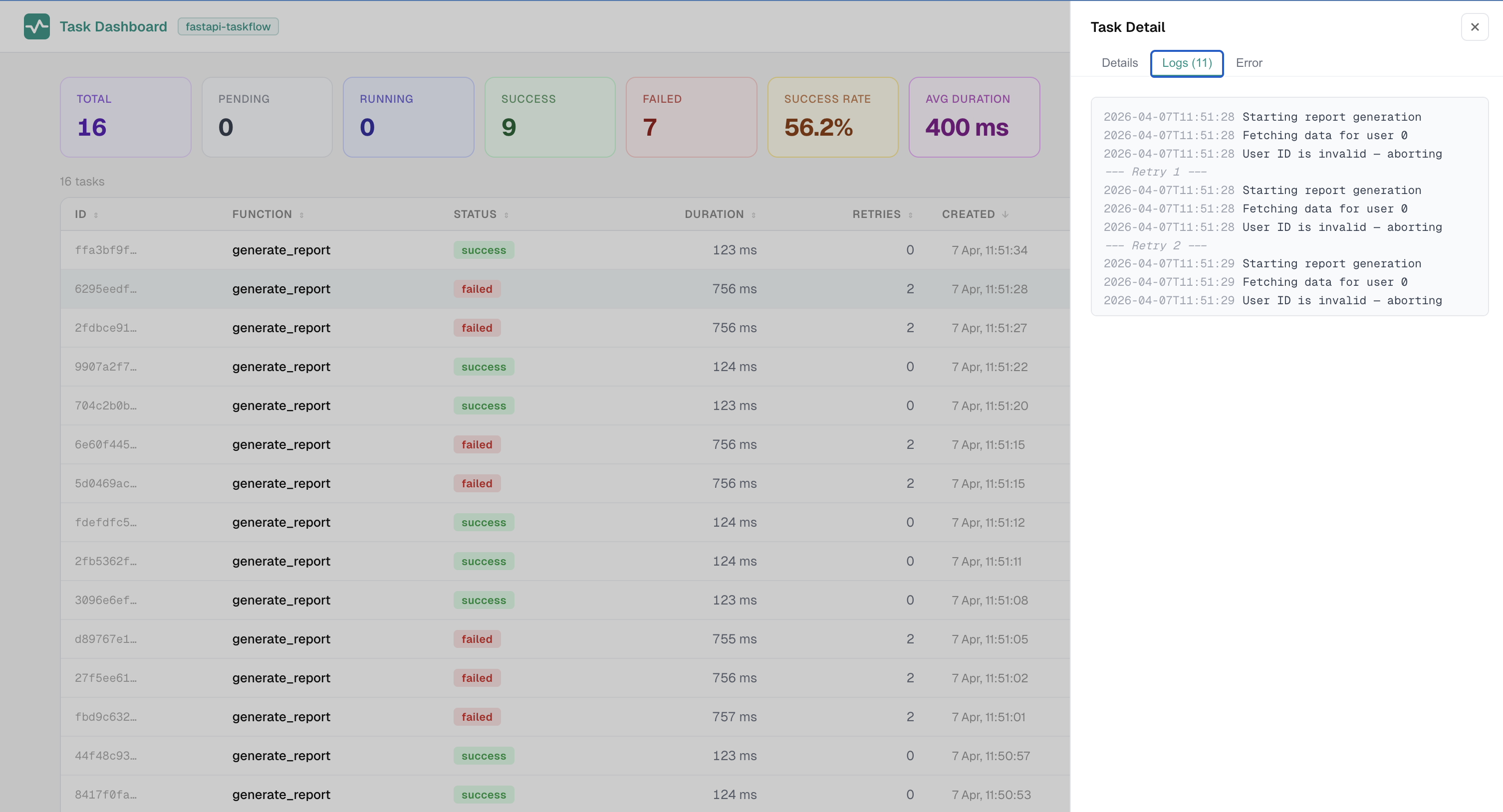
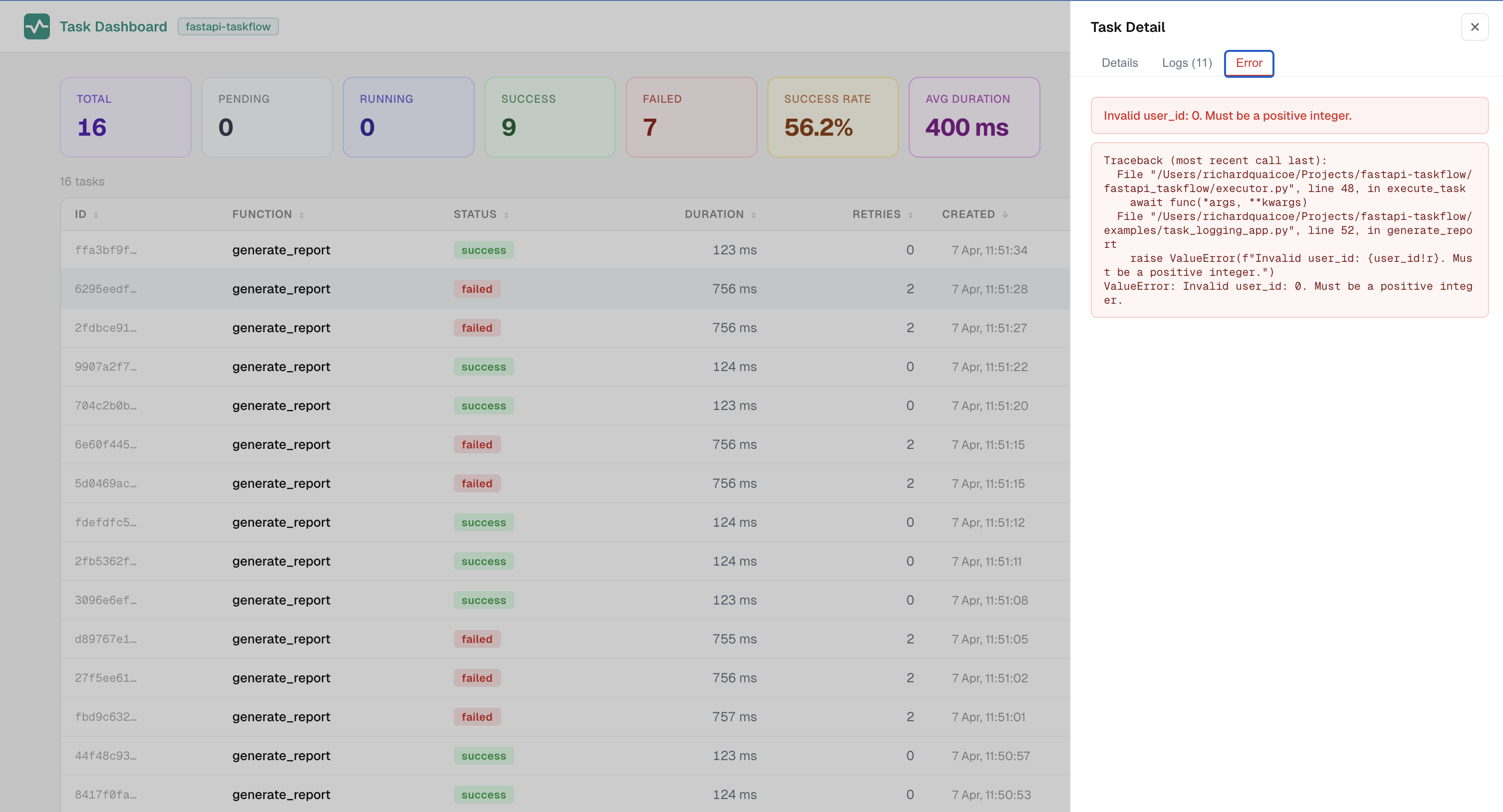
- Task IDs and full lifecycle tracking:
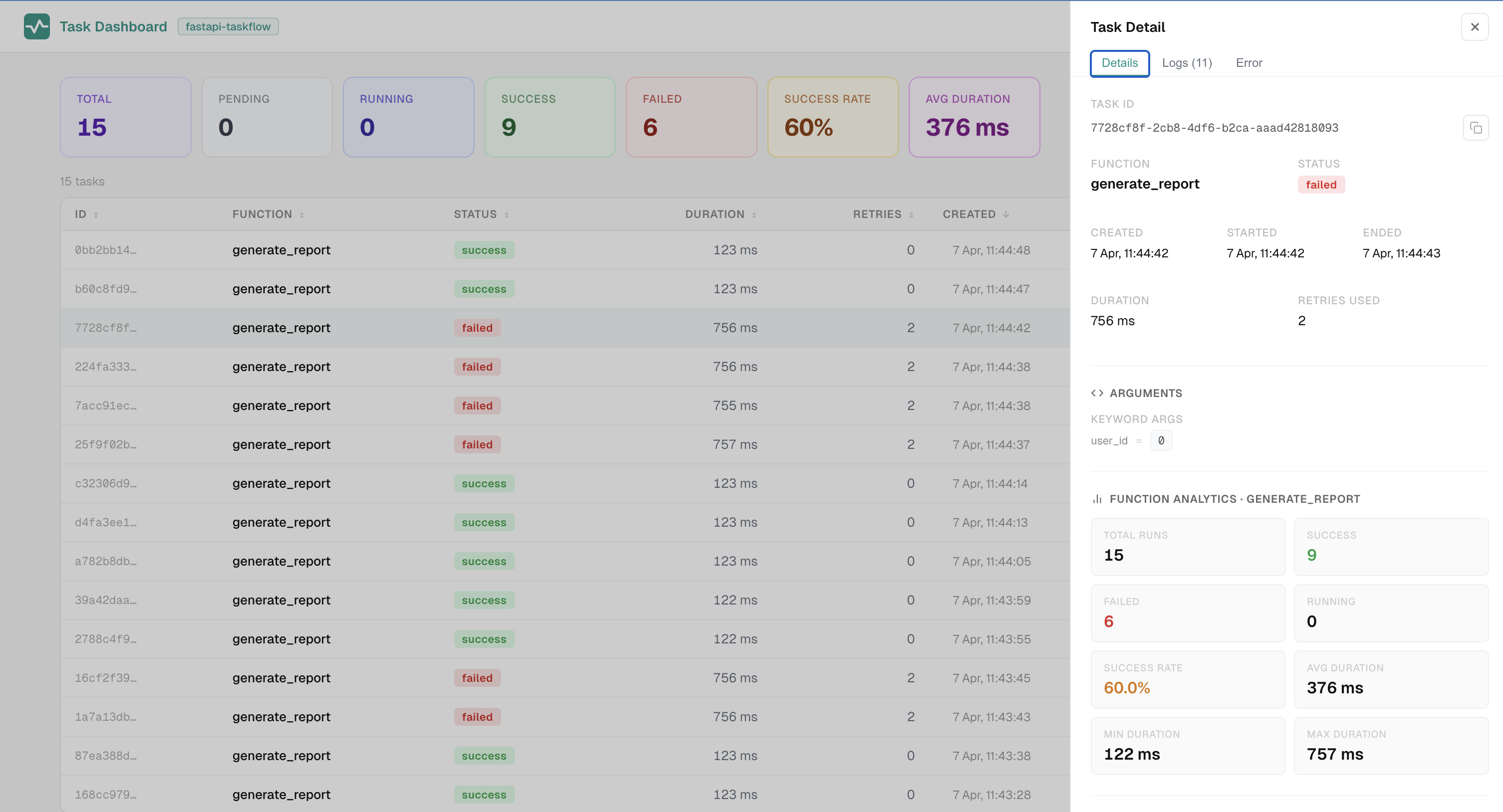
PENDING,RUNNING,SUCCESS,FAILED - Live admin dashboard over SSE at
/tasks/dashboard - SQLite persistence out of the box, Redis as an optional extra
- Pending task requeue: unfinished tasks at shutdown are re-dispatched on startup
- Zero-migration injection: keep your existing
BackgroundTasksannotations - Both sync and async task functions supported
Installation
pip install fastapi-taskflow
With Redis backend:
pip install "fastapi-taskflow[redis]"
Quick start
from fastapi import BackgroundTasks, FastAPI
from fastapi_taskflow import TaskAdmin, TaskManager

task_manager = TaskManager(snapshot_db="tasks.db", snapshot_interval=30.0)
app = FastAPI()

# auto_install=True patches FastAPI's BackgroundTasks injection so existing
# route signatures work without any changes.
TaskAdmin(app, task_manager, auto_install=True)


@task_manager.task(retries=3, delay=1.0, backoff=2.0)
def send_email(address: str) -> None:
    ...


@app.post("/signup")
def signup(email: str, background_tasks: BackgroundTasks):
    task_id = background_tasks.add_task(send_email, address=email)
    return {"task_id": task_id}
uvicorn examples.basic_app:app --reload

curl -X POST "http://localhost:8000/signup?email=user@example.com"
curl "http://localhost:8000/tasks"
curl "http://localhost:8000/tasks/metrics"
open "http://localhost:8000/tasks/dashboard"
Injection patterns
Three ways to get a ManagedBackgroundTasks instance into your routes:
# Pattern 1: keep the native annotation (requires auto_install=True)
def route(background_tasks: BackgroundTasks):
    task_id = background_tasks.add_task(my_func, arg)

# Pattern 2: explicit managed type (also requires auto_install=True)
from fastapi_taskflow import ManagedBackgroundTasks

def route(background_tasks: ManagedBackgroundTasks):
    task_id = background_tasks.add_task(my_func, arg)

# Pattern 3: explicit Depends — no install() required
from fastapi import Depends

def route(tasks=Depends(task_manager.get_tasks)):
    task_id = tasks.add_task(my_func, arg)
Decorator options
| Parameter | Type | Default | Description |
|---|---|---|---|
retries |
int |
0 |
Additional attempts after the first failure |
delay |
float |
0.0 |
Seconds before the first retry |
backoff |
float |
1.0 |
Multiplier applied to delay on each retry |
persist |
bool |
False |
Save this task for requeue on restart |
name |
str |
function name | Override the name shown in the dashboard |
API endpoints
| Method | Path | Description |
|---|---|---|
GET |
/tasks |
List all tasks |
GET |
/tasks/{task_id} |
Single task detail |
GET |
/tasks/metrics |
Aggregated stats |
GET |
/tasks/dashboard |
Live HTML dashboard |
What this is not
This is not a distributed task queue. If you need tasks to run on separate workers, survive across multiple app instances, or integrate with a message broker, use Celery, ARQ, Taskiq, or a similar tool. This library is for in-process background work that needs more control than the bare BackgroundTasks provides.
License
MIT
Project details
Verified details
These details have been verified by PyPIProject links
GitHub Statistics
Maintainers
Release history Release notifications | RSS feed


Download files
Download the file for your platform. If you're not sure which to choose, learn more about installing packages.
Source Distribution
Built Distribution
Filter files by name, interpreter, ABI, and platform.
If you're not sure about the file name format, learn more about wheel file names.
Copy a direct link to the current filters
File details
Details for the file fastapi_taskflow-0.2.0.tar.gz.
File metadata
- Download URL: fastapi_taskflow-0.2.0.tar.gz
- Upload date:
- Size: 1.5 MB
- Tags: Source
- Uploaded using Trusted Publishing? Yes
- Uploaded via: twine/6.1.0 CPython/3.13.7
File hashes
| Algorithm | Hash digest | |
|---|---|---|
| SHA256 |
020cc587d05378c80e869ab3876c54c4232cf7053a63aa14e37582e41ea0bf08
|
|
| MD5 |
947cfb95ccc7724f54db81188c008cae
|
|
| BLAKE2b-256 |
a7acaf13adf6ace7eaf60fa6f5b8841c15772a4eaced78f03108a2d7fd3db09d
|
Provenance
The following attestation bundles were made for fastapi_taskflow-0.2.0.tar.gz:
Publisher:
release.yml on Attakay78/fastapi-taskflow
-
Statement:
-
Statement type:
https://in-toto.io/Statement/v1 -
Predicate type:
https://docs.pypi.org/attestations/publish/v1 -
Subject name:
fastapi_taskflow-0.2.0.tar.gz -
Subject digest:
020cc587d05378c80e869ab3876c54c4232cf7053a63aa14e37582e41ea0bf08 - Sigstore transparency entry: 1247097220
- Sigstore integration time:
-
Permalink:
Attakay78/fastapi-taskflow@7acf11c811645ce0c6655d977d8baab159357344 -
Branch / Tag:
refs/heads/main - Owner: https://github.com/Attakay78
-
Access:
public
-
Token Issuer:
https://token.actions.githubusercontent.com -
Runner Environment:
github-hosted -
Publication workflow:
release.yml@7acf11c811645ce0c6655d977d8baab159357344 -
Trigger Event:
push
-
Statement type:
File details
Details for the file fastapi_taskflow-0.2.0-py3-none-any.whl.
File metadata
- Download URL: fastapi_taskflow-0.2.0-py3-none-any.whl
- Upload date:
- Size: 43.1 kB
- Tags: Python 3
- Uploaded using Trusted Publishing? Yes
- Uploaded via: twine/6.1.0 CPython/3.13.7
File hashes
| Algorithm | Hash digest | |
|---|---|---|
| SHA256 |
a9a9e43b5aca97aeaad69b6ec25e887d83638485489cc1ae8736e738aeb96eea
|
|
| MD5 |
fc45987d5e8ee89b7ab3a2b7596d467a
|
|
| BLAKE2b-256 |
f1a560f28ec593ac7423aecc32752d8e6f15c58e134899f2962c0cd2a1e88bad
|
Provenance
The following attestation bundles were made for fastapi_taskflow-0.2.0-py3-none-any.whl:
Publisher:
release.yml on Attakay78/fastapi-taskflow
-
Statement:
-
Statement type:
https://in-toto.io/Statement/v1 -
Predicate type:
https://docs.pypi.org/attestations/publish/v1 -
Subject name:
fastapi_taskflow-0.2.0-py3-none-any.whl -
Subject digest:
a9a9e43b5aca97aeaad69b6ec25e887d83638485489cc1ae8736e738aeb96eea - Sigstore transparency entry: 1247097227
- Sigstore integration time:
-
Permalink:
Attakay78/fastapi-taskflow@7acf11c811645ce0c6655d977d8baab159357344 -
Branch / Tag:
refs/heads/main - Owner: https://github.com/Attakay78
-
Access:
public
-
Token Issuer:
https://token.actions.githubusercontent.com -
Runner Environment:
github-hosted -
Publication workflow:
release.yml@7acf11c811645ce0c6655d977d8baab159357344 -
Trigger Event:
push
-
Statement type:






