
Turn FastAPI BackgroundTasks into a production-ready task system. Retries, control, resiliency and visibility without workers or brokers.
Verified details
These details have been verified by PyPIProject links
GitHub Statistics
Maintainers

Project description

Turn FastAPI BackgroundTasks into a production-ready task system.
Retries, control, resiliency and visibility without workers or brokers.
FastAPI's BackgroundTasks handles simple fire-and-forget work well. But in real applications you quickly hit the same gaps: tasks fail silently, you have no visibility into what ran, and nothing survives a restart.
fastapi-taskflow is a thin layer on top of what you already have. It does not compete with Celery, ARQ, Taskiq, or Dramatiq. It is built for teams who are already using FastAPI's native background tasks and want retries, resilience, status tracking, and a live dashboard without adding infrastructure.
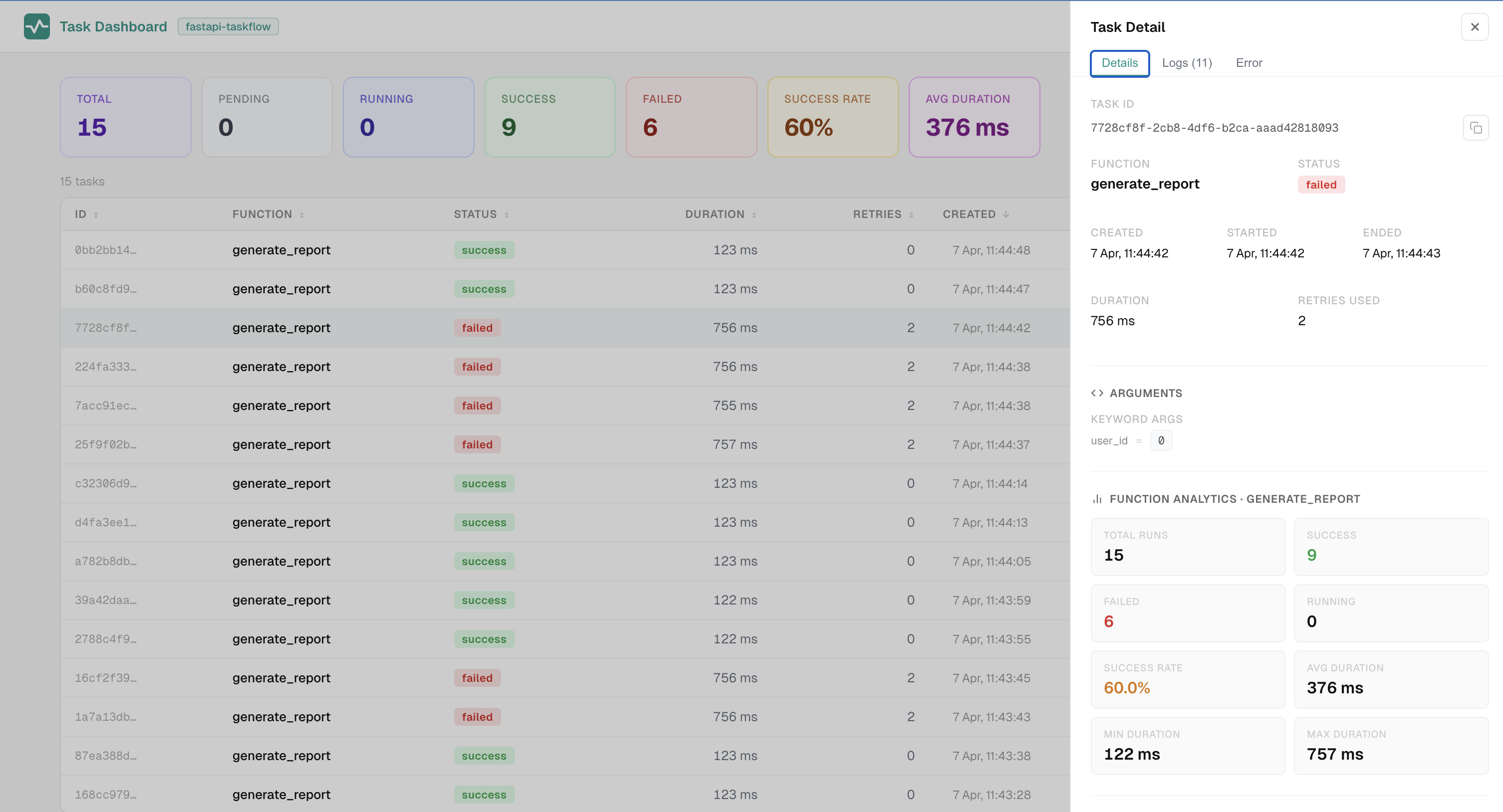
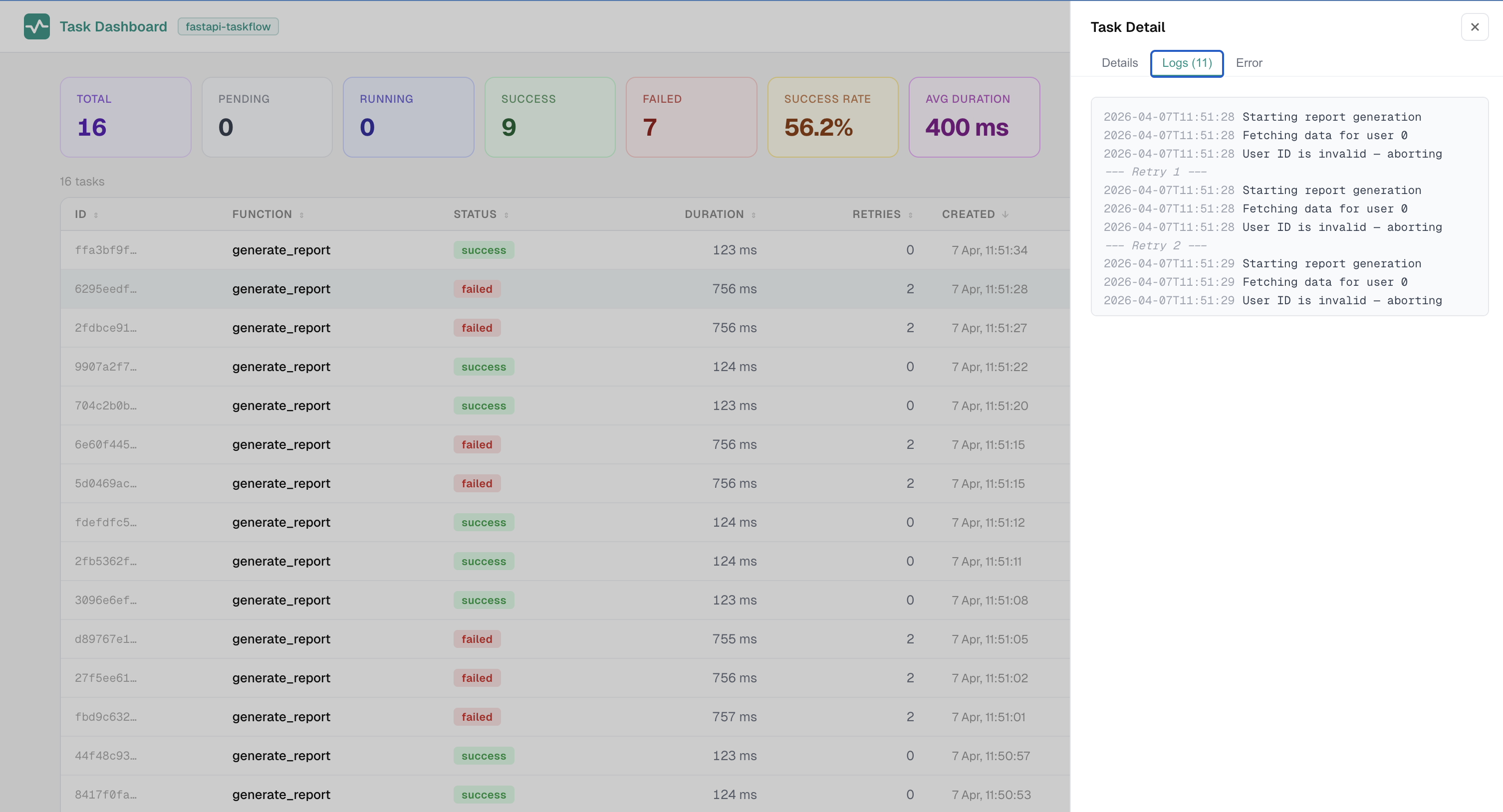
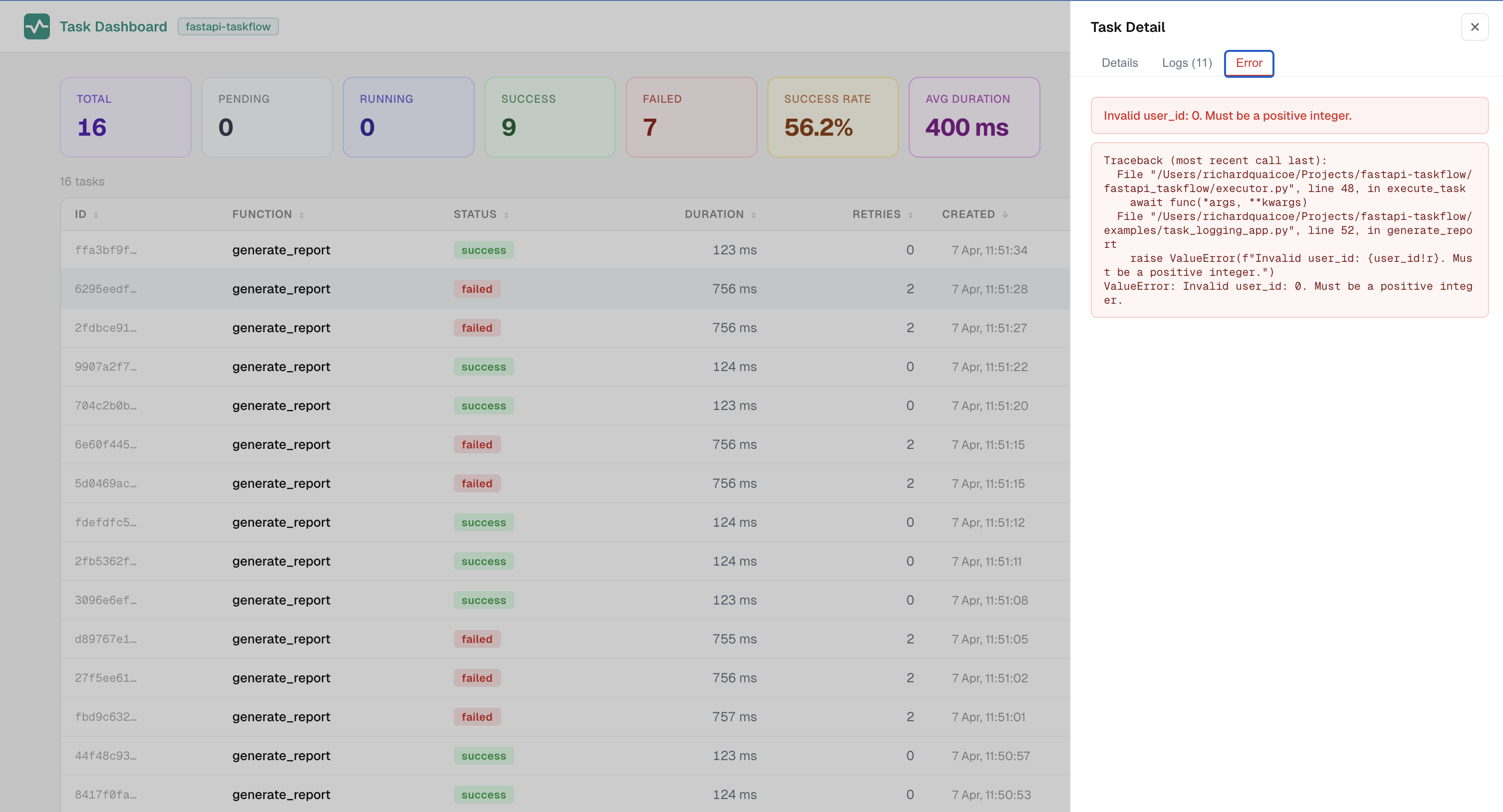
Features
- Automatic retries with configurable delay and exponential backoff
- Task IDs and full lifecycle tracking:
PENDING,RUNNING,SUCCESS,FAILED,INTERRUPTED - Live admin dashboard over SSE at
/tasks/dashboard - SQLite persistence out of the box, Redis as an optional extra
- Pending task requeue: unfinished tasks at shutdown are re-dispatched on startup
requeue_on_interrupt: opt-in requeue for idempotent tasks interrupted mid-execution- Idempotency keys: prevent duplicate execution of the same logical operation
- Multi-instance support: atomic requeue claiming, shared task history across instances
task_log(message, level=, **extra): structured log entries with level filtering and arbitrary extra fieldsget_task_context(): access task metadata (task_id, attempt, tags) from any code path inside a running task- Tags: attach key/value labels at enqueue time, forwarded to every log and lifecycle event
- Pluggable observers:
FileLogger,StdoutLogger,InMemoryLogger, and customTaskObserverimplementations - Argument encryption: Fernet-based at-rest encryption for task args and kwargs
- Trace context propagation: OpenTelemetry spans flow from the request into background execution (Python 3.11+)
- Concurrency controls: opt-in semaphore for async tasks and dedicated thread pool for sync tasks
- Priority queues:
priority=on@task_manager.task()oradd_task()— higher-priority tasks run first, equal-priority tasks are FIFO - Eager dispatch:
eager=Truestarts a task immediately viaasyncio.create_taskbefore the HTTP response is sent - Scheduled tasks:
@task_manager.schedule(every=)andcron=with distributed lock for multi-instance - Zero-migration injection: keep your existing
BackgroundTasksannotations - Both sync and async task functions supported
Installation
pip install fastapi-taskflow
With all optional dependencies:
pip install "fastapi-taskflow[all]"
Or install only what you need:
| Extra | Installs | Required for |
|---|---|---|
redis |
redis[asyncio] |
Redis persistence backend |
scheduler |
croniter |
Cron-based scheduled tasks |
encryption |
cryptography |
Argument encryption at rest |
pip install "fastapi-taskflow[redis]"
pip install "fastapi-taskflow[scheduler]"
pip install "fastapi-taskflow[encryption]"
Quick start
from fastapi import BackgroundTasks, FastAPI
from fastapi_taskflow import TaskAdmin, TaskManager

task_manager = TaskManager(snapshot_db="tasks.db", snapshot_interval=30.0)
app = FastAPI()

# auto_install=True patches FastAPI's BackgroundTasks injection so existing
# route signatures work without any changes.
TaskAdmin(app, task_manager, auto_install=True)


@task_manager.task(retries=3, delay=1.0, backoff=2.0)
def send_email(address: str) -> None:
    ...


@app.post("/signup")
def signup(email: str, background_tasks: BackgroundTasks):
    task_id = background_tasks.add_task(send_email, address=email)
    return {"task_id": task_id}
uvicorn examples.basic_app:app --reload

curl -X POST "http://localhost:8000/signup?email=user@example.com"
curl "http://localhost:8000/tasks"
curl "http://localhost:8000/tasks/metrics"
open "http://localhost:8000/tasks/dashboard"
Injection patterns
Three ways to get a ManagedBackgroundTasks instance into your routes:
# Pattern 1: keep the native annotation (requires auto_install=True)
def route(background_tasks: BackgroundTasks):
    task_id = background_tasks.add_task(my_func, arg)

# Pattern 2: explicit managed type (also requires auto_install=True)
from fastapi_taskflow import ManagedBackgroundTasks

def route(background_tasks: ManagedBackgroundTasks):
    task_id = background_tasks.add_task(my_func, arg)

# Pattern 3: explicit Depends — no install() required
from fastapi import Depends

def route(tasks=Depends(task_manager.get_tasks)):
    task_id = tasks.add_task(my_func, arg)
Decorator options
| Parameter | Type | Default | Description |
|---|---|---|---|
retries |
int |
0 |
Additional attempts after the first failure |
delay |
float |
0.0 |
Seconds before the first retry |
backoff |
float |
1.0 |
Multiplier applied to delay on each retry |
persist |
bool |
False |
Save this task for requeue on restart |
name |
str |
function name | Override the name shown in the dashboard |
requeue_on_interrupt |
bool |
False |
Requeue this task if it was mid-execution at shutdown. Only set for idempotent tasks. |
eager |
bool |
False |
Start the task via asyncio.create_task immediately when add_task() is called, before the response is sent. Per-call eager on add_task() overrides this. |
priority |
int | None |
None |
Route through the priority queue. Higher integers run first. Conventional range 1 (lowest) to 10 (highest). Per-call priority on add_task() overrides this. |
Idempotency keys
Pass an idempotency_key to add_task() to prevent the same logical operation from running twice. If a non-failed task with the same key already exists, the original task_id is returned and the task is not enqueued again.
task_id = tasks.add_task(send_notification, order_id, idempotency_key="order-42-notified")
Useful for handling retried HTTP requests, duplicate webhook deliveries, or double-clicks.
API endpoints
| Method | Path | Description |
|---|---|---|
GET |
/tasks |
List all tasks |
GET |
/tasks/{task_id} |
Single task detail |
GET |
/tasks/metrics |
Aggregated stats |
GET |
/tasks/dashboard |
Live HTML dashboard |
POST |
/tasks/{task_id}/retry |
Retry a failed or interrupted task |
Multi-instance deployments
fastapi-taskflow supports running multiple instances behind a load balancer when a shared backend is configured.
Same host, multiple processes -- use SQLite. All instances share the same file. Requeue claiming is atomic so only one instance picks up each task on restart.
Multiple hosts -- use Redis. All instances share the same Redis instance. Idempotency keys, requeue claiming, and completed task history all work across hosts.
from fastapi_taskflow.backends import RedisBackend

task_manager = TaskManager(
    snapshot_backend=RedisBackend("redis://localhost:6379/0"),
    requeue_pending=True,
)
Dashboard in multi-instance deployments -- the dashboard shows live tasks for the instance it is connected to. Completed tasks from all instances are visible via the shared backend (with a short cache window). For accurate live task visibility, route dashboard traffic to a single instance using sticky sessions at the load balancer. See the multi-instance guide for examples.
Known caveats:
- Live
PENDINGandRUNNINGtasks from other instances are not visible in real time. Each instance only holds its own in-memory state. - SQLite multi-instance only works when all processes share the same file path on the same host. It does not work across separate machines.
- Tasks in
RUNNINGstate at the time of a hard crash (SIGKILL, OOM) cannot be recovered. Only clean shutdowns trigger the pending store write.
Structured task logging
task_log() accepts an optional level= and arbitrary **extra keyword fields. Extras are forwarded to observers as structured fields rather than embedded in the message string.
from fastapi_taskflow import get_task_context, task_log

@task_manager.task(retries=3)
def process_order(order_id: int) -> None:
    ctx = get_task_context()
    task_log("Processing order", order_id=order_id, attempt=ctx.attempt if ctx else 0)
    task_log("Payment gateway error", level="warning", order_id=order_id, code=503)
get_task_context() returns a TaskContext with task_id, func_name, attempt, and tags from any code path inside a running task.
Observability
Pass one or more observers to loggers= to receive structured LogEvent and LifecycleEvent objects for every task_log() call and status transition:
from fastapi_taskflow import FileLogger, StdoutLogger, TaskManager

task_manager = TaskManager(
    snapshot_db="tasks.db",
    loggers=[
        FileLogger("tasks.log", log_lifecycle=True),
        StdoutLogger(log_lifecycle=True, min_level="warning"),
    ],
)
Built-in observers:
| Observer | Description |
|---|---|
FileLogger |
Rotating plain text file. Works with tail -f, grep, and log shippers. |
StdoutLogger |
Prints to stdout. Suitable for containers with a log agent. |
InMemoryLogger |
Captures events in memory for test assertions. |
The log_file shorthand on TaskManager remains fully supported and creates a FileLogger internally.
Tags
Attach key/value labels to a task at enqueue time. Tags flow through to every log and lifecycle event.
task_id = tasks.add_task(
    send_email,
    address=email,
    tags={"user_id": str(user_id), "source": "signup"},
)
Argument encryption
When tasks carry sensitive data, encrypt args and kwargs at rest with Fernet:
import os
from fastapi_taskflow import TaskManager

task_manager = TaskManager(
    snapshot_db="tasks.db",
    encrypt_args_key=os.environ["TASK_ENCRYPTION_KEY"],
)
Generate a key:
python -c "from cryptography.fernet import Fernet; print(Fernet.generate_key().decode())"
Args and kwargs are encrypted at add_task() time and decrypted only inside the executor. They are never stored in plain text in the task store, the database, or any log file. Requires pip install "fastapi-taskflow[encryption]".
Concurrency controls
By default, tasks share the event loop and thread pool with request handlers. Under burst task load this can increase request latency. Both controls are opt-in and do not change existing behaviour when not set.
max_concurrent_tasks — caps how many async tasks hold event loop time simultaneously via an asyncio.Semaphore. Tasks waiting for a slot are parked without blocking the loop.
max_sync_threads — runs sync task functions in a dedicated ThreadPoolExecutor, isolated from the default pool used by sync request handlers.
task_manager = TaskManager(
    snapshot_db="tasks.db",
    max_concurrent_tasks=10,
    max_sync_threads=8,
)
Both default to None. When not set, execution is identical to previous versions.
Priority queues
Pass priority= to control execution order. Higher-priority tasks run before lower-priority ones regardless of arrival order. Equal-priority tasks execute in arrival (FIFO) order.
@task_manager.task(retries=2, priority=9)
async def send_otp(phone: str) -> None:
    ...

@task_manager.task(priority=1)
def generate_report(user_id: int) -> None:
    ...

@app.post("/otp")
async def otp(phone: str, tasks=Depends(task_manager.get_tasks)):
    # Runs before the report even if the report was queued first.
    task_id = tasks.add_task(send_otp, phone)
    return {"task_id": task_id}
Set priority= at the decorator level as a default, then override it per call:
task_id = tasks.add_task(process_item, item_id, priority=10)  # rush job
task_id = tasks.add_task(process_item, item_id, priority=1)   # defer
task_id = tasks.add_task(process_item, item_id)               # use decorator default
Tasks with no priority route through Starlette's normal background task list unchanged.
Eager dispatch
Set eager=True to start a task via asyncio.create_task the moment add_task() is called, before FastAPI sends the response. The task is tracked and retried exactly like a normal task.
@task_manager.task(eager=True)
async def notify_user(user_id: int, body: str) -> None:
    await push_service.send(user_id, body)

@app.post("/action")
async def action(user_id: int, tasks=Depends(task_manager.get_tasks)):
    task_id = tasks.add_task(notify_user, user_id, "Your request is processing")
    # notify_user is already running here, before the response goes out.
    return {"task_id": task_id}
Override per call with tasks.add_task(func, arg, eager=True). When priority= is also set, the priority queue governs dispatch and eager is ignored.
Scheduled tasks
Run functions automatically at a fixed interval or on a cron expression. Scheduled tasks go through the same execution path as manually enqueued tasks, so retries, logging, persistence, and the dashboard all work without any extra setup.
from fastapi import FastAPI
from fastapi_taskflow import TaskAdmin, TaskManager, task_log

task_manager = TaskManager(snapshot_db="tasks.db")
app = FastAPI()
TaskAdmin(app, task_manager)


@task_manager.schedule(every=300, retries=1)
async def health_check() -> None:
    task_log("Running health check")
    ...


@task_manager.schedule(cron="0 2 * * *")
def nightly_cleanup() -> None:
    task_log("Starting cleanup")
    ...


@task_manager.schedule(cron="0 9 * * *", timezone="America/New_York")
async def morning_report() -> None:
    ...
Cron expressions require pip install "fastapi-taskflow[scheduler]". Interval-based schedules have no extra dependencies. Cron expressions default to UTC. Pass any IANA timezone name with timezone= to evaluate in local time.
Scheduled tasks also appear in the task registry, so they can be enqueued manually from a route alongside their automatic schedule. In multi-instance deployments, a distributed lock ensures only one instance fires each entry per interval.
Custom dashboard title
Replace the "fastapi-taskflow" label in the dashboard header and login page with your own app name:
TaskAdmin(app, task_manager, title="My App")
File logging
In addition to the observer system, a plain text log file can be configured directly on TaskManager:
task_manager = TaskManager(
    snapshot_db="tasks.db",
    log_file="tasks.log",
    log_lifecycle=True,
)
Each line has the format [task_id] [func_name] 2026-01-01T12:00:00 message. For multi-process or multi-host deployments see the file logging guide.
What this is not
fastapi-taskflow does not compete with Celery, ARQ, Taskiq, or Dramatiq. Those tools are built for distributed workers, message brokers, and high-throughput task routing. This library is for teams using FastAPI's native BackgroundTasks who want retries, visibility, and resilience without adding worker infrastructure.
License
MIT
Project details
Verified details
These details have been verified by PyPIProject links
GitHub Statistics
Maintainers
Release history Release notifications | RSS feed


Download files
Download the file for your platform. If you're not sure which to choose, learn more about installing packages.
Source Distribution
Built Distribution
Filter files by name, interpreter, ABI, and platform.
If you're not sure about the file name format, learn more about wheel file names.
Copy a direct link to the current filters
File details
Details for the file fastapi_taskflow-0.7.0.tar.gz.
File metadata
- Download URL: fastapi_taskflow-0.7.0.tar.gz
- Upload date:
- Size: 1.6 MB
- Tags: Source
- Uploaded using Trusted Publishing? Yes
- Uploaded via: twine/6.1.0 CPython/3.13.12
File hashes
| Algorithm | Hash digest | |
|---|---|---|
| SHA256 |
f0a13a78bc112840f2f74cb07b00d18c62002b64c28317c65f2bd398d81e4cc3
|
|
| MD5 |
072b8618e92548941b49963a2a20639f
|
|
| BLAKE2b-256 |
3cde684b0ba2c09d89c3660c5898cb4aeba0e3a8a7ce9f937a25c3f25e0906a3
|
Provenance
The following attestation bundles were made for fastapi_taskflow-0.7.0.tar.gz:
Publisher:
release.yml on Attakay78/fastapi-taskflow
-
Statement:
-
Statement type:
https://in-toto.io/Statement/v1 -
Predicate type:
https://docs.pypi.org/attestations/publish/v1 -
Subject name:
fastapi_taskflow-0.7.0.tar.gz -
Subject digest:
f0a13a78bc112840f2f74cb07b00d18c62002b64c28317c65f2bd398d81e4cc3 - Sigstore transparency entry: 1392294391
- Sigstore integration time:
-
Permalink:
Attakay78/fastapi-taskflow@101115e699ed3c62a6ae0ccdb394a519f5295f99 -
Branch / Tag:
refs/heads/main - Owner: https://github.com/Attakay78
-
Access:
public
-
Token Issuer:
https://token.actions.githubusercontent.com -
Runner Environment:
github-hosted -
Publication workflow:
release.yml@101115e699ed3c62a6ae0ccdb394a519f5295f99 -
Trigger Event:
workflow_run
-
Statement type:
File details
Details for the file fastapi_taskflow-0.7.0-py3-none-any.whl.
File metadata
- Download URL: fastapi_taskflow-0.7.0-py3-none-any.whl
- Upload date:
- Size: 100.5 kB
- Tags: Python 3
- Uploaded using Trusted Publishing? Yes
- Uploaded via: twine/6.1.0 CPython/3.13.12
File hashes
| Algorithm | Hash digest | |
|---|---|---|
| SHA256 |
9f069a4b3098e634a5ce98f3153fc26b397f68754f01687a103c9498f7368606
|
|
| MD5 |
5fc7fa5d5c84e5c8694e97289d06d454
|
|
| BLAKE2b-256 |
e0074424ac8925d2b45c16ec4ca3d0c5a1dc4ef7f74b20f437651ce1f4428b35
|
Provenance
The following attestation bundles were made for fastapi_taskflow-0.7.0-py3-none-any.whl:
Publisher:
release.yml on Attakay78/fastapi-taskflow
-
Statement:
-
Statement type:
https://in-toto.io/Statement/v1 -
Predicate type:
https://docs.pypi.org/attestations/publish/v1 -
Subject name:
fastapi_taskflow-0.7.0-py3-none-any.whl -
Subject digest:
9f069a4b3098e634a5ce98f3153fc26b397f68754f01687a103c9498f7368606 - Sigstore transparency entry: 1392294478
- Sigstore integration time:
-
Permalink:
Attakay78/fastapi-taskflow@101115e699ed3c62a6ae0ccdb394a519f5295f99 -
Branch / Tag:
refs/heads/main - Owner: https://github.com/Attakay78
-
Access:
public
-
Token Issuer:
https://token.actions.githubusercontent.com -
Runner Environment:
github-hosted -
Publication workflow:
release.yml@101115e699ed3c62a6ae0ccdb394a519f5295f99 -
Trigger Event:
workflow_run
-
Statement type:






