
Fast elliptic curve digital signatures

Project description


About
This is a python package for doing fast elliptic curve cryptography, specifically digital signatures.
Security
I am not aware of any current issues. There is no nonce reuse, no branching on secret material, and all points are validated before any operations are performed on them. Timing side challenges are mitigated via Montgomery point multiplication. Nonces are generated per RFC6979. The default curve used throughout the package is P256 which provides 128 bits of security. If you require a higher level of security you can specify the curve parameter in a method to use a curve over a bigger field e.g. P384. All that being said, crypto is tricky and I’m not beyond making mistakes. Please use a more established and reviewed library for security critical applications. Open an issue or email me if you see any security issue or risk with this library.
Python Versions Supported
The initial release of this package was targeted at python2.7. Earlier versions may work but have no guarantee of correctness or stability. As of release 1.2.1+ python3 is now supported as well.
Supported Primitives
Curves over Prime Fields
P192 (
fastecdsa.curve.P192)P224 (
fastecdsa.curve.P224)P256 (
fastecdsa.curve.P256)P384 (
fastecdsa.curve.P384)P521 (
fastecdsa.curve.P521)secp256k1 (bitcoin curve) (
fastecdsa.curve.secp256k1)
Arbitrary Curves
As of version 1.5.1 construction of arbitrary curves in Weierstrass form
(y^2 = x^3 + ax + b (mod p)) is supported. I advise against using custom curves for any
security critical applications. It’s up to you to make sure that the parameters you pass here are
correct, no validation of the base point is done, and in general no sanity checks are done. Use
at your own risk.
from fastecdsa.curve import Curve
curve = Curve(
    name,  # (str): The name of the curve
    p,  # (long): The value of p in the curve equation.
    a,  # (long): The value of a in the curve equation.
    b,  # (long): The value of b in the curve equation.
    q,  # (long): The order of the base point of the curve.
    gx,  # (long): The x coordinate of the base point of the curve.
    gy,  # (long): The y coordinate of the base point of the curve.
    oid  # (str): The object identifier of the curve (optional).
)
Hash Functions
Any hash function in the hashlib module (md5, sha1, sha224, sha256, sha384, sha512)
will work, as will any hash function that implements the same interface / core functionality as the
those in hashlib. For instance, if you wish to use SHA3 as the hash function the
pysha3 package will work with this library as long as it is at version >=1.0b1 (as previous
versions didn’t work with the hmac module which is used in nonce generation).
Performance
Curves over Prime Fields
Currently it does basic point multiplication significantly faster than the ecdsa
package. You can see the times for 1,000 signature and verification operations below,
fast.py corresponding to this package and regular.py corresponding
to ecdsa package.
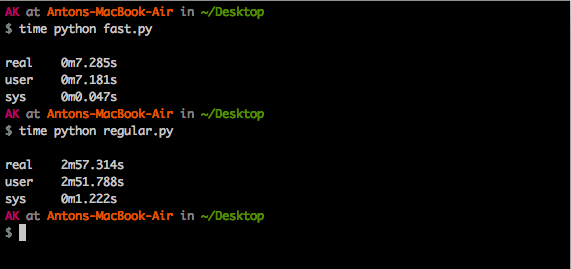
As you can see, this package in this case is ~25x faster.
Benchmarking
If you’d like to benchmark performance on your machine you can do so using the command:
$ python setup.py benchmarkThis will use the timeit module to benchmark 1000 signature and verification operations
for each curve supported by this package.
Installing
You can use pip: $ pip install fastecdsa or clone the repo and use
$ python setup.py install. Note that you need to have a C compiler.
You also need to have GMP on your system as the underlying
C code in this package includes the gmp.h header (and links against gmp
via the -lgmp flag). On debian you can install all dependencies as follows:
$ sudo apt-get install python-dev libgmp3-devUsage
Generating Keys
You can use this package to generate keys if you like. Recall that private keys on elliptic curves are integers, and public keys are points i.e. integer pairs.
from fastecdsa import keys, curve

# generate a private key for curve P256
priv_key = keys.gen_private_key(curve.P256)

# get the public key corresponding to the private key we just generated
pub_key = keys.get_public_key(priv_key, curve.P256)
Signing and Verifying
Some basic usage is shown below:
from fastecdsa import curve, ecdsa, keys
from hashlib import sha384

m = "a message to sign via ECDSA"  # some message

''' use default curve and hash function (P256 and SHA2) '''
private_key = keys.gen_private_key(curve.P256)
public_key = keys.get_public_key(private_key, curve.P256)
# standard signature, returns two integers
r, s = ecdsa.sign(m, private_key)
# should return True as the signature we just generated is valid.
valid = ecdsa.verify((r, s), m, public_key)

''' specify a different hash function to use with ECDSA '''
r, s = ecdsa.sign(m, private_key, hashfunc=sha384)
valid = ecdsa.verify((r, s), m, public_key, hashfunc=sha384)

''' specify a different curve to use with ECDSA '''
private_key = keys.gen_private_key(curve.P224)
public_key = keys.get_public_key(private_key, curve.P224)
r, s = ecdsa.sign(m, private_key, curve=curve.P224)
valid = ecdsa.verify((r, s), m, public_key, curve=curve.P224)

''' using SHA3 via pysha3>=1.0b1 package '''
import sha3  # pip install [--user] pysha3==1.0b1
from hashlib import sha3_256
private_key, public_key = keys.gen_keypair(curve.P256)
r, s = ecdsa.sign(m, private_key, hashfunc=sha3_256)
valid = ecdsa.verify((r, s), m, public_key, hashfunc=sha3_256)
Arbitrary Elliptic Curve Arithmetic
The Point class allows arbitrary arithmetic to be performed over curves. The two main
operations are point addition and point multiplication (by a scalar) which can be done via the
standard python operators (+ and * respectively):
# example taken from the document below (section 4.3.2):
# https://koclab.cs.ucsb.edu/teaching/cren/docs/w02/nist-routines.pdf

from fastecdsa.curve import P256
from fastecdsa.point import Point

xs = 0xde2444bebc8d36e682edd27e0f271508617519b3221a8fa0b77cab3989da97c9
ys = 0xc093ae7ff36e5380fc01a5aad1e66659702de80f53cec576b6350b243042a256
S = Point(xs, ys, curve=P256)

xt = 0x55a8b00f8da1d44e62f6b3b25316212e39540dc861c89575bb8cf92e35e0986b
yt = 0x5421c3209c2d6c704835d82ac4c3dd90f61a8a52598b9e7ab656e9d8c8b24316
T = Point(xt, yt, curve=P256)

# Point Addition
R = S + T

# Point Subtraction: (xs, ys) - (xt, yt) = (xs, ys) + (xt, -yt)
R = S - T

# Point Doubling
R = S + S  # produces the same value as the operation below
R = 2 * S  # S * 2 works fine too i.e. order doesn't matter

d = 0xc51e4753afdec1e6b6c6a5b992f43f8dd0c7a8933072708b6522468b2ffb06fd

# Scalar Multiplication
R = d * S  # S * d works fine too i.e. order doesn't matter

e = 0xd37f628ece72a462f0145cbefe3f0b355ee8332d37acdd83a358016aea029db7

# Joint Scalar Multiplication
R = d * S + e * T
Acknowledgements
Thanks to those below for contributing improvements:
targon
Release history Release notifications | RSS feed


Download files
Download the file for your platform. If you're not sure which to choose, learn more about installing packages.
Source Distribution
Built Distributions
Filter files by name, interpreter, ABI, and platform.
If you're not sure about the file name format, learn more about wheel file names.
Copy a direct link to the current filters
File details
Details for the file fastecdsa-1.5.2.tar.gz.
File metadata
- Download URL: fastecdsa-1.5.2.tar.gz
- Upload date:
- Size: 25.0 kB
- Tags: Source
- Uploaded using Trusted Publishing? No
File hashes
| Algorithm | Hash digest | |
|---|---|---|
| SHA256 |
255cb06434988b87ae7a4fc1a641d0edbb5f363015697e6ae0c36728f95cb012
|
|
| MD5 |
790bc4f227ec3bfb1644941408d5dd6d
|
|
| BLAKE2b-256 |
d3e64e65c88da32b7b6a1ba18312e6136dc0ff5f75184cd2f1cf9413fdcf0e17
|
File details
Details for the file fastecdsa-1.5.2-cp36-cp36m-macosx_10_12_x86_64.whl.
File metadata
- Download URL: fastecdsa-1.5.2-cp36-cp36m-macosx_10_12_x86_64.whl
- Upload date:
- Size: 34.7 kB
- Tags: CPython 3.6m, macOS 10.12+ x86-64
- Uploaded using Trusted Publishing? No
File hashes
| Algorithm | Hash digest | |
|---|---|---|
| SHA256 |
4499f2899f1d9a8c7d6bc14b1f1e7c51a65994d0fe5c6f2f7a1b025a22558e59
|
|
| MD5 |
b41e056231b0c95d10971496dfa883e2
|
|
| BLAKE2b-256 |
34702154999488cb9c40bd5b096648b462922cc328307f023d51f01834b551c9
|
File details
Details for the file fastecdsa-1.5.2-cp27-none-macosx_10_12_x86_64.whl.
File metadata
- Download URL: fastecdsa-1.5.2-cp27-none-macosx_10_12_x86_64.whl
- Upload date:
- Size: 34.5 kB
- Tags: CPython 2.7, macOS 10.12+ x86-64
- Uploaded using Trusted Publishing? No
File hashes
| Algorithm | Hash digest | |
|---|---|---|
| SHA256 |
ef678ec1bc16f3178f74b95b32aeb92bcda9eff0485530d17ec4b16eecb583d8
|
|
| MD5 |
376a1f53f2517db48782acf0c6505848
|
|
| BLAKE2b-256 |
4e50bf81b2382ef2cdaf9e2292d4e40398532a8bc322af96a2f6f1f939fa4c24
|






