
FluxFEM: A weak-form-centric differentiable finite element framework in JAX

Project description






FluxFEM
A weak-form-centric differentiable finite element framework in JAX, where variational forms are treated as first-class, differentiable programs.
Examples and Features
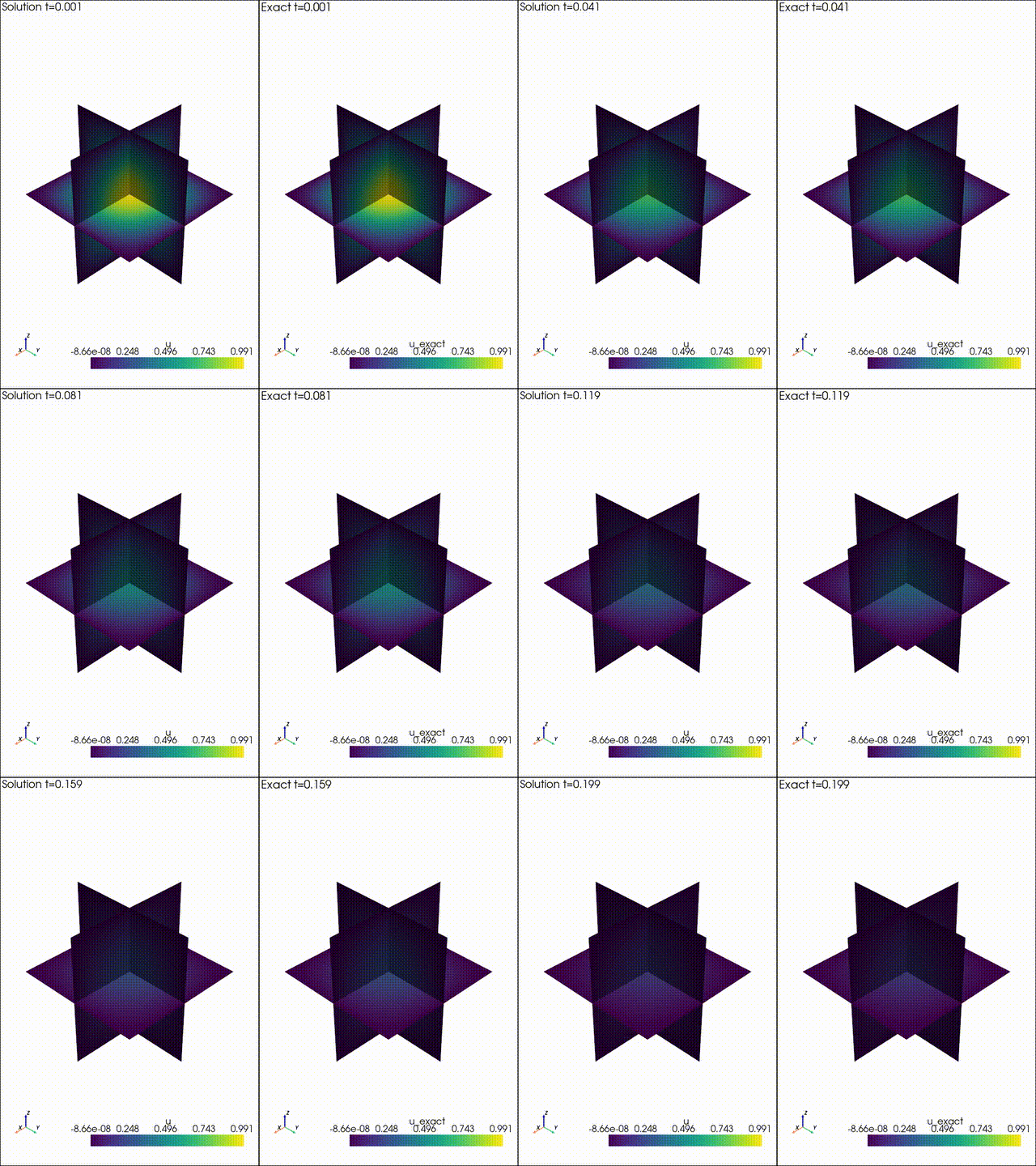
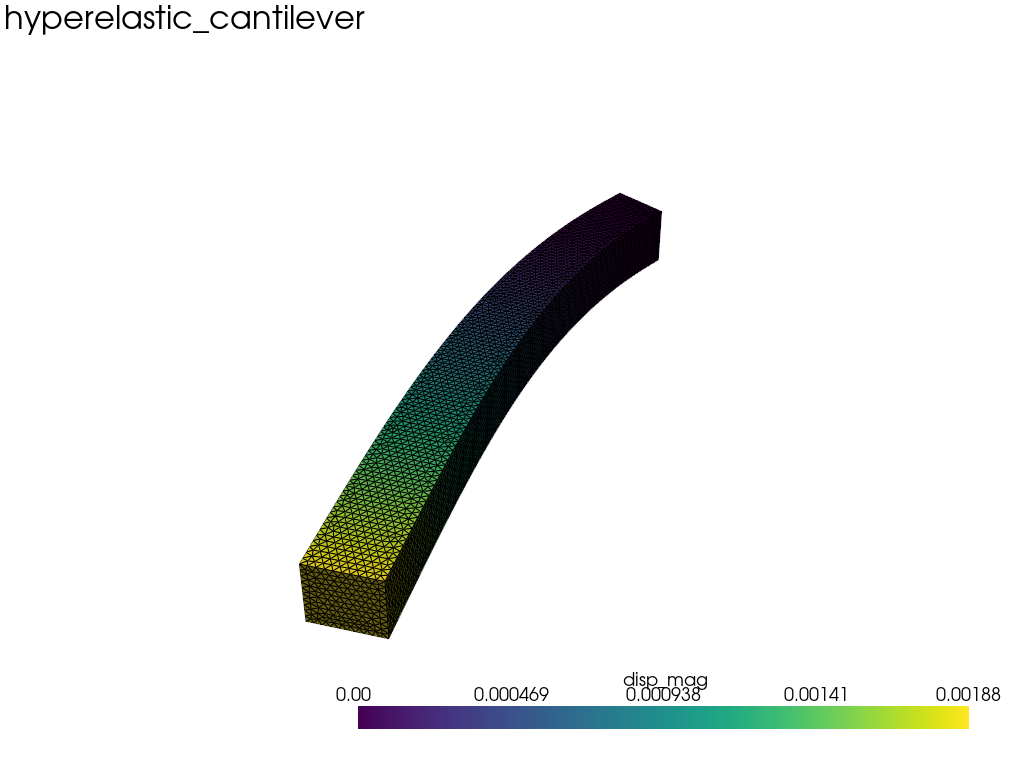
| Example 1: Diffusion | Example 2: Neo Neohookean Hyper Elasticity |
|
|
Features
- Built on JAX, enabling automatic differentiation with grad, jit, vmap, and related transformations.
- Weak-form–centric API that keeps formulations close to code; weak forms are represented as expression trees and compiled into element kernels, enabling automatic differentiation of residuals, tangents, and objectives.
- Two assembly approaches: weak-form-based assembly and a tensor-based (scikit-fem–style) assembly.
- Handles both linear and nonlinear analyses with AD in JAX.
Usage
This library provides two assembly approaches.
- A weak-form-based assembly, where the variational form is written symbolically and compiled before assembly.
- A tensor-based assembly, where trial and test functions are represented explicitly as element-level tensors and assembled accordingly (in the style of scikit-fem).
The first approach offers simplicity and clarity, as mathematical expressions can be written almost directly in code. For more complex operations (e.g. nonlinear materials, custom contractions, or experimental operators), the second approach can be easier to implement and debug.
Importantly, both approaches share the same underlying execution model: the weak-form-based assembly is compiled into the same element-level tensor representation used by the tensor-based assembly.
Assembly Flow
All expressions are first compiled into an element-level evaluation plan, which operates on quadrature-point–major tensors. This plan is then executed independently for each element during assembly.
As a result, both assembly approaches:
- use the same quadrature-major (q, a, i) data layout,
- perform element-local tensor contractions,
- and are fully compatible with JAX transformations such as
jit,vmap, and automatic differentiation.
weak-form-based assembly
In the weak-form-based assembly, the variational formulation itself is the primary object. The expression below defines a symbolic computation graph, which is later compiled and executed at the element level.
import fluxfem as ff
import fluxfem.helpers_wf as h_wf

space = ff.make_hex_space(mesh, dim=3, intorder=2)
D = ff.isotropic_3d_D(1.0, 0.3)

# u, v are symbolic trial/test fields (weak-form DSL objects).
# u.sym_grad / v.sym_grad are symbolic nodes (expression tree), not numeric arrays.
# dOmega() is the integral measure; the whole expression is compiled before assembly.
bilinear_form = ff.BilinearForm.volume(
    lambda u, v, D: h_wf.ddot(v.sym_grad, h_wf.matmul_std(D, u.sym_grad)) * h_wf.dOmega()
)

K_wf = space.assemble_bilinear_form(
    bilinear_form.get_compiled(),
    params=D,
)
tensor-based assembly (scikit-fem-style)
import fluxfem as ff
import numpy as np
import fluxfem.helpers_ts as h_ts

def linear_elasticity_form(ctx: ff.FormContext, D: np.ndarray) -> ff.jnp.ndarray:
    # ctx.trial / ctx.test are FormField objects (not raw arrays).
    # Their basis values and gradients are stored in a quadrature-major layout:
    #   ctx.trial.N (n_qp, n_nodes)
    #   ctx.trial.gradN: (n_qp, n_nodes, 3)
    #   Bu, Bv are jnp.ndarray: (n_qp, 6, n_dofs)
    Bu = h_ts.sym_grad(ctx.trial)
    Bv = h_ts.sym_grad(ctx.test)
    return h_ts.ddot(Bv, D, Bu) #(n_qp, n_dofs, n_dofs)


space = ff.make_hex_space(mesh, dim=3, intorder=2)
D = ff.isotropic_3d_D(1.0, 0.3)
K = space.assemble_bilinear_form(linear_elasticity_form, params=D)
Nonlinear residual assembly with a weak-form DSL (Neo-Hookean)
Below is a Neo-Hookean hyperelasticity example written in weak form. The residual is expressed symbolically and compiled into element-level kernels executed per element. No manual derivation of tangent operators is required; consistent tangents (Jacobians) for Newton-type solvers are obtained automatically via JAX AD.
def neo_hookean_residual_wf(v, u, params):
    mu = params["mu"]
    lam = params["lam"]
    F = h_wf.I(3) + h_wf.grad(u)  # deformation gradient
    C = h_wf.matmul(h_wf.transpose(F), F)
    C_inv = h_wf.inv(C)
    J = h_wf.det(F)

    S = mu * (h_wf.I(3) - C_inv) + lam * h_wf.log(J) * C_inv
    dE = 0.5 * (h_wf.matmul(h_wf.grad(v), F) + h_wf.transpose(h_wf.matmul(h_wf.grad(v), F)))
    return h_wf.ddot(S, dE) * h_wf.dOmega()
autodiff + jit compile
You can differentiate through the solve and JIT compile the hot path. The inverse diffusion tutorial shows this pattern:
def loss_theta(theta):
    kappa = jnp.exp(theta)
    u = solve_u_jit(kappa, traction_true)
    diff = u[obs_idx_j] - u_obs[obs_idx_j]
    return 0.5 * jnp.mean(diff * diff)

solve_u_jit = jax.jit(solve_u)
loss_theta_jit = jax.jit(loss_theta)
grad_fn = jax.jit(jax.grad(loss_theta))
Documentation
Full documentation, tutorials, and API reference are hosted at this site.
SetUp
You can install FluxFEM either via pip or Poetry.
Supported Python Versions
FluxFEM supports Python 3.11–3.13:
Choose one of the following methods:
Using pip
pip install fluxfem
Using poetry
poetry add fluxfem
Acknowledgements
I acknowledge the open-source software, libraries, and communities that made this work possible.
Release history Release notifications | RSS feed


Download files
Download the file for your platform. If you're not sure which to choose, learn more about installing packages.
Source Distribution
Built Distribution
Filter files by name, interpreter, ABI, and platform.
If you're not sure about the file name format, learn more about wheel file names.
Copy a direct link to the current filters
File details
Details for the file fluxfem-0.1.5.tar.gz.
File metadata
- Download URL: fluxfem-0.1.5.tar.gz
- Upload date:
- Size: 78.1 kB
- Tags: Source
- Uploaded using Trusted Publishing? No
- Uploaded via: poetry/1.8.3 CPython/3.11.14 Linux/6.11.0-1018-azure
File hashes
| Algorithm | Hash digest | |
|---|---|---|
| SHA256 |
ada15cd3e25101d20d0992f8c92d1dd830feb33358fbb8ff068709e0c1488f4a
|
|
| MD5 |
ad9773da5514a38f96a6a7ea37b4e7cc
|
|
| BLAKE2b-256 |
b86c1f1565631081092957a1cb409f694491da7046e627f545b8804be00b2dc8
|
File details
Details for the file fluxfem-0.1.5-py3-none-any.whl.
File metadata
- Download URL: fluxfem-0.1.5-py3-none-any.whl
- Upload date:
- Size: 92.4 kB
- Tags: Python 3
- Uploaded using Trusted Publishing? No
- Uploaded via: poetry/1.8.3 CPython/3.11.14 Linux/6.11.0-1018-azure
File hashes
| Algorithm | Hash digest | |
|---|---|---|
| SHA256 |
f1f52338b2cd830b5e6315927c41cfa8a46c02020ca991856c19ea76629a5a64
|
|
| MD5 |
25d2ed3c71e68cb0dc24035c6b7f7190
|
|
| BLAKE2b-256 |
30424566415917f5614cc1b02ad5513e8a547bab4f4f3377ecf5a20e9a6eee3c
|






