
FluxFEM: A weak-form-centric differentiable finite element framework in JAX

Project description






FluxFEM
A weak-form-centric differentiable finite element framework in JAX, where variational forms are treated as first-class, differentiable programs.
Examples and Features
| Example 1: Diffusion | Example 2: Neo Neohookean Hyper Elasticity |
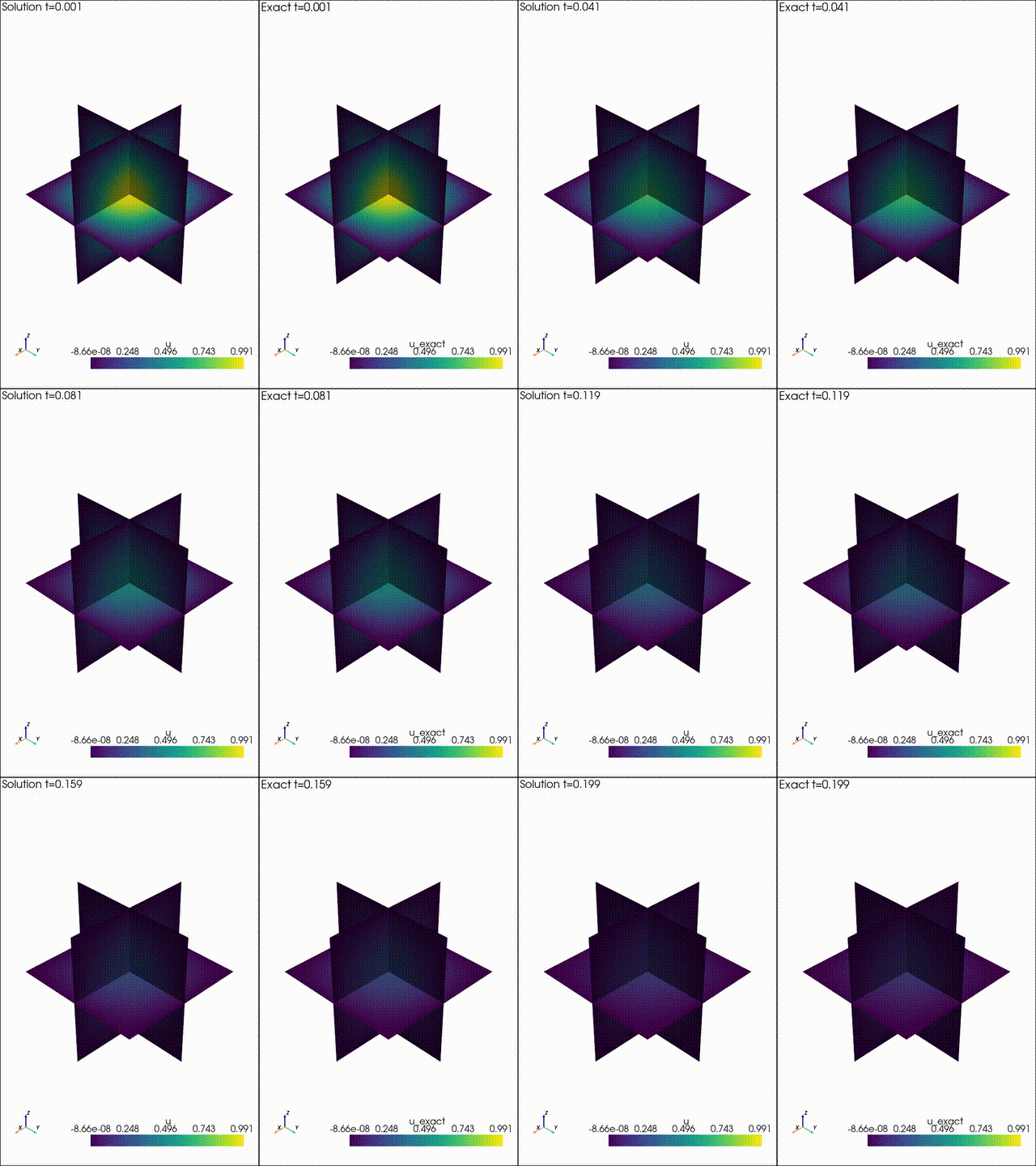
|
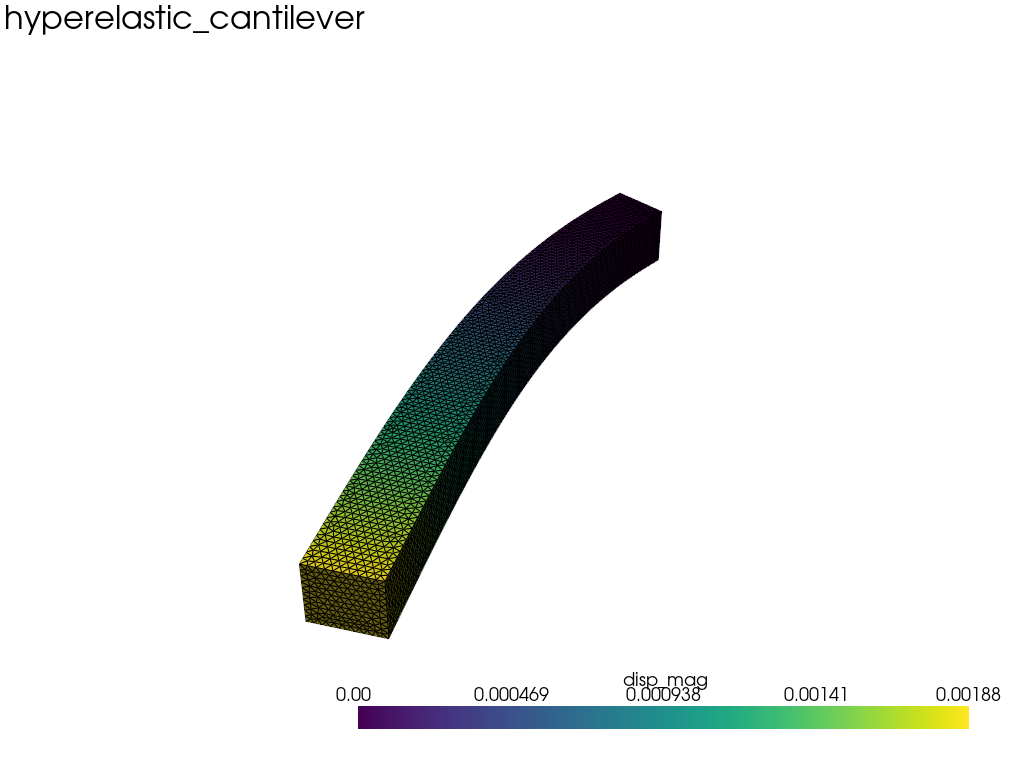
|
Features
- Built on JAX, enabling automatic differentiation with grad, jit, vmap, and related transformations.
- Weak-form–centric API that keeps formulations close to code; weak forms are represented as expression trees and compiled into element kernels, enabling automatic differentiation of residuals, tangents, and objectives.
- Two assembly approaches: tensor-based (scikit-fem–style) assembly and weak-form-based assembly.
- Handles both linear and nonlinear analyses with AD in JAX.
- Optional PETSc/PETSc-shell solvers via
petsc4pyfor scalable linear solves (addfluxfem[petsc]).
Usage
This library provides two assembly approaches.
- A tensor-based assembly, where trial and test functions are represented explicitly as element-level tensors and assembled accordingly (in the style of scikit-fem).
- A weak-form-based assembly, where the variational form is written symbolically and compiled before assembly.
The two approaches are functionally equivalent and share the same element-level execution model,
but they differ in how you author the weak form. The example below mirrors the paper's diffusion
case and makes the distinction explicit with jnp.
Assembly Flow
All expressions are first compiled into an element-level evaluation plan, which operates on quadrature-point–major tensors. This plan is then executed independently for each element during assembly.
As a result, both assembly approaches:
- use the same quadrature-major (q, a, i) data layout,
- perform element-local tensor contractions,
- and are fully compatible with JAX transformations such as
jit,vmap, and automatic differentiation.
kernel-based assembly (explicit JIT units)
If you want to control JIT boundaries explicitly, build a JIT-compiled element kernel
and pass it to space.assemble. The kernel must return the integrated element
contribution (not the quadrature integrand). For untagged raw kernels, pass kind=.
import fluxfem as ff
import jax
import jax.numpy as jnp

space = ff.make_hex_space(mesh, dim=1, intorder=2)

# bilinear: kernel(ctx) -> (n_ldofs, n_ldofs)
ker_K = ff.make_element_bilinear_kernel(ff.diffusion_form, 1.0, jit=True)
K = space.assemble(ff.diffusion_form, 1.0, kernel=ker_K)

# linear: kernel(ctx) -> (n_ldofs,)
def linear_kernel(ctx):
    integrand = ff.scalar_body_force_form(ctx, 2.0)
    wJ = ctx.w * ctx.test.detJ
    return (integrand * wJ[:, None]).sum(axis=0)

ker_F = jax.jit(linear_kernel)
F = space.assemble(ff.scalar_body_force_form, 2.0, kernel=ker_F)
tensor-based vs weak-form-based (diffusion example)
tensor-based assembly
The tensor-based assembly provides an explicit, low-level formulation with element kernels written using jax.numpy.(jnp).
import fluxfem as ff
import jax.numpy as jnp

@ff.kernel(kind="bilinear", domain="volume")
def diffusion_form(ctx: ff.FormContext, kappa):
    # ctx.test.gradN / ctx.trial.gradN: (n_qp, n_nodes, dim)
    # output tensor: (n_qp, n_nodes, n_nodes)
    return kappa * jnp.einsum("qia,qja->qij", ctx.test.gradN, ctx.trial.gradN)

space = ff.make_hex_space(mesh, dim=3, intorder=2)
params = ff.Params(kappa=1.0)
K_ts = space.assemble(diffusion_form, params=params.kappa)
weak-form-based assembly
In the weak-form-based assembly, the variational formulation itself is the primary object. The expression below defines a symbolic computation graph, which is later compiled and executed at the element level.
import fluxfem as ff
import fluxfem.helpers_wf as h_wf

space = ff.make_hex_space(mesh, dim=3, intorder=2)
params = ff.Params(kappa=1.0)

# u, v are symbolic trial/test fields (weak-form DSL objects).
# u.grad / v.grad are symbolic nodes (expression tree), not numeric arrays.
# dOmega() is the integral measure; the whole expression is compiled before assembly.
form_wf = ff.BilinearForm.volume(
    lambda u, v, p: p.kappa * (v.grad @ u.grad) * h_wf.dOmega()
).get_compiled()

K_wf = space.assemble(form_wf, params=params)
Linear Elasticity assembly (weak-form based assembly)
import fluxfem as ff
import fluxfem.helpers_wf as h_wf

space = ff.make_hex_space(mesh, dim=3, intorder=2)
D = ff.isotropic_3d_D(1.0, 0.3)

form_wf = ff.BilinearForm.volume(
    lambda u, v, D: h_wf.ddot(v.sym_grad, D @ u.sym_grad) * h_wf.dOmega()
).get_compiled()

K = space.assemble(form_wf, params=D)
Neo-Hookean residual assembly (weak-form DSL)
Below is a Neo-Hookean hyperelasticity example written in weak form. The residual is expressed symbolically and compiled into element-level kernels executed per element. No manual derivation of tangent operators is required; consistent tangents (Jacobians) for Newton-type solvers are obtained automatically via JAX AD.
def neo_hookean_residual_wf(v, u, params):
    mu = params["mu"]
    lam = params["lam"]
    F = h_wf.I(3) + h_wf.grad(u)  # deformation gradient
    C = h_wf.matmul(h_wf.transpose(F), F)
    C_inv = h_wf.inv(C)
    J = h_wf.det(F)

    S = mu * (h_wf.I(3) - C_inv) + lam * h_wf.log(J) * C_inv
    dE = 0.5 * (h_wf.matmul(h_wf.grad(v), F) + h_wf.transpose(h_wf.matmul(h_wf.grad(v), F)))
    return h_wf.ddot(S, dE) * h_wf.dOmega()

res_form = ff.ResidualForm.volume(neo_hookean_residual_wf).get_compiled()
autodiff + jit compile
You can differentiate through the solve and JIT compile the hot path. The inverse diffusion tutorial shows this pattern:
def loss_theta(theta):
    kappa = jnp.exp(theta)
    u = solve_u_jit(kappa, traction_true)
    diff = u[obs_idx_j] - u_obs[obs_idx_j]
    return 0.5 * jnp.mean(diff * diff)

solve_u_jit = jax.jit(solve_u)
loss_theta_jit = jax.jit(loss_theta)
grad_fn = jax.jit(jax.grad(loss_theta))
FESpace vs FESpacePytree
Use FESpace for standard workflows with a fixed mesh. When you need to carry
the space through JAX transformations (e.g., shape optimization where mesh
coordinates are part of the computation), use FESpacePytree via
make_*_space_pytree(...). This keeps the mesh/basis in the pytree so
jax.jit/jax.grad can see geometry changes.
Mixed systems
Mixed problems can be assembled from residual blocks and solved as a coupled system.
import fluxfem as ff
import jax.numpy as jnp

mixed = ff.MixedFESpace({"u": space_u, "p": space_p})
residuals = ff.make_mixed_residuals(
    u=res_u,  # (v, u, params) -> Expr
    p=res_p,  # (q, u, params) -> Expr
)
problem = ff.MixedProblem(mixed, residuals, params=ff.Params(alpha=1.0))

u0 = jnp.zeros(mixed.n_dofs)
R = problem.assemble_residual(u0)
J = problem.assemble_jacobian(u0, return_flux_matrix=True)
Block assembly
For constraints like contact problems (e.g., adding Lagrange multipliers), build a block matrix explicitly:
from fluxfem import solver as ff_solver

# Example blocks from contact coupling
K_uu = ...
K_cc = ...
K_uc = ...

blocks = ff_solver.make_block_matrix(
    diag=ff_solver.block_diag(order=("u", "c"), u=K_uu, c=K_cc),
    rel={("u", "c"): K_uc},
    symmetric=True,
    transpose_rule="T",
)

# Lazy container; assemble when you need the global matrix.
K = blocks.assemble()
FluxFEM also provides contact utilities like ContactSurfaceSpace to build constraint contributions.
Documentation
Full documentation, tutorials, and API reference are hosted at this site.
Tutorials
tutorials/linearelastic_tensile_bar.py(linear elasticity, weak-form assembly)tutorials/neo_hookean_cantilever.py(nonlinear hyperelasticity)tutorials/thermoelastic_bar_1d.py/tutorials/thermoelastic_bar_1d_mixed.py(thermoelastic coupling)tutorials/petsc_shell_poisson_demo.py(PETSc shell solver integration; see alsotutorials/petsc_shell_poisson_pmat_demo.py)
Setup
You can install FluxFEM either via pip or Poetry.
Supported Python Versions
FluxFEM supports Python 3.11–3.13:
Choose one of the following methods:
Using pip
pip install fluxfem
pip install "fluxfem[cuda12]" -f https://storage.googleapis.com/jax-releases/jax_cuda_releases.html
Using poetry
poetry add fluxfem
poetry add fluxfem[cuda12]
PETSc Integration
Optional PETSc-based solvers are available via petsc4py. Enable with the extra:
pip install "fluxfem[petsc]"
or
pip install "fluxfem[petsc,cuda12]" -f https://storage.googleapis.com/jax-releases/jax_cuda_releases.html
poetry add fluxfem --extras "petsc"
or
poetry add "fluxfem[petsc,cuda12]"
or
poetry add fluxfem --extras "petsc" --extras "cuda12"
Note: you must match the petsc4py version to the PETSc version you have
installed. The current FluxFEM extra pins petsc4py==3.24.4 (see
[project.optional-dependencies]), so make sure your PETSc install is
compatible with that petsc4py release, or override it to match your PETSc
build.
GPU note: this repo currently tests CUDA via the cuda12 extra only. Other CUDA
versions are not covered by CI and may require manual JAX installation.
Acknowledgements
I acknowledge the open-source software, libraries, and communities that made this work possible.
Release history Release notifications | RSS feed


Download files
Download the file for your platform. If you're not sure which to choose, learn more about installing packages.
Source Distribution
Built Distribution
Filter files by name, interpreter, ABI, and platform.
If you're not sure about the file name format, learn more about wheel file names.
Copy a direct link to the current filters
File details
Details for the file fluxfem-0.2.3.tar.gz.
File metadata
- Download URL: fluxfem-0.2.3.tar.gz
- Upload date:
- Size: 157.9 kB
- Tags: Source
- Uploaded using Trusted Publishing? No
- Uploaded via: poetry/1.8.3 CPython/3.11.14 Linux/6.11.0-1018-azure
File hashes
| Algorithm | Hash digest | |
|---|---|---|
| SHA256 |
a65ce1f3db766e65996058e086858a1300a75a951d0780073f44be39f1d295f1
|
|
| MD5 |
4c6ed75e708a2a6cb501e4f86e3c9ea0
|
|
| BLAKE2b-256 |
851355c2b2e07aac4ecbcf32079939b56e2043c4e79169355ddce7351d58fb8e
|
File details
Details for the file fluxfem-0.2.3-py3-none-any.whl.
File metadata
- Download URL: fluxfem-0.2.3-py3-none-any.whl
- Upload date:
- Size: 178.1 kB
- Tags: Python 3
- Uploaded using Trusted Publishing? No
- Uploaded via: poetry/1.8.3 CPython/3.11.14 Linux/6.11.0-1018-azure
File hashes
| Algorithm | Hash digest | |
|---|---|---|
| SHA256 |
a5d42c60d4cbbe9f098e5235961f2d05a1f0ff13bdceaa34ed1793eb99b0c3eb
|
|
| MD5 |
fb236eda57a4485bafb6f7966e668f9b
|
|
| BLAKE2b-256 |
c33b30b2c43fc9c51537b7055c8272632e492c193fe3e6f0b7c0e64d5b704a59
|






