
This release is a pre-release and may not be stable for production use.
Flower: A Friendly Federated AI Framework

Website |
Blog |
Docs |
Summit |
Slack






Flower (flwr) is a framework for building federated AI systems. The
design of Flower is based on a few guiding principles:
-
Customizable: Federated learning systems vary wildly from one use case to another. Flower allows for a wide range of different configurations depending on the needs of each individual use case.
-
Extendable: Flower originated from a research project at the University of Oxford, so it was built with AI research in mind. Many components can be extended and overridden to build new state-of-the-art systems.
-
Framework-agnostic: Different machine learning frameworks have different strengths. Flower can be used with any machine learning framework, for example, PyTorch, TensorFlow, Hugging Face Transformers, PyTorch Lightning, scikit-learn, JAX, TFLite, MONAI, fastai, MLX, XGBoost, LeRobot for federated robots, Pandas for federated analytics, or even raw NumPy for users who enjoy computing gradients by hand.
-
Understandable: Flower is written with maintainability in mind. The community is encouraged to both read and contribute to the codebase.
Meet the Flower community on flower.ai!
Federated Learning Tutorial
Flower's goal is to make federated learning accessible to everyone. This series of tutorials introduces the fundamentals of federated learning and how to implement them in Flower.
Stay tuned, more tutorials are coming soon. Topics include Privacy and Security in Federated Learning, and Scaling Federated Learning.
30-Minute Federated Learning Tutorial

Documentation
- Installation
- Quickstart (TensorFlow)
- Quickstart (PyTorch)
- Quickstart (Hugging Face)
- Quickstart (PyTorch Lightning)
- Quickstart (Pandas)
- Quickstart (fastai)
- Quickstart (JAX)
- Quickstart (scikit-learn)
- Quickstart (Android [TFLite])
- Quickstart (iOS [CoreML])
Flower Baselines
Flower Baselines is a collection of community-contributed projects that reproduce the experiments performed in popular federated learning publications. Researchers can build on Flower Baselines to quickly evaluate new ideas. The Flower community loves contributions! Make your work more visible and enable others to build on it by contributing it as a baseline!
- DASHA
- DepthFL
- FedBN
- FedMeta
- FedMLB
- FedPer
- FedProx
- FedNova
- HeteroFL
- FedAvgM
- FedRep
- FedStar
- FedWav2vec2
- FjORD
- MOON
- niid-Bench
- TAMUNA
- FedVSSL
- FedXGBoost
- FedPara
- FedAvg
- FedOpt
Please refer to the Flower Baselines Documentation for a detailed categorization of baselines and for additional info including:
Flower Usage Examples
Several code examples show different usage scenarios of Flower (in combination with popular machine learning frameworks such as PyTorch or TensorFlow).
Quickstart examples:
- Quickstart (TensorFlow)
- Quickstart (PyTorch)
- Quickstart (Hugging Face)
- Quickstart (PyTorch Lightning)
- Quickstart (fastai)
- Quickstart (Pandas)
- Quickstart (JAX)
- Quickstart (MONAI)
- Quickstart (scikit-learn)
- Quickstart (Android [TFLite])
- Quickstart (iOS [CoreML])
- Quickstart (MLX)
- Quickstart (XGBoost)
Other examples:
- Raspberry Pi & Nvidia Jetson Tutorial
- PyTorch: From Centralized to Federated
- Vertical FL
- Federated Finetuning of OpenAI's Whisper
- Federated Finetuning of Large Language Model
- Federated Finetuning of a Vision Transformer
- Advanced Flower with TensorFlow/Keras
- Advanced Flower with PyTorch
- Comprehensive Flower+XGBoost
- Flower with KaplanMeierFitter from the lifelines library
- Sample Level Privacy with Opacus
- Flower with a Tabular Dataset
Community
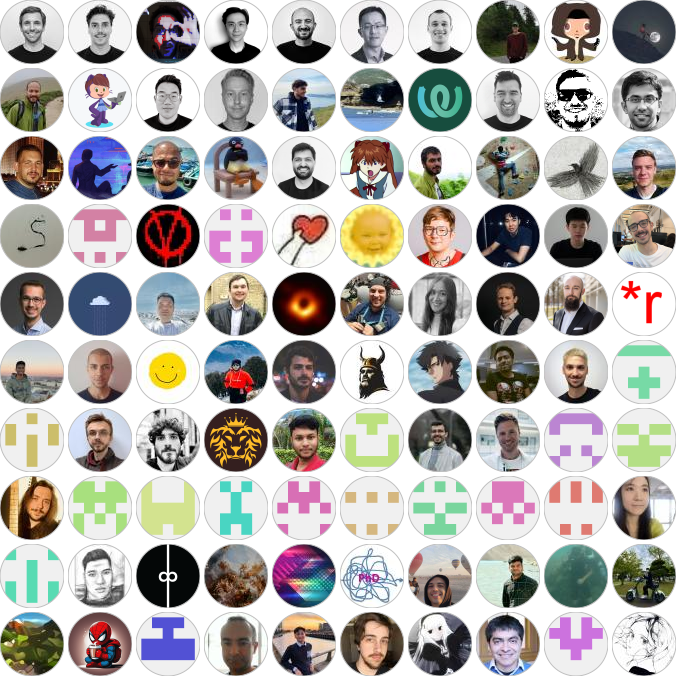
Flower is built by a wonderful community of researchers and engineers. Join Slack to meet them, contributions are welcome.
Citation
If you publish work that uses Flower, please cite Flower as follows:
@article{beutel2020flower,
  title={Flower: A Friendly Federated Learning Research Framework},
  author={Beutel, Daniel J and Topal, Taner and Mathur, Akhil and Qiu, Xinchi and Fernandez-Marques, Javier and Gao, Yan and Sani, Lorenzo and Kwing, Hei Li and Parcollet, Titouan and Gusmão, Pedro PB de and Lane, Nicholas D},
  journal={arXiv preprint arXiv:2007.14390},
  year={2020}
}
Please also consider adding your publication to the list of Flower-based publications in the docs, just open a Pull Request.
Contributing to Flower
We welcome contributions. Please see CONTRIBUTING.md to get started!
2 maintainers


Metadata
2 maintainers
Release files for flwr-nightly 1.27.0.dev20260226
For a detailed explanation of source distributions (sdists) and built distributions (wheels), please see the package formats documentation.
Source distribution (sdist)
| File | Size | Uploaded | |
|---|---|---|---|
| flwr_nightly-1.27.0.dev20260226.tar.gz | 421.4 kB | Details |
Built distribution (wheel)
| File | Interpreter | ABI | Platform | Reset |
|---|---|---|---|---|
| flwr_nightly-1.27.0.dev20260226-py3-none-any.whl | Python 3 | none | any | Details |
Total release size: 1.2 MB
Release files / flwr_nightly-1.27.0.dev20260226.tar.gz
| Download URL | flwr_nightly-1.27.0.dev20260226.tar.gz |
|---|---|
| Size | 421.4 kB |
| Tags | Source |
|
SHA-256 checksum How to use checksums |
4f09644b5f673956f253809574b1d569702c472ce43b079e6d1994e57a1cff90
|
|
BLAKE2b-256 checksum How to use checksums |
44b854fafefc9ace45cd47ba1d7d564c0894a9343a39cbae34da02bd14ab7834
|
| Upload date | |
|
Uploaded using Trusted Publishing? What is trusted publishing? |
No |
| Uploaded via |
poetry/2.1.3 CPython/3.10.19 Linux/6.8.0-1044-azure
|
Release files / flwr_nightly-1.27.0.dev20260226-py3-none-any.whl
| Download URL | flwr_nightly-1.27.0.dev20260226-py3-none-any.whl |
|---|---|
| Size | 764.2 kB |
| Tags | Python 3 |
|
SHA-256 checksum How to use checksums |
95c522164e639c095ef8d6c1af3406a3a50f6c89d4bb4bcdf9bf708daf3dbdd2
|
|
BLAKE2b-256 checksum How to use checksums |
4978f8519a9f1de1f55f313c1d22c7e8eb38a206519d18aaf643c82752bdfc69
|
| Upload date | |
|
Uploaded using Trusted Publishing? What is trusted publishing? |
No |
| Uploaded via |
poetry/2.1.3 CPython/3.10.19 Linux/6.8.0-1044-azure
|














