
Intelligent Market Monitoring


Project description
open-veanu/fraudcrawler
Intelligent Market Monitoring
The pipeline for monitoring the market has the folling main steps:
- search for a given term using SerpAPI
- get product information using ZyteAPI
- assess relevance of the found products using an OpenAI API
Installation
python3.11 -m venv .venv
source .venv/bin/activate
pip install fraudcrawler
Usage
.env file
Make sure to create an .env file with the necessary API keys and credentials (c.f. .env.example file).
Run demo pipeline
python -m fraudcrawler.launch_demo_pipeline
Customize the pipeline
Start by initializing the client
from fraudcrawler import FraudCrawlerClient

# Initialize the client
client = FraudCrawlerClient()
For setting up the search we need 5 main objects.
search_term: str
The search term for the query (similar to search terms used within major search providers).
language: Language
The language used in SerpAPI ('hl' parameter), as well as for the optional search term enrichement (e.g. finding similar and related search terms). language=Language('German') creates an object having a language name and a language code as: Language(name='German', code='de').
location: Location
The location used in SerpAPI ('gl' parameter). location=Location('Switzerland') creates an object having a location name and a location code as Location(name='Switzerland', code='ch').
deepness: Deepness
Defines the search depth with the number of results to retrieve and optional enrichment parameters.
prompts: List[Prompt]
The list of prompts to classify a given product with (multiple) LLM calls. Each prompt object has a name, a context (used for defining the user prompt), a system_prompt (for defining the classification task), and allowed_classes (a list of possible classes).
from fraudcrawler import Language, Location, Deepness, Prompt
# Setup the search
search_term = "sildenafil"
language = Language(name="German")
location = Location(name="Switzerland")
deepness = Deepness(num_results=50)
prompts = [
    Prompt(
        name="relevance",
        system_prompt=(
            "You are a helpful and intelligent assistant. Your task is to classify any given product "
            "as either relevant (1) or not relevant (0), strictly based on the context and product details provided by the user. "
            "You must consider all aspects of the given context and make a binary decision accordingly. "
            "If the product aligns with the user's needs, classify it as 1 (relevant); otherwise, classify it as 0 (not relevant). "
            "Respond only with the number 1 or 0."
        ),
        allowed_classes=[0, 1],
    )
]
(Optional) Add search term enrichement. This will find related search terms (in a given language) and search for these as well.
from fraudcrawler import Enrichment
deepness.enrichment = Enrichment(
    additional_terms=5,
    additional_urls_per_term=10
)
(Optional) Add marketplaces where we explicitely want to look for (this will focus your search as the :site parameter for a google search)
from fraudcrawler import Host
marketplaces = [
    Host(name="International", domains="zavamed.com,apomeds.com"),
    Host(name="National", domains="netdoktor.ch, nobelpharma.ch"),
]
(Optional) Exclude urls (where you don't want to find products)
excluded_urls = [
    Host(name="Compendium", domains="compendium.ch"),
]
(Optional) Exclude previously collected urls (intends to save credits)
previously_collected_urls = [
    https://pharmaciedelabateliere.ch/shop/sante/douleurs-inflammations/dafalgan-cpr-eff-500-mg-16-pce/,
    https://eiche.ch/product/schmerzmittel-52cd81d5d206a/dafalgan-brausetabletten-1336653,
]
And finally run the pipeline
# Execute the pipeline
client.execute(
    search_term=search_term,
    language=language,
    location=location,
    deepness=deepness,
    prompts=prompts,
    # marketplaces=marketplaces,    # Uncomment this for using marketplaces
    # excluded_urls=excluded_urls   # Uncomment this for using excluded_urls
    # previously_collected_urls=previously_collected_urls    # Uncomment this for using previously_selected_urls
)
This creates a file with name pattern <search_term>_<language.code>_<location.code>_<datetime[%Y%m%d%H%M%S]>.csv inside the folder data/results/.
Once the pipeline terminated the results can be loaded and examined as follows:
df = client.load_results()
print(df.head(n=10))
If the client has been used to run multiple pipelines, an overview of the available results (for a given instance of
FraudCrawlerClient) can be obtained with
client.print_available_results()
Contributing
see CONTRIBUTING.md
Async Setup
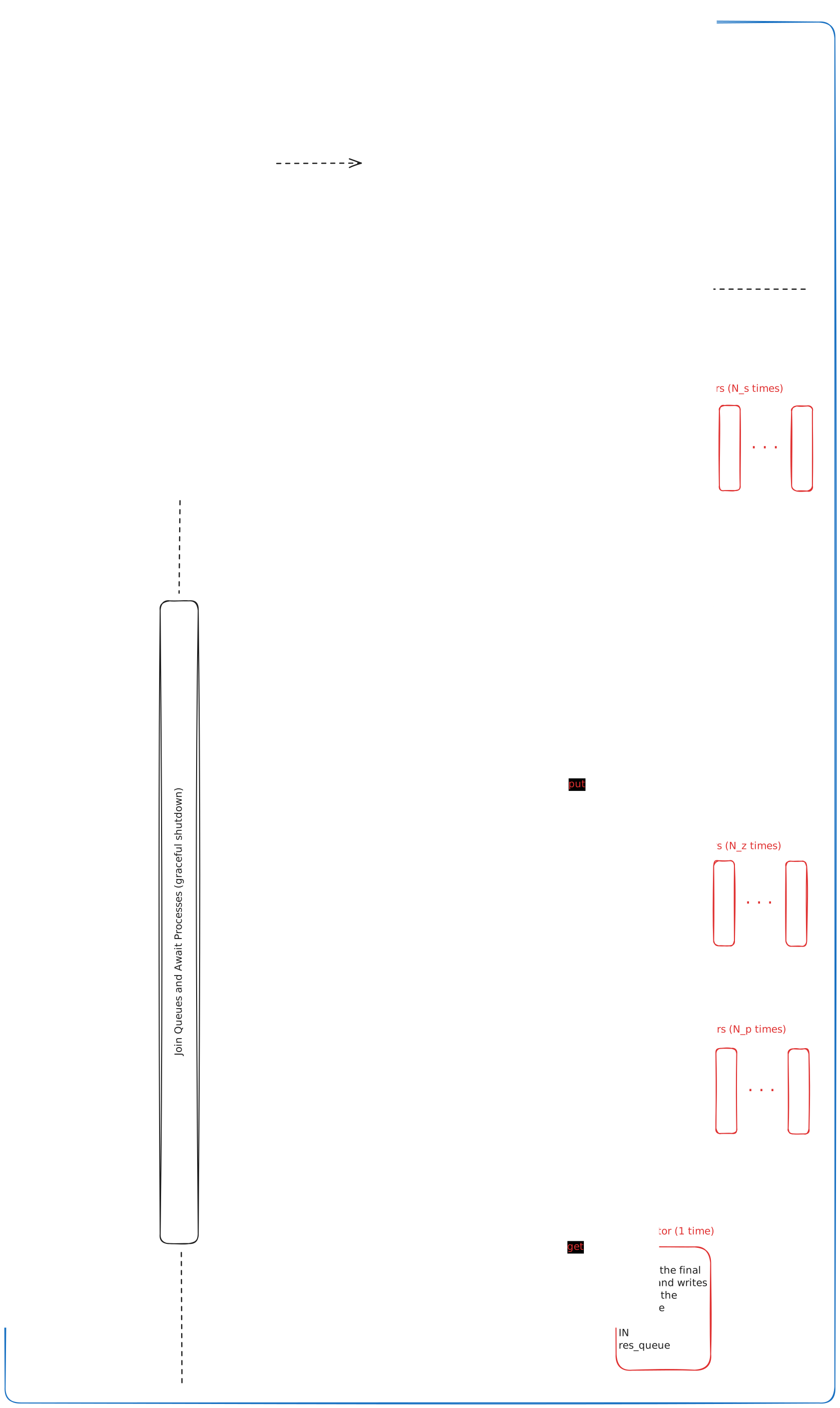
The Orchestrator class in src/base/orchestrator.py is designed to coordinate multiple services that may have interdependencies, allowing them to run in a semi-iterative manner. This means, for example, that product A can be at stage III of the pipeline while product B is still at stage I.
This behavior is enabled through an asynchronous pipeline setup. The three main steps, Search, Context Extraction, and Processing, all utilize httpx.AsyncClient. It is both possible and highly recommended to manage a single AsyncClient instance per application for efficiency. We provide a HttpxAsyncClient class that you can pass For more details, see the httpx documentation.
The following image provides a schematic representation of the package's async setup.
Release history Release notifications | RSS feed


Download files
Download the file for your platform. If you're not sure which to choose, learn more about installing packages.
Source Distribution
Built Distribution
Filter files by name, interpreter, ABI, and platform.
If you're not sure about the file name format, learn more about wheel file names.
Copy a direct link to the current filters
File details
Details for the file fraudcrawler-0.6.2.tar.gz.
File metadata
- Download URL: fraudcrawler-0.6.2.tar.gz
- Upload date:
- Size: 998.5 kB
- Tags: Source
- Uploaded using Trusted Publishing? No
- Uploaded via: poetry/2.2.1 CPython/3.13.7 Linux/6.12.47-1.qubes.fc37.x86_64
File hashes
| Algorithm | Hash digest | |
|---|---|---|
| SHA256 |
5ee7c1f360d67d628a04348eed23514bef705e2e7986a418d265fc1185ef116f
|
|
| MD5 |
45ffecffddac15874f9d9fad3cb84a8a
|
|
| BLAKE2b-256 |
e54ce53206f743cc661508c1bfe3eda443638ca0d4a667e84f129bea7cf9989f
|
File details
Details for the file fraudcrawler-0.6.2-py3-none-any.whl.
File metadata
- Download URL: fraudcrawler-0.6.2-py3-none-any.whl
- Upload date:
- Size: 1.0 MB
- Tags: Python 3
- Uploaded using Trusted Publishing? No
- Uploaded via: poetry/2.2.1 CPython/3.13.7 Linux/6.12.47-1.qubes.fc37.x86_64
File hashes
| Algorithm | Hash digest | |
|---|---|---|
| SHA256 |
5391eb064e2cd218ed4882b7588ce45509ed0b685e571adce7b236171b784459
|
|
| MD5 |
3210de428a319475e604776262d66067
|
|
| BLAKE2b-256 |
30b248738ec9f011a8dceb5ece65490d35054b391cdbfdd16795d1c99122bd32
|






