
gngram-lookup





How common is this word? O(1) answer. 500 years of books. 5 million words.
Word frequency, commonness scores, and part-of-speech tags derived from the Google Books Ngram corpus, the largest longitudinal word-frequency dataset ever compiled.
Quick Start
pip install gngram-lookup
python -m gngram_lookup.download_data       # frequency data, ~110 MB
python -m gngram_lookup.download_pos_data   # POS tag data, optional
import gngram_lookup as ng

# Does this word exist in 500 years of print?
ng.exists('computer')        # True
ng.exists('xyznotaword')     # False

# How common is it? (1=most common, 100=least common)
ng.word_score('the')         # 1
ng.word_score('computer')    # 18
ng.word_score('rucksack')    # 58
ng.word_score('xyznotaword') # None

# Full frequency data
ng.frequency('computer')
# {'peak_tf': 2000, 'peak_df': 2000, 'sum_tf': 892451, 'sum_df': 312876}

# Part-of-speech tags
ng.pos('fast')                        # ['.', 'ADJ', 'ADP', 'ADV', 'CONJ', 'DET', ...]
ng.pos('fast', min_tf=1_000_000)      # ['ADJ', 'ADV', 'NOUN']  — dominant tags only
ng.has_pos('sing', ng.PosTag.VERB)    # True
Features
- O(1) Lookups - Hash-bucketed parquet files, no full scan
- 5 Million Words - Broadest vocabulary coverage of any static lookup package
- 500 Years of Data - 1500s through 2000s, decade-by-decade
- Word Score - 1–100 commonness scale, log-normalized against the corpus
- Peak Decade - Know when a word was most used in print
- POS Tags - Part-of-speech tags from Google's own tag set
- Batch Lookup - Efficient multi-word queries grouped by hash prefix
- Prefix Clustering - Find all corpus words sharing a prefix; handles y-drop allomorphs
- Possessive & Hyphen Fallback -
ship's→ship,north-west→north - Unicode Normalization - Smart quotes, accents, and Unicode apostrophes handled
Word Score Zones
Words are scored 1–100 based on their total corpus frequency, log-normalized against the (the most frequent word). The scale compresses the Zipfian spike at the top and gives meaningful resolution across the rest of the vocabulary.
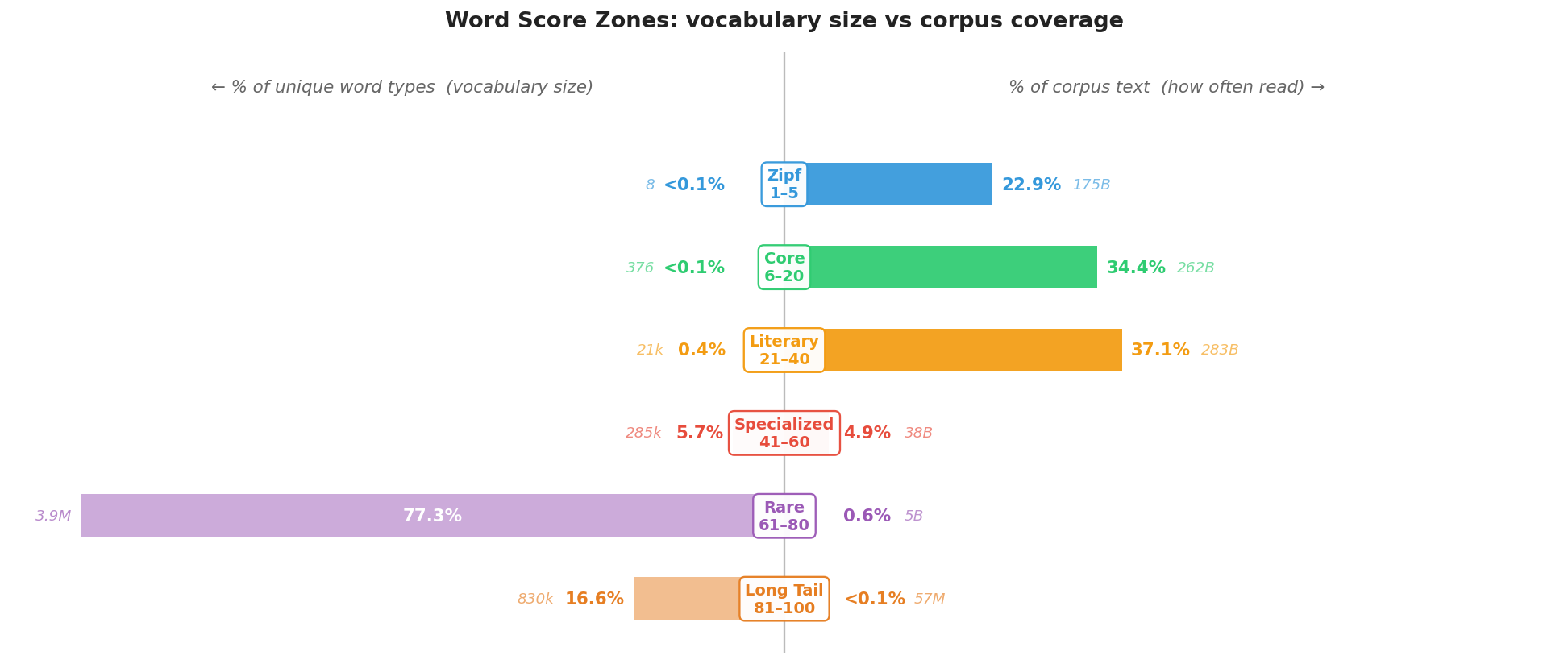
| Score | Zone | Description | Examples |
|---|---|---|---|
| 1–5 |  |
Function words dominating millions of books | the, of, and, to, a |
| 6–20 |  |
Everyday words known by all speakers | computer, walk, beautiful |
| 21–40 |  |
Vocabulary of books, not everyday speech | algorithm, philosophy, synthesis |
| 41–60 |  |
Domain-specific but attested | rucksack, carbonate, heliotrope |
| 61–80 |  |
Infrequent but legitimate | arcane technical and literary terms |
| 81–100 |  |
Extremely low frequency | niche, archaic, or highly specialized |
import gngram_lookup as ng

# "the data philosopher defenestrated eigenvalues into petrichor"
ng.word_score('the')            # 1   → Zipf
ng.word_score('data')           # 19  → Core
ng.word_score('philosopher')    # 32  → Literary
ng.word_score('eigenvalue')     # 43  → Specialized
ng.word_score('defenestrated')  # 67  → Rare
ng.word_score('petrichor')      # 82  → Long Tail

# Filter to common words only
def is_common(word):
    score = ng.word_score(word)
    return score is not None and score <= 30
The Problem This Solves
In NLP, you frequently need to know not just whether a token is a word, but how common it is.
Not "what does it mean?" Not "what's its etymology?" Just: is this a word real people actually write, and how often?
No other static lookup package gives you this from a corpus spanning 500 years of print at 5 million word coverage with O(1) access.
Why Google Books Ngrams?
The Google Books Ngram corpus isn't a dictionary (too narrow). It isn't a web crawl (too noisy). It isn't limited to a single decade or language register.
It's a statistical analysis of over 8 million books spanning the 1500s to the 2000s, one of the largest datasets ever assembled for studying how language changes over time. The frequency data captures real written usage at a scale no other freely available corpus matches.
If a word appears in this corpus with meaningful frequency, it's a word that real writers actually used.
When to Use This
- Vocabulary filtering - Score words to keep common ones, discard rare ones
- NLP preprocessing - Filter candidates before expensive model calls
- Content analysis - Measure the reading level or register of a text
- Spell-check pre-filtering - Reject low-scoring tokens before fuzzy matching
- Temporal analysis - Find when a word peaked in usage
- POS disambiguation - Resolve ambiguous tokens using corpus-attested tags
What This Doesn't Do
- No definitions, synonyms, or semantic relationships (use spaCy or WordNet for that)
- No spell-checking or suggestions (just existence and frequency)
- No real-time or web data (this is a static corpus snapshot)
CLI
exists computer       # True, exit 0
exists xyznotaword    # False, exit 1

score computer        # 18
score xyznotaword     # None, exit 1

freq computer
# peak_tf_decade: 2000
# peak_df_decade: 2000
# sum_tf: 892451
# sum_df: 312876

pos fast              # ADJ ADV VERB
pos-freq corn         # ADJ: 1,433,642 / NOUN: 11,722,803 / VERB: 85,411
has-pos sing VERB     # True, exit 0
has-pos fast NOUN     # False, exit 1
Prefix Cluster Script
Show all corpus words sharing a prefix with a given word, ranked by frequency:
poetry run python scripts/cluster.py happy --sort freq --with-freq --min-tf 100000
# 4 results written to /tmp/cluster_happy.txt
Documentation
Development
git clone https://github.com/craigtrim/gngram-lookup.git
cd gngram-lookup
make install   # Install dependencies
make test      # Run tests
make all       # Full pipeline
See Also
- bnc-lookup - O(1) lookup for British National Corpus (669k words, zero setup)
- wordnet-lookup - O(1) lookup for WordNet
Attribution
Data derived from the Google Books Ngram dataset.
License
This package is dual-licensed:
- Software: MIT License
- Ngram Data: Creative Commons Attribution 3.0 Unported (CC BY 3.0)
See LICENSE for complete terms.
Links
- Repository: github.com/craigtrim/gngram-lookup
- PyPI: pypi.org/project/gngram-lookup
- Author: Craig Trim (craigtrim@gmail.com)
1 maintainer

Metadata
1 maintainer
Release files for gngram-lookup 1.4.0
For a detailed explanation of source distributions (sdists) and built distributions (wheels), please see the package formats documentation.
Source distribution (sdist)
| File | Size | Uploaded | |
|---|---|---|---|
| gngram_lookup-1.4.0.tar.gz | 20.5 kB | Details |
Built distribution (wheel)
| File | Interpreter | ABI | Platform | Reset |
|---|---|---|---|---|
| gngram_lookup-1.4.0-py3-none-any.whl | Python 3 | none | any | Details |
Total release size: 42.7 kB
Release files / gngram_lookup-1.4.0.tar.gz
| Download URL | gngram_lookup-1.4.0.tar.gz |
|---|---|
| Size | 20.5 kB |
| Tags | Source |
|
SHA-256 checksum How to use checksums |
f0878421f169b98ef9be439d90053b4ec910dc75bcf8411cfce33ad189ef5cb9
|
|
BLAKE2b-256 checksum How to use checksums |
6a870d5c6fbe8e282e242fa87d9024e289699898386380a746fbad75e28ac192
|
| Upload date | |
|
Uploaded using Trusted Publishing? What is trusted publishing? |
No |
| Uploaded via |
poetry/2.3.2 CPython/3.11.9 Darwin/25.3.0
|
Release files / gngram_lookup-1.4.0-py3-none-any.whl
| Download URL | gngram_lookup-1.4.0-py3-none-any.whl |
|---|---|
| Size | 22.3 kB |
| Tags | Python 3 |
|
SHA-256 checksum How to use checksums |
83adc61108f9c313cd054c3e960fe62f4c757fd96df588aeb0344045a22da2bd
|
|
BLAKE2b-256 checksum How to use checksums |
d744e9c0ddae323ce3f6eda5ee6a70e3a32599080ae8a1cebdcb6b95df04c055
|
| Upload date | |
|
Uploaded using Trusted Publishing? What is trusted publishing? |
No |
| Uploaded via |
poetry/2.3.2 CPython/3.11.9 Darwin/25.3.0
|














