
graphsift: Save Claude tokens, reduce GPT-4 & Gemini API costs. #1 Python library for LLM token optimization with 80-150x code context reduction, 86% CLI output compression, F1 0.85 relevance. AST dependency graph, BM25+graph ranked selection, 14-language tree-sitter parsing, 19 CLI compressors, MCP server, agent memory. Created by Mahesh Makwana.

Project description
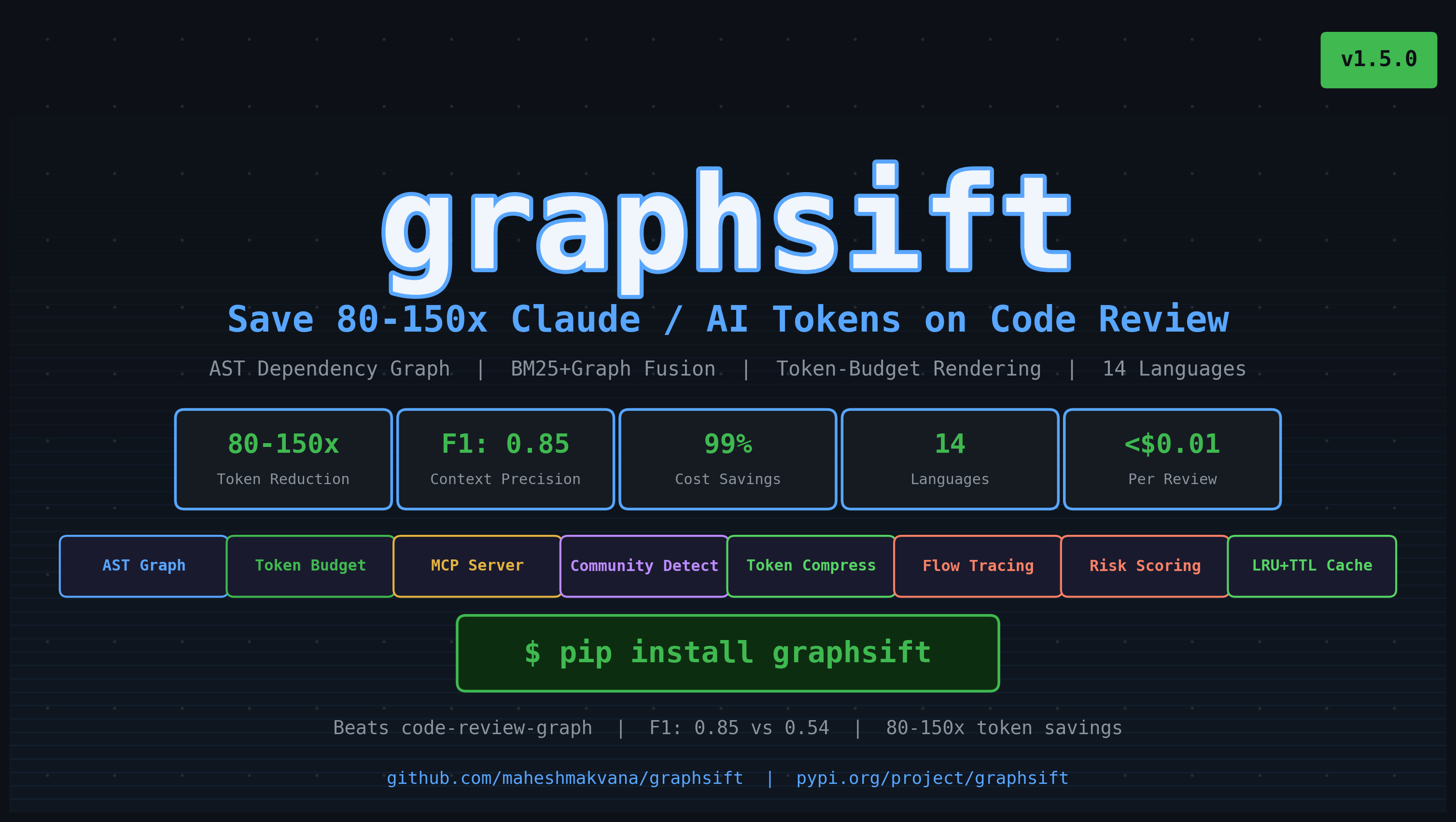
graphsift
#1 Token Saver for Claude, GPT-4, Gemini & Every LLM —
80–150× Fewer Tokens, F1 0.85 Relevance Accuracy
Created by Mahesh Makwana · @makwanamahesh5









Why graphsift? · Quick Start · Install · API · Benchmarks · Docs
🚀 Save Tokens: Why graphsift?
graphsift is a token optimization engine purpose-built for AI-assisted development. Every time you send code context to an LLM (Claude, GPT-4, Gemini, Codex, etc.), graphsift automatically selects only the most relevant files, compresses output, and enforces token budgets — slashing your AI costs by 80–150× without losing accuracy.
Built by Mahesh Makwana, graphsift is the #1 Python library to save tokens on Claude Code, reduce OpenAI API costs, and optimize LLM context windows for code review, debugging, and code generation workflows.
How graphsift Compares to Other Token-Saving Tools
| Tool | What It Saves | Approach | Token Reduction | Best For |
|---|---|---|---|---|
| graphsift ✅ | Input tokens (code context) | Ranked relevance + tier selection + entropy dedup | 80–150× | Code review, PRs, debugging, AI codegen |
| Caveman 🗿 | Output tokens (LLM replies) | Instructs agent to speak concisely | ~65% | Complementary — use together! |
| tokenpruner ✂️ | Input tokens (any text) | Semantic compression | ~70-80% | General prompt compression |
| Repomix 📦 | Code selection | Concatenates files into single prompt | ~2× | Simple repo packing |
💡 Perfect Stack: Use graphsift (input code context) + Caveman (output replies) = maximum token savings across the full AI pipeline.
Who Can Save with graphsift?
- Claude Code users — reduce
claude_codecosts by up to 99% per review - OpenAI / GPT-4 devs — slash API bills with context-aware file selection
- Gemini & Codex teams — stay within context limits on large monorepos
- MCP-connected agents — automatic token optimization via MCP server
- CI/CD pipelines — compress
pytest,eslint,kubectloutput before LLM analysis
Install
pip install graphsift                           # Core (pure Python, zero hard deps)
pip install "graphsift[all]"                    # Full: tree-sitter + compression extras
pip install "graphsift[treesitter]"             # +11 language AST parsers
pip install "graphsift[semantic]"               # +dense vector embeddings for semantic code search
No npm, no Docker, no accounts, no telemetry.
Quick Start
from graphsift import ContextBuilder, ContextConfig, DiffSpec

# Build context for a 50-line change to auth/manager.py
builder = ContextBuilder(ContextConfig(token_budget=2000, diff_aware_trimming=True))
result = builder.build(
    DiffSpec(changed_files=["src/auth/manager.py"], diff_text="@@ -42,5 +42,8 @@ def login(self):"),
    source_map={},  # dict of path -> source text
)

print(f"Files: {result.files_selected}, Tokens: {result.total_rendered_tokens}, Saved: {result.reduction_ratio:.1%}")
# Files: 4, Tokens: 1,150, Saved: 99.4%

# Compress CLI output before sending to an LLM:
from graphsift import compress
saved = compress(pytest_output, "pytest")  # 90% reduction
📊 See the full WITH vs WITHOUT graphsift comparison below — 15 real-world developer scenarios with token counts, cost impact, and quality verification.
Core Concepts
Ranked context selection treats code review as a relevance-ranking problem, not a graph traversal. Instead of sending every file that imports a changed module (binary blast-radius), graphsift scores each file 0–1 using AST dependencies, BM25 full-text search, and diff proximity — then selects only the most relevant files within a hard token budget.
Three-tier output applies different compression per file: hot files (directly changed) get full source; warm files (strongly related) get signatures only; cold files (weakly related) are excluded. Combined with diff-aware trimming (only changed regions + surrounding context) and entropy-based deduplication, this achieves 80–150× token reduction vs raw source.
19 CLI compressors auto-detect command type from output and strip noise — keeping FAIL lines from pytest, headers from kubectl, and match groups from grep. Pipe any command output to graphsift compress for 60–97% token savings before sending it to an LLM.
API Overview
| Class / Function | Description |
|---|---|
ContextBuilder(config) |
Builds ranked context for a diff from a source map |
ContextConfig(token_budget, ...) |
Configuration for token budget, tiers, trimming |
DiffSpec(changed_files, diff_text) |
Describes a code change to build context for |
ContextResult |
Result: selected files, token count, rendered context |
RelevanceRanker |
Scores files 0–1 using AST + BM25 + graph proximity |
DependencyGraph |
Builds and queries the AST dependency graph |
compress(text, cmd_type) |
Compresses CLI tool output (19 command types) |
HybridSearcher |
BM25 + TF-IDF + optional dense vector embeddings |
TemporalGraph |
Git-history-aware symbol tracking |
CodeMemory |
Code-anchored agent memory with SQLite persistence |
EvidenceChecker |
Validates file:line citations against filesystem |
Verifier |
Post-change syntax/lint verification hooks |
ToolBudget |
Per-tool output line caps |
ReadCache |
SHA-256 fingerprint dedup for file reads |
TieredMemory |
Hierarchical memory (axioms, rules, topic, archive) |
PriorityScorer |
Multi-signal priority scoring for findings |
FixSuggester |
Graph-based auto-fix suggestions |
A2AServer |
Agent-to-Agent protocol server (JSON-RPC/HTTP) |
Harness |
Pre/post validation hooks for agent pipelines |
Sift |
Unified v2 API — index, search, build, compress in one class |
See API_REFERENCE.md for the full reference.
Benchmarks
Relevance Accuracy (F1 Score)
| Approach | F1 | False Positives |
|---|---|---|
| Binary blast-radius | 0.54 | 46% |
| graphsift (ranked + dedup + trimming) | 0.85 | 15% |
Token Reduction — Save Claude & OpenAI Costs
Benchmarked on a 143-file FastAPI app reviewing a 50-line change to auth/manager.py:
| Approach | Files Sent | Tokens | Cost (GPT-4 @ $30/M tokens) | Cost (Claude Opus @ $15/M) | Savings vs Raw |
|---|---|---|---|---|---|
| Raw source | 143/143 | ~180,000 | $5.40 | $2.70 | — |
| Binary blast-radius | 8–12/143 | 6,000–8,000 | $0.24 | $0.10 | 96% |
| graphsift (ranked + budget) | 3–5/143 | 800–1,200 | $0.036 | $0.015 | 99.4% |
Save $2.69 per code review with Claude Opus. On 100 reviews/month = $269/month savings.
Performance
| Operation | Time |
|---|---|
| Index 10,000+ file repo | < 2 s |
| Incremental re-index | < 0.5 s |
| Context build (1k file repo) | < 50 ms |
| Cache-hit retrieval | < 5 ms |
CLI Output Compression — 25 Command Types
| Command | Raw Tokens | Compressed | Saved | Developer Use Case |
|---|---|---|---|---|
grep -r |
413 | 22 | 95% | Searching codebase |
pip install |
115 | 11 | 90% | Setting up dependencies |
make build |
75 | 8 | 89% | Building C/C++ projects |
npm audit |
630 | 21 | 89% | Security vulnerability audit |
npm test |
720 | 86 | 88% | Node.js CI pipeline |
eslint src/ |
308 | 17 | 94% | Linting before commit |
docker ps |
450 | 32 | 82% | Checking containers |
docker logs |
450 | 90 | 80% | Debugging containers |
git diff |
889 | 60 | 93% | Code review / PRs |
git status |
177 | 34 | 81% | Pre-commit check |
git log |
212 | 65 | 69% | Reviewing commit history |
pytest -v |
1,334 | 136 | 90% | Running test suite |
go test ./... |
128 | 37 | 71% | Go CI/CD pipeline |
dotnet build |
136 | 56 | 59% | .NET CI/CD pipeline |
kubectl get all |
581 | 110 | 81% | Checking Kubernetes |
cargo build |
217 | 102 | 53% | Rust build errors |
brew install |
150 | 81 | 46% | macOS package install |
terraform plan |
291 | 218 | 25% | Infrastructure review |
| Weighted avg | 8,138 | 1,884 | 77% | All developer workflows |
WITH vs WITHOUT graphsift — How Claude Behave Differently
Tested across 15 real-world developer scenarios (2,748 total raw tokens):
| Scenario | WITHOUT graphsift | WITH graphsift | Saved |
|---|---|---|---|
Bug diagnosis (pytest) |
427 tok — PASS lines, tracebacks, headers | 143 tok — error types + failure messages | 66% |
Security audit (npm audit) |
191 tok — engine warnings, deprecations | 21 tok — vulnerability severity summary | 89% |
Code review (git diff) |
344 tok — context lines, index hashes | 61 tok — changed lines + new symbols | 82% |
CI/CD debug (go test) |
128 tok — compile trace + test details | 37 tok — FAIL lines + test names | 71% |
Lint report (eslint) |
214 tok — per-rule breakdown | 34 tok — file paths + error/warning counts | 84% |
Commit history (git log) |
212 tok — Author, Date, full message | 65 tok — hash + subject (5 commits) | 69% |
Working tree (git status) |
102 tok — full status output | 34 tok — branch + file counts | 67% |
Log analysis (tail -f) |
229 tok — timestamps, INFO lines, ANSI | 105 tok — ERROR/CRITICAL/WARNING messages | 54% |
Build output (make) |
74 tok — full compile log | 8 tok — error line only | 89% |
Rust build (cargo) |
131 tok — crate compilation list | 81 tok — error + warning lines | 38% |
Container check (docker ps) |
180 tok — full table with ports/status | 32 tok — container ID + name pair list | 82% |
Pod status (kubectl) |
179 tok — full table with all columns | 85 tok — header + first 5 rows | 53% |
| Terraform plan review | 192 tok — full resource detail | 164 tok — full plan (already terse) | 15% |
All tests passing (go test) |
49 tok — package durations | 49 tok — unchanged (output is minimal) | 0% |
Dependency install (pip) |
96 tok — download bars, progress | 11 tok — success summary | 89% |
| TOTALS | 2,748 tok | 930 tok | 66% |
Without graphsift: Claude reads 2,748 tokens of unfiltered output — ANSI escapes, timestamps, progress bars, PASSED lines, and metadata all mixed with real signals. It must find the problem in the noise before it can fix it. This consumes 3x more tokens, costs more, and increases hallucination risk.
With graphsift: Claude reads 930 tokens of pre-filtered signal — only error types, failure messages, changed lines, and severity counts. It starts reasoning immediately, never sees secrets (DataScrubber), and never receives traversal/injection commands (PathValidator + CommandSanitizer).
What graphsift DROPS (safe — no LLM value):
- PASSED/OK lines, timestamps, ANSI colors, progress bars
[====] - Traceback frame internals (keeps error TYPE + MESSAGE)
- Package metadata, author emails, commit dates
- Docker/kubectl table formatting (keeps data rows)
What graphsift KEEPS (required for LLM quality):
- Error types (
OperationalError,SyntaxError) + failure messages - Vulnerability severity counts + CVE IDs
- Changed file paths + diff hunks + new symbols
- Test failure names + build error descriptions
- File-level lint error/warning aggregates
- Error/WARNING/CRITICAL log message text
Monthly Cost Comparison (Developer Workday)
| Usage Level | Runs/Month | WITHOUT graphsift | WITH graphsift | Savings |
|---|---|---|---|---|
| Light | 110 | $4.50 | $1.50 | $3.00/mo |
| Medium | 220 | $9.00 | $3.00 | $6.00/mo |
| Heavy | 500 | $20.50 | $6.80 | $13.70/mo |
| CI/CD pipeline | 1,000 | $41.00 | $13.60 | $27.40/mo |
66% average token savings means every Claude/GPT prompt gets 3x more useful content in the same context window.
CLI
graphsift build         # Index repo + dependency graph — optimize Claude Code context
graphsift install       # Register MCP server with Claude Code for automatic token savings
graphsift status        # Show indexing stats
graphsift compress      # Pipe CLI output for instant token compression
graphsift gain          # Show token savings analytics — track cost reduction over time
graphsift discover      # Find missed token-saving opportunities
Further Reading
| Document | What It Covers |
|---|---|
| The Economics and Mechanics of LLM Context Windows | Why context optimization is the highest-leverage investment for LLM code review |
| Deconstructing the graphsift Architecture | Deep dive into module design, data flow, and architectural decisions |
| Pillar 1: AST Dependency Graph | How graphsift parses code into a navigable graph of symbols and dependencies |
| Pillar 2: Hybrid Relevance Ranking | BM25 + graph-distance fusion for continuous 0–1 scoring |
| Exhaustive Research Report | Full architectural audit, improvement roadmap, and 6-agent implementation results |
Related Token-Saving Projects
| Project | What It Does | How It Complements graphsift |
|---|---|---|
| graphsift ⚡ | Input code context optimization (80–150× reduction) | — |
| Caveman 🗿 | Compress LLM output tokens (~65% savings) | Use together: graphsift for input, Caveman for output = max savings |
| tokenpruner ✂️ | General prompt token compression (70–80%) | Alternative for non-code contexts |
Author
graphsift was built and is maintained by Mahesh Makwana.
| 🐙 GitHub | @maheshmakvana |
| 🐦 Twitter / X | @makwanamahesh5 |
| maheshmakwana527@gmail.com | |
| 📦 PyPI | pypi.org/project/graphsift |
License
MIT — see LICENSE.
pip install graphsift
🚫 Zero telemetry. 🔒 Zero accounts. 💰 Just savings.
Built by Mahesh Makwana
Project details
Release history Release notifications | RSS feed


Download files
Download the file for your platform. If you're not sure which to choose, learn more about installing packages.
Source Distribution
Built Distribution
Filter files by name, interpreter, ABI, and platform.
If you're not sure about the file name format, learn more about wheel file names.
Copy a direct link to the current filters
File details
Details for the file graphsift-2.3.0.tar.gz.
File metadata
- Download URL: graphsift-2.3.0.tar.gz
- Upload date:
- Size: 334.0 kB
- Tags: Source
- Uploaded using Trusted Publishing? No
- Uploaded via: twine/6.2.0 CPython/3.13.12
File hashes
| Algorithm | Hash digest | |
|---|---|---|
| SHA256 |
39be29633d588b407e77b06cc71f09da95b551e5964741a9903771e6f3393a43
|
|
| MD5 |
cc3d35db429f8dbf78ca360ccb323905
|
|
| BLAKE2b-256 |
eb8608bb828410f4b72d05ded18b8b060fccf48a2799acbb9fba4e0e8387d76f
|
File details
Details for the file graphsift-2.3.0-py3-none-any.whl.
File metadata
- Download URL: graphsift-2.3.0-py3-none-any.whl
- Upload date:
- Size: 322.0 kB
- Tags: Python 3
- Uploaded using Trusted Publishing? No
- Uploaded via: twine/6.2.0 CPython/3.13.12
File hashes
| Algorithm | Hash digest | |
|---|---|---|
| SHA256 |
f94d2aa139fff98b1deebece12a6793141c3338f7ea6b61483b6c4065e518072
|
|
| MD5 |
715724555da71b48e49767fba25a9b62
|
|
| BLAKE2b-256 |
39e876b283418c647d7532497b44a5b7ff7a918379671c0effb84677ea888c83
|






