
vlse
The 48 test functions of the Virtual Library of Simulation Experiments
(Surjanovic & Bingham, SFU), ported to JAX. Each one is a line-by-line translation of the R source
published on that site, and the test suite re-runs those R sources on every invocation to check
agreement at rel=1e-12.
uv add jaxvlse # the distribution is `jaxvlse`; the import stays `import vlse`
vlse itself is unavailable on PyPI — it collides with the existing vise under PyPI's
confusable-character rule. Only the distribution name carries the prefix; nothing in the code does.
Use
Every function is an equinox.Module — a pytree, so it jits, vmaps and differentiates, and can be
passed into and returned from transformed functions.
import vlse
import jax
import jax.random as jr

f = vlse.Ackley(d=20)
lo, hi = f.domain                                   # (-32.768, 32.768)
x = jr.uniform(jr.key(0), (100, 20), minval=lo, maxval=hi)

f(x)                                                # (100,), batched over leading axes
f(x[0])                                             # scalar
jax.grad(lambda x: f(x).sum())(x)                   # (100, 20)
f.ymin                                              # 0.0, the minimum over `domain`
Instantiated bare, a function is exactly as published: native domain, published output. Enable
jax_enable_x64 before importing vlse for f64 (the package never touches the flag itself, and the
Hartmann coefficient tables are built at import).
Normalized form
normalized=True takes the unit cube in and shifts the minimum to 0, which is usually what an
optimizer benchmark wants:
g = vlse.Ackley(d=20, normalized=True)
g(jax.random.uniform(jax.random.key(0), (100, 20)))       # inputs in [0, 1]^20, min at 0.0
The two forms are exactly g(u) == f(lo + (hi - lo) * u) - f.ymin.
API
There is no base class and no registry. Every class is standalone and exposes the same members:
class Ackley(eqx.Module):
    d: int
    a: float = 20.0
    b: float = 0.2
    c: float = 2 * math.pi
    normalized: bool = False

    domain: ClassVar[tuple[float, float]] = (-32.768, 32.768)
    ymin: ClassVar[float] = 0.0

    def __call__(self, x: Float[Array, "... d"]) -> Float[Array, "..."]: ...
d — always present, always asserted on in __call__. 19 functions are defined for any
dimension and take it as their first argument (Ackley(d=5), Powell(d=8), Trid(d=5)); the rest
are fixed-dimension and take nothing (Branin(), Hartmann6()).
domain — a (lo, hi) pair, per axis. Plain floats when the axes share bounds, a pair of
length-d arrays where they differ (Bukin6, McCormick, Branin, Camel6). Either way
lo, hi = f.domain unpacks and lo + (hi - lo) * u broadcasts.
ymin — the global minimum over domain, as a Python float.
d, domain and ymin are ClassVars where they are constants and properties where they depend on
a field, so read them off the instance either way. Function parameters are ordinary fields carrying
the published defaults (Ackley.a/b/c, Michalewicz.m, Shekel.b/C, Langermann.c/A).
Alternate published forms are arguments, not classes: rescaled=True is the Picheny et al.
(2012) reparametrization (Sphere, Rosenbrock, Branin, GoldsteinPrice, Hartmann6),
Branin(modified=True) the Forrester et al. (2008) modified Branin, Bohachevsky(variant=1|2|3) one
of the three Bohachevsky functions, Shekel(m=5|7|10) one of the three published truncations.
Branin(modified=True) is a different function rather than a reparametrization, so it does not
combine with rescaled=True; ForresterLowFidelity is a separate class for the same reason.
Nothing is declared static. __call__ wears @eqx.filter_jit, which filters by is_array, so
every non-array leaf (d, normalized, rescaled, modified, variant) is held static
automatically — python-level branches never see a tracer, and flipping one retraces:
eqx.filter_jit(lambda f, x: f(x))(vlse.Ackley(d=5, normalized=True), x)
Functions
All 48 import from the top level; vlse.functions holds them, split into the SFU site's sections.
(d) marks the functions that take a dimension.
| section | functions |
|---|---|
many_local_minima |
Ackley (d), Bukin6, CrossInTray, DropWave, EggHolder, GramacyLee, Griewank (d), HolderTable, Langermann, Levy (d), Levy13, Rastrigin (d), Schaffer2, Schaffer4, Schwefel (d), Shubert |
bowl_shaped |
Bohachevsky, Perm0 (d), RotatedHyperEllipsoid (d), Sphere (d), SumPowers (d), SumSquares (d), Trid (d) |
plate_shaped |
Booth, Matyas, McCormick, PowerSum (d), Zakharov (d) |
valley_shaped |
Camel3, Camel6, DixonPrice (d), Rosenbrock (d) |
steep_drops |
DeJong5, Easom, Michalewicz (d) |
other |
Beale, Branin, Colville, Forrester, ForresterLowFidelity, GoldsteinPrice, Hartmann3, Hartmann4, Hartmann6, Perm (d), Powell (d), Shekel, StyblinskiTang (d) |
Deviations from the R sources
- The Hartmann 6-D pages are swapped upstream.
hart6r.Rcomputes Picheny's-(2.58 + s) / 1.94andhart6sc.Rthe plain-s. HereHartmann6()is the plain form andHartmann6(rescaled=True)the rescaled one; the parity table maps the two files crosswise. shekelr.Rhardcodesm <- 10and ignores its argument, soShekel(m=5)andShekel(m=7)cannot be checked against it. They are checked against an independent reference instead.spherefmod.Ris published for d=6 only;Sphere(rescaled=True)generalizes it. Its normalizing constants are recomputed fromdand reproduce the published1745/899at d=6.Michalewicz.yminhas no closed form. It is computed once on a grid — the terms are separable, so that is exact up to grid resolution — and cached.Forrester.yminis the numerically computed-6.020740055767083rather than the-6.02074the page prints, which is rounded up in magnitude and would put the normalized form below 0.ForresterLowFidelity.yminis likewise numerical, and valid only for the default(A, B, C).
Development
uv sync
uv run --no-sync pytest tests -q                 # ~10s
uv run --no-sync python tools/fetch_sfu.py       # refresh tools/sfu/*.R from the SFU site
Parity is checked live: tests/functions/test_reference.py shells out to Rscript, evaluates the vendored R
sources, and compares — there is no frozen golden data. Without R on PATH that one module skips and
the rest of the suite still runs. CI covers 3.10–3.13 plus a --resolution lowest-direct job, so the
dependency floors are real ones.
Benchmarks
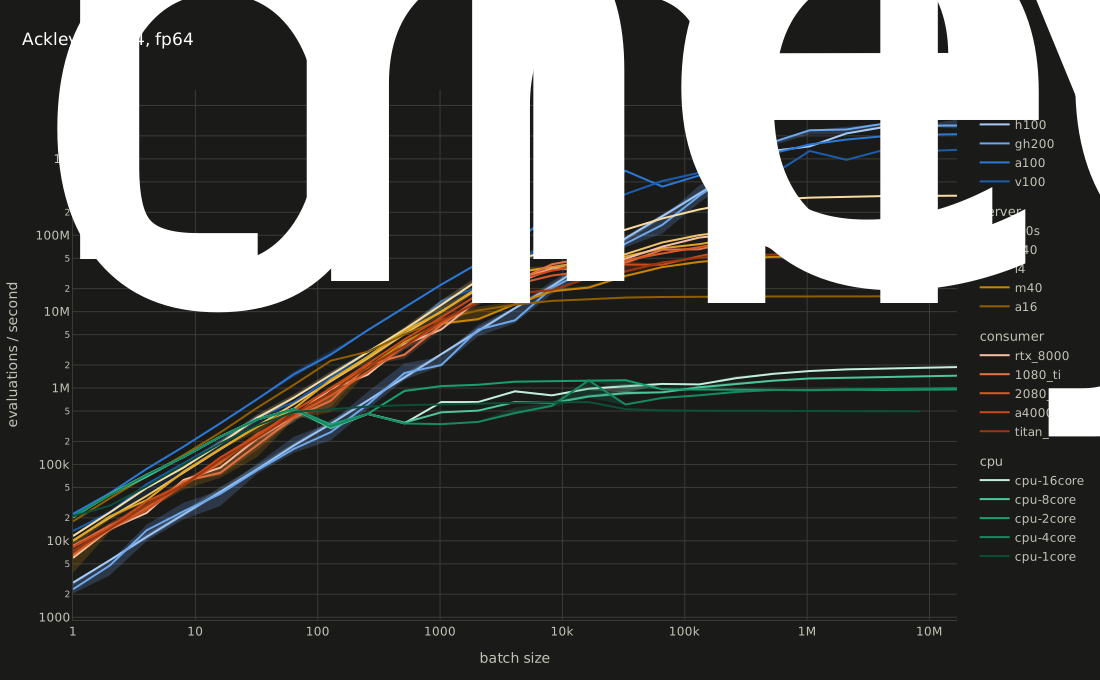
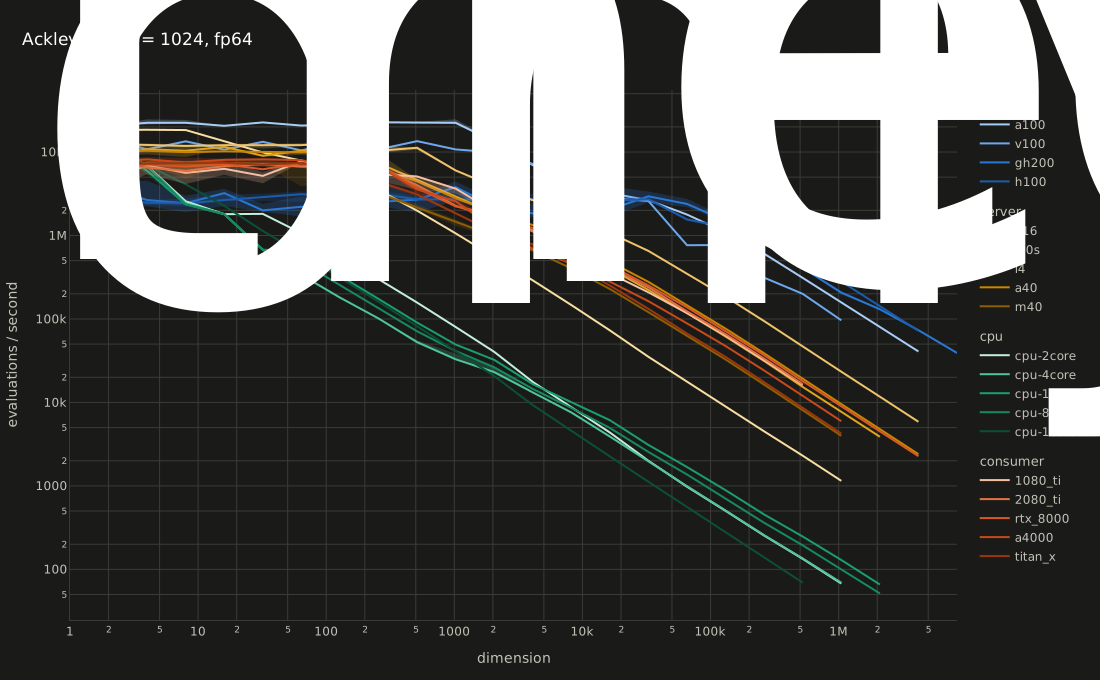
Throughput of one function (Ackley) in f64, swept across the GPUs and CPUs of one cluster — grown
along the batch axis at d=20, and along the dimension axis at batch 128. Median per-call throughput
with a 95% interval on the median shaded, log-log, one line per device, coloured by market segment.
Either figure opens hoverable:
The f32 panels, where everything but the hpc parts runs one to two orders faster:
batch,
dim.
Read the small end of either axis as latency rather than as throughput — JAX is dispatch-bound there. Nodes are shared and clocks vary with what else is on the machine, so this is an order-of-magnitude picture, not a certified ranking.
bench/ holds the sweeps above under bench/functions/; what is measured, how,
and where each curve stops is in bench/README.md.
License
GPL-2.0-only, matching the SFU reference implementations this is derived from. See LICENSE and NOTICE.
1 maintainer

Metadata
1 maintainer
Release files for jaxvlse 0.1.0
For a detailed explanation of source distributions (sdists) and built distributions (wheels), please see the package formats documentation.
Source distribution (sdist)
| File | Size | Uploaded | |
|---|---|---|---|
| jaxvlse-0.1.0.tar.gz | 21.2 kB | Details |
Built distribution (wheel)
| File | Interpreter | ABI | Platform | Reset |
|---|---|---|---|---|
| jaxvlse-0.1.0-py3-none-any.whl | Python 3 | none | any | Details |
Total release size: 48.7 kB
Release files / jaxvlse-0.1.0.tar.gz
| Download URL | jaxvlse-0.1.0.tar.gz |
|---|---|
| Size | 21.2 kB |
| Tags | Source |
|
SHA-256 checksum How to use checksums |
1def19efa309c51fbcd75f6d0c5407ab50c8c639d262788b591358991178bf55
|
|
BLAKE2b-256 checksum How to use checksums |
dfed2be85a196c9cd93eb39abd39aea4b2104252da2a6ae5a08712e07348f030
|
| Upload date | |
|
Uploaded using Trusted Publishing? What is trusted publishing? |
No |
| Uploaded via |
uv/0.10.2 {"installer":{"name":"uv","version":"0.10.2","subcommand":["publish"]},"python":null,"implementation":{"name":null,"version":null},"distro":{"name":"Ubuntu","version":"24.04","id":"noble","libc":null},"system":{"name":null,"release":null},"cpu":null,"openssl_version":null,"setuptools_version":null,"rustc_version":null,"ci":null}
|
Release files / jaxvlse-0.1.0-py3-none-any.whl
| Download URL | jaxvlse-0.1.0-py3-none-any.whl |
|---|---|
| Size | 27.5 kB |
| Tags | Python 3 |
|
SHA-256 checksum How to use checksums |
6b66874058f3ff4a955f9f14431bb7e5fb82054b2c361eef4607d00efbc0d5d0
|
|
BLAKE2b-256 checksum How to use checksums |
210390b5f206be65d44eeae19774bd8daf28e4420813d197f4f970e5f5e2119a
|
| Upload date | |
|
Uploaded using Trusted Publishing? What is trusted publishing? |
No |
| Uploaded via |
uv/0.10.2 {"installer":{"name":"uv","version":"0.10.2","subcommand":["publish"]},"python":null,"implementation":{"name":null,"version":null},"distro":{"name":"Ubuntu","version":"24.04","id":"noble","libc":null},"system":{"name":null,"release":null},"cpu":null,"openssl_version":null,"setuptools_version":null,"rustc_version":null,"ci":null}
|














