
vlse
The 48 test functions of the Virtual Library of Simulation Experiments (Surjanovic & Bingham, SFU), ported to JAX, plus an L-BFGS-B solver.
- Each function is a line-by-line port of the R source published on the SFU site. The test suite
re-runs those R sources and checks agreement at
rel=1e-12. - Functions are callable objects and valid pytrees: they
jit,vmap,grad, and run unchanged on CPU or GPU. Evaluation happens in the dtype of the input. vlse.optim.minimiseis L-BFGS-B compiled to a single XLA program, tested against scipy's Fortran implementation.
uv add jaxvlse # the distribution is `jaxvlse`; the import stays `import vlse`
Use
import vlse
import jax
import jax.random as jr

f = vlse.Ackley(d=20)
lo, hi = f.domain                                   # per-axis bounds, (-32.768, 32.768)
x = jr.uniform(jr.key(0), (100, 20), minval=lo, maxval=hi)

f(x)                                                # (100,), batched over leading axes
f(x[0])                                             # scalar
jax.grad(lambda x: f(x).sum())(x)                   # (100, 20)
f.ymin                                              # 0.0, the minimum over `domain`
API
Every function has the same shape. Ignoring the JAX machinery, it is just:
class SomeFunction:
    d: int              # input dimension: a constructor argument for the 19
                        # any-dimensional functions, fixed for the rest
    domain: (lo, hi)    # per-axis bounds, each of length d
    ymin: float         # the global minimum of the function over `domain`

    def __call__(self, x):   # x: (..., d)  ->  (...)
        ...
Function parameters are constructor arguments carrying the published defaults
(Ackley(a=, b=, c=), Michalewicz(m=), Shekel(b=, C=)). Alternate published forms are
arguments too, not separate classes: rescaled=True is the Picheny et al. (2012)
reparametrization, Branin(modified=True) the Forrester et al. (2008) modified Branin,
Bohachevsky(variant=1|2|3) and Shekel(m=5|7|10) the published variants.
normalized=True takes the unit cube in and shifts the minimum to 0 — the form an optimizer
benchmark usually wants. Exactly: g(u) == f(lo + (hi - lo) * u) - f.ymin.
Instantiated bare, a function is exactly as published. For f64, enable jax_enable_x64 before
importing vlse.
Functions
The dimension, domain and minimum of any-dimensional functions may depend on d; the values
below that do are given as formulas.
Many local minima
| function | d |
domain | minimum | parameters |
|---|---|---|---|---|
Ackley |
any | [-32.768, 32.768] | 0 | a, b, c |
Bukin6 |
2 | [-15, -5] × [-3, 3] | 0 | |
CrossInTray |
2 | [-10, 10] | -2.06261 | |
DropWave |
2 | [-5.12, 5.12] | -1 | |
EggHolder |
2 | [-512, 512] | -959.641 | |
GramacyLee |
1 | [0.5, 2.5] | -0.869011 | |
Griewank |
any | [-600, 600] | 0 | |
HolderTable |
2 | [-10, 10] | -19.2085 | |
Langermann |
2 | [0, 10] | -4.1558 | c, A |
Levy |
any | [-10, 10] | 0 | |
Levy13 |
2 | [-10, 10] | 0 | |
Rastrigin |
any | [-5.12, 5.12] | 0 | |
Schaffer2 |
2 | [-100, 100] | 0 | |
Schaffer4 |
2 | [-100, 100] | 0.292579 | |
Schwefel |
any | [-500, 500] | 0 | |
Shubert |
2 | [-5.12, 5.12] | -186.731 |
Bowl-shaped
| function | d |
domain | minimum | parameters |
|---|---|---|---|---|
Bohachevsky |
2 | [-100, 100] | 0 | variant (required, 1|2|3) |
Perm0 |
any | [-d, d] | 0 | beta |
RotatedHyperEllipsoid |
any | [-65.536, 65.536] | 0 | |
Sphere |
any | [-5.12, 5.12] | 0 | rescaled |
SumPowers |
any | [-1, 1] | 0 | |
SumSquares |
any | [-5.12, 5.12] | 0 | |
Trid |
any | [-d², d²] | -d(d+4)(d-1)/6 |
Plate-shaped
| function | d |
domain | minimum | parameters |
|---|---|---|---|---|
Booth |
2 | [-10, 10] | 0 | |
Matyas |
2 | [-10, 10] | 0 | |
McCormick |
2 | [-1.5, 4] × [-3, 4] | -1.9133 | |
PowerSum |
any | [0, d] | 0 | |
Zakharov |
any | [-5, 10] | 0 |
Valley-shaped
| function | d |
domain | minimum | parameters |
|---|---|---|---|---|
Camel3 |
2 | [-5, 5] | 0 | |
Camel6 |
2 | [-3, 3] × [-2, 2] | -1.03163 | |
DixonPrice |
any | [-10, 10] | 0 | |
Rosenbrock |
any | [-5, 10] | 0 | rescaled |
Steep ridges and drops
| function | d |
domain | minimum | parameters |
|---|---|---|---|---|
DeJong5 |
2 | [-65.536, 65.536] | 0.998 | |
Easom |
2 | [-100, 100] | -1 | |
Michalewicz |
any | [0, π] | grid-computed | m |
Other
| function | d |
domain | minimum | parameters |
|---|---|---|---|---|
Beale |
2 | [-4.5, 4.5] | 0 | |
Branin |
2 | [-5, 10] × [0, 15] | 0.397887 | a, b, c, r, s, t, rescaled, modified |
Colville |
4 | [-10, 10] | 0 | |
Forrester |
1 | [0, 1] | -6.02074 | |
ForresterLowFidelity |
1 | [0, 1] | 0.665095 | A, B, C |
GoldsteinPrice |
2 | [-2, 2] | 3 | rescaled |
Hartmann3 |
3 | [0, 1] | -3.86278 | |
Hartmann4 |
4 | [0, 1] | -3.1345 | |
Hartmann6 |
6 | [0, 1] | -3.32237 | rescaled |
Perm |
any | [-d, d] | 0 | beta |
Powell |
any | [-4, 5] | 0 | |
Shekel |
4 | [0, 10] | -10.5364 | m (5|7|10), b, C |
StyblinskiTang |
any | [-5, 5] | -39.166 d |
Deviations from the R sources
- The Hartmann 6-D pages are swapped upstream:
hart6r.Rcomputes Picheny's rescaled form andhart6sc.Rthe plain one.Hartmann6()is the plain form here; the parity table maps the two files crosswise. shekelr.Rhardcodesm <- 10, soShekel(m=5)andShekel(m=7)are checked against an independent reference instead.spherefmod.Ris published for d=6 only;Sphere(rescaled=True)generalizes it, reproducing the published constants at d=6.Michalewicz.yminhas no closed form; it is computed per-axis on a grid (the terms are separable) and cached.Forrester.yminis the numerically computed-6.020740055767083rather than the page's rounded-6.02074, which would put the normalized form below 0.
Optimizer
vlse.optim.minimise is L-BFGS-B (Byrd, Lu, Nocedal & Zhu 1995) written as a single
jax.lax.while_loop: a solve is one XLA dispatch, a multistart batch is a vmap, and the whole
thing jits, differentiates and runs on any backend.
from vlse.optim import minimise

f = vlse.Ackley(d=20)
state = minimise(f, x0, bounds=f.domain, tol=1e-9)      # state.x, state.f, state.error, ...

starts = jr.uniform(jr.key(0), (256, 20), minval=lo, maxval=hi)
jax.jit(jax.vmap(lambda x0: minimise(f, x0, f.domain)))(starts)
The signature follows scipy.optimize.minimize: minimise(fun, x0, bounds=None, args=(), tol=1e-5, max_iterations=100, history_length=10, ...). The stopping criterion is scipy's pgtol,
the line search follows scipy's lnsrlb/dcsrch, and every tolerance is read off the working
dtype. Enable jax_enable_x64: f64 is what the solver is written, tested and benchmarked for.
The result is not byte-identical to scipy — XLA reassociates the arithmetic, and on a multimodal
box the last bit can decide a basin. The test suite (tests/optim/) therefore solves all 48
functions from 32 shared starts in six modes (sequential / lax.map / vmap × CPU / GPU) and
holds each mode to scipy statistically: outside the multimodal set, every start must land exactly
where scipy lands; on it, a one-sided Wilcoxon signed-rank over the per-start differences,
Šidák-corrected across the battery, must not show the solver landing in worse minima than scipy.
Benchmarks
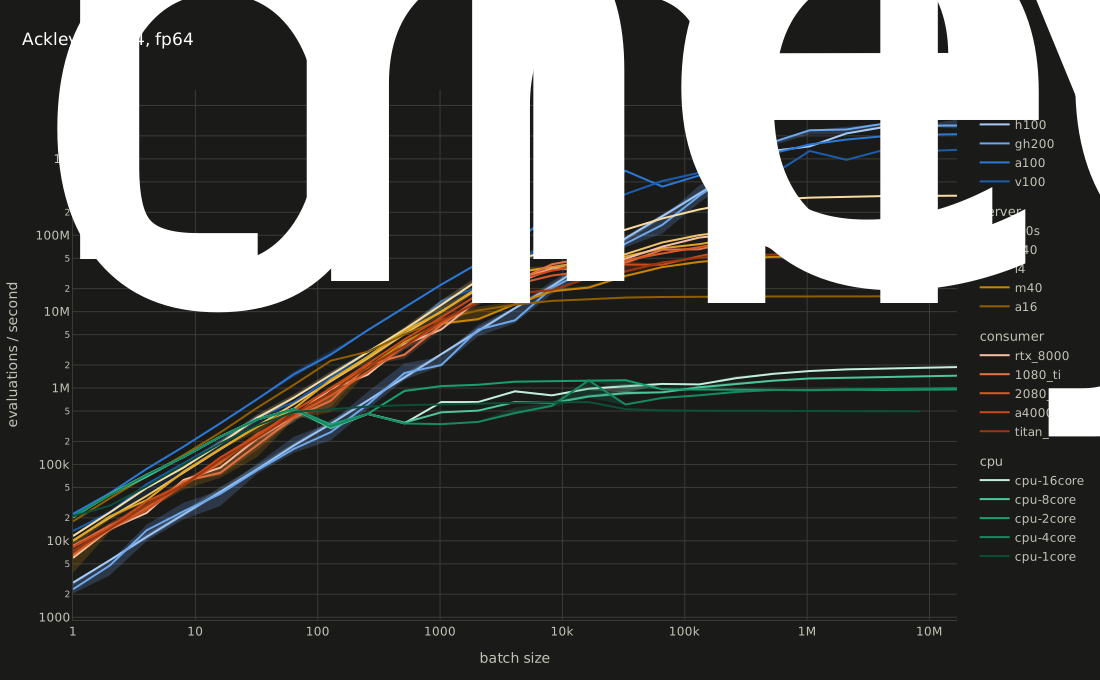
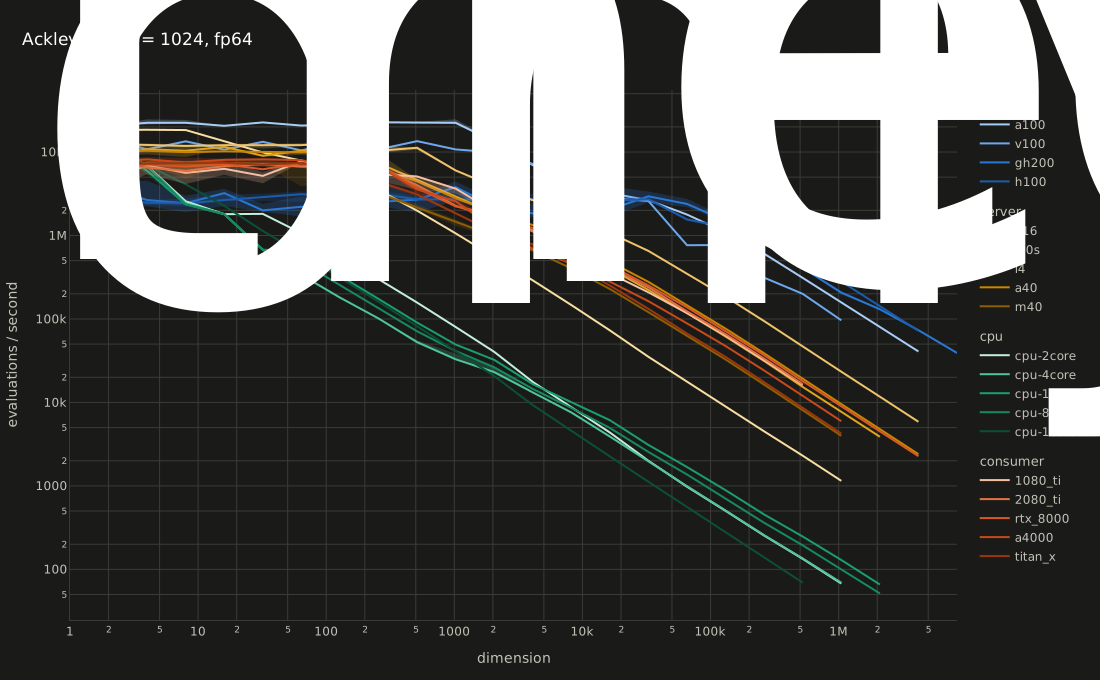
Both benches sweep every GPU and CPU of one cluster along two axes — batch size at fixed dimension, dimension at fixed batch — climbing powers of two until the device gives out. Median per-call throughput, 95% interval shaded, log-log. Figures open hoverable.
Function evaluation (Ackley, f64; the
f32 batch
and f32 dim
panels run one to two orders faster on everything but the hpc parts):
L-BFGS-B, against scipy's Fortran on the same objective, starts and box:
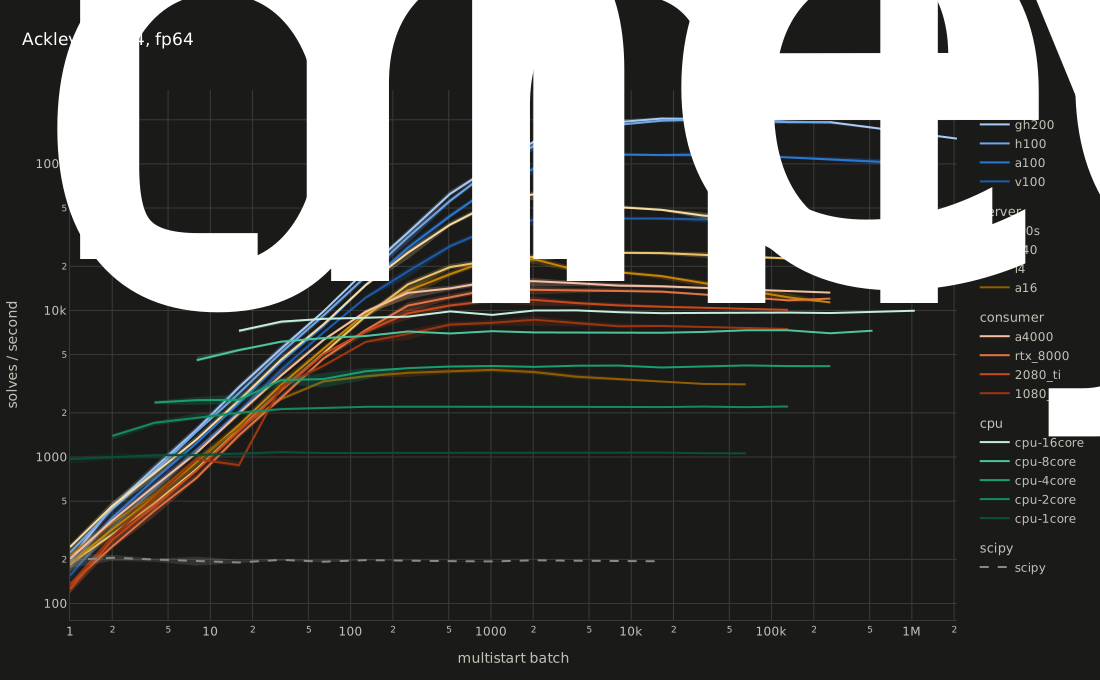
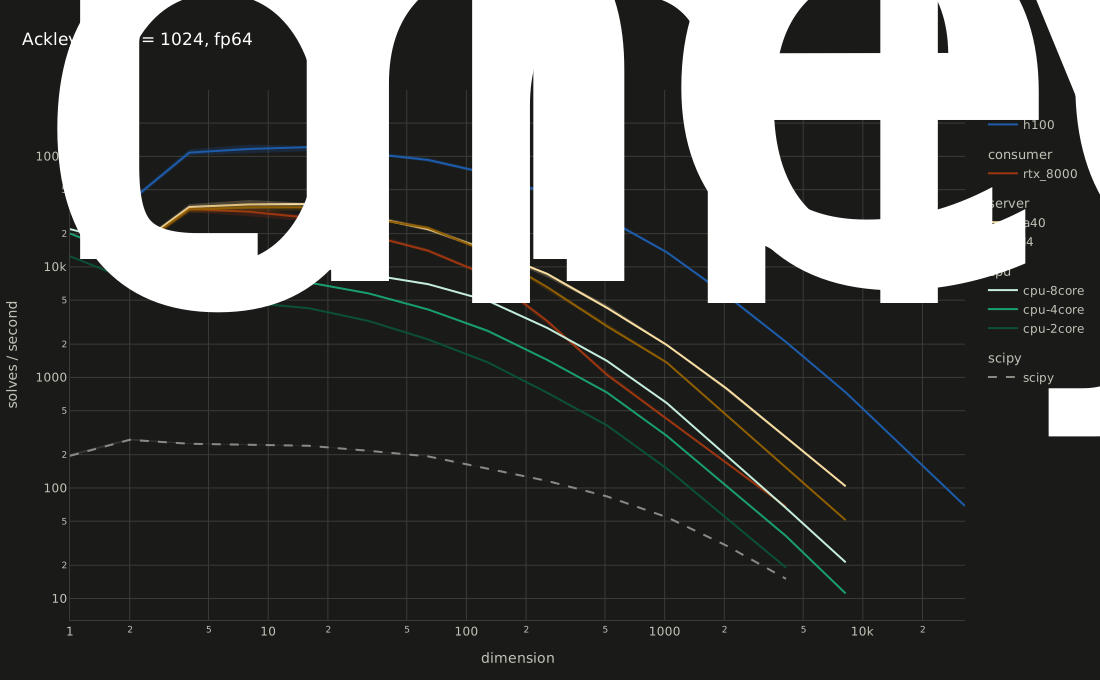
Read the small end of either axis as latency, not throughput — JAX is dispatch-bound there. What is measured, how, and where each curve stops: bench/README.md.
Development
uv sync
uv run --no-sync pytest tests/functions -q       # ~15s, parity + API
uv run --no-sync pytest tests/optim -q           # ~2min, the solver against scipy
uv run --no-sync python tools/fetch_sfu.py       # refresh tools/sfu/*.R from the SFU site
Parity is checked live: tests/functions/test_reference.py shells out to Rscript against the
vendored sources — no frozen golden data. Without R on PATH that module skips.
License
GPL-2.0-only, matching the SFU reference implementations this is derived from. See LICENSE and NOTICE.
1 maintainer

Metadata
1 maintainer
Release files for jaxvlse 0.1.1
For a detailed explanation of source distributions (sdists) and built distributions (wheels), please see the package formats documentation.
Source distribution (sdist)
| File | Size | Uploaded | |
|---|---|---|---|
| jaxvlse-0.1.1.tar.gz | 30.5 kB | Details |
Built distribution (wheel)
| File | Interpreter | ABI | Platform | Reset |
|---|---|---|---|---|
| jaxvlse-0.1.1-py3-none-any.whl | Python 3 | none | any | Details |
Total release size: 64.4 kB
Release files / jaxvlse-0.1.1.tar.gz
| Download URL | jaxvlse-0.1.1.tar.gz |
|---|---|
| Size | 30.5 kB |
| Tags | Source |
|
SHA-256 checksum How to use checksums |
3f2655b71d1a88aead37c587c7efa521750c7cb2b9b4cae678e0e9f713547ddb
|
|
BLAKE2b-256 checksum How to use checksums |
aa87b8b68a4beac57a08d12108d8ecc87bd3f305c5cdaf69c326a03bfdd05e26
|
| Upload date | |
|
Uploaded using Trusted Publishing? What is trusted publishing? |
No |
| Uploaded via |
uv/0.10.2 {"installer":{"name":"uv","version":"0.10.2","subcommand":["publish"]},"python":null,"implementation":{"name":null,"version":null},"distro":{"name":"Ubuntu","version":"24.04","id":"noble","libc":null},"system":{"name":null,"release":null},"cpu":null,"openssl_version":null,"setuptools_version":null,"rustc_version":null,"ci":null}
|
Release files / jaxvlse-0.1.1-py3-none-any.whl
| Download URL | jaxvlse-0.1.1-py3-none-any.whl |
|---|---|
| Size | 33.9 kB |
| Tags | Python 3 |
|
SHA-256 checksum How to use checksums |
4bf60ab8297853ee7bbdd87d3371d1d5b722ff4ecf3d8c574e888d6b980c0360
|
|
BLAKE2b-256 checksum How to use checksums |
416fa6d6a1f9f6eddcf0602932188a1361060761a2bbaeebb1903e933b947387
|
| Upload date | |
|
Uploaded using Trusted Publishing? What is trusted publishing? |
No |
| Uploaded via |
uv/0.10.2 {"installer":{"name":"uv","version":"0.10.2","subcommand":["publish"]},"python":null,"implementation":{"name":null,"version":null},"distro":{"name":"Ubuntu","version":"24.04","id":"noble","libc":null},"system":{"name":null,"release":null},"cpu":null,"openssl_version":null,"setuptools_version":null,"rustc_version":null,"ci":null}
|














