
vlse
The 48 test functions of the Virtual Library of Simulation Experiments (Surjanovic & Bingham, SFU), ported to JAX, plus an L-BFGS-B solver.
- Each function is a line-by-line port of the R source published on the SFU site. The test suite
re-runs those R sources and checks agreement at
rel=1e-12. - Functions are callable objects and valid pytrees: they
jit,vmap,grad, and run unchanged on CPU or GPU. Evaluation happens in the dtype of the input. vlse.optim.minimiseis L-BFGS-B compiled to a single XLA program, tested against scipy's Fortran implementation.
uv add jaxvlse # the distribution is `jaxvlse`; the import stays `import vlse`
Use
import vlse
import jax
import jax.random as jr

f = vlse.Ackley(d=20)
lo, hi = f.domain                                   # per-axis bounds, (-32.768, 32.768)
x = jr.uniform(jr.key(0), (100, 20), minval=lo, maxval=hi)

f(x)                                                # (100,), batched over leading axes
f(x[0])                                             # scalar
jax.grad(lambda x: f(x).sum())(x)                   # (100, 20)
f.ymin                                              # 0.0, the minimum over `domain`
API
Every function has the same shape:
class SomeFunction:
    d: int              # input dimension; a constructor argument for the any-d functions
    domain: (lo, hi)    # per-axis bounds, each of length d
    ymin: float         # global minimum over `domain`

    def __call__(self, x):   # (..., d) -> (...)
        ...
Published parameters and variants are constructor arguments, never separate classes:
Ackley(a=, b=, c=), Michalewicz(m=), Shekel(m=5|7|10, b=, C=),
Bohachevsky(variant=1|2|3), rescaled=True for the Picheny et al. (2012) forms,
Branin(modified=True) for the Forrester et al. (2008) modified Branin.
normalized=True takes the unit cube in and shifts the minimum to 0:
g(u) == f(lo + (hi - lo) * u) - f.ymin. Instantiated bare, a function is exactly as
published. For f64, enable jax_enable_x64 before importing vlse.
Functions
The dimension, domain and minimum of any-dimensional functions may depend on d; the values
below that do are given as formulas.
Many local minima
| function | d |
domain | minimum | parameters |
|---|---|---|---|---|
Ackley |
any | [-32.768, 32.768] | 0 | a, b, c |
Bukin6 |
2 | [-15, -5] × [-3, 3] | 0 | |
CrossInTray |
2 | [-10, 10] | -2.06261 | |
DropWave |
2 | [-5.12, 5.12] | -1 | |
EggHolder |
2 | [-512, 512] | -959.641 | |
GramacyLee |
1 | [0.5, 2.5] | -0.869011 | |
Griewank |
any | [-600, 600] | 0 | |
HolderTable |
2 | [-10, 10] | -19.2085 | |
Langermann |
2 | [0, 10] | -4.1558 | c, A |
Levy |
any | [-10, 10] | 0 | |
Levy13 |
2 | [-10, 10] | 0 | |
Rastrigin |
any | [-5.12, 5.12] | 0 | |
Schaffer2 |
2 | [-100, 100] | 0 | |
Schaffer4 |
2 | [-100, 100] | 0.292579 | |
Schwefel |
any | [-500, 500] | 0 | |
Shubert |
2 | [-5.12, 5.12] | -186.731 |
Bowl-shaped
| function | d |
domain | minimum | parameters |
|---|---|---|---|---|
Bohachevsky |
2 | [-100, 100] | 0 | variant (required, 1|2|3) |
Perm0 |
any | [-d, d] | 0 | beta |
RotatedHyperEllipsoid |
any | [-65.536, 65.536] | 0 | |
Sphere |
any | [-5.12, 5.12] | 0 | rescaled |
SumPowers |
any | [-1, 1] | 0 | |
SumSquares |
any | [-5.12, 5.12] | 0 | |
Trid |
any | [-d², d²] | -d(d+4)(d-1)/6 |
Plate-shaped
| function | d |
domain | minimum | parameters |
|---|---|---|---|---|
Booth |
2 | [-10, 10] | 0 | |
Matyas |
2 | [-10, 10] | 0 | |
McCormick |
2 | [-1.5, 4] × [-3, 4] | -1.9133 | |
PowerSum |
any | [0, d] | 0 | |
Zakharov |
any | [-5, 10] | 0 |
Valley-shaped
| function | d |
domain | minimum | parameters |
|---|---|---|---|---|
Camel3 |
2 | [-5, 5] | 0 | |
Camel6 |
2 | [-3, 3] × [-2, 2] | -1.03163 | |
DixonPrice |
any | [-10, 10] | 0 | |
Rosenbrock |
any | [-5, 10] | 0 | rescaled |
Steep ridges and drops
| function | d |
domain | minimum | parameters |
|---|---|---|---|---|
DeJong5 |
2 | [-65.536, 65.536] | 0.998 | |
Easom |
2 | [-100, 100] | -1 | |
Michalewicz |
any | [0, π] | grid-computed | m |
Other
| function | d |
domain | minimum | parameters |
|---|---|---|---|---|
Beale |
2 | [-4.5, 4.5] | 0 | |
Branin |
2 | [-5, 10] × [0, 15] | 0.397887 | a, b, c, r, s, t, rescaled, modified |
Colville |
4 | [-10, 10] | 0 | |
Forrester |
1 | [0, 1] | -6.02074 | |
ForresterLowFidelity |
1 | [0, 1] | 0.665095 | A, B, C |
GoldsteinPrice |
2 | [-2, 2] | 3 | rescaled |
Hartmann3 |
3 | [0, 1] | -3.86278 | |
Hartmann4 |
4 | [0, 1] | -3.1345 | |
Hartmann6 |
6 | [0, 1] | -3.32237 | rescaled |
Perm |
any | [-d, d] | 0 | beta |
Powell |
any | [-4, 5] | 0 | |
Shekel |
4 | [0, 10] | -10.5364 | m (5|7|10), b, C |
StyblinskiTang |
any | [-5, 5] | -39.166 d |
Deviations from the R sources
- The Hartmann 6-D pages are swapped upstream:
hart6r.Rcomputes Picheny's rescaled form andhart6sc.Rthe plain one.Hartmann6()is the plain form here; the parity table maps the two files crosswise. shekelr.Rhardcodesm <- 10, soShekel(m=5)andShekel(m=7)are checked against an independent reference instead.spherefmod.Ris published for d=6 only;Sphere(rescaled=True)generalizes it, reproducing the published constants at d=6.Michalewicz.yminhas no closed form; it is computed per-axis on a grid (the terms are separable) and cached.Forrester.yminis the numerically computed-6.020740055767083rather than the page's rounded-6.02074, which would put the normalized form below 0.
Optimizer
vlse.optim.minimise is L-BFGS-B (Byrd, Lu, Nocedal & Zhu 1995) written as a single
jax.lax.while_loop: a solve is one XLA dispatch, a multistart batch is a vmap, and the whole
thing jits, differentiates and runs on any backend.
from vlse.optim import minimise

f = vlse.Ackley(d=20)
state = minimise(f, x0, bounds=f.domain, tol=1e-9)      # state.x, state.f, state.error, ...

starts = jr.uniform(jr.key(0), (256, 20), minval=lo, maxval=hi)
jax.jit(jax.vmap(lambda x0: minimise(f, x0, f.domain)))(starts)
The signature follows scipy.optimize.minimize: minimise(fun, x0, bounds=None, args=(), tol=1e-5, ftol=0.0, max_iterations=100, history_length=10, ...). x0 may be any pytree —
the solve runs on the raveled vector and x/grad come back in x0's structure, with
bounds mirroring it. Stopping is scipy's pgtol (plus ftol on relative decrease when
set), the line search follows scipy's lnsrlb/dcsrch, and every tolerance is read off the
working dtype. Enable jax_enable_x64: f64 is what the solver is written, tested and
benchmarked for.
The result is not byte-identical to scipy — XLA reassociates the arithmetic, and on a
multimodal box the last bit can decide a basin. The test suite (tests/optim/) therefore
solves all 48 functions from 32 shared starts in six modes (sequential / lax.map / vmap
× CPU / GPU): outside the multimodal set every start must land exactly where scipy lands;
on it, a Šidák-corrected one-sided Wilcoxon signed-rank must not show the solver landing in
worse minima than scipy.
Benchmarks
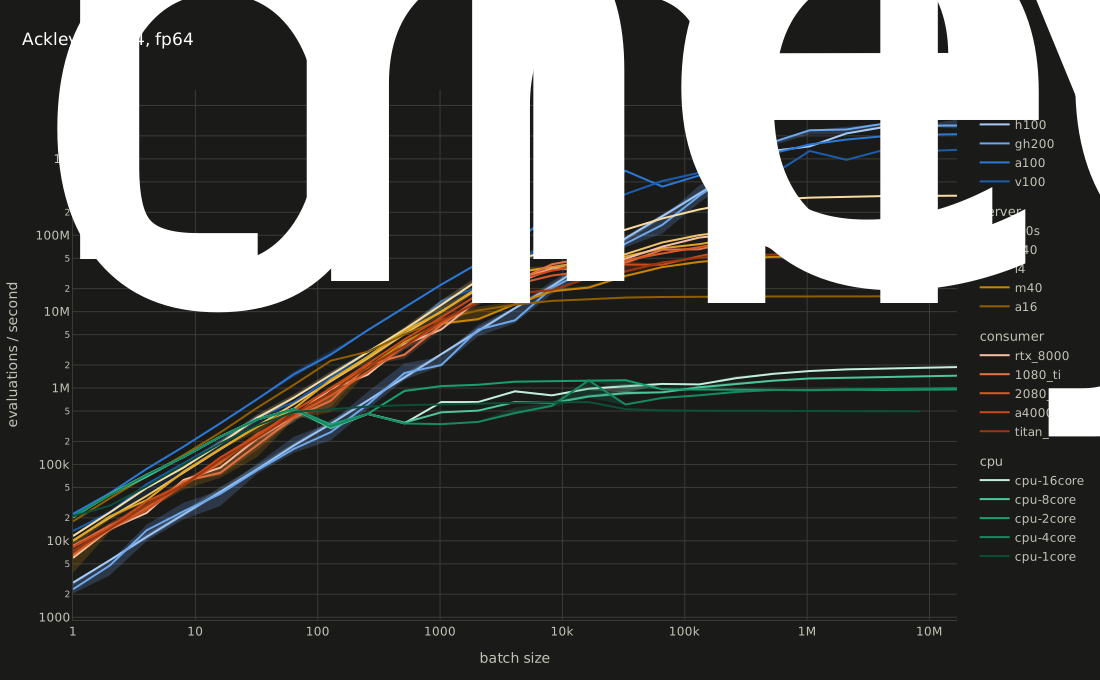
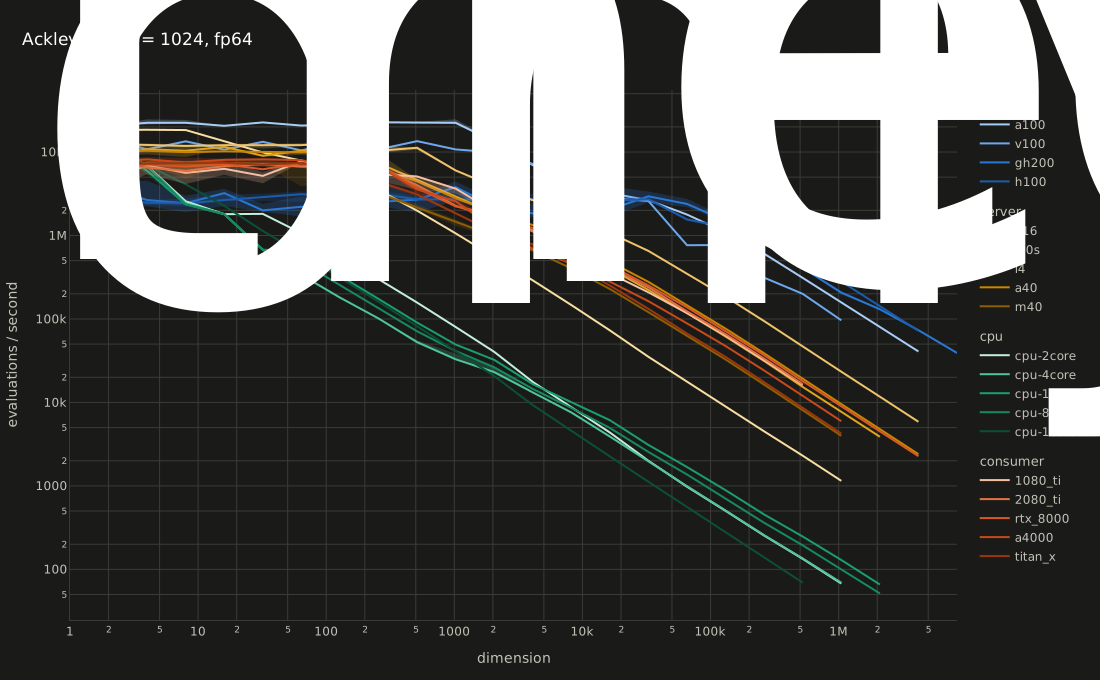
Both benches sweep every GPU and CPU of one cluster over batch size and dimension, climbing powers of two until the device gives out. Median per-call throughput, 95% interval shaded, log-log; figures open hoverable.
Function evaluation (Ackley, f64; the
f32 batch
and f32 dim
panels run one to two orders faster on everything but the hpc parts):
L-BFGS-B, against scipy's Fortran on the same objective, starts and box (f64; the f32 batch and f32 dim panels solve the same problem in single precision, to the 1e-3 projected gradient that precision can resolve rather than f64's 1e-9):
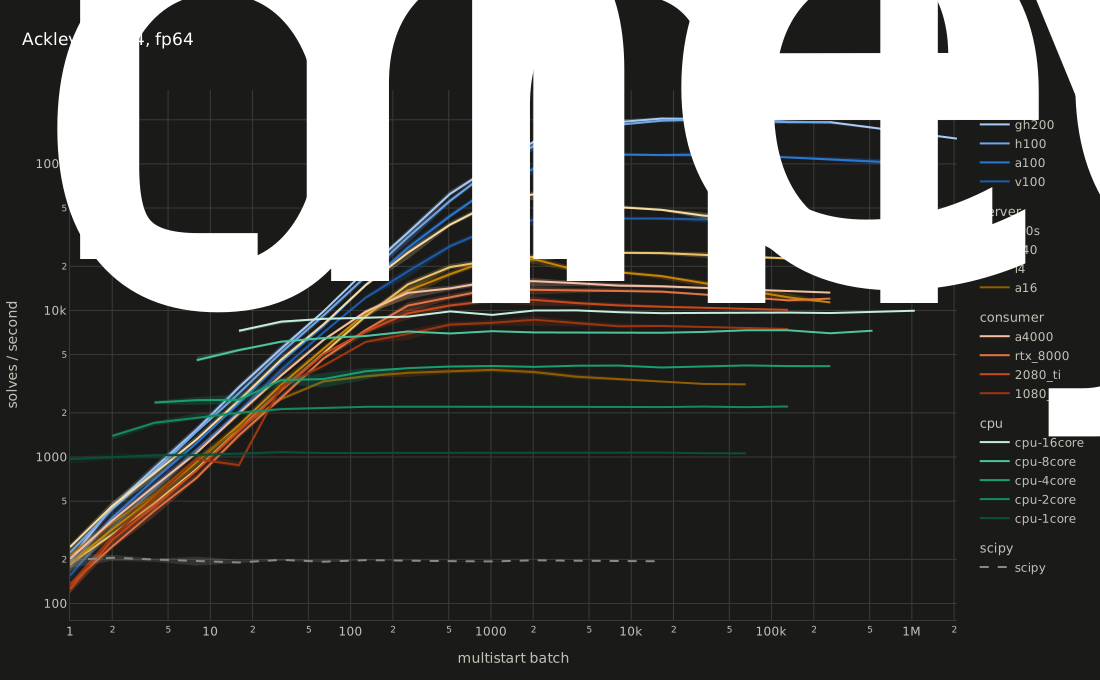
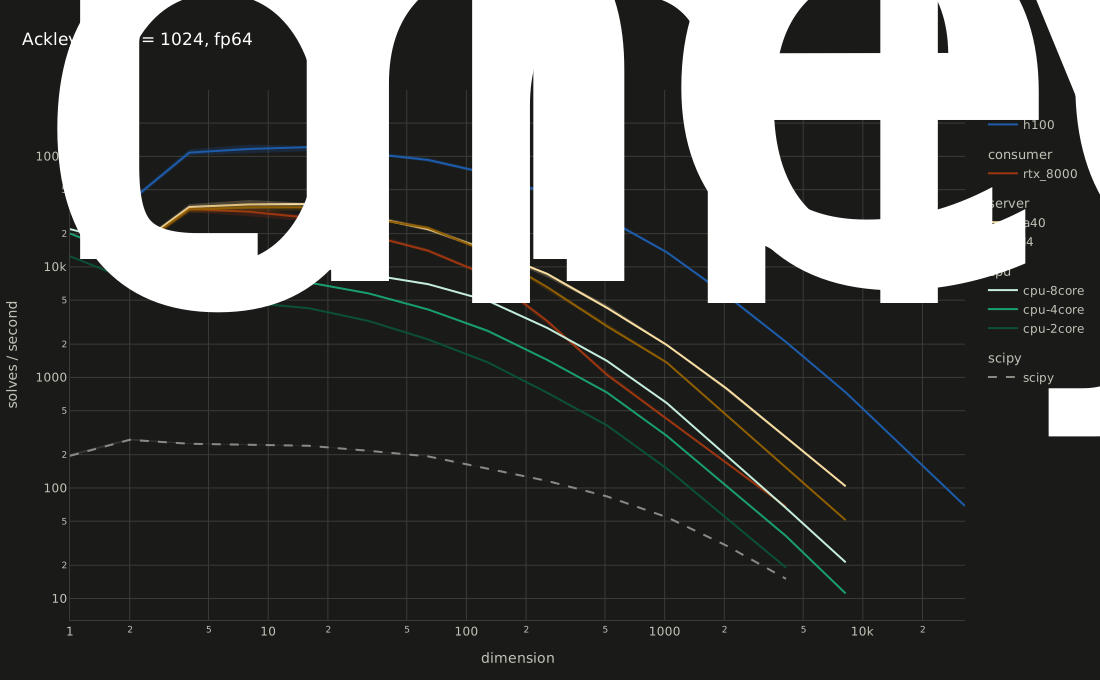
Read the small end of either axis as latency, not throughput — JAX is dispatch-bound there. What is measured, how, and where each curve stops: bench/README.md.
Development
uv sync
uv run --no-sync pytest tests/functions -q       # ~15s, parity + API
uv run --no-sync pytest tests/optim -q           # ~2min, the solver against scipy
uv run --no-sync python tools/fetch_sfu.py       # refresh tools/sfu/*.R from the SFU site
Parity is checked live: tests/functions/test_reference.py shells out to Rscript against the
vendored sources — no frozen golden data. Without R on PATH that module skips.
License
GPL-2.0-only, matching the SFU reference implementations this is derived from. See LICENSE and NOTICE.
1 maintainer

Metadata
1 maintainer
Release files for jaxvlse 0.1.3
For a detailed explanation of source distributions (sdists) and built distributions (wheels), please see the package formats documentation.
Source distribution (sdist)
| File | Size | Uploaded | |
|---|---|---|---|
| jaxvlse-0.1.3.tar.gz | 31.3 kB | Details |
Built distribution (wheel)
| File | Interpreter | ABI | Platform | Reset |
|---|---|---|---|---|
| jaxvlse-0.1.3-py3-none-any.whl | Python 3 | none | any | Details |
Total release size: 66.1 kB
Release files / jaxvlse-0.1.3.tar.gz
| Download URL | jaxvlse-0.1.3.tar.gz |
|---|---|
| Size | 31.3 kB |
| Tags | Source |
|
SHA-256 checksum How to use checksums |
33cb1695edbd2c7165db6704d252412925c6aec9253876a35a906be1f25c2adf
|
|
BLAKE2b-256 checksum How to use checksums |
a79994bcf7e846bc5118de741c453019cf049a67569fb2201c101cf8ca911d74
|
| Upload date | |
|
Uploaded using Trusted Publishing? What is trusted publishing? |
No |
| Uploaded via |
uv/0.10.2 {"installer":{"name":"uv","version":"0.10.2","subcommand":["publish"]},"python":null,"implementation":{"name":null,"version":null},"distro":{"name":"Ubuntu","version":"24.04","id":"noble","libc":null},"system":{"name":null,"release":null},"cpu":null,"openssl_version":null,"setuptools_version":null,"rustc_version":null,"ci":null}
|
Release files / jaxvlse-0.1.3-py3-none-any.whl
| Download URL | jaxvlse-0.1.3-py3-none-any.whl |
|---|---|
| Size | 34.7 kB |
| Tags | Python 3 |
|
SHA-256 checksum How to use checksums |
e37e8073f78498fcffcb4cc20a6f6924ebb4a619a2dc169bb3ae22deaaacc381
|
|
BLAKE2b-256 checksum How to use checksums |
28e32bb95662cc866591dd2a969e94b9481de34afeddb64563f2dc2503375839
|
| Upload date | |
|
Uploaded using Trusted Publishing? What is trusted publishing? |
No |
| Uploaded via |
uv/0.10.2 {"installer":{"name":"uv","version":"0.10.2","subcommand":["publish"]},"python":null,"implementation":{"name":null,"version":null},"distro":{"name":"Ubuntu","version":"24.04","id":"noble","libc":null},"system":{"name":null,"release":null},"cpu":null,"openssl_version":null,"setuptools_version":null,"rustc_version":null,"ci":null}
|














