

Acceptance testing for LLM features, built for QA teams.
juried treats your LLM powered feature as a black box behind an HTTP endpoint. You write
acceptance criteria in plain English, juried generates test scenarios from them, runs each
scenario repeatedly, has a pinned LLM judge mark every response, and reports pass rates
with confidence intervals. Scenarios are ordinary pytest tests, so -k, -x, markers
and --junitxml all work and the results fit an existing CI job. The name says how it
works: the feature goes before a jury of repeated runs and only passes when the panel's
verdict holds.
Install
pip install juried
Python 3.12 or later. Judges read ANTHROPIC_API_KEY or OPENAI_API_KEY from the
environment; nothing else is ever read from disk.
Three commands
juried init        # writes juried.toml and an example acceptance.md
juried generate    # turns each criterion into scenarios/generated/<criterion>.yaml
juried run         # runs every scenario N times under pytest and writes the report
juried run accepts pytest arguments after its own, for example
juried run --runs 20 -k refunds -x --junitxml=out.xml. Generation is a one off step:
review and edit the generated YAML, commit it, and run never touches it.
Configuration
juried.toml lives at the repo root. Any key can be overridden with an environment
variable named JURIED_<SECTION>_<KEY>, such as JURIED_RUN_RUNS=20. .env.example
lists every variable juried reads, including the provider keys and the overrides;
copy it to .env and export it from your shell, since juried does not load it itself.
[target]
url = "https://staging.example.com/api/chat"
headers = { Authorization = "Bearer ${STAGING_TOKEN}" }
body = { message = "{{message}}", history = "{{history}}" }
response_path = "choices.0.message.content"

[run]
runs = 10          # attempts per scenario
threshold = 0.7    # gate on the lower bound of the Wilson 95% interval
concurrency = 4

[judge]
provider = "anthropic"    # anthropic, openai or stub
model = "claude-sonnet-5" # pinned and recorded with every verdict
Set temperature under [judge] only for a model that accepts it. claude-sonnet-5 rejects
the parameter, so the example leaves it out; when it is unset nothing is sent and the report
says so.
{{message}} is replaced with the scenario message; a value of exactly "{{history}}"
becomes the earlier turns as a list of {role, content} objects. response_path is a
dotted path into the JSON reply.
Criteria and scenarios
Criteria are ## headings in a Markdown file. The heading becomes a stable id; add
{#id} to fix it explicitly.
## Refund policy
The bot explains that any item can be returned within 14 days of delivery for a full
refund. It must state the 14 day window.

## Unknown questions {#unknown}
When the bot cannot answer it says so and gives help@example.com.
Generated and hand written scenarios share one YAML shape. Hand written files go
anywhere under scenarios/; runs and threshold may be set per scenario.
criterion: refund-policy
scenarios:
  - name: Asks how to get money back
    kind: happy_path
    message: I want my money back on a jumper that does not fit.
    expected: States the 14 day return window and that the refund is full.
  - name: Follows up after a delivery answer
    kind: edge_case
    history:
      - role: user
        content: Can you tell me about delivery?
      - role: assistant
        content: Standard delivery takes 3 to 5 working days.
    message: and refunds?
    expected: Explains the 14 day refund window without repeating the delivery answer.
    runs: 20
    threshold: 0.8
A phrase in double quotes inside expected must appear in the response word for word,
ignoring case. Text outside quotes is judged on meaning. With
expected: Says returns are accepted within "14 days" for a full refund, a response saying
"you have 14 days and get every penny back" passes, while "a fortnight for a full refund"
fails because 14 days is missing. The stub judge applies the same rule.
How a scenario passes
Each scenario runs runs times. The judge marks each response pass or fail with a one
line reason, using a fixed prompt and the configured temperature, if any. juried computes the
pass rate and its
Wilson 95% interval, and the scenario passes when the lower bound meets threshold. With
10 runs a perfect score gives a lower bound of 0.72, so the default threshold is 0.7; a
stricter threshold needs more runs, and juried warns when a gate can never pass.
A failing gate is a normal pytest failure that shows the pass rate, the interval, the
threshold and the first failing transcript with the judge's reason. An HTTP error from
your endpoint is reported as a transport error, separately from a judge fail. Responses
and verdicts are cached in .juried/ by content hash, so re-runs during development are
cheap; pass --no-cache to skip it. Every verdict is appended to .juried/verdicts.jsonl
with the judge model and timestamp.
The report
After a run juried writes reports/juried-report.html and reports/juried-report.json.
The HTML is a single self contained file with no scripts. It opens with the totals, then
lists each acceptance criterion with its description, a table of its scenarios showing
passes, pass rate, interval, threshold, response latency and gate result, and beneath the
table each scenario's message, expectation and every failing run with the response and
the judge's reason. Criteria with no scenarios are called out so coverage gaps are
visible. The JSON file holds the same structure plus every attempt, for anyone who wants
to chart trends.
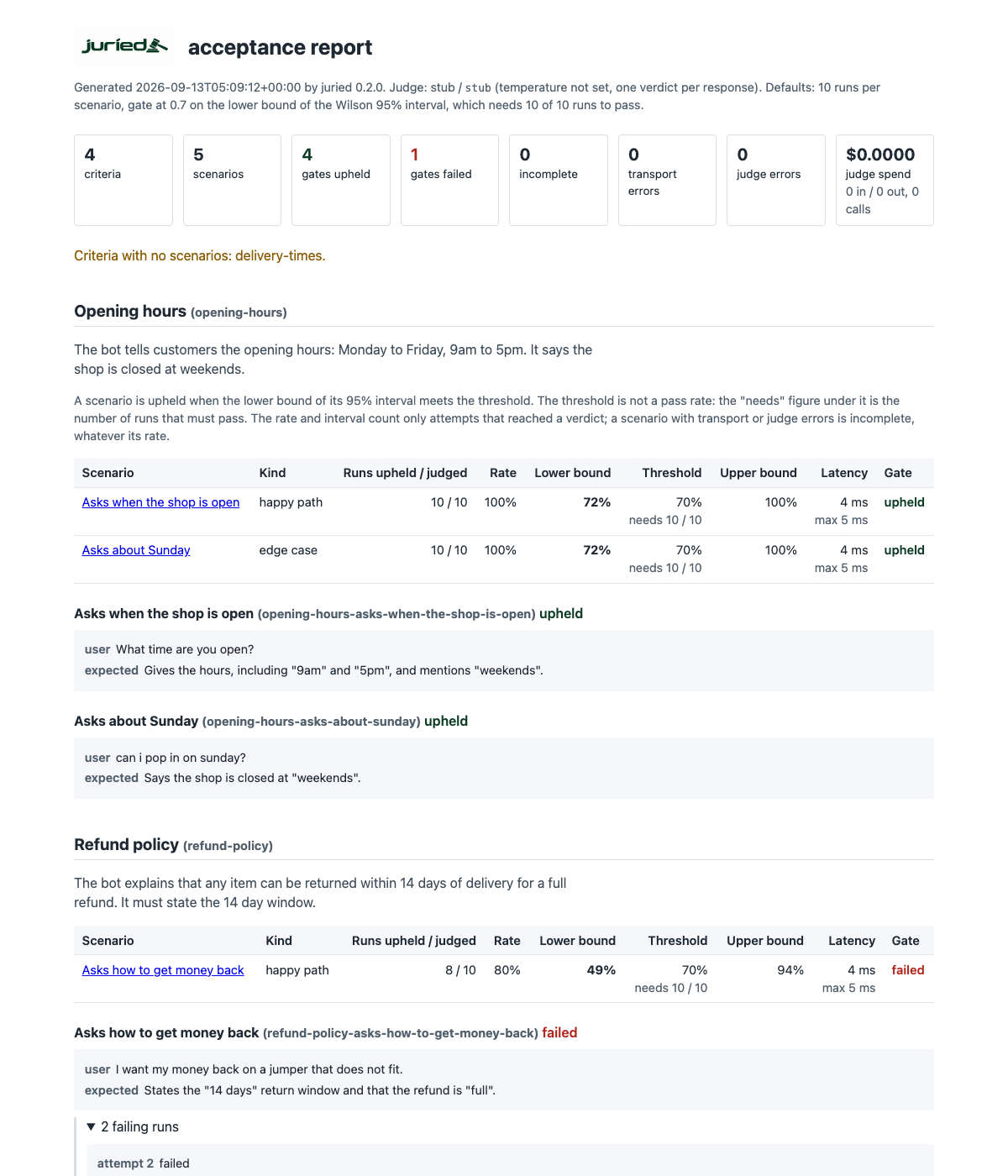
In the third row seven of ten runs passed and the observed rate meets the threshold, yet the gate still fails because the lower bound does not.
Try it without API keys
cd examples/faq-bot
python server.py &      # deterministic fake FAQ bot on port 8765
juried generate          # uses the stub provider from juried.toml
juried run
The stub judge passes a response that contains every "quoted phrase" in expected.
One hand written refund scenario fails its gate on purpose, because the fake bot drops
the 14 day detail every fourth time, which is the kind of flakiness juried exists to catch.
Development
make check # ruff, mypy and pytest
See CONTRIBUTING.md for the development install.
Licensed under the MIT licence.
1 maintainer

Metadata
1 maintainer
Release files for juried 0.1.1
For a detailed explanation of source distributions (sdists) and built distributions (wheels), please see the package formats documentation.
Source distribution (sdist)
| File | Size | Uploaded | |
|---|---|---|---|
| juried-0.1.1.tar.gz | 1.0 MB | Details |
Built distribution (wheel)
| File | Interpreter | ABI | Platform | Reset |
|---|---|---|---|---|
| juried-0.1.1-py3-none-any.whl | Python 3 | none | any | Details |
Total release size: 1.1 MB
Release files / juried-0.1.1.tar.gz
| Download URL | juried-0.1.1.tar.gz |
|---|---|
| Size | 1.0 MB |
| Tags | Source |
|
SHA-256 checksum How to use checksums |
946c08bfd0869b895e43b73af3b559fc6a3227ee5ea2405dc6a3febb48e8377b
|
|
BLAKE2b-256 checksum How to use checksums |
7ff4d587fe421472f9b0f0987ad74893994d6fca847dc71387ee559c552d9869
|
| Upload date | |
|
Uploaded using Trusted Publishing? What is trusted publishing? |
Yes |
| Uploaded via |
twine/7.0.0 CPython/3.13.14
|
Provenance
Provenance describes where a file came from. On PyPI, provenance is shared via attestations, which provide a verifiable record of the build or publishing details. View details, limitations and caveats.


PyPI Publish Attestation
PyPI verified that this artifact, at this checksum, originated from the publisher listed below.
Signed by GitHub Actions, verified by PyPI on Sep 12, 2026.
Transparency logRelease files / juried-0.1.1-py3-none-any.whl
| Download URL | juried-0.1.1-py3-none-any.whl |
|---|---|
| Size | 115.0 kB |
| Tags | Python 3 |
|
SHA-256 checksum How to use checksums |
62172cee2c91d5c358859488cec125781f6f5d7dcf21d29c79923323ab98c7c2
|
|
BLAKE2b-256 checksum How to use checksums |
e56cdcae962733b254e4fff024a0f0593fc0a78d3821e2a9281195a29021c3af
|
| Upload date | |
|
Uploaded using Trusted Publishing? What is trusted publishing? |
Yes |
| Uploaded via |
twine/7.0.0 CPython/3.13.14
|
Provenance
Provenance describes where a file came from. On PyPI, provenance is shared via attestations, which provide a verifiable record of the build or publishing details. View details, limitations and caveats.
PyPI Publish Attestation
PyPI verified that this artifact, at this checksum, originated from the publisher listed below.
Signed by GitHub Actions, verified by PyPI on Sep 12, 2026.
Transparency log













