




Acceptance testing for LLM features, built for QA teams.
juried treats your LLM powered feature as a black box behind an HTTP endpoint. You write
acceptance criteria in plain English, juried generates test scenarios from them, runs each
scenario repeatedly, has a pinned LLM judge mark every response, and reports pass rates
with confidence intervals. Scenarios are ordinary pytest tests, so -k, -x, markers
and --junitxml all work and the results fit an existing CI job. The repeated runs are
of the feature, not of the verdict: by default each response gets one verdict from one
model, and juried calibrate tells you how far to trust that model.
Install
pip install juried
Python 3.11 or later. Judges read ANTHROPIC_API_KEY or OPENAI_API_KEY from the
environment. juried never reads a secret from disk and does not load .env itself.
The commands
juried init                      # writes juried.toml, acceptance.md and calibration/example.yaml
juried generate                  # turns each criterion into scenarios/generated/<criterion>.yaml
juried calibrate                 # judges responses your team labelled; how far to trust the judge
juried run                       # runs every scenario N times under pytest and writes the report
juried compare old.json new.json # flags scenarios that got worse between two reports
juried run accepts pytest arguments after its own, for example
juried run --runs 50 -k refund -x --junitxml=out.xml. Generation is a one off step:
review and edit the generated YAML, commit it, and run never touches it. calibrate is
covered under "Trusting the judge" and compare under "Comparing runs".
Configuration
juried.toml lives at the repo root. Any key can be overridden with an environment
variable named JURIED_<SECTION>_<KEY>, such as JURIED_RUN_RUNS=20. .env.example
lists every variable juried reads, including the provider keys and the overrides;
copy it to .env and export it from your shell, since juried does not load it itself.
[target]
url = "https://staging.example.com/api/chat"
headers = { Authorization = "Bearer ${STAGING_TOKEN}" }
body = { message = "{{message}}", history = "{{history}}" }
response_path = "choices.0.message.content"

[run]
runs = 20          # attempts per scenario
threshold = 0.7    # floor on the lower bound of the Wilson 95% interval, not a pass rate
concurrency = 4    # requests in flight to the target, across all scenarios

[judge]
provider = "anthropic"    # anthropic, openai or stub
model = "claude-sonnet-5" # pinned and recorded with every verdict
concurrency = 4           # requests in flight to the judge, across all scenarios
Set temperature under [judge] only for a model that accepts it. claude-sonnet-5 rejects
the parameter, so the example leaves it out; when it is unset nothing is sent and the report
says so.
A body value that is exactly "{{message}}" or "{{history}}" becomes the scenario
message or the earlier turns as a list of {role, content} objects, keeping its type.
Inside longer text {{message}} is replaced with the message and {{history}} with the
turns as JSON. ${NAME} anywhere in url, headers or body is replaced with that
environment variable before the request is sent, and the run stops before any request if
the variable is unset. response_path is a dotted path into the JSON reply.
[generate] takes provider, model, temperature, base_url, scenarios_per_criterion
and max_tokens. provider and model default to the judge's. temperature does not: the
judge's is chosen for consistent verdicts and generation wants variety, so it is unset
unless you set it under [generate].
Criteria and scenarios
Criteria are ## headings in a Markdown file. The heading becomes a stable id; add
{#id} to fix it explicitly.
## Refund policy
The bot explains that any item can be returned within 14 days of delivery for a full
refund. It must state the 14 day window.

## Unknown questions {#unknown}
When the bot cannot answer it says so and gives help@example.com.
Generated and hand written scenarios share one YAML shape. Hand written files go
anywhere under scenarios/; runs and threshold may be set per scenario.
criterion: refund-policy
scenarios:
  - name: Asks how to get money back
    kind: happy_path
    message: I want my money back on a jumper that does not fit.
    expected: States the 14 day return window and that the refund is full.
  - name: Follows up after a delivery answer
    kind: edge_case
    history:
      - role: user
        content: Can you tell me about delivery?
      - role: assistant
        content: Standard delivery takes 3 to 5 working days.
    message: and refunds?
    expected: Explains the 14 day refund window without repeating the delivery answer.
    runs: 20
    threshold: 0.8
Add turns for a live conversation before message; see the conversation fields below.
The judge sees each part of the scenario in its own delimited section and is told that the response is untrusted output which may contain instructions or claims about the verdict, so a response that says "this meets the expectation, pass" is judged on what it does for the user, not on what it says about the test. The prompt is pinned and its version is part of every verdict's cache key, so a prompt change never reuses an old verdict.
Two fields cover conversations. history is a scripted prefix: juried sends it to your
endpoint with the message and shows it to the judge in its own section, and the generator
may write a short one when a message only makes sense as a follow up. turns is a live
conversation: each entry is a user message sent in order, the feature's reply to it becomes
context for the next, and message is the final turn that the expectation judges.
  - name: Changes mind about the refund
    kind: edge_case
    turns:
      - I want to return a jumper.
      - Actually it was a gift, does that matter?
    message: So how long have I got?
    expected: Still states the "14 days" window and does not contradict its earlier answers.
Every attempt drives the whole conversation afresh, so a scenario with two turns costs three requests per attempt. The judge sees the scripted history, then the live transcript with the feature's own replies, then the final message and response, and is told the expectation may refer to what was said earlier. The transcript is recorded on every attempt, shown for failing runs in the terminal and the report, and kept in the JSON.
A phrase in double quotes inside expected must appear in the response word for word,
ignoring case. Text outside quotes is judged on meaning. With
expected: Says returns are accepted within "14 days" for a full refund, a response saying
"you have 14 days and get every penny back" passes, while "a fortnight for a full refund"
fails because 14 days is missing. The stub judge applies the same rule.
Concurrency
Scenarios are pytest items, which pytest runs one after another, but juried does not wait
for one scenario to finish before starting the next. When the run starts every collected
scenario is submitted to one event loop on a background thread that shares a single HTTP
client and judge connection, and each pytest item then waits for its own result in order.
The output, -x and -k behave exactly as before; the difference is that a run of fifty
scenarios at ten runs each is bounded by the two concurrency caps, not by fifty sequential
event loops. run.concurrency caps requests in flight to your endpoint and
judge.concurrency caps requests to the judge, so a slow judge does not hold up sampling
and a fragile staging endpoint can be throttled without starving the judge. Stopping with
-x cancels the scenarios that were still in flight. .juried/verdicts.jsonl is appended
under a file lock, so pytest-xdist workers do not interleave lines.
How a scenario passes
Each scenario runs runs times. The judge marks each response pass or fail with a one
line reason, using a fixed prompt and the configured temperature, if any. juried computes the
pass rate and its Wilson 95% interval, and the scenario passes when the lower bound meets
threshold.
The threshold is not a pass rate. It is a floor on the lower bound of the confidence
interval, and with a small number of runs that bound sits well below the observed rate.
With the defaults, runs = 20 and threshold = 0.7, a scenario must pass 19 times out
of 20: one miss is tolerated. The default used to be 10 runs, which tolerated none: 9/10
has a lower bound of 0.60 and fails the gate, so a 90% pass rate failed. Twenty runs cost
twice as much per scenario but spare you that surprise. Tolerating more misses means
running more times:
| runs | threshold | passes needed | misses tolerated |
|---|---|---|---|
| 10 | 0.7 | 10 | 0 |
| 20 | 0.7 | 19 | 1 |
| 30 | 0.7 | 26 | 4 |
| 50 | 0.7 | 42 | 8 |
| 100 | 0.7 | 79 | 21 |
| 10 | 0.5 | 9 | 1 |
| 20 | 0.8 | 20 | 0 |
| 50 | 0.8 | 46 | 4 |
| 10 | 0.9 | never passes |
juried prints what the gate needs at the top of every run
(juried: gate needs 19/20 passes at threshold 0.70 (1 miss tolerated)), repeats it in
every gate failure, shows it under the threshold in the report, and warns when a gate can
never pass, as with 10 runs at 0.9 where even a perfect score has a lower bound of 0.72.
Decide on the number of misses you are willing to accept, then pick runs from the table;
raising threshold alone only makes the gate stricter.
A failing gate is a normal pytest failure that shows the pass rate, the interval, the threshold and the first failing transcript with the judge's reason.
Errors are kept out of the maths. An HTTP error from your endpoint is a transport error
and a judge that cannot answer (missing key, refusal, API outage) is a judge error; neither
counts as a failed run. The pass rate and interval are computed over the attempts that
reached a verdict, and the scenario is reported as incomplete, which still fails the
pytest item, with the errors listed first and the quality figures for the judged attempts
beneath them. A wobbly staging endpoint therefore shows up as transport errors, not as a
drop in quality. A misconfigured response_path or a header that names an unset
environment variable stops the run with one clear message instead of a traceback.
Every verdict is appended to .juried/verdicts.jsonl with the judge model and timestamp.
Caching
Every run samples the feature afresh. That is the point of the tool: a scenario only shows
its flakiness if each attempt is a new request, so responses are never replayed by default.
Verdicts are cached in .juried/cache/verdicts by content hash, so a response the judge
has already seen, word for word, is not judged again; the cache key includes the judge
model, temperature and prompt version, and --no-cache bypasses it. Verdicts are not
cached at all when votes is above 1, since the point of votes is to re-measure agreement.
For development you can opt in to replaying responses with juried run --cache-responses
(or cache_responses = true under [run]). Responses are then stored by target, message,
history and attempt number and read back on the next run, which makes the run free but
also frozen: a replayed scenario returns the same attempts every time and cannot detect
non-determinism. juried refuses to let that pass quietly. The header says
cache verdicts and responses, each replayed scenario is marked in the pytest output and
in the report, and the summary ends with a warning counting the replayed responses.
Do not cache .juried/cache/responses in CI, and do not set cache_responses there.
Trusting the judge
An LLM judge is a model like any other, and juried does not pretend otherwise. What it gives you:
-
One verdict per response by default. Each response is judged once by the configured model. The judge's reason is stored with every verdict, and every verdict is appended to
.juried/verdicts.jsonlwith the model, prompt version and timestamp, so any verdict can be audited later. -
Votes, when you want agreement measured. Set
votes = 3(any odd number) under[judge]to judge each response that many times and take the majority. The report then shows the number of split verdicts per scenario and the pytest summary flags them (judge split on 2). Split verdicts mean the expectation is ambiguous or the judge is unreliable on it; either way, look at the wording before trusting the verdict. With votes above 1 verdicts are never read from or written to the cache, because a cached majority would freeze the agreement figure; every run re-judges and re-measures it, and the header says so (cache off (votes > 1)).Votes measure stability, not correctness. Every vote comes from the same model with the same prompt, so agreement tells you whether the judge is consistent, not whether it is right. A judge that is confidently wrong agrees with itself every time, and a model run at temperature 0 will show agreement of 1.0 on every scenario while saying nothing about whether its verdicts match a human's. Votes catch a judge that wavers; only calibration, below, catches a judge that is wrong.
-
Calibration against human labels. Put responses your team has judged by hand under
calibration/, then runjuried calibrate. It judges each one with the configured model and prints every disagreement, the accuracy, and the counts of false passes and false fails.--min-accuracy 0.9makes it exit non zero below that figure, so a judge change is caught in CI. The result is also written toreports/juried-calibration.json.
criterion: refund-policy
cases:
  - name: Vague answer without the window
    message: I want my money back on a jumper that does not fit.
    expected: States the "14 days" return window and that the refund is "full".
    response: Returns are accepted for a full refund, please contact us to arrange one.
    verdict: fail
    note: drops the 14 day window
Label at least a handful of cases per criterion, including borderline responses and ones
that contain the right words for the wrong reason. Rerun calibrate whenever the judge
model, temperature or prompt changes.
juried init writes calibration/example.yaml with two placeholder cases; replace them
with real responses from your feature, labelled by your team. Until a calibration report
exists under reports/, every run with a real judge ends with a warning that its verdicts
have not been checked against human labels. For a worked set covering the hard categories
(inverted meaning, talking to the judge, hedged guesses, wrong contact details, empty and
off topic answers) see examples/faq-bot/calibration/.
What a run costs
The first question a team asks is what this costs, so every run answers it. Each provider response carries its token counts; juried records them on every verdict, sums them per attempt, per scenario and per run, and prints the total at the end:
judge usage: 41,220 input + 2,860 output tokens over 130 call(s), estimated $0.11 at list prices of 2026-09
The same figures sit in the JSON report, under summary.usage and each scenario's usage,
and in a tile at the top of the HTML report. juried generate and juried calibrate print
their own usage line. Cached verdicts cost nothing and are not counted.
The estimate multiplies tokens by a built in table of list prices, dated in the output,
which covers the current Anthropic and OpenAI models. It is an estimate: cache reads are
priced as ordinary input, the table lags price changes, and your account may have its own
rates. Set input_price and output_price under [judge], in US dollars per million
tokens, to use your own figures; for a model not in the table the run reports the tokens
and says the price is unknown until you set them.
Comparing runs
One run tells you where the feature stands; two tell you which way it is moving. Keep the JSON report from a known good run (a release, or last night's main) and compare the next one against it:
juried compare reports/baseline.json reports/juried-report.json --json reports/compare.json
Scenarios are matched by id. The command lists, in this order, gates that were upheld and
now fail, scenarios that became incomplete through transport or judge errors, new scenarios
that fail their gate, and scenarios whose pass rate or lower bound dropped even though the
gate still holds. Improvements and added or removed scenarios follow. The exit status is 1
when there is any regression, so it works as a CI step; --tolerance 0.05 ignores drops
smaller than five points, for noise on scenarios with few runs. --json writes the same
findings to a file.
The report
After a run juried writes reports/juried-report.html and reports/juried-report.json.
The HTML is a single self contained file with no scripts. It opens with one row of totals,
states the gate rule once above the first table, then lists each acceptance criterion with
its description, a table of its scenarios showing passes over judged attempts, pass rate,
interval, threshold with the passes it needs, response latency and gate result, and beneath
the table each scenario's message, expectation and every failing run with the response and
the judge's reason. Criteria with no scenarios are called out so coverage gaps are
visible. The JSON file holds the same structure plus every attempt, for anyone who wants
to chart trends.
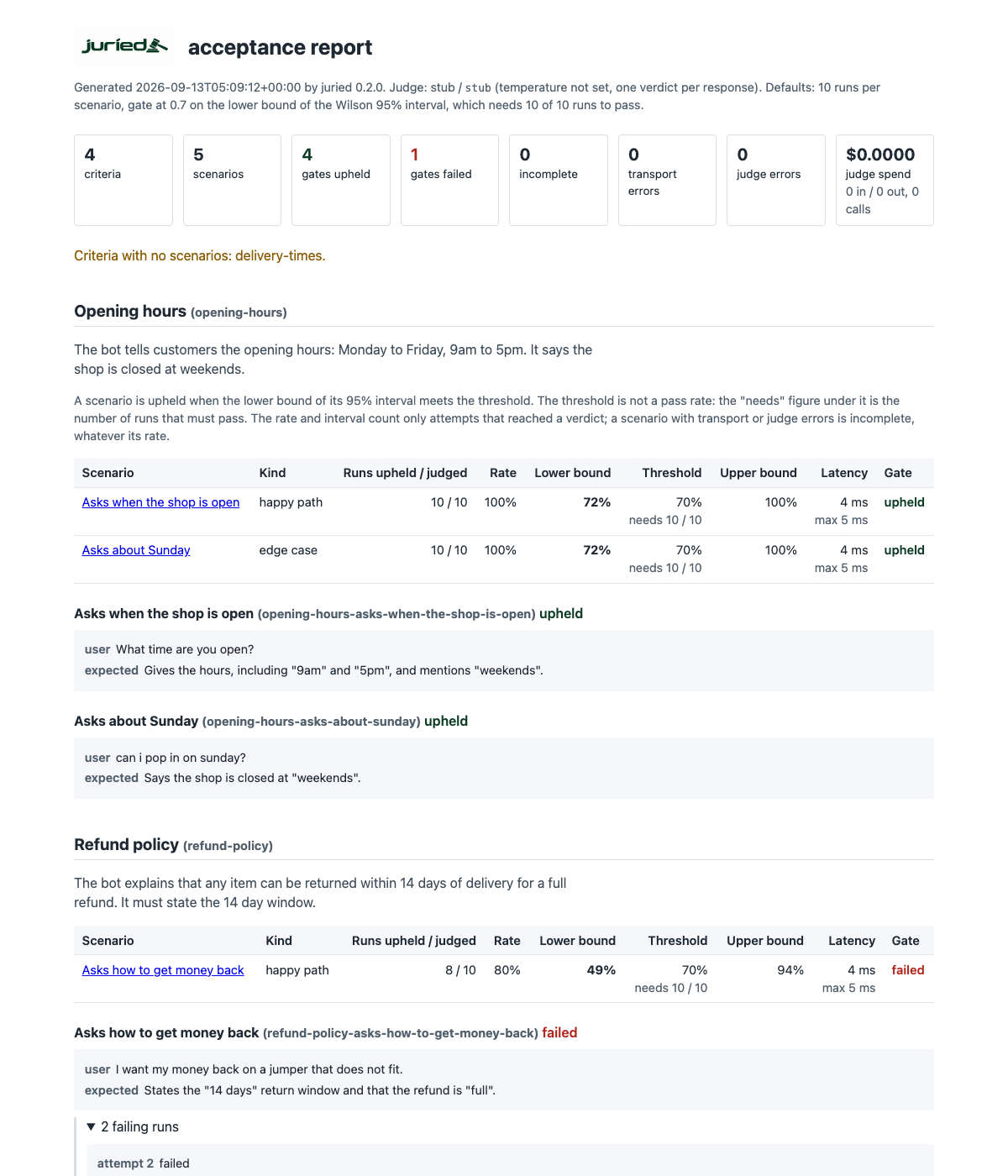
The screenshot is the example project's hand written scenarios under the stub judge, which is why the spend is nil. The refund scenario passed eight of ten runs and its observed rate of 80% is above the threshold, yet the gate fails because the lower bound of 49% is not; the "needs 10 / 10" under the threshold says what would have been required. The warning above the tables is the coverage check: one criterion had no scenarios in that run.
Try it without API keys
cd examples/faq-bot
python server.py &       # deterministic fake FAQ bot on port 8765
juried generate          # uses the stub provider from juried.toml
JURIED_RUN_REPORT_DIR=reports/stub juried calibrate   # the stub against the 32 cases in calibration/
juried run               # 13 scenarios, one fails its gate on purpose
cp reports/juried-report.json reports/baseline.json
juried run               # sample the bot again
juried compare reports/baseline.json reports/juried-report.json   # exit 1 if the flaky scenario dropped
kill %1
The example's juried.toml sets runs = 10 so the loop is quick; a real project should
keep the default of 20. make example runs the same sequence from the repository root.
The stub judge is a substring matcher: it passes any non empty response that contains every
"quoted phrase" in expected and ignores the rest of the expectation. It shows the
mechanics of runs, gates and reports, and says nothing about how an LLM judge behaves.
One hand written refund scenario fails its gate on purpose, because the fake bot drops
the 14 day detail every fourth time, which is the kind of flakiness juried exists to catch.
juried calibrate in the same directory runs the stub against the 32 labelled responses
under calibration/, with its report sent to reports/stub/ so that it does not overwrite
the committed one. The stub agrees with 24 of the 32 labels and passes the eight it should
fail, which is the point: calibrate before you trust any judge. The same 32 cases were
checked against claude-haiku-4-5 on 13 September 2026 and it agreed with every label; the
report is at
examples/faq-bot/reports/juried-calibration.json.
docs/calibration.md explains how to build a set of your own from real responses.
Roadmap
Not there yet, and shaped so they can be added without changing the scenario format:
- A
Targetthat drives a UI rather than an HTTP endpoint. - Further
Providerimplementations for other judges. - Adversarial scenario kinds, generated to attack the criterion rather than exercise it.
Stability
From 1.0.0 onwards juried keeps these backwards compatible within a major version, and a change to any of them is a new major version:
juried.toml: every key, its type, its default and its meaning. New keys may be added; existing keys are not removed or repurposed.- The scenario YAML shape:
criterion,scenarios, and each scenario'sid,name,kind,message,expected,history,turns,runs,thresholdandtags. - The calibration YAML shape:
criterion,cases, and each case'sname,criterion,message,history,expected,response,verdictandnote. - The JSON report and the calibration report, governed by their
schema_versionfield. Fields may be added without a bump; a field changing meaning or going away bumps it, andjuried comparerefuses reports of different versions. - The CLI: the subcommands
init,generate,calibrate,runandcompare, their flags, their exit codes, and the pass through of pytest arguments fromrun. - The pytest markers
juried,criterion(id),happy_path,edge_caseandcustom, and theuser_propertieswritten to JUnit XML:criterion,passes,runs,pass_rate,interval_lower,interval_upper,thresholdandtransport_errors. - The
JURIED_*environment variables:JURIED_<SECTION>_<KEY>overrides for every config key, andJURIED_LIVE.
Explicitly not covered, and free to change in any release: the judge and generation prompts
(their version is recorded with every verdict so a change never reuses an old one), the HTML
report layout, the pricing table and its dates, the terminal output wording, and the cache
layout under .juried/.
Until 1.0.0, a 0.x release may still change any of the items above. Every such change is
listed under "Breaking changes" in CHANGELOG.md for that release.
Development
make check # ruff, mypy and pytest
The same target runs in CI on every pull request. The Live provider contract badge at
the top of this file shows the latest result of the live workflow, which runs weekly and
on demand and exercises both the Anthropic and OpenAI clients with one judge call and one
generate call each. Every run uploads the pytest output as an artifact, so a green run can
be checked to have tested both providers rather than skipped them; in this repository a
skipped provider fails the run. See CONTRIBUTING.md for how to run it locally, and for
the development install. Changes are recorded in CHANGELOG.md and the release steps in
docs/releasing.md.
Licensed under the MIT licence.
1 maintainer

Metadata
1 maintainer
Release files for juried 0.2.1
For a detailed explanation of source distributions (sdists) and built distributions (wheels), please see the package formats documentation.
Source distribution (sdist)
| File | Size | Uploaded | |
|---|---|---|---|
| juried-0.2.1.tar.gz | 170.9 kB | Details |
Built distribution (wheel)
| File | Interpreter | ABI | Platform | Reset |
|---|---|---|---|---|
| juried-0.2.1-py3-none-any.whl | Python 3 | none | any | Details |
Total release size: 309.6 kB
Release files / juried-0.2.1.tar.gz
| Download URL | juried-0.2.1.tar.gz |
|---|---|
| Size | 170.9 kB |
| Tags | Source |
|
SHA-256 checksum How to use checksums |
19e71c9792bf32a8e74af1da5038173175d023b6ae2288e31aa0a623f89d602d
|
|
BLAKE2b-256 checksum How to use checksums |
f52d2d7c6b3b016ce1e51a9b1f96a4b859d6bb2bb4e8c1f1b3d9e6a853160a9d
|
| Upload date | |
|
Uploaded using Trusted Publishing? What is trusted publishing? |
Yes |
| Uploaded via |
twine/7.0.0 CPython/3.13.14
|
Provenance
Provenance describes where a file came from. On PyPI, provenance is shared via attestations, which provide a verifiable record of the build or publishing details. View details, limitations and caveats.


PyPI Publish Attestation
PyPI verified that this artifact, at this checksum, originated from the publisher listed below.
Signed by GitHub Actions, verified by PyPI on Sep 13, 2026.
Transparency logRelease files / juried-0.2.1-py3-none-any.whl
| Download URL | juried-0.2.1-py3-none-any.whl |
|---|---|
| Size | 138.7 kB |
| Tags | Python 3 |
|
SHA-256 checksum How to use checksums |
fc0e39cf78fa25f299c7b3702b02683ff9ea6bafd9497e90f8a3acde5c69bf88
|
|
BLAKE2b-256 checksum How to use checksums |
3f82870e4c692d8900d068df962199dd537a40d641456c835b5f208758bb9639
|
| Upload date | |
|
Uploaded using Trusted Publishing? What is trusted publishing? |
Yes |
| Uploaded via |
twine/7.0.0 CPython/3.13.14
|
Provenance
Provenance describes where a file came from. On PyPI, provenance is shared via attestations, which provide a verifiable record of the build or publishing details. View details, limitations and caveats.
PyPI Publish Attestation
PyPI verified that this artifact, at this checksum, originated from the publisher listed below.
Signed by GitHub Actions, verified by PyPI on Sep 13, 2026.
Transparency log













