

Your AI coding tools, under one roof.
See and share the MCP servers, plugins and skills
that Claude Code, Codex and Cursor load.




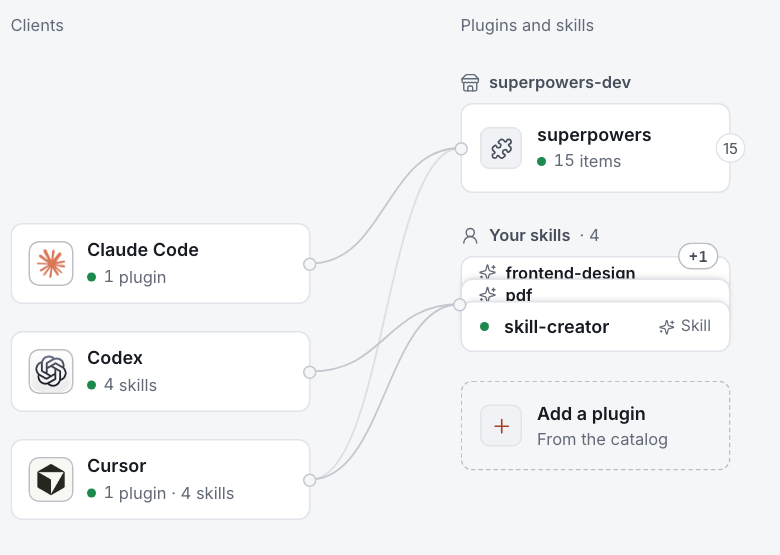
Everything your agents load, on one map
Claude Code, Codex and Cursor each keep their own settings. Kitden puts their plugins, skills, MCP servers and instruction files on one map, so what one agent has and another lacks shows at a glance. Add what an agent is missing, turn an item off or remove it, on the same page.
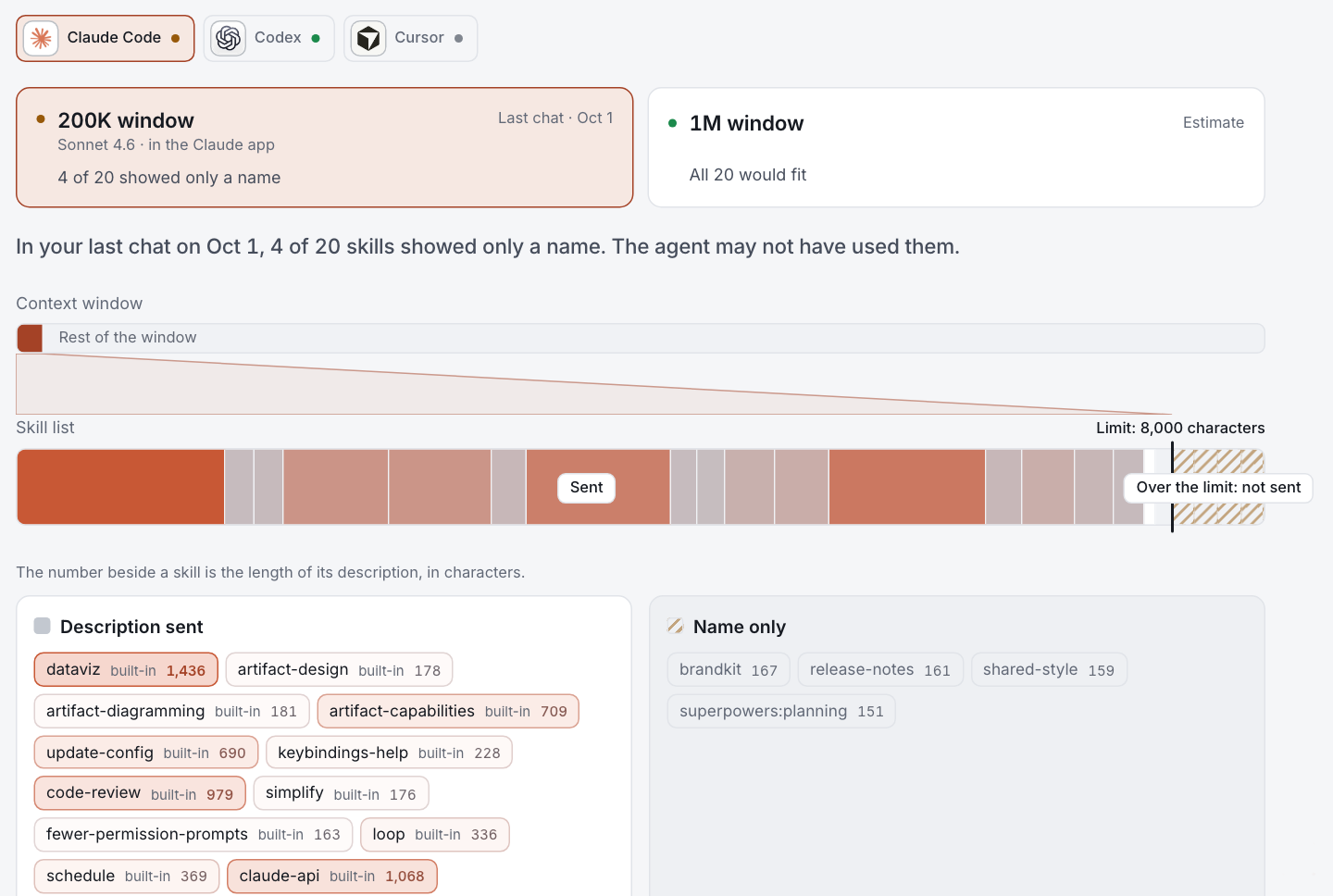
See whether your skills fit
Every chat starts with the list of your skills, and that list has a small budget: 1% of the context window in Claude Code, 2% in Codex. Past it, Claude Code sends some skills by name only and Codex shortens or drops them, so the agent may never reach for them. Kitden reads the last chat's log and shows which skills went in whole, so you can turn off the ones you do not use. A guess for another window is marked Estimate. Cursor gets no verdict: Kitden cannot see what it sends.
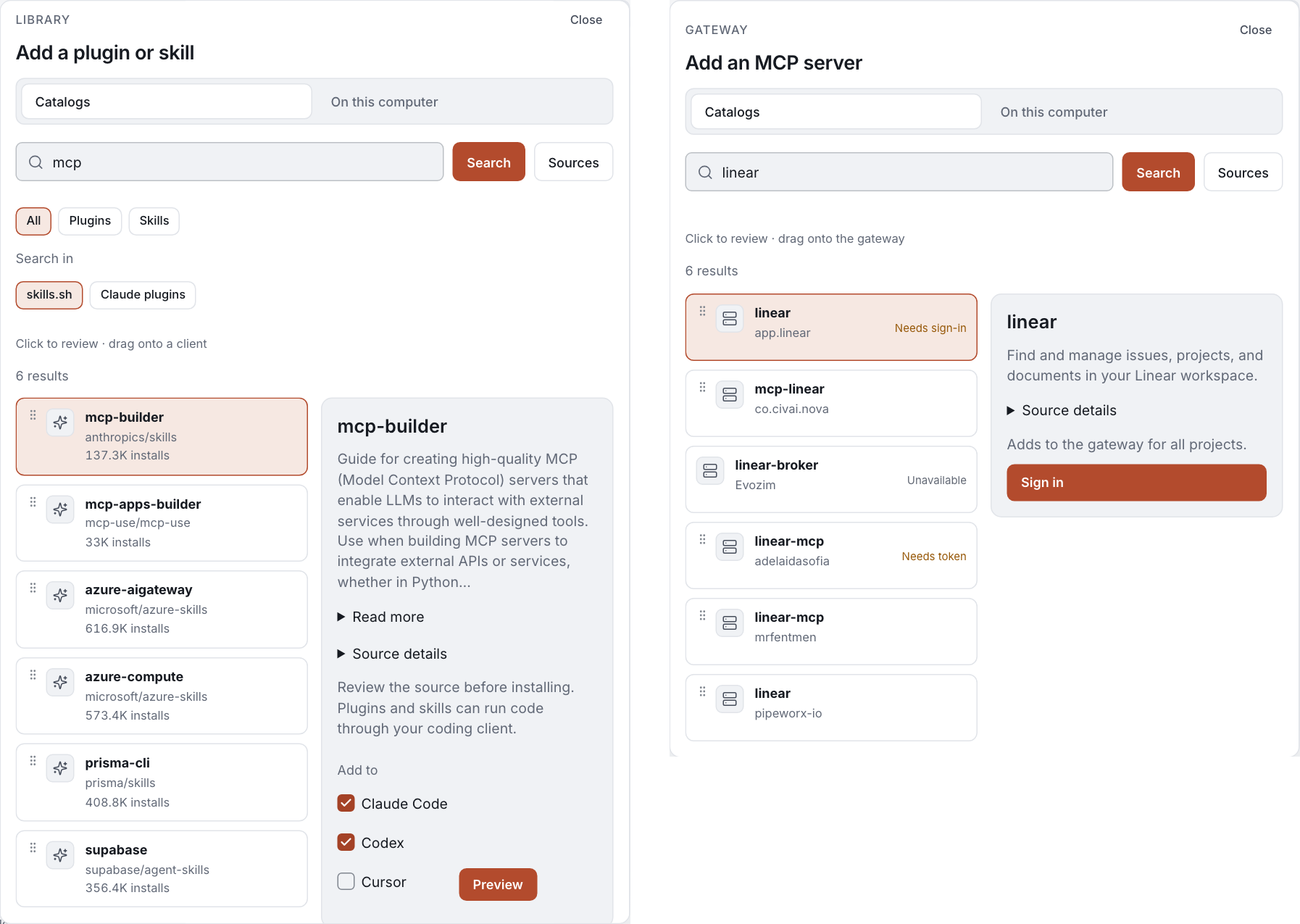
Find and add from one place
Search the official MCP Registry, skills.sh, the Claude plugins marketplace and any public GitHub repository without leaving the page. Tick the agents a plugin or skill goes to. An MCP server goes to the gateway, and says first whether it needs a sign-in or a token.
One gateway for your MCP servers
Move a server into the Kitden gateway and every agent you use gets it: set it up once, not once per agent. Every tool has a switch, for all projects or one, and a tool that is off is refused, not just hidden. A token or sign-in is given once and checked before Apply.
Every change can be undone
- Nothing is written until you press Apply. Every change shows a preview first, with the exact edit under Show changes.
- Apply keeps a backup, and Undo puts it back. Changes keeps the history of what you did. If a file changed since, Kitden stops instead of overwriting it.
- Everything stays on your computer. The page runs at 127.0.0.1 behind a private link. No account, no telemetry. Kitden goes online only for the catalogs you open, the remote servers you add, and a check for a newer Kitden, at most once a day.
- Secrets live in the macOS Keychain or your Linux keyring only. The page shows no more than their first and last characters.
- Kitden's agent tools only read. Asking an agent to show your setup changes nothing.
Add only servers and plugins you trust: they run with your permissions.
And more
| Feature | What it does |
|---|---|
| Per project | Turn a server or a tool on or off for one project only. |
| See what runs | How often each tool is called, and which tools only read. |
| Instructions in view | Which CLAUDE.md, AGENTS.md, rules, hooks, commands and agents each client loads, and where they come from. |
| MCP server | kitden mcp lets any agent read your setup, so "show my setup" or "why does this load twice" gets a true answer. Its own tools only read. |
| Plugin | For Claude Code and Codex. /plugin install kitden --marketplace KonstantinStarovoytov/kitden adds six skills and no server. /kitden:audit lists what to turn off in the project you are in, and /kitden:context says whether your skills fit. The skills only read, and offer to install Kitden when it is missing; you change things on the page. More. |
Get started
Needs macOS or Linux, uv and at
least one of Claude Code, Codex or Cursor. On Linux, install libsecret-tools (Debian,
Ubuntu) or libsecret (Fedora, Arch) so Kitden can keep server secrets in your keyring.
Try it on a sample first. Your own settings are not read or changed:
uvx --python 3.13 kitden demo
Install it and open it for your own setup:
uv tool install --python 3.13 kitden && kitden
Or with Homebrew: brew install konstantinstarovoytov/tap/kitden, then kitden.
Update later from the page, or with uv tool upgrade kitden or brew upgrade kitden.
Guide · Roadmap · Releases · Issues · Contributing · Apache-2.0
1 maintainer

Metadata
1 maintainer
Release files for kitden 0.9.0
For a detailed explanation of source distributions (sdists) and built distributions (wheels), please see the package formats documentation.
Source distribution (sdist)
| File | Size | Uploaded | Provenance | Actions |
|---|---|---|---|---|
| kitden-0.9.0.tar.gz | 875.8 kB | Without provenance | Details for kitden-0.9.0.tar.gz |
Built distribution (wheel)
| File | Interpreter | ABI | Platform | Actions Reset |
|---|---|---|---|---|
| kitden-0.9.0-py3-none-any.whl | Python 3 | none | any | Details for kitden-0.9.0-py3-none-any.whl |
Total release size: 1.8 MB
Release files / kitden-0.9.0.tar.gz
| Download URL | kitden-0.9.0.tar.gz |
|---|---|
| Size | 875.8 kB |
| Tags | Source |
|
SHA-256 checksum How to use checksums |
d6cf3dbd1301f76a21fbeb59c48499916ebbc5acc740d8bacbff2ae1753b4705
|
|
BLAKE2b-256 checksum How to use checksums |
bd1a568c006dd0a85573a9e302576775a5cd6b392863ca0ea865ed3e0d285f21
|
| Upload date | |
|
Uploaded using Trusted Publishing? What is trusted publishing? |
Yes |
| Uploaded via |
uv/0.10.10 {"installer":{"name":"uv","version":"0.10.10","subcommand":["publish"]},"python":null,"implementation":{"name":null,"version":null},"distro":{"name":"Ubuntu","version":"26.04","id":"resolute","libc":null},"system":{"name":null,"release":null},"cpu":null,"openssl_version":null,"setuptools_version":null,"rustc_version":null,"ci":true}
|
Release files / kitden-0.9.0-py3-none-any.whl
| Download URL | kitden-0.9.0-py3-none-any.whl |
|---|---|
| Size | 957.9 kB |
| Tags | Python 3 |
|
SHA-256 checksum How to use checksums |
975cd47bca1ba85c7865c73d25146c2c5311ffffbd4072d6d534f90773eaaa51
|
|
BLAKE2b-256 checksum How to use checksums |
9bc4aae2c0e446adb17a333cfb0f0d3def199db98f35b635aaaeb8d2238b9eb3
|
| Upload date | |
|
Uploaded using Trusted Publishing? What is trusted publishing? |
Yes |
| Uploaded via |
uv/0.10.10 {"installer":{"name":"uv","version":"0.10.10","subcommand":["publish"]},"python":null,"implementation":{"name":null,"version":null},"distro":{"name":"Ubuntu","version":"26.04","id":"resolute","libc":null},"system":{"name":null,"release":null},"cpu":null,"openssl_version":null,"setuptools_version":null,"rustc_version":null,"ci":true}
|
Security for kitden 0.9.0
Provenance
Provenance describes where a file came from. On PyPI, provenance is shared via attestations, which provide a verifiable record of the build or publishing details. View details, limitations and caveats.
No provenance found
None of the files in this release were uploaded with provenance metadata.
A note on package security
PyPI is a repository for distributing packages, not a service for auditing them. While third-party security researchers and our staff do their best to detect and remove malicious packages, PyPI cannot guarantee the quality, security or suitability of any given package.
To learn more about protecting yourself from malicious actors, visit our package security documentation.














