
The shape-shifting MCP hub — mount() into any MCP server at runtime. 7 registries. No restart.
Verified details
These details have been verified by PyPIProject links
GitHub Statistics
Maintainers

Project description

🌊 Kitsune MCP
One MCP entry. 10,000+ servers on demand.
Load only the tools you need. Switch instantly. No restarts.





The problem with static MCP setups
Every server you add to your config loads all its tools at startup — and keeps them there, all session long. Whether your agent uses them or not.
Five servers means 3,000–5,000 tokens of overhead on every request. Your agent sees 50+ tools and has to reason about all of them before it can act.
Kitsune MCP is one entry that replaces all of them.
mount("brave-search", tools=["web_search"])  # only the tool you need
# task done — switch instantly:
unmount()
mount("supabase")                            # different server, no restart
unmount()
mount("@modelcontextprotocol/server-github") # and again
One config entry. Any server across 7 registries. Load only the tools the current task needs — 2 out of 20 if that's all you need. Your agent stays focused and your costs stay low.
Base overhead: 7 tools, ~650 tokens (measured). Each mounted server adds only what you actually load.
Built for two audiences
Adaptive agents
An agent that loads everything upfront burns tokens on tools it never calls — and makes worse decisions because it sees too many options at once. An agent that mounts on demand is leaner, faster, and more focused:
- Mount only what the current task needs — switch to something else when it's done
mount(server_id, tools=[...])to cherry-pick — load 2 tools from a server that has 20- Chain across multiple servers in one session without touching config or restarting
- Token overhead stays flat: ~650 base + only what you load
Kitsune MCP is designed around the real economics of an agent loop.
MCP developers
Beyond MCP Inspector's basic schema viewer, Kitsune MCP gives you a full development workflow inside your actual AI client:
| Need | Tool |
|---|---|
| Explore a server's tools and schemas | inspect(server_id) |
| Quality-score your server end-to-end | test(server_id) → score 0–100 |
| Benchmark tool latency | bench(server_id, tool, args) → p50, p95, min, max |
| Prototype endpoint-backed tools live | craft(name, description, params, url) |
| Test inside real Claude/Cursor workflows | mount() → call tools natively → unmount() |
| Compare two servers side by side | mount one, test, unmount, mount the other |
No separate web UI. No isolated test environment. Test how your server actually behaves when an AI uses it.
Two modes
kitsune-mcp |
kitsune-forge |
|
|---|---|---|
| Purpose | Adaptive agents, everyday mounting | MCP evaluation, benchmarking, crafting |
| Tools | 7 (mount, unmount, search, inspect, call, key, status) | All 17 |
| Token overhead | ~650 tokens | ~1,700 tokens |
| Use when | Agents mounting per task, minimal token budget | Discovering, testing, benchmarking, prototyping |
Token numbers are measured from actual registered schemas — see examples/benchmark.py.
Both modes from the same package:
{ "command": "kitsune-mcp" }                        ← lean (default)
{ "command": "kitsune-forge" }                      ← full suite
{ "command": "kitsune-mcp",
  "env": { "KITSUNE_TOOLS": "mount,unmount,key" } }    ← custom
How It Fits Together
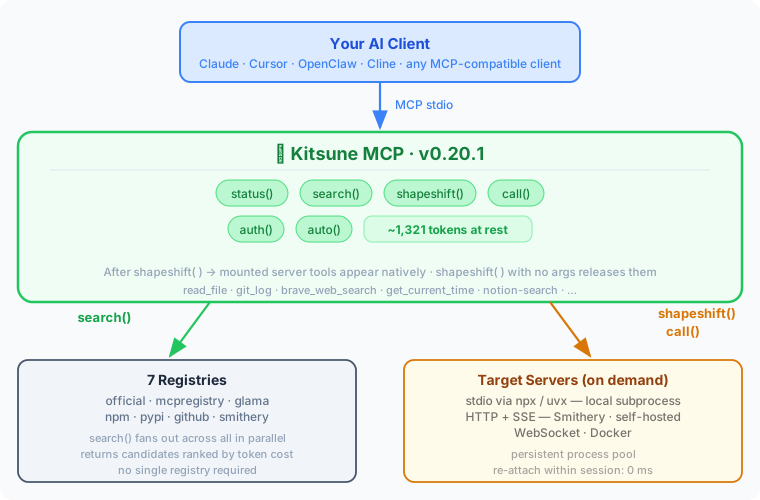
mount() injects tools directly at runtime via FastMCP's live API. Token overhead stays flat regardless of how many servers you explore.
Need the full evaluation suite? kitsune-forge adds execution, connection management, benchmarking, and tool crafting:
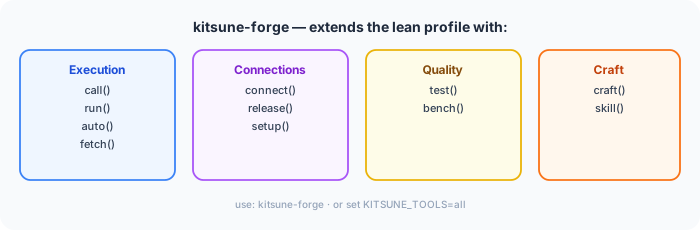
Quick Start
pip install kitsune-mcp
Add to your MCP client config — once, globally:
{
  "mcpServers": {
    "kitsune": {
      "command": "kitsune-mcp"
    }
  }
}
Works with Claude Desktop, Claude Code, Cursor, Cline, OpenClaw, Continue.dev, Zed, and any MCP-compatible client. No API keys needed.
| Client | Global config file |
|---|---|
| Claude Desktop (macOS) | ~/Library/Application Support/Claude/claude_desktop_config.json |
| Claude Desktop (Windows) | %APPDATA%\Claude\claude_desktop_config.json |
| Claude Code | ~/.claude/mcp.json |
| Cursor / Windsurf | ~/.cursor/mcp.json |
| Cline / Continue.dev | VS Code settings / ~/.continue/config.json |
| OpenClaw | MCP config in OpenClaw settings |
Server Sources
Kitsune MCP searches across 7 registries in parallel — tens of thousands of servers, no single one required.
| Registry | Auth | registry= value |
|---|---|---|
| modelcontextprotocol/servers | None | official |
| registry.modelcontextprotocol.io | None | mcpregistry |
| Glama | None | glama |
| npm | None | npm |
| PyPI | None | pypi |
| GitHub repos | None | github:owner/repo |
| Smithery | Free API key | smithery |
Default search() fans out across all no-auth registries automatically. Add a SMITHERY_API_KEY to extend discovery with Smithery's hosted server catalog (HTTP servers, no local install required).
How It Works
The proxy model
Kitsune MCP is a dynamic MCP proxy. It sits between your AI client and any number of other MCP servers, connecting to them on demand:
Your AI client
    │
    ▼
Kitsune MCP          ← the one entry in your config
    │
    ├── (on mount) ──► filesystem server   (spawned subprocess)
    ├── (on mount) ──► brave-search server (spawned subprocess)
    └── (on mount) ──► remote HTTP server  (HTTP+SSE connection)
Nothing is copied. When you call a mounted tool, Kitsune MCP forwards the call to the original server via JSON-RPC and returns the result. The server's logic always runs on the server — Kitsune MCP only relays the schema and the call.
What mount() does, step by step
- Connects to the target server via the right transport (stdio subprocess, HTTP, WebSocket)
- Handshakes — sends MCP
initialize/notifications/initialized - Fetches
tools/list,resources/list,prompts/listfrom the server - Registers each tool as a native FastMCP tool — a proxy closure with the exact signature from the schema
- Notifies the AI client (
notifications/tools/list_changed) so the new tools appear immediately
The AI sees read_file, write_file, list_directory as if they were always there. There's no wrapper or call_tool("filesystem", ...) indirection — the tools are first-class.
unmount() reverses all of it: deregisters the proxy closures, clears resources and prompts, notifies the client.
Resources and prompts
mount() proxies all three MCP primitives, not just tools:
| Primitive | What gets proxied |
|---|---|
| Tools | Every tool from tools/list, registered with its exact parameter schema |
| Resources | Static resources from resources/list — readable via the MCP resources API |
| Prompts | Every prompt from prompts/list, with its argument signature |
Template URIs (e.g. file:///{path}) are skipped — they require parameter binding that adds complexity with little practical gain. Everything else is proxied.
Transport is automatic
| Server source | How it runs |
|---|---|
| npm package | npx <package> — spawned locally |
| pip package | uvx <package> — spawned locally |
| GitHub repo | npx github:user/repo or uvx --from git+https://... |
| Docker image | docker run --rm -i --memory 512m <image> |
| Smithery hosted | HTTP+SSE (requires SMITHERY_API_KEY) |
| WebSocket server | ws:// / wss:// |
Why inspect() before mount()
inspect() connects to the server and fetches its schemas — but does not register anything. Zero tools added to context, zero tokens consumed by the AI.
Use it to:
- See exact parameter names and types before committing
- Check credential requirements upfront (avoid a cryptic error mid-task)
- Get the measured token cost of the mount so you can budget
- Verify the server actually starts and responds before a live session
inspect("mcp-server-brave-search")
# → CREDENTIALS
# →   ✗ missing  BRAVE_API_KEY — Brave Search API key
# →   Add to .env:  BRAVE_API_KEY=your-value
# → Token cost: ~99 tokens (measured)

# Add the key to .env — picked up immediately, no restart needed
# Then mount and use in the same session:
mount("mcp-server-brave-search")
call("brave_web_search", arguments={"query": "MCP protocol 2025"})
Security
Kitsune MCP introduces a trust model for servers you haven't personally audited.
Trust tiers
Every mount(), call(), and connect() result shows where the server comes from:
| Tier | Sources | Indicator |
|---|---|---|
| High | official (modelcontextprotocol/servers) |
✓ Source: official |
| Medium | mcpregistry, glama, smithery |
✓ Source: smithery |
| Community | npm, pypi, github |
⚠️ Source: npm (community — not verified) |
Install command validation
Before spawning any subprocess, Kitsune MCP validates the executable name:
- Blocks shell metacharacters (
&,;,|,`,$) — prevents injection via a crafted server ID - Blocks path traversal (
../) — prevents escaping to arbitrary binaries
Arguments are passed directly to asyncio.create_subprocess_exec (never a shell), so they are not subject to shell interpretation.
Credential warnings
mount() probes tool descriptions for unreferenced environment variable patterns. If a tool mentions BRAVE_API_KEY and that variable isn't set, you get a warning immediately — before you call anything:
⚠️  Credentials may be required — add to .env:
  BRAVE_API_KEY=your-value
  Or: key("BRAVE_API_KEY", "your-value")
Process isolation and sandboxing
- stdio servers run as separate OS processes — no shared memory with Kitsune MCP
- Docker servers run with
--rm -i --memory 512m --label kitsune-mcp=1 fetch()blocks private IPs, loopback, and non-HTTPS URLs (SSRF protection)- The process pool has a hard cap of 10 concurrent processes and evicts idle ones after 1 hour
What You Can Access
One kitsune-mcp entry unlocks any of these on demand — no config changes, no restart:
| Category | Servers | Key needed | Lean tokens |
|---|---|---|---|
| Web search | Brave Search, Exa, Linkup, Parallel | Free API keys | ~150–993 |
| Web scraping | Firecrawl, ScrapeGraph AI | Free tiers | ~400 (lean) |
| Code & repos | GitHub (official, 26 tools) | Free GitHub token | ~500 (lean) |
| Productivity | Notion, Linear, Slack | Free workspace keys | ~400 (lean) |
| Maps, Calendar, Gmail, Drive | Free GCP key / OAuth | varies | |
| Memory | Mem0, knowledge graphs | Free tiers | ~300 |
| No key required | Filesystem, Git, weather, Yahoo Finance | — | ~300–1,000 |
The same pattern works for all of them:
mount("brave")                                    # web search in 2 tools
call("brave_web_search", arguments={"query": "…"})

mount("firecrawl-mcp", tools=["scrape","search"]) # scraping, lean (2 of 9 tools)
call("scrape", arguments={"url": "https://…"})

mount("@modelcontextprotocol/server-github", tools=["create_issue","search_repositories"])
call("create_issue", arguments={"owner": "…", "repo": "…", "title": "…"})
Token cost scales with what you load, not what exists. A 26-tool GitHub server costs ~500 tokens if you only mount 3 tools. See .env.example for the full key catalog with lean mount hints.
Security note on .env
Kitsune MCP re-reads .env on every call — which means adding a key instantly activates it. That convenience comes with a responsibility: .env is the single place all your API keys live. A few practices worth following:
- Add
.envto.gitignore— never commit real keys - Use project-level
.envfor project-specific keys;~/.chameleon/.envfor personal global keys - Prefer minimal OAuth scopes and fine-grained tokens (e.g. GitHub fine-grained tokens with per-repo permissions)
- Rotate keys that get exposed; Kitsune MCP picks up the new value immediately without restart
Why Not Just X?
"Can't I just add more servers to mcp.json?" — Every configured server starts at launch and exposes all tools constantly. You can't add or remove mid-session without a restart. With 5+ servers you're burning thousands of tokens on every request for tools rarely needed. Kitsune MCP keeps the tool list minimal — mount what you need, unmount it when done.
"What about MCP Inspector?" — MCP Inspector is a standalone web UI that connects to one server and lets you inspect schemas and call tools manually. It's useful for basic debugging but isolated from real AI workflows. Kitsune MCP tests servers inside actual Claude or Cursor sessions — how an AI really uses them. It adds test() scoring, bench() latency numbers, side-by-side server comparison, and craft() for live endpoint prototyping. It also discovers and installs servers on demand; Inspector requires you to already have one running.
"What about mcp-dynamic-proxy?" — It hides tools behind call_tool("brave", "web_search", {...}) — always a wrapper. After mount("mcp-server-brave-search"), Kitsune MCP gives you a real native brave_web_search with the actual schema. It also can't discover or install packages at runtime.
"Can FastMCP do this natively?"
| FastMCP native | Kitsune MCP | |
|---|---|---|
| Proxy a known HTTP/SSE server | ✅ | ✅ |
| Mount tools at runtime | ✅ (write code) | ✅ mount() |
| Search registries to discover servers | ❌ | ✅ npm · official · Glama · Smithery |
| Install npm / PyPI / GitHub packages on demand | ❌ | ✅ |
| Atomic shed — retract all morphed tools at once | ❌ | ✅ unmount() |
| Persistent stdio process pool | ❌ | ✅ |
Zero boilerplate — works after pip install |
❌ | ✅ |
Configuration
Minimal (no API keys)
{
  "mcpServers": {
    "protean": { "command": "kitsune-mcp" }
  }
}
Optional integrations
{
  "mcpServers": {
    "kitsune": {
      "command": "kitsune-mcp",
      "env": { "SMITHERY_API_KEY": "your-key" }
    }
  }
}
Get a free key at smithery.ai/account/api-keys. Without it, Kitsune MCP is fully functional via npm, PyPI, official registries, and GitHub.
Frictionless credentials — Kitsune MCP re-reads .env on every inspect(), mount(), and call(). Add a key mid-session and it takes effect immediately — no restart:
# .env (CWD, ~/.env, or ~/.chameleon/.env — all checked, CWD wins)
BRAVE_API_KEY=your-key
GITHUB_TOKEN=ghp_...
Or use key() to write to .env and activate in one step:
key("BRAVE_API_KEY", "your-key") # writes to .env, active immediately
All Tools
kitsune-mcp — lean profile (7 tools, ~650 token overhead)
| Tool | Description |
|---|---|
mount(server_id, tools) |
Inject a server's tools live. tools=[...] for lean morph. |
unmount(release) |
Remove morphed tools. release=True kills the process immediately. |
search(query, registry) |
Search MCP servers across registries. |
inspect(server_id) |
Show tools, schemas, and live credential status (✓/✗ per key). |
call(tool_name, server_id, args) |
Call a tool. server_id optional when mounted — current form used. |
key(env_var, value) |
Save an API key to .env and load it immediately. |
status() |
Show current form, active connections (PID + RAM), token stats. |
kitsune-forge — full suite (all 17 tools, ~1,700 token overhead)
Everything above, plus:
| Tool | Description |
|---|---|
call(tool_name, server_id, args) |
Already in lean profile — listed here for completeness. |
run(package, tool, args) |
Run from npm/pip directly. uvx:pkg-name for Python. |
auto(task, tool, args) |
Search → pick best server → call in one step. |
fetch(url, intent) |
Fetch a URL, return compressed text (~17x smaller than raw HTML). |
craft(name, description, params, url) |
Register a custom tool backed by your HTTP endpoint. unmount() removes it. |
connect(command, name) |
Start a persistent server. Accepts server_id or shell command. |
release(name) |
Kill a persistent connection by name. |
setup(name) |
Step-by-step setup wizard for a connected server. |
test(server_id, level) |
Quality-score a server 0–100. |
bench(server_id, tool, args) |
Benchmark tool latency — p50, p95, min, max. |
skill(qualified_name) |
Load a skill into context. Persisted across sessions. |
Usage Examples
Adaptive agent — multi-server session, zero config
# Task 1: read some files
mount("@modelcontextprotocol/server-filesystem", tools=["read_file"])
read_file(path="/tmp/data.csv")
unmount()

# Task 2: search the web
mount("mcp-server-brave-search")
brave_web_search(query="latest MCP servers 2025")
unmount()

# Task 3: run a git query
mount("@modelcontextprotocol/server-git", tools=["git_log"])
git_log(repo_path=".", max_count=5)
unmount()
# Three different servers. One session. Zero config edits.
MCP developer workflow — test your server
# Evaluate your server before publishing
inspect("my-server")               # review schemas and credentials
test("my-server")                  # quality score 0–100
bench("my-server", "my_tool", {})  # p50, p95 latency

# Prototype a tool backed by your local endpoint
craft(
    name="my_tool",
    description="Calls my ranking service",
    params={"query": {"type": "string"}},
    url="http://localhost:8080/rank"
)
my_tool(query="test")   # call it natively inside Claude
unmount()
Same-session usage with call()
After mount(), use call() immediately — no restart, no server_id needed:
mount("@modelcontextprotocol/server-filesystem")
# → "In this session: call('tool_name', arguments={...})"

call("list_directory", arguments={"path": "/Users/me/project"})
call("read_file", arguments={"path": "/Users/me/project/README.md"})
unmount()
Search, mount, use, unmount
search("web search")
mount("mcp-server-brave-search")
key("BRAVE_API_KEY", "your-key")   # picked up immediately
call("brave_web_search", arguments={"query": "MCP protocol 2025"})
unmount()
Persistent server with setup guidance
connect("uvx voice-mode", name="voice")
setup("voice")                      # shows missing env vars
key("DEEPGRAM_API_KEY", "your-key")
setup("voice")                      # confirms ready
mount("voice-mode")
speak(text="Hello from Kitsune MCP!")
unmount(release=True)                  # kills process, frees RAM
Installation
pip install kitsune-mcp        # from PyPI
# or
git clone https://github.com/kaiser-data/kitsune-mcp && pip install -e .
Requirements: Python 3.12+ · node/npx (for npm servers) · uvx from uv (for pip servers)
Contributing
make dev     # install with dev dependencies
make test    # pytest
make lint    # ruff
Issues and PRs: github.com/kaiser-data/kitsune-mcp
MIT License · Python 3.12+ · Built on FastMCP
Project details
Verified details
These details have been verified by PyPIProject links
GitHub Statistics
Maintainers
Release history Release notifications | RSS feed


Download files
Download the file for your platform. If you're not sure which to choose, learn more about installing packages.
Source Distribution
Built Distribution
Filter files by name, interpreter, ABI, and platform.
If you're not sure about the file name format, learn more about wheel file names.
Copy a direct link to the current filters
File details
Details for the file kitsune_mcp-0.8.0.tar.gz.
File metadata
- Download URL: kitsune_mcp-0.8.0.tar.gz
- Upload date:
- Size: 283.9 kB
- Tags: Source
- Uploaded using Trusted Publishing? Yes
- Uploaded via: twine/6.1.0 CPython/3.13.12
File hashes
| Algorithm | Hash digest | |
|---|---|---|
| SHA256 |
49c80d9a0d0c97810523e2e11b06d64b05701d433876e9d43c41e39e91c5c5c9
|
|
| MD5 |
e797200df1001d18b5e7d0d010d1bf94
|
|
| BLAKE2b-256 |
ae374448d22267d3c1c1a2ca2ec41fd95e5fd629554a9e9248e704778c741760
|
Provenance
The following attestation bundles were made for kitsune_mcp-0.8.0.tar.gz:
Publisher:
publish.yml on kaiser-data/kitsune-mcp
-
Statement:
-
Statement type:
https://in-toto.io/Statement/v1 -
Predicate type:
https://docs.pypi.org/attestations/publish/v1 -
Subject name:
kitsune_mcp-0.8.0.tar.gz -
Subject digest:
49c80d9a0d0c97810523e2e11b06d64b05701d433876e9d43c41e39e91c5c5c9 - Sigstore transparency entry: 1266664750
- Sigstore integration time:
-
Permalink:
kaiser-data/kitsune-mcp@7764d3bf012ff82cc1ab6b2e54231e5929483438 -
Branch / Tag:
refs/tags/v0.8.0 - Owner: https://github.com/kaiser-data
-
Access:
public
-
Token Issuer:
https://token.actions.githubusercontent.com -
Runner Environment:
github-hosted -
Publication workflow:
publish.yml@7764d3bf012ff82cc1ab6b2e54231e5929483438 -
Trigger Event:
push
-
Statement type:
File details
Details for the file kitsune_mcp-0.8.0-py3-none-any.whl.
File metadata
- Download URL: kitsune_mcp-0.8.0-py3-none-any.whl
- Upload date:
- Size: 322.4 kB
- Tags: Python 3
- Uploaded using Trusted Publishing? Yes
- Uploaded via: twine/6.1.0 CPython/3.13.12
File hashes
| Algorithm | Hash digest | |
|---|---|---|
| SHA256 |
6ae0841ee44a36197493b3fee47667c9abb4d13b89decc4a78cdc40420288c2b
|
|
| MD5 |
270d9acf442991746e3f40c0a9db1d36
|
|
| BLAKE2b-256 |
a5cbcc765a86a3fbb2e8cdc2ecbb57865279bedf1e34096c69a0d89d81b030e6
|
Provenance
The following attestation bundles were made for kitsune_mcp-0.8.0-py3-none-any.whl:
Publisher:
publish.yml on kaiser-data/kitsune-mcp
-
Statement:
-
Statement type:
https://in-toto.io/Statement/v1 -
Predicate type:
https://docs.pypi.org/attestations/publish/v1 -
Subject name:
kitsune_mcp-0.8.0-py3-none-any.whl -
Subject digest:
6ae0841ee44a36197493b3fee47667c9abb4d13b89decc4a78cdc40420288c2b - Sigstore transparency entry: 1266664848
- Sigstore integration time:
-
Permalink:
kaiser-data/kitsune-mcp@7764d3bf012ff82cc1ab6b2e54231e5929483438 -
Branch / Tag:
refs/tags/v0.8.0 - Owner: https://github.com/kaiser-data
-
Access:
public
-
Token Issuer:
https://token.actions.githubusercontent.com -
Runner Environment:
github-hosted -
Publication workflow:
publish.yml@7764d3bf012ff82cc1ab6b2e54231e5929483438 -
Trigger Event:
push
-
Statement type:






