

Knowte
From sources to grounded knowledge.
A local-first workspace for finding information, extracting evidence,
reviewing claims, and building reusable understanding with AI.


✨ What Knowte does
Knowte turns research into an inspectable knowledge chain:
Search → Sources → Evidence → Claims → Wiki / Projects
- Find or import Sources. Search arXiv, OpenAlex, Semantic Scholar, and an optional SearXNG web source, or import links and structured results from elsewhere.
- Read and ground. Inspect saved papers and webpages, then preserve exact text passages or visual regions as Evidence.
- Distill with review. Write Claims manually or let a model propose them. Every AI proposal remains pending until you accept, keep as disputed, or discard it.
- Organize and create. Every reviewed active Claim belongs to the global Wiki. Projects select a topic-specific subset and generate focused Articles.
The durable knowledge database and captured content stay on your machine. AI and search services are contacted only for features you explicitly configure and use.
⚡ Quick Start
Knowte requires Python 3.9 or newer.
1. Install and run
python -m pip install knowte
knowte
Open http://127.0.0.1:7880. Running knowte is all
that is required for the default local address and port.
Specify them only when needed:
knowte --host 127.0.0.1 --port 8080
From a source checkout, use:
python -m pip install -e .
knowte
2. Find something
The three academic backends are enabled by default, so the first search needs no account or AI configuration.
- Enter a topic, title, author, or keywords in Search.
- Optionally choose research areas and a year range.
- Leave Keyword selected and click Search.
- Select useful results in the list. The Review panel tracks the selection.
- Click Add selected Sources to save them to the global Source Library.
Use Find More to continue the same retrieval. Knowte reuses cached academic candidates when possible and requests the next actual SearXNG page for Web Search.
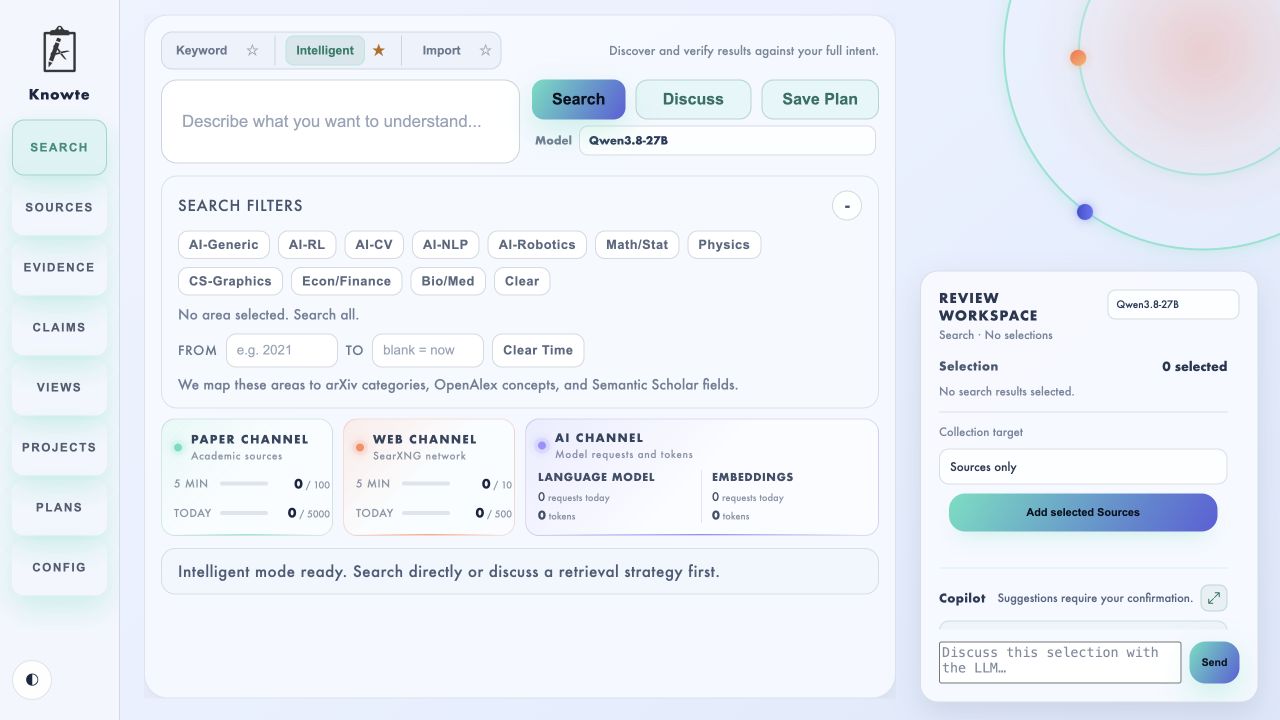
Search directly, discuss a retrieval strategy, or import results from elsewhere.
3. Build the knowledge chain
- Open Sources, select a saved Source, and use the magnifying-glass action to inspect it.
- Select text or capture a region to create precise Evidence. You can also select one or more Sources, enter an optional focus, and choose Propose Evidence via LLM.
- Open Evidence to review material across Sources. Select up to 30 items, then write a Claim manually or choose Propose Claims via LLM.
- Open Claims to accept, keep disputed, revise, relate, tag, or withdraw Claims. Reviewed active Claims enter the global Wiki automatically; select a subset when you want to add it to the active Project.
- Open Wiki and choose Organize with AI to structure all reviewed Claims, or switch to Graph to inspect accepted Claim relations. Use Projects to collect a topic-specific subset and generate an Article.
Tab spinners show work still running. A notification beside a destination Tab means a proposal is ready for review; opening that review queue clears the notification.
🧭 The workflow
Search
Search has three modes:
- Keyword sends the entered query directly to the enabled search backends.
- Intelligent retrieves candidates and uses configured models for semantic ranking and relevance verification. The original query is searched directly unless you choose Discuss.
- Import accepts URLs, DOI or arXiv identifiers, and Knowte's structured JSON format. Copy import prompt provides instructions you can give to an external LLM.
In Intelligent mode, Discuss asks the Search Copilot to propose separate Academic and Web retrieval queries. You can continue the conversation, edit the proposals, and move candidates into or out of the Top 5 Search list. The confirmed Search list—not the unchanged text in the input—is then executed.
Filters apply to every retrieval action. Save Plan preserves reusable search conditions; Plans currently run manually and use the credentials and service endpoints currently saved in Config.
Sources
A Search result becomes durable only after it is added to the global Source Library. A Source preserves what was encountered; model output never silently becomes or rewrites a Source.
- PDFs open in the built-in reader with their original pages.
- Web Sources open in a clean reading view, with Original web available when native layout or interaction matters.
- Refresh captures the latest accessible content again.
- Tags and Annotations can be attached without changing the captured Source.
Sources remain globally shared. Projects select reviewed Claims; their supporting Evidence and Sources follow automatically through provenance.
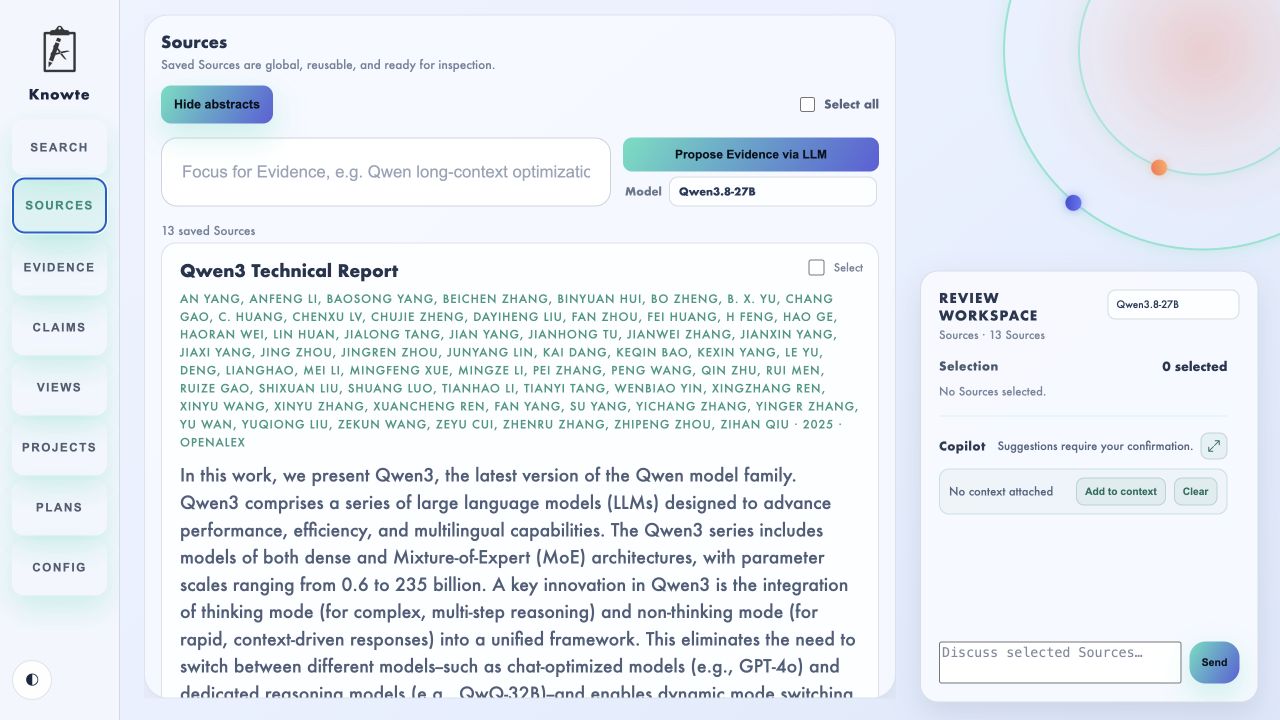
Saved Sources remain global while the active workspace supplies stage-specific actions.
Evidence
Evidence is an addressable excerpt or snapshot grounded in a Source. It can be created directly while inspecting material or proposed from selected Sources by an AI model.
AI-proposed Evidence includes its quotation, location, rationale, and any material caveat. It stays in Awaiting review until accepted or discarded. Accepted Evidence can be opened back at its Source location, tagged in batches, annotated, and reused across Claims.
Claims
A Claim is an atomic proposition that can be examined and revised. Claims use three user-facing bases:
- Background — accepted prior knowledge intentionally kept without local Evidence;
- Reported — stated directly by linked Evidence;
- Inference — derived from one or more Evidence items.
Evidence may support, contradict, or limit a Claim. Claim-to-Claim relations are supports, contradicts, or related.
Claim proposals consider the selected Evidence together and compare likely existing Claims before suggesting new Claims, links, revisions, or relations. The proposal report shows what was considered and what was skipped. Proposed changes do not enter the knowledge base until reviewed.
Use Audit Claims when you want a broader consistency pass. An audit can cover the entire Library or an Any-of / All-of Tag scope. Knowte first builds a local set of likely pairs, shows the expected number of model batches, and then lets you start, pause, resume, or cancel the review. Its findings enter the same proposal queue rather than changing Claims automatically.
Wiki and Projects
These are two projections over the same global knowledge objects:
- Wiki is one global, purpose-neutral encyclopedia containing every reviewed active Claim. New Claims appear under Unorganized until a reviewed structural patch assigns them to Pages.
- Graph is rebuilt deterministically from accepted Claims and their relations. It does not ask a model to invent edges.
- Project selects Claims for one topic and Purpose. Supporting Evidence and Sources follow through Claim provenance. Open a Project to filter the global Claim pool by text, Any-of Tags, and All-of Tags. Add Claims manually or use Recommend Claims to ask a selected model for a reviewable shortlist from that exact same scope. Organize the accepted subset into a reviewable Project Wiki, or generate and save Articles around a specific reading goal without mechanically using every Claim. Article generation happens inside a Project and uses only that Project's Claims.
Export knowledge
Export the global Wiki from Wiki, or export one topic-specific Project from Projects. Each ZIP contains readable Markdown, machine-readable JSON, a versioned manifest, complete upstream provenance, and included Snapshot Evidence images.
Import Wiki and Project packages through their matching workspace; Knowte
rejects a package opened in the wrong place. A Wiki package receives one
complete review in Wiki, then its page tree and all dependent Sources,
Evidence, and Claims are deduplicated and merged into the global knowledge
base. A Project package opens as an isolated Import Review Project; none of its
knowledge is accepted until you approve it there.
These portable packages support sharing and archival snapshots, but a full
copy of ~/.knowte/ remains the complete application backup.
🧠 Configure AI
AI is optional. Keyword Search and manual knowledge work remain available without it.
Open Config → AI Models:
- Add one Model profile for every model or endpoint you want to use.
- Choose its provider, Base URL, exact model ID, optional API key, proxy routing, and available capabilities.
- Under AI roles, assign an exact profile to Embeddings, Intelligent Search, Review Copilot, Evidence, Claims, Wiki, and Article generation.
- Save Config.
Knowte includes adapters for OpenAI-compatible endpoints, OpenAI, Google
Gemini, Anthropic, DeepSeek, Alibaba Model Studio / Qwen, Moonshot / Kimi, and
advanced Custom Recipes. A local OpenAI-compatible Base URL commonly ends in
/v1, for example:
http://127.0.0.1:8000/v1
Do not append /chat/completions. Enter the exact model ID served by the
endpoint; it is not an arbitrary display name.
Capabilities are conservative and provider-specific. Depending on the adapter and model, Knowte can send extracted text, multiple native documents, source URLs, or provider web-search tools. Unsupported capability controls remain unavailable. Custom Recipe is the advanced escape hatch for a documented request format that does not fit a built-in adapter.
Each profile can use automatic routing, the system proxy, a direct connection, or a custom proxy. Automatic routing keeps local endpoints direct and lets public endpoints use the system proxy.
The Review Copilot is contextual to the active Tab and selection. Its compact panel can expand into the main workspace for detailed context management. Custom instructions and supported request parameters are configurable; stage prompts remain separate so Search discussion, Evidence extraction, Claim review, and Wiki maintenance do not share the wrong task contract.
API keys are stored in ~/.knowte/config.yml, are exposed to the UI only as
configured / not configured, and are never copied into Plans. Choose providers
appropriate for the Sources, Evidence, Claims, and conversation context you
send them.
🧩 Knowte Web Companion
The bundled browser extension lets you create Sources and Evidence while reading an original webpage. Chromium browsers and Firefox are supported for local loading.
- Start Knowte and open Config → Knowte Web Companion.
- Choose Copy extension path.
- Open the browser's extension page and load that folder:
- Chromium:
chrome://extensions, enable Developer mode, then Load unpacked. - Firefox:
about:debugging#/runtime/this-firefox, then load the extension'smanifest.jsontemporarily.
- Chromium:
- In a native folder picker, press
⌘⇧Gon macOS orCtrl+Lon Windows/Linux to paste the copied path directly. - Generate a temporary pairing key in Knowte and enter it in the extension within five minutes.
On a webpage, select text or start a capture from the floating Knowte control.
The default shortcuts are Alt+Shift+K for text and Alt+Shift+X for a
region; browser extension settings can remap them. The inline editor lets you
choose a destination, add Tags or an Annotation, and save without leaving the
page. Save page stores only the current webpage as a Source.
Knowte must be running when the extension pairs or saves. An already loaded extension does not need to be reinstalled after ordinary Knowte restarts.
🌐 Enable Web Search
Web Search uses SearXNG, a separate open-source metasearch engine. Knowte can set up and operate a private local instance, but Docker must already be installed and running.
Managed setup
Open Config → Source Connections → Web Search · SearXNG, then choose Set up. Knowte will:
- pull the official
docker.io/searxng/searxng:latestimage, automatically trying the officialghcr.io/searxng/searxng:latestpackage if that registry cannot be reached; - create a local-only service and verify its JSON search API;
- prefer port
8888, falling back through8889–8898; - save and enable the working endpoint.
Docker Desktop, Docker Engine, Colima, and compatible alternatives are supported. The Docker Desktop window does not need to remain open.
Use Start / Stop to control the container, Update to pull and recreate it, View logs to inspect recent output, and Remove to remove the managed service. The image remains cached unless Delete cached image too is selected. Managed logs are capped at about 30 MB and image pulls time out after 10 minutes. If a pull is interrupted, Docker keeps completed image layers, so a later Set up attempt can reuse them; an unfinished layer may need to resume or restart.
If both official registries are slow or unavailable, configure a registry mirror in Docker itself. This keeps authentication, caching, and mirror policy consistent for every Docker client instead of storing registry-specific image paths in Knowte.
SearXNG can run locally without a proxy, but it is not a network bypass: each enabled engine still needs outbound access to its upstream service. A healthy container may therefore return few or no results when those upstreams are not reachable. When required, configure an outgoing proxy in SearXNG itself; AI model proxy settings in Knowte do not affect the SearXNG container. See the SearXNG outgoing-request settings.
Existing SearXNG
Follow the official SearXNG Docker installation guide and enable JSON output:
search:
  formats:
    - html
    - json
Then enable Web Search, enter the endpoint, and save Config:
http://127.0.0.1:8888/search
Verify it with:
curl --noproxy '*' -s \
  'http://127.0.0.1:8888/search?q=alpha&format=json' \
  | python -m json.tool
For a custom Docker installation, set KNOWTE_DOCKER_BIN to the Docker
executable. See the
SearXNG Search API documentation
for endpoint details. SearXNG is distributed under
its own license.
🔎 Search sources and result limits
| Source | Coverage | Optional configuration |
|---|---|---|
| arXiv | Preprints and open research papers | None |
| OpenAlex | Broad scholarly metadata | Contact email recommended |
| Semantic Scholar | Papers and citation metadata | API key |
| SearXNG | General web results | Running SearXNG endpoint |
Keyword results defaults to 100. It is the initial academic target and
the increment used by Find More. Academic providers cap a single request at
100, so Knowte caches surplus candidates and avoids another provider request
while usable cached results remain.
Intelligent results defaults to 20 and controls how many candidates may
pass final model verification. Web-only searches use the actual results in
each SearXNG page rather than pretending every page contains a fixed number.
For mixed searches, the initial source allocation is 3:3:3:1 for three
academic sources plus Web, 4:4:2 for two plus Web, and 7:3 for one plus Web.
Academic sources share evenly without Web. These are targets: available
academic results fill shortages after filtering and deduplication.
🔒 Local data
By default, Knowte stores its durable state under ~/.knowte/:
config.yml— configuration and locally stored credentials;knowte.db— Sources, Evidence, Claims, relations, Tags, Annotations, Projects, review proposals, and Wiki state;content/— captured documents, webpages, and snapshots;plans.json— saved Search Plans;usage.json— local request and token counters.
The browser UI has no authentication or multi-user isolation. Keep the default loopback host unless you intentionally want to expose Knowte on another interface.
🛠️ Development
uv pip install -e .
python -m unittest discover -s tests -v
python -m compileall -q knowte tests
node --check knowte/web/app.js
Node.js is needed only for the optional JavaScript syntax check.
🚧 Project status
Knowte is alpha software. The core local workflow, contextual Review Copilot, AI proposal queues, global Wiki, Claim graph, Article generation, Projects, Tags, Annotations, saved Plans, and browser companion are implemented and evolving.
Scheduled or recurring Plans, authentication, and multi-user isolation are not implemented yet. Expect data models and UI details to continue changing before a stable release.
Bug reports, ideas, and careful feedback are welcome.
📄 License
Knowte is released under the MIT License.
1 maintainer

Metadata
1 maintainer
Release files for knowte 0.6.0
For a detailed explanation of source distributions (sdists) and built distributions (wheels), please see the package formats documentation.
Source distribution (sdist)
| File | Size | Uploaded | |
|---|---|---|---|
| knowte-0.6.0.tar.gz | 2.4 MB | Details |
Built distribution (wheel)
| File | Interpreter | ABI | Platform | Reset |
|---|---|---|---|---|
| knowte-0.6.0-py3-none-any.whl | Python 3 | none | any | Details |
Total release size: 5.0 MB
Release files / knowte-0.6.0.tar.gz
| Download URL | knowte-0.6.0.tar.gz |
|---|---|
| Size | 2.4 MB |
| Tags | Source |
|
SHA-256 checksum How to use checksums |
d9b7e35c054f75e80cca54d6117f0be268760bb2ce4095b0e69c9c9786ee9f94
|
|
BLAKE2b-256 checksum How to use checksums |
7b371b352363e8bb219f434ae7b2036f7b90eb0a45b3cdce25083120d451f044
|
| Upload date | |
|
Uploaded using Trusted Publishing? What is trusted publishing? |
No |
| Uploaded via |
twine/6.1.0 CPython/3.10.12
|
Release files / knowte-0.6.0-py3-none-any.whl
| Download URL | knowte-0.6.0-py3-none-any.whl |
|---|---|
| Size | 2.6 MB |
| Tags | Python 3 |
|
SHA-256 checksum How to use checksums |
b50032d8caed9f97ab933279846610728462e139e56058d6fa6aae7a3569d627
|
|
BLAKE2b-256 checksum How to use checksums |
d9bc06db19ba813ba2579babba69cd165b60a7e5052472d90d2ad2520ede558a
|
| Upload date | |
|
Uploaded using Trusted Publishing? What is trusted publishing? |
No |
| Uploaded via |
twine/6.1.0 CPython/3.10.12
|














