
ko-hand-ocr
Reads one line of handwritten Korean + English. A 31M model trained from scratch on synthetic data — no handwriting dataset, no inherited terms.





한국어 · English
photo -> line cutting -> ko-hand-ocr -> "부서 : 포테토뭉부서"
At a glance
| What it reads | One line of handwritten Korean + English, from a photo |
| Model | ViT-Small encoder (ImageNet, Apache-2.0) + 4-layer TrOCR decoder trained from scratch |
| Vocabulary | 229 jamo tokens — not 11,172 syllables, so unseen characters are still writable |
| Parameters | 31M — one seventh of ko-trocr (213.7M) |
| Weights | 116 MB single · 465 MB four-way ensemble (downloaded separately) |
| Package | 83 KB — the code only |
| Speed | 0.16 s per cell · 1.37 s for a whole photo — CPU only, no GPU |
| Memory | 890 MB single · 1.35 GB ensemble |
| Accuracy | 93.5% on handwriting fonts never seen in training (93.9% ensemble) |
| Training data | Synthetic — drawn on the fly from OFL fonts. Nothing is stored on disk |
| License | Apache-2.0, weights included — no dataset terms inherited |
| Python | 3.10+ · PyTorch 2.5+ |
What it does — and does not
Does
- Reads a whole photo: finds the lines, cuts them, reads each one (
read_photo) - Reads pre-cut line images, batched (
read) - Constrained decoding — restrict the output to a candidate list, and report whether the free and constrained readings agree (
both) - Ensemble reading — run several checkpoints and take the answer they agree on
- Runs fully offline on CPU. Nothing is sent anywhere
Does not
- Split a table cell into label and value —
read_photoonly cuts down to lines - Handle vertical writing or merged cells
- Stay silent on an empty cell — a cell that is pure scribble still produces something
Why it exists
In practice the only publicly available Korean handwriting OCR model is
ddobokki/ko-trocr, and its training data comes from AI Hub, which places conditions
on purpose of use and on redistribution. That blocks it from being embedded in an
in-house tool or shipped as a public package. So the same capability was rebuilt
from scratch — with a provenance chain that can be audited part by part.

Install
pip install git+https://github.com/jysvai/ko-hand-ocr.git
Not on PyPI yet. Until it is, install from the repository.
Weights ship separately — they are too large for the repository, so they are attached to Releases.
| Download | Size | What it is |
|---|---|---|
ko-hand-ocr-v46.zip |
116MB | A single checkpoint. Enough for most uses. 0.16 s/cell |
ko-hand-ocr-ensemble.zip |
465MB | Four checkpoints. More accurate, 10x slower |
curl -LO https://github.com/jysvai/ko-hand-ocr/releases/download/v0.2.0/ko-hand-ocr-v46.zip
Pass the unzipped folder straight to Reader(). It must contain config.json,
vocab.json and model.safetensors.
Quick start
from kohandocr.reader import Reader

reader = Reader("ko-hand-ocr-v46", device="cpu")   # the unzipped folder

# A whole photo. Line cutting is included.
reader.read_photo(open("scan.jpg", "rb").read())
# -> ['보안점검표', '부서 : 포테토뭉부서', '이름 : 감자밭']

# If the lines are already cut, hand the images in directly. Batch them for speed.
reader.read([cell_a, cell_b, cell_c])

# Given a candidate list, the output can be constrained to it.
reader.both([cell_b], options=["포테토뭉부서", "감자밭", "김클로드"])
# -> [{'text': '부서 : 포테토뭄부서', 'constrained': '포테토뭉부서', 'agrees': True}]
Do not trust the constrained result on its own. Because it is constrained, the
model must return something from the list. If the true answer is not in the list you
get a confident wrong answer and nothing looks off. When agrees is false, hand it
to a human.
Reading with several checkpoints
Different checkpoints fail on different cells. Train a little longer on the same data and some cells survive while others die — which tells you those cells were being read by a thin margin. So keep several checkpoints and take the answer they agree on.
unzipped/
  config.json  vocab.json  model.safetensors
  also/
    v20b/  config.json  vocab.json  model.safetensors
    v19/   ...
If also/ is present, Reader uses it automatically. The call site does not change.
Combining by confidence was measured and it did not work — the model is sometimes more confident about a wrong answer. So selection is by how much the outputs agree, not by confidence.
How it is built
  64 x 640 line image
          |
   ViT-Small encoder          facebook/deit-small-patch16-224 (ImageNet-1k, Apache-2.0)
   patch 16                   pretrained weights, continued at a lower learning rate
          |
   TrOCR decoder              4 layers, 6 heads — trained from scratch
          |
   229 jamo tokens            ㄱ ㅏ ㅁ ... assembled into 감
          |
      "부서 : 감자밭"
Two decisions carry most of the result.
Jamo, not syllables. Memorising all 11,172 Hangul syllables needs a large output layer and still fails on anything rare. 229 jamo compose into any syllable, so a character the model never saw in training is still writable — which matters for names.
The encoder is not frozen, but it is not shaken either. It already learned to see on ImageNet, so it continues at a lower learning rate while the blank decoder learns fast. Training both at the same rate destroys what the encoder knew.
Accuracy
Measured two ways. Both matter. All figures below come from
python tools/verify.py (400 lines per font, 11 photos).
| unseen fonts (mean) | worst font | 11 handwriting photos | worst photo | |
|---|---|---|---|---|
| single (v46) | 93.5% | 86.4% | 89.6% | 66.7% |
| four | 93.9% | 88.1% | 95.6% | 83.1% |
Similarity is measured per jamo; on the photo side each photo gets one vote.
Do not take the photo number at face value. It is measured on 11 photos (37 cells) taken by the author, so it swings ±5%p. The figure closer to what you would see on someone else's handwriting is the unseen-fonts column — tested only on six font families never used in training, where the swing is half as wide (±2-3%p).
Four checkpoints open a large gap on photos (95.6 vs 89.6) and a small one on fonts (93.9 vs 93.5). The photo gap is large because where one checkpoint collapses another carries the cell — the worst photo goes from 66.7% with one checkpoint to 83.1% with four. The cost is being ten times slower.
Per font (400 lines each)
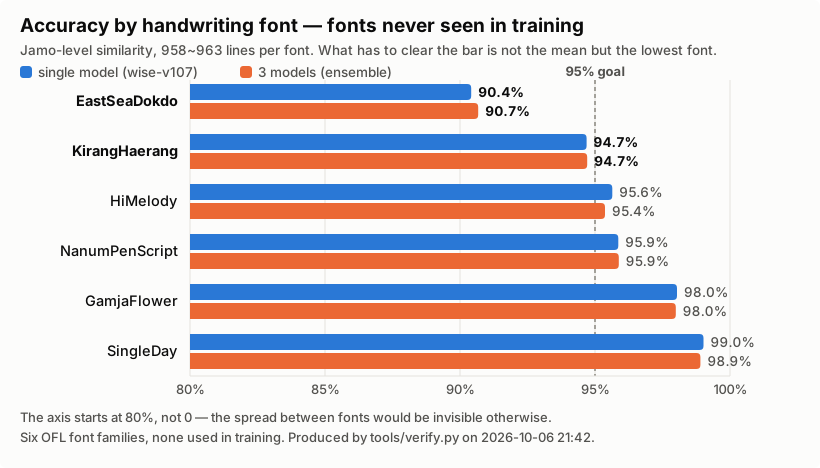
Look only at the average and the font that collapses is hidden. The real spread is 12%p.
| Font | single (v46) | four |
|---|---|---|
| EastSeaDokdo (동해독도) | 86.4% | 88.1% |
| KirangHaerang (기랑해랑) | 92.4% | 92.6% |
| HiMelody (하이멜로디) | 93.2% | 93.2% |
| NanumPenScript (나눔펜스크립트) | 94.0% | 94.2% |
| GamjaFlower (감자꽃) | 96.9% | 97.0% |
| SingleDay (싱글데이) | 97.9% | 98.1% |
What has to clear the bar is not the mean but the lowest font. The goal is 90% on all six; EastSeaDokdo has not got there yet.
All six are fonts never used in training, and all are SIL Open Font License.
python tools/holdout.py <checkpoint-dir> --per-font --sample sample.png
What the test sheet actually looks like
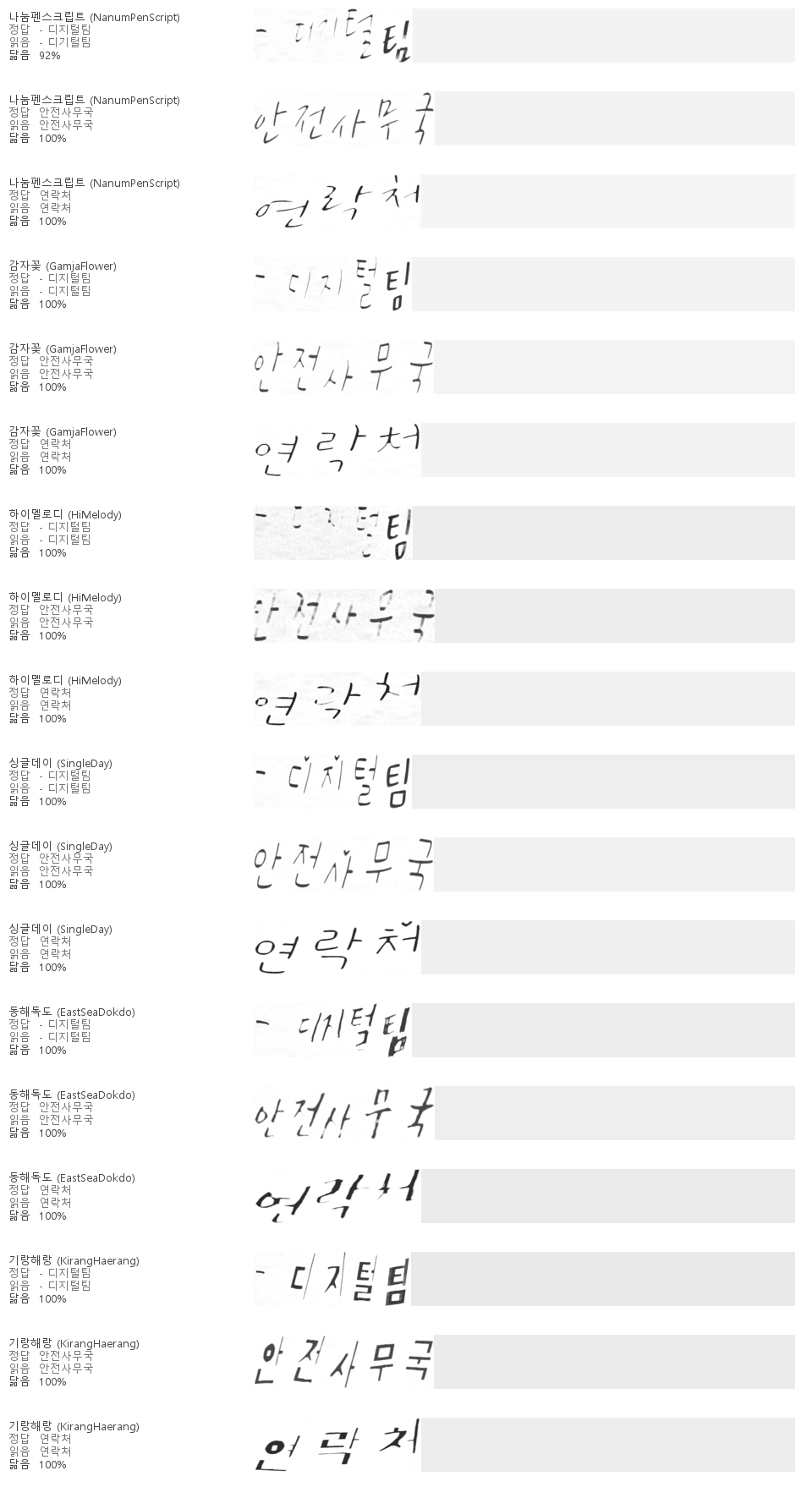
Three lines per font, with the ground truth, what the model read, and the similarity. The pale band on the right is the leftover space from fitting into a 64x640 frame — this is exactly what the model sees.
It shows why the gap opens. SingleDay has well-separated characters and intact
strokes, close to print. EastSeaDokdo smears and drops strokes, so 안전사무국
looks like a different word almost entirely — a human cannot read it without context
either.
This is an image, not a font file. Drawing glyphs with a font is what the OFL
permits; what is not redistributed is the .ttf files themselves
(PROVENANCE.md).
Speed and footprint (measured)
No GPU needed. Emitting jamo one at a time is the bottleneck, so more cores do not help much — and by the same token it does not get slower on a weak machine.
CPU only, median over 11 photos (37 cells). Time is split into cutting and reading — shrinking the model does not shrink cutting, and when a photo holds only three or four lines, cutting is more than half the cost.
| cut | read | one photo (3.4 cells) | per cell | |
|---|---|---|---|---|
| single, beam 5 | 0.82s | 0.55s | 1.37s | 0.16s |
| single, greedy | 0.82s | 0.32s | 1.13s | 0.10s |
| four, beam 5 | 0.82s | 5.73s | 6.55s | 1.70s |
Memory is about 890MB for one checkpoint, about 1.35GB for four.
Produced with python tools/bench.py --all --device cpu. That harness walks exactly the
path the application walks — a speed measured along a different path is not the speed
the user gets.
Where it runs
Built and tested on Windows. Training and inference were both run on Windows 11 with Python 3.13/3.14.
| Windows | Where it was built. Training and inference both verified |
| macOS | Untested. Inference is pure PyTorch + PIL so it should run, but it has not been confirmed |
| Linux | Not tried yet |
tools/train.ps1 is PowerShell, so it is Windows-only. Elsewhere, call
python -m kohandocr.train directly — all that script does is wait for the previous
run to release the GPU, launch it, and watch the first few steps.
Training
No data is baked ahead of time. A corpus line is generated, drawn with a handwriting font, and fed in on the spot. Nothing is left on disk, and a change to the distribution takes effect from the next step.
python tools/fetch_fonts.py                       # fetch OFL handwriting fonts
python -m kohandocr.train --out runs/v1 \
       --steps 20000 --batch 40 --workers 3 --letters 128
Fonts are looked up in this order. No path is hard-coded.
- whatever
--fontswas given - the
KOHAND_FONTSenvironment variable ~/.cache/ko-hand-ocr/fonts
The fonts are not in this repository and are not redistributed. The 109 Nanum handwriting fonts come from clova.ai/handwriting. Details in PROVENANCE.md.
How closely the synthetic images match real handwriting is checked against the measured
distributions recorded in kohandocr/measured.json — nine of them (ink coverage,
density, aspect ratio, margins and so on).
python tools/match.py # target vs current synthesis, side by side
Running longer does not make it better. After changing the synthesis distribution, run short, keep intermediate checkpoints, and pick between them (measured: 15,000 steps was the peak and 30,000 steps was worse).
python tools/pick.py runs/v1-15000 runs/v1-30000 # score the kept checkpoints and pick
License
Apache-2.0, weights included. The licenses of the fonts used in training do not attach to the weights — the weights are not a derivative of the glyph artwork, they are values learned from images. The reasoning is recorded part by part in PROVENANCE.md.
1 maintainer

Metadata
1 maintainer
Release files for ko-hand-ocr 0.2.0
For a detailed explanation of source distributions (sdists) and built distributions (wheels), please see the package formats documentation.
Source distribution (sdist)
| File | Size | Uploaded | |
|---|---|---|---|
| ko_hand_ocr-0.2.0.tar.gz | 87.4 kB | Details |
Built distribution (wheel)
| File | Interpreter | ABI | Platform | Reset |
|---|---|---|---|---|
| ko_hand_ocr-0.2.0-py3-none-any.whl | Python 3 | none | any | Details |
Total release size: 171.3 kB
Release files / ko_hand_ocr-0.2.0.tar.gz
| Download URL | ko_hand_ocr-0.2.0.tar.gz |
|---|---|
| Size | 87.4 kB |
| Tags | Source |
|
SHA-256 checksum How to use checksums |
6f2b2936a0396863a05d1c1a1c0fede593af5cc435b0c1da4935adebf6c954d2
|
|
BLAKE2b-256 checksum How to use checksums |
a0e6e6eb11d5e4952b1c0c6113319d3c17e8349a1743ae5fe0e1b5554de290e9
|
| Upload date | |
|
Uploaded using Trusted Publishing? What is trusted publishing? |
No |
| Uploaded via |
twine/7.0.0 CPython/3.14.7
|
Release files / ko_hand_ocr-0.2.0-py3-none-any.whl
| Download URL | ko_hand_ocr-0.2.0-py3-none-any.whl |
|---|---|
| Size | 83.9 kB |
| Tags | Python 3 |
|
SHA-256 checksum How to use checksums |
3116f9ee2cc3fb09c18d363c64625a3668ec87b773bdd26dd6595e48a92b89bd
|
|
BLAKE2b-256 checksum How to use checksums |
c4aa6e41bd13c9ab166715572f138505a6530be3aa48e6786bd260f976b7ae4d
|
| Upload date | |
|
Uploaded using Trusted Publishing? What is trusted publishing? |
No |
| Uploaded via |
twine/7.0.0 CPython/3.14.7
|














