
langchain-middleware-stack
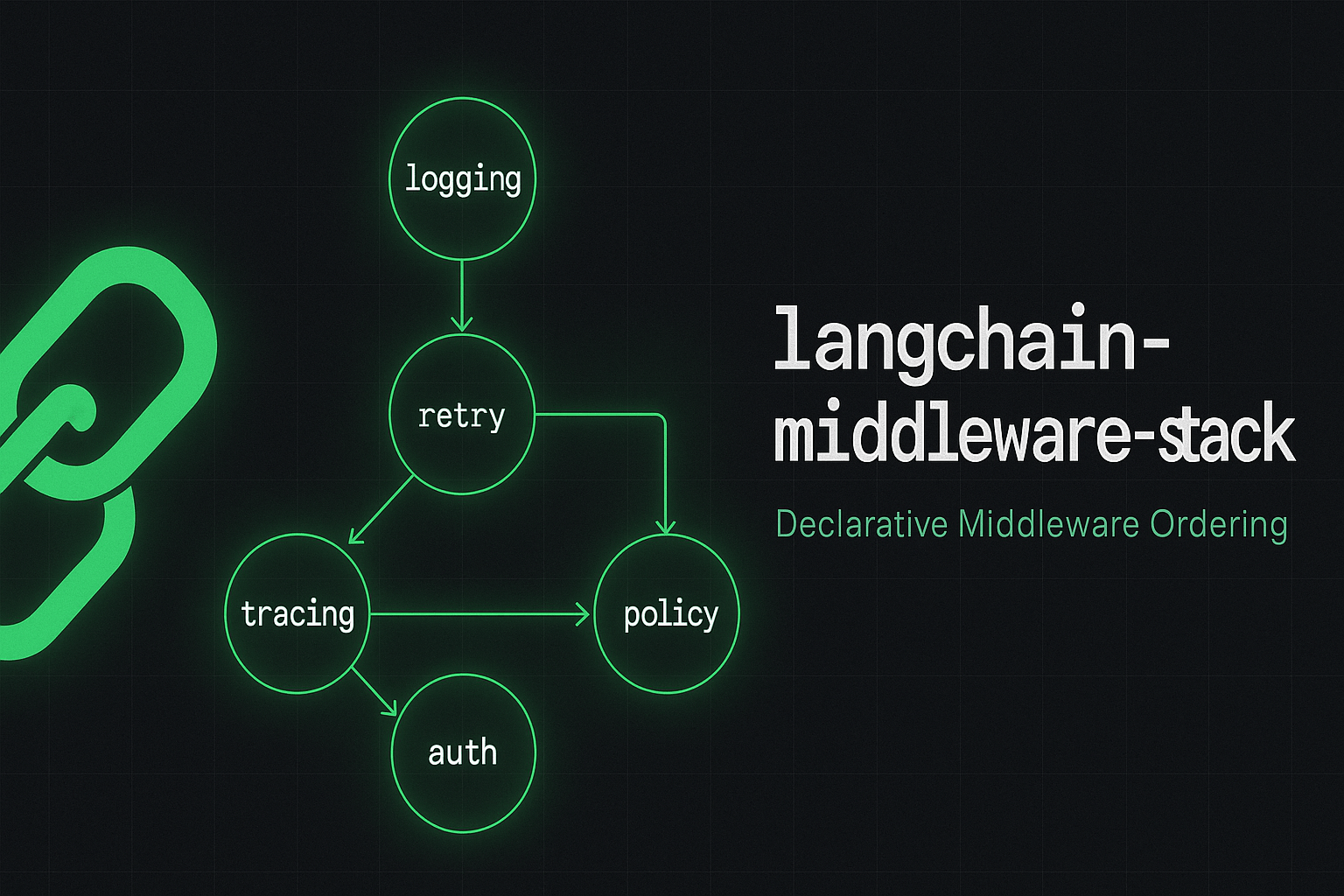
Declarative middleware ordering for LangChain Deep Agents using stable slug-based DAG resolution.
Why
In LangChain Deep Agents, middleware is a first-class control layer over model calls, tools, and state. The framework still composes it as a positional middleware=[...] list on create_agent. In that model, ordering is semantics: the first entry is the outermost wrapper (for example around wrap_model_call), so reordering changes retries, timeouts, logging, and policy in non-obvious ways.
The underlying issue is not middleware itself — it is that composition is positional instead of declarative. That breaks down in production because:
- Fragility — Inserting or reordering entries changes behavior; constraints like “after logging, before retry” are not declared on the middleware type.
- Poor composability — Separate teams or packages cannot merge contributions without one owner of the final list and implicit coordination.
- Hidden coupling — Dependencies are expressed as indices, not as explicit, reviewable constraints.
- No validated guarantees — Ordering invariants and dependency relationships are not enforced before runtime.
**langchain-middleware-stack** addresses this with constraint-based composition (DAG + topological sort, stable Kahn tie-break). You declare intent with four primitives:
| Primitive | Role |
|---|---|
slug |
Stable, unique identity for each middleware |
after / before |
Self-declared ordering constraints |
MiddlewareStack |
Topological resolver (Kahn's algorithm, stable tie-break) |
wires |
Cross-middleware attribute injection at resolve-time |
Installation
pip install langchain-middleware-stack
Zero runtime dependencies. Python ≥ 3.9.
Demo notebook
[notebooks/deep-agents-middleware.ipynb](notebooks/deep-agents-middleware.ipynb) walks through baseline vs improved, both using a real [ChatOpenAI](https://python.langchain.com/docs/integrations/chat/openai/) model (OPENAI_API_KEY required for those cells):
| Baseline | [create_agent](https://reference.langchain.com/python/langchain/agents/create_agent) with a manually ordered middleware=[...] list. |
| Improved | The same middleware types added to a MiddlewareStack in scrambled order; resolve() produces the LangChain list (outermost first), then create_agent uses that list. |
Appendices at the end: an offline wrap(handler) toy stack and optional LangChain FakeListChatModel — not the main teaching path.
make notebook # from a dev setup with `make setup`
Quick start
from langchain_middleware_stack import MiddlewareStack
from langchain_middleware_stack.middleware import LoggingMiddleware, RetryMiddleware

stack = MiddlewareStack()
stack.add([RetryMiddleware(max_retries=3), LoggingMiddleware()])
# or: stack.add(RetryMiddleware(...)).add(LoggingMiddleware())
ordered = stack.resolve()
# -> [LoggingMiddleware, RetryMiddleware]
# retry.after=("logging",) reordered — every retry is logged
Writing your own middleware
from typing import ClassVar
from langchain_middleware_stack import BaseMiddleware

class TracingMiddleware(BaseMiddleware):
    slug: ClassVar[str] = "tracing"
    after: ClassVar[tuple[str, ...]] = ("logging",)  # run after logging

    def wrap(self, handler, *args, **kwargs):
        with tracer.start_span(handler.__name__):
            return handler(*args, **kwargs)

    async def awrap(self, handler, *args, **kwargs):
        with tracer.start_span(handler.__name__):
            return await handler(*args, **kwargs)
BaseMiddleware is a mixin — use it with LangChain's AgentMiddleware when you pass middleware into create_agent. Subclasses must implement the agent hooks you need (typically wrap_model_call); declare tools (often ()) on the class.
from typing import ClassVar

from langchain.agents.middleware import AgentMiddleware
from langchain_middleware_stack import BaseMiddleware

class MyMiddleware(AgentMiddleware, BaseMiddleware):
    slug: ClassVar[str] = "my-middleware"
    tools: ClassVar[tuple] = ()

    def wrap_model_call(self, request, handler):
        # intercept model calls; delegate with handler(request)
        return handler(request)
The notebook uses this pattern end-to-end for the baseline and improved scenarios.
Cross-middleware wiring
wires injects an attribute from a resolved upstream middleware into your middleware at stack build time:
class ConsumerMiddleware(BaseMiddleware):
    slug: ClassVar[str] = "consumer"
    after: ClassVar[tuple[str, ...]] = ("provider",)
    wires: ClassVar[dict[str, tuple[str, str]]] = {
        "_shared_fn": ("provider", "exported_fn")
    }
    # _shared_fn is injected from provider.exported_fn after resolve()
Error reference
| Exception | Raised when |
|---|---|
MiddlewareResolutionError |
Base class for all stack build errors |
MiddlewareCycleError |
Dependency graph contains a cycle |
MiddlewareDuplicateSlugError |
Two middleware share the same slug |
MiddlewareWiringError |
Cross-middleware wiring fails |
RetryExhaustedError |
RetryMiddleware runs out of attempts |
LangChain upstream and related initiatives
Pointers to declarative ordering and composition for agent middleware—the same problem this package targets (not exhaustive):
| Link | Kind | Topic |
|---|---|---|
| #33885 | issue (langchain-ai/langchain) |
Middleware declaring dependencies; tracked as a possible 1.x evolution |
| #2126 | issue (langchain-ai/deepagents) |
Less rigid middleware composition at the Deep Agents entry point |
| #34514 | PR (langchain-ai/langchain, open) |
depends_on on middleware classes and topological ordering inside create_agent |
This package is a standalone resolver you can use with the current harness; how much overlaps with #34514 if it merges is an integration detail for later. A maintainer-facing draft lives in docs/github-issue-langchain-community.md (fill before opening a tracking issue).
License
Apache-2.0
Author
João Gabriel Lima — LinkedIn · joaogabriellima.eng@gmail.com · jambu.ai
1 maintainer

Metadata
1 maintainer
Release files for langchain-middleware-stack 0.1.3
For a detailed explanation of source distributions (sdists) and built distributions (wheels), please see the package formats documentation.
Source distribution (sdist)
| File | Size | Uploaded | |
|---|---|---|---|
| langchain_middleware_stack-0.1.3.tar.gz | 1.5 MB | Details |
Built distribution (wheel)
| File | Interpreter | ABI | Platform | Reset |
|---|---|---|---|---|
| langchain_middleware_stack-0.1.3-py3-none-any.whl | Python 3 | none | any | Details |
Total release size: 1.5 MB
Release files / langchain_middleware_stack-0.1.3.tar.gz
| Download URL | langchain_middleware_stack-0.1.3.tar.gz |
|---|---|
| Size | 1.5 MB |
| Tags | Source |
|
SHA-256 checksum How to use checksums |
932957246ee76d8fb85fcfdf2e29e6b383d82c88af5173bf4ff810d33240ba5f
|
|
BLAKE2b-256 checksum How to use checksums |
6f371e5d5ecf9189c0c5205eb7bf1d4afe4e7b8cd9ee50a7695dd041e364c3e8
|
| Upload date | |
|
Uploaded using Trusted Publishing? What is trusted publishing? |
No |
| Uploaded via |
twine/6.2.0 CPython/3.12.3
|
Release files / langchain_middleware_stack-0.1.3-py3-none-any.whl
| Download URL | langchain_middleware_stack-0.1.3-py3-none-any.whl |
|---|---|
| Size | 19.2 kB |
| Tags | Python 3 |
|
SHA-256 checksum How to use checksums |
1436c9c1a34a2139a3f3e9950f972adc8f0683a141ff5ecf3f5ad9f5d8188969
|
|
BLAKE2b-256 checksum How to use checksums |
4fca271d2a325bdd051c5d70278cbf672e0ea3880f842a570732f9fe58eebe0f
|
| Upload date | |
|
Uploaded using Trusted Publishing? What is trusted publishing? |
No |
| Uploaded via |
twine/6.2.0 CPython/3.12.3
|














