
LIANA+: an all-in-one cell-cell communication framework 




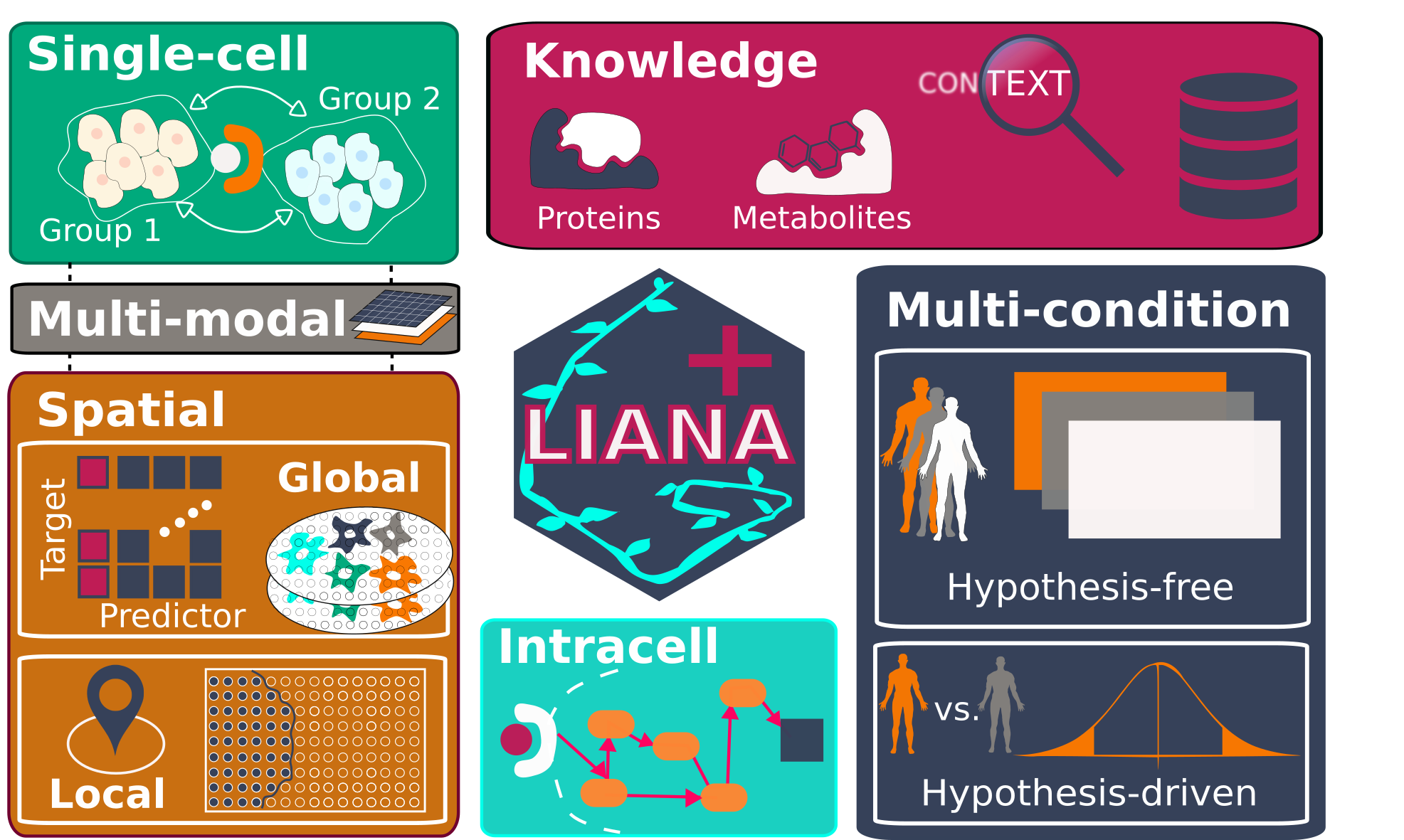
LIANA+ is a scalable framework that adapts and extends existing methods and knowledge to study cell-cell communication in single-cell, spatially-resolved, and multi-modal omics data. It is part of the scverse ecosystem, and relies on AnnData & MuData objects as input.
Contributions
We welcome suggestions, ideas, and contributions! Please do not hesitate to contact us, open issues, and check the contributions guide.
Vignettes
A set of extensive vignettes can be found in the LIANA+ documentation.
Claude Code Skill
LIANA+ provides an Agent Skill for Claude Code that guides the agent to use the library correctly: which method fits which data, where results land, and the defaults that trip users up. Install it once into your personal skills directory:
liana-install-skills
The command comes with pip install liana, so run it from any Python environment that has liana. It copies the skill to ~/.claude/skills/liana/, where Claude Code picks it up automatically in every project and directory; type /skills in Claude Code to confirm liana is listed. After upgrading liana, refresh the copy with liana-install-skills --force. Then ask Claude Code for liana tasks in plain words ("which cell types signal to which in this Xenium slide", "compare interactions between conditions", "run this on mouse") and the skill is consulted automatically.
Decision Tree
Use the tree below to find a starting point for your analysis. Broad, data-driven choices sit at the top and trickle down to specific methods (click a node to open its tutorial).
flowchart TD
    Start{What is your data?}

    %% ===== Spatially-resolved =====
    Start -->|Spatially-resolved| Res{Resolution?}
    Res -->|Single-cell| ScType{Analysis type?}
    ScType -->|Interaction scoring| Inflow[Inflow Score]
    ScType -->|Interaction scoring| ScConstr[Standard LR methods<br/>spatially-constrained]
    ScType -->|Spatial co-occurrence| LRIC[LRIC]
    ScType -->|Unsupervised| InflowMofa[Communication Programs<br/>Inflow + MOFA-Flex]
    Res -->|Spot-based| SpType{Analysis type?}
    SpType -->|Bivariate| LocalQ{Local<br/>interactions?}
    LocalQ -->|Yes| Local[Local Bivariate Metrics]
    LocalQ -->|No| Global[Global Bivariate Metrics]
    SpType -->|Unsupervised| MISTy[Multi-view Learning<br/>MISTy]

    %% ===== Dissociated single-cell =====
    Start -->|Dissociated single-cell| Compare{Compare across<br/>samples?}
    Compare -->|No| Steady[Steady-state LR Inference]
    Compare -->|Yes| Contrast{Specific<br/>contrast?}
    Contrast -->|Yes| Targeted[Targeted Differential]
    Contrast -->|Yes| CrossTalk[pyCrossTalkeR<br/>network differential]
    Contrast -->|No| MOFA[MOFA+]
    Contrast -->|No| Tensor[Tensor-cell2cell]
    Tensor --> TensorExt[Extended Tutorials<br/>ccc-protocols]
    Tensor --> TensorMet[CCC Patterns: protein + metabolite<br/>Tensor-cell2cell CTCA]

    %% ===== Multi-modal =====
    Start -->|Multi-modal| ModalSp{Spatial?}
    ModalSp -->|Yes| SMA[Multi-Modal Spatial]
    ModalSp -->|No| SCMulti[Multi-Modal Single-Cell]
    SCMulti --> Metab[Metabolite-mediated CCC]

    %% ===== Styling =====
    classDef decision fill:#f6f0f1,stroke:#364159,stroke-width:1px,color:#364159;
    classDef spatial fill:#e0fbf8,stroke:#00786e,color:#05564f;
    classDef dissoc fill:#fdeef4,stroke:#ba1b57,color:#7c1039;
    classDef multimodal fill:#e9ecf3,stroke:#4a587a,color:#2a3348;
    classDef external fill:#ffffff,stroke:#9e9e9e,stroke-dasharray:5 3,color:#424242;

    class Start,Res,ScType,SpType,LocalQ,Compare,Contrast,ModalSp decision;
    class Inflow,LRIC,ScConstr,InflowMofa,Local,Global,MISTy spatial;
    class Steady,Targeted,CrossTalk,MOFA,Tensor dissoc;
    class SMA,SCMulti,Metab multimodal;
    class TensorExt,TensorMet external;

    %% ===== Links (click events) =====
    click Inflow "https://liana.readthedocs.io/en/latest/tutorials/notebooks/inflow_score.html"
    click LRIC "https://liana.readthedocs.io/en/latest/tutorials/notebooks/LRIC_tutorial.html"
    click InflowMofa "https://liana.readthedocs.io/en/latest/tutorials/notebooks/inflow_mofaflex.html"
    click ScConstr "https://liana.readthedocs.io/en/latest/tutorials/notebooks/inflow_score.html"
    click Local "https://liana.readthedocs.io/en/latest/tutorials/notebooks/bivariate.html"
    click Global "https://liana.readthedocs.io/en/latest/tutorials/notebooks/bivariate.html"
    click MISTy "https://liana.readthedocs.io/en/latest/tutorials/notebooks/misty.html"
    click Steady "https://liana.readthedocs.io/en/latest/tutorials/notebooks/basic_usage.html"
    click Targeted "https://liana.readthedocs.io/en/latest/tutorials/notebooks/targeted.html"
    click CrossTalk "https://liana.readthedocs.io/en/latest/tutorials/notebooks/liana_pyCrossTalkeR.html"
    click MOFA "https://liana.readthedocs.io/en/latest/tutorials/notebooks/mofatalk.html"
    click Tensor "https://liana.readthedocs.io/en/latest/tutorials/notebooks/liana_c2c.html"
    click TensorExt "https://ccc-protocols.readthedocs.io/en/latest/"
    click TensorMet "https://earmingol.github.io/cell2cell/tutorials/Version2/Tensor-cell2cell-CTCA-LIANA/"
    click SMA "https://liana.readthedocs.io/en/latest/tutorials/notebooks/sma.html"
    click SCMulti "https://liana.readthedocs.io/en/latest/tutorials/notebooks/sc_multi.html"
    click Metab "https://liana.readthedocs.io/en/latest/tutorials/notebooks/sc_multi.html#metabolite-mediated-ccc-from-transcriptomics-data"
This tree is a guide rather than an exhaustive map: the methods are modular and can be adapted or combined across data types and questions, and all of them typically build on curated prior knowledge (see the prior knowledge tutorial for working with ligand–receptor and other resources).
API
For further information please check LIANA's API documentation.
Cite LIANA+:
@article {Dimitrov2024,
    author = {Dimitrov, Daniel and Sch{\"a}fer, Philipp Sven Lars and  Farr, Elias and Rodriguez-Mier, Pablo and Lobentanzer, Sebastian and Badia-i-Mompel, Pau and Dugourd, Aurelien and Tanevski, Jovan and Ramirez Flores, Ricardo Omar and Saez-Rodriguez, Julio},
    title = {LIANA+ provides an all-in-one framework for cell--cell communication inference},
    journal = {Nature Cell Biology},
    year = {2024},
    volume = {26},
    number = {9},
    pages = {1613--1622},
    DOI = {10.1038/s41556-024-01469-w},
    URL = {https://doi.org/10.1038/s41556-024-01469-w}
}
@article {Dimitrov2022,
    author = {Dimitrov, Daniel and T{\"u}rei, D{\'e}nes and Garrido-Rodriguez, Martin and Burmedi, Paul L. and Nagai, James S. and Boys, Charlotte and Ramirez Flores, Ricardo O. and Kim, Hyojin and Szalai, Bence and Costa, Ivan G. and Valdeolivas, Alberto and Dugourd, Aur{\'e}lien and Saez-Rodriguez, Julio},
    title = {Comparison of methods and resources for cell-cell communication inference from single-cell RNA-Seq data},
    journal = {Nature Communications},
    year = {2022},
    volume = {13},
    number = {1},
    pages = {3224},
    DOI = {10.1038/s41467-022-30755-0},
    URL = {https://doi.org/10.1038/s41467-022-30755-0}
}
Please also consider citing any of the methods and/or resources that were particularly relevant for your research!
Metadata
Release files for liana 2.1.0
For a detailed explanation of source distributions (sdists) and built distributions (wheels), please see the package formats documentation.
Source distribution (sdist)
| File | Size | Uploaded | Provenance | Actions |
|---|---|---|---|---|
| liana-2.1.0.tar.gz | 1.6 MB | With provenance | Details for liana-2.1.0.tar.gz |
Built distribution (wheel)
| File | Interpreter | ABI | Platform | Actions Reset |
|---|---|---|---|---|
| liana-2.1.0-py3-none-any.whl | Python 3 | none | any | Details for liana-2.1.0-py3-none-any.whl |
Total release size: 2.3 MB
Release files / liana-2.1.0.tar.gz
| Download URL | liana-2.1.0.tar.gz |
|---|---|
| Size | 1.6 MB |
| Tags | Source |
|
SHA-256 checksum How to use checksums |
84bfcafff443833dfe9f4f87492645a09433b98f18003baf53c89a2319962edd
|
|
BLAKE2b-256 checksum How to use checksums |
1048b9c5f75eb6e34a99428c109472906107d0d34436a9f937e7a344e62c9f96
|
| Upload date | |
|
Uploaded using Trusted Publishing? What is trusted publishing? |
Yes |
| Uploaded via |
twine/7.0.0 CPython/3.13.16
|
Provenance
Provenance describes where a file came from. On PyPI, provenance is shared via attestations, which provide a verifiable record of the build or publishing details. View details, limitations and caveats.


PyPI Publish Attestation
PyPI verified that this artifact, at this checksum, originated from the publisher listed below.
Signed by GitHub Actions, verified by PyPI on Oct 31, 2026.
Transparency logRelease files / liana-2.1.0-py3-none-any.whl
| Download URL | liana-2.1.0-py3-none-any.whl |
|---|---|
| Size | 664.1 kB |
| Tags | Python 3 |
|
SHA-256 checksum How to use checksums |
4a0bd7053eba20ebeb0829b394748cd4d511e146338d92b2adf44cfc6fca9e37
|
|
BLAKE2b-256 checksum How to use checksums |
eba3bb7839937c307fb292bc54aba3235cc09cb4b0d97427febc4beefdfed0a6
|
| Upload date | |
|
Uploaded using Trusted Publishing? What is trusted publishing? |
Yes |
| Uploaded via |
twine/7.0.0 CPython/3.13.16
|
Provenance
Provenance describes where a file came from. On PyPI, provenance is shared via attestations, which provide a verifiable record of the build or publishing details. View details, limitations and caveats.
PyPI Publish Attestation
PyPI verified that this artifact, at this checksum, originated from the publisher listed below.
Signed by GitHub Actions, verified by PyPI on Oct 31, 2026.
Transparency logSecurity for liana 2.1.0
Provenance
Provenance describes where a file came from. On PyPI, provenance is shared via attestations, which provide a verifiable record of the build or publishing details. View details, limitations and caveats.
Full provenance
Both files in this release have been uploaded with provenance metadata.
Attestation for liana-2.1.0.tar.gz
PyPI Publish Attestation
PyPI verified that this artifact, at this checksum, originated from the publisher listed below.
Signed by GitHub Actions, verified by PyPI on Oct 31, 2026.
Transparency logA note on package security
PyPI is a repository for distributing packages, not a service for auditing them. While third-party security researchers and our staff do their best to detect and remove malicious packages, PyPI cannot guarantee the quality, security or suitability of any given package.
To learn more about protecting yourself from malicious actors, visit our package security documentation.














