
linkgym




linkgym is a Gymnasium environment for 5G NR link adaptation (MCS selection) built on NVIDIA Sionna SYS, with classical baselines and a fixed evaluation protocol.
Goodput vs mean SNR on held-out test seeds. PPO (gamma = 0, mean of 3 training seeds) against Sionna's OLLA tuned on validation seeds and an oracle that knows the channel of the slot being decided. Details in the M3 results.
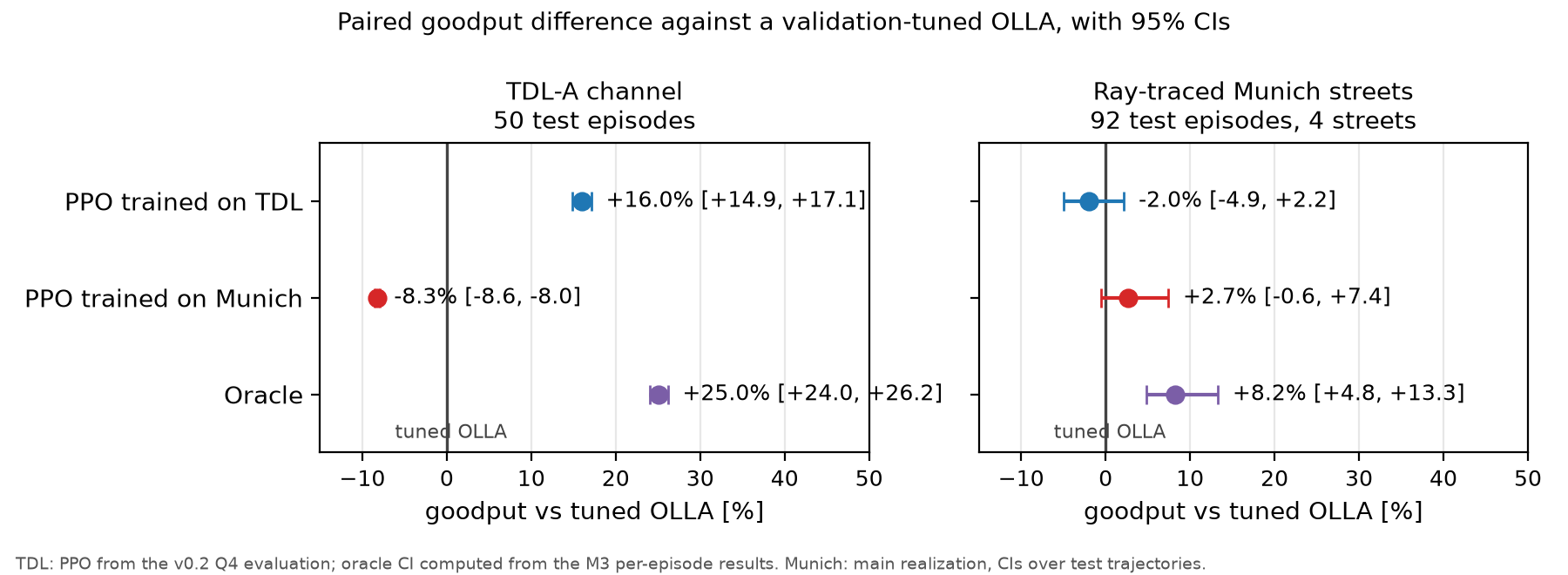
In the default scenario, PPO trained on linkgym delivers +16.0% goodput over a validation-tuned OLLA (95% CI [+14.9%, +17.1%], paired over 50 held-out episodes) at a lower TBLER.
Why
Recent RL link-adaptation studies on Sionna (see Related work) each build their own
environment. linkgym is a reusable, pip-installable Gymnasium environment,
registered as linkgym/LinkAdaptation-v0, with built-in baselines (fixed MCS, ILLA, OLLA,
oracle) and a fixed evaluation protocol. All policies are evaluated with common random
numbers: for a given seed, every policy faces the same channel and the same ACK draws.
Installation
pip install linkgym           # environment and baselines
pip install "linkgym[train]"  # adds Stable-Baselines3 and TensorBoard for the PPO example
From source, with the training extras:
git clone https://github.com/Tempip/linkgym.git
cd linkgym
pip install -e ".[train]"
Requires Python >= 3.11 (tested on 3.11 and 3.12); sionna-no-rt 2.1.x is installed
automatically. A CPU-only PyTorch build is enough. To avoid downloading CUDA wheels, install
it first with pip install torch --index-url https://download.pytorch.org/whl/cpu. The
simulator runs faster with one torch thread; call torch.set_num_threads(1) in your own
script (the package does not change it).
Quickstart
Create the environment and evaluate Sionna's OLLA with linkgym.evaluate:
import gymnasium as gym

import linkgym
from linkgym.baselines import OLLAPolicy

env = gym.make("linkgym/LinkAdaptation-v0", speed=3.0)  # any ScenarioConfig field
obs, info = env.reset(seed=0)
obs, reward, terminated, truncated, info = env.step(env.action_space.sample())

result = linkgym.evaluate(
    OLLAPolicy(bler_target=0.1), env_kwargs={"speed": 3.0}, seeds=[1000, 1001]
)
print(result["goodput_mbps"]["mean"], result["observed_tbler"]["mean"])
Train PPO with Stable-Baselines3 and evaluate it the same way. This needs the [train] extra
(pip install "linkgym[train]"); it is a short run, the results below use 1M steps:
import gymnasium as gym
from stable_baselines3 import PPO
from stable_baselines3.common.env_util import make_vec_env

import linkgym
from linkgym.baselines import SB3Policy

vec_env = make_vec_env(lambda: gym.make("linkgym/LinkAdaptation-v0"), n_envs=4, seed=0)
model = PPO("MlpPolicy", vec_env, gamma=0.0, seed=0).learn(total_timesteps=8_192)
print(linkgym.evaluate(SB3Policy(model), seeds=[1000])["goodput_mbps"]["mean"])
A longer walk-through is in examples/quickstart.ipynb.
Results
Default scenario, held-out test seeds 1000-1009, 5 episodes each (50 episodes of 1000 slots). Means over the test seeds; PPO is the mean of 3 training seeds (std 0.04 Mbit/s across them). All policies except the oracle observe exactly the same delayed feedback (wideband SINR, HARQ ACK/NACK, MCS used).
| policy | goodput Mbit/s | observed TBLER |
|---|---|---|
| fixed MCS 14 | 23.34 | 0.277 |
| ILLA, no outer loop (target 0.1) | 19.45 | 0.524 |
OLLA, default step (target 0.1, delta_up 1 dB) |
30.35 | 0.103 |
OLLA, tuned on validation seeds (target 0.1, delta_up 0.25 dB) |
30.89 | 0.110 |
| PPO, gamma = 0 | 35.82 | 0.067 |
| oracle (ILLA on the channel of the current slot) | 38.62 | 0.026 |
PPO vs tuned OLLA, paired over the 50 test episodes: +4.93 Mbit/s (+16.0%) goodput per episode, 95% bootstrap CI [+4.65, +5.21] Mbit/s ([+14.9%, +17.1%]). The protocol, validation-based selection, the other comparisons and the figures are in docs/results/m3/README.md.
Environment at a glance
linkgym/LinkAdaptation-v0 |
|
|---|---|
| Action | Discrete(26): MCS 3-28 of the 5G NR PDSCH MCS table 1 |
| Observation | Box(-1, 1, (12,)): the last 4 reports (wideband SINR, HARQ ACK/NACK, MCS used), delayed by the feedback delay |
| Reward | delivered bits of the slot divided by the TB size of MCS 28, in [0, 1] |
| Episode | 1000 slots, then truncated=True; never terminated |
| Default scenario | single cell, single SISO link, 3GPP TDL-A, 100 ns delay spread, 3.5 GHz, 15 m/s, 52 PRB at 30 kHz, mean SNR drawn per episode from U(5, 20) dB, feedback delay 1 slot |
Every scenario field can be passed to gym.make. Timing, observation layout and info keys
are in docs/environment.md.
Reproducing the results
Bash:
pip install -e ".[train]"
for gamma in 0 0.9; do
  for seed in 0 1 2; do
    python examples/train_ppo.py --gamma $gamma --seed $seed
  done
done
python examples/evaluate_all.py
PowerShell:
pip install -e ".[train]"
foreach ($gamma in "0", "0.9") {
  foreach ($seed in 0, 1, 2) {
    python examples/train_ppo.py --gamma $gamma --seed $seed
  }
}
python examples/evaluate_all.py
Measured on an AMD Ryzen 7 7700X (8 cores, 16 threads), Windows 11, CPU only (torch 2.14.0+cpu, sionna-no-rt 2.1.0):
- Each training run: 1,015,808 steps with 8
SubprocVecEnvworkers, 654-657 s; the six runs took 67 minutes one after another. evaluate_all.py, on 8 worker processes: 42 s for the OLLA tuning grid on the validation seeds, then 535 s for all test evaluations. It writes the tables and figures todocs/results/m3/.
Numbers can differ slightly on other hardware, operating systems or library versions; the committed CSVs are the reference.
Limitations
- A simplified link-level simulator: a single SISO link, a SINR-to-BLER abstraction with coarse BLER tables, no HARQ retransmissions, no interference, no channel estimation error.
- One scenario: results for other channels, speeds or feedback delays are not known.
- PPO uses Stable-Baselines3 default hyperparameters, 1M steps and 3 training seeds.
- OLLA and PPO optimise different objectives: OLLA holds a TBLER target, PPO maximises goodput; the comparison is in goodput, with TBLER reported alongside.
- The oracle knows the current slot's channel and is not achievable in practice.
- A policy learned in this simulator adapts to its abstraction; the results may not transfer to real systems.
Full lists: results, simulator, environment.
Roadmap (v0.2, not started)
- Include the agent's own pending actions in the observation when the feedback delay is larger than one slot.
- A variant with a continuous SINR-offset action.
- A reward variant with a TBLER constraint.
- Vectorised, batched environments for faster training.
Contributing
Setup, checks and commit conventions are in CONTRIBUTING.md.
Related work
- sionna-rl: a reproducible study comparing PPO against Sionna's OLLA for single-link MCS selection.
- M. Tsampazi, N. N. Santhi, N. Perrotta, F. Dressler, T. Melodia, "ARIADNE: AI-RAN Informed Link Adaptation in Digital Twin Network Environments", European Wireless 2026. arXiv:2605.29772. RL (PPO) link adaptation integrated with Sionna SYS over ray-traced channels, compared against OLLA and SALAD.
linkgym differs from these in that it is a reusable, pip-installable, registered Gymnasium environment rather than a single study.
Citation
If you use linkgym, please cite it:
@software{rodrigues2026linkgym,
  author  = {Rodrigues, Pedro},
  title   = {linkgym: A Gymnasium environment for 5G NR link adaptation},
  year    = {2026},
  version = {0.1.0},
  url     = {https://github.com/Tempip/linkgym}
}
GitHub's "Cite this repository" button uses CITATION.cff.
License
MIT. See LICENSE.
This project is not affiliated with or endorsed by NVIDIA. Sionna is a trademark of NVIDIA Corporation.
1 maintainer

Metadata
1 maintainer
Release files for linkgym 0.1.0
For a detailed explanation of source distributions (sdists) and built distributions (wheels), please see the package formats documentation.
Source distribution (sdist)
| File | Size | Uploaded | |
|---|---|---|---|
| linkgym-0.1.0.tar.gz | 517.4 kB | Details |
Built distribution (wheel)
| File | Interpreter | ABI | Platform | Reset |
|---|---|---|---|---|
| linkgym-0.1.0-py3-none-any.whl | Python 3 | none | any | Details |
Total release size: 537.4 kB
Release files / linkgym-0.1.0.tar.gz
| Download URL | linkgym-0.1.0.tar.gz |
|---|---|
| Size | 517.4 kB |
| Tags | Source |
|
SHA-256 checksum How to use checksums |
54f619a9ded782201f0a6e9f3d8af77bbc478d41549816743c7e5789db51bd81
|
|
BLAKE2b-256 checksum How to use checksums |
8debdaf9d484c0ddd0a2007640432892744c953217ff8f320fe505ad9958c472
|
| Upload date | |
|
Uploaded using Trusted Publishing? What is trusted publishing? |
Yes |
| Uploaded via |
twine/7.0.0 CPython/3.13.14
|
Provenance
Provenance describes where a file came from. On PyPI, provenance is shared via attestations, which provide a verifiable record of the build or publishing details. View details, limitations and caveats.


PyPI Publish Attestation
PyPI verified that this artifact, at this checksum, originated from the publisher listed below.
Signed by GitHub Actions, verified by PyPI on Sep 30, 2026.
Transparency logRelease files / linkgym-0.1.0-py3-none-any.whl
| Download URL | linkgym-0.1.0-py3-none-any.whl |
|---|---|
| Size | 20.0 kB |
| Tags | Python 3 |
|
SHA-256 checksum How to use checksums |
3cc00577b36cdbaa16246e6a00427253efd0a121e14594b4c7cfd1be932c46cd
|
|
BLAKE2b-256 checksum How to use checksums |
098202fb5e1ff1119fd4767448239fcce2aa05304b590e5a5b6d95a7a75a7fc9
|
| Upload date | |
|
Uploaded using Trusted Publishing? What is trusted publishing? |
Yes |
| Uploaded via |
twine/7.0.0 CPython/3.13.14
|
Provenance
Provenance describes where a file came from. On PyPI, provenance is shared via attestations, which provide a verifiable record of the build or publishing details. View details, limitations and caveats.
PyPI Publish Attestation
PyPI verified that this artifact, at this checksum, originated from the publisher listed below.
Signed by GitHub Actions, verified by PyPI on Sep 30, 2026.
Transparency log













