
LLM testing framework for validating agent behavior and tool usage

Project description
LLM Goose 🪿






Goose is a batteries‑included Python library and CLI for validating LLM agents end‑to‑end. Currently designed for LangChain-based agents, with plans for framework-agnostic support in the future.
Design conversational test cases, run them through a local web dashboard or CLI.
Turn your “vibes‑based” LLM evaluations into repeatable, versioned tests instead of “it felt smart on that one prompt” QA.
Why Goose?
Think of Goose as pytest for LLM agents:
- Stop guessing – Encode expectations once, rerun them on every model/version/deploy.
- See what actually happened – Rich execution traces, validation results, and per‑step history.
- Fits your stack – Wraps your existing agents and tools; no framework rewrite required.
- Stay in Python – Pydantic models, type hints, and a straightforward API.
Install in your project 🚀
Install the core library and CLI from PyPI:
pip install llm-goose
Quick Start: Minimal Example 🏃♂️
Here's a complete, runnable example of testing an LLM agent with Goose. This creates a simple weather assistant agent and tests it.
1. Set up your agent
Create my_agent.py:
from typing import Any

from dotenv import load_dotenv
from langchain.agents import create_agent
from langchain_core.messages import HumanMessage
from langchain_core.tools import tool
from goose.testing.models.messages import AgentResponse

load_dotenv()

@tool
def get_weather(location: str) -> str:
    """Get the current weather for a given location."""
    return f"The weather in {location} is sunny and 75°F."

agent = create_agent(
    model="gpt-4o-mini",
    tools=[get_weather],
    system_prompt="You are a helpful weather assistant",
)

def query_weather_agent(question: str) -> AgentResponse:
    """Query the agent and return a normalized response."""
    result = agent.invoke({"messages": [HumanMessage(content=question)]})
    return AgentResponse.from_langchain(result)
2. Set up fixtures
Create tests/conftest.py:
from goose.testing import Goose, fixture

from my_agent import query_weather_agent

@fixture(name="weather_goose") # name is optional - defaults to func name
def weather_goose_fixture() -> Goose:
    """Provide a Goose instance wired up to the sample LangChain agent."""

    return Goose(
        agent_query_func=query_weather_agent,
        validator_model=ChatOpenAI(model="gpt-4o-mini")
    )
3. Write a test
Create tests/test_weather.py. Fixture will be injected into recognized test functions. Test function and file names need to start with test_ in order to be discovered.
from goose.testing import Goose

def test_weather_query(weather_goose: Goose) -> None:
    """Test that the agent can answer weather questions."""

    weather_goose.case(
        query="What's the weather like in San Francisco?",
        expectations=[
            "Agent provides weather information for San Francisco",
            "Response mentions sunny weather and 75°F",
        ],
        expected_tool_calls=[get_weather],
    )
4. Run the test
# run help to get more information
goose-run --help

# tests is the name of the folder containing tests
goose-run tests

# add -v / --verbose to stream detailed steps
goose-run -v tests
That's it! Goose will run your agent, check that it called the expected tools, and validate the response against your expectations.
Goose API & GUI
Install the API with extras:
pip install "llm-goose[api]"
Then launch the service from your project (for example, after wiring Goose into your own system):
# run help to get more information
goose-api --help

# start the API server (FastAPI + Uvicorn)
# example_tests is the name of the folder containing tests
goose-api example_tests
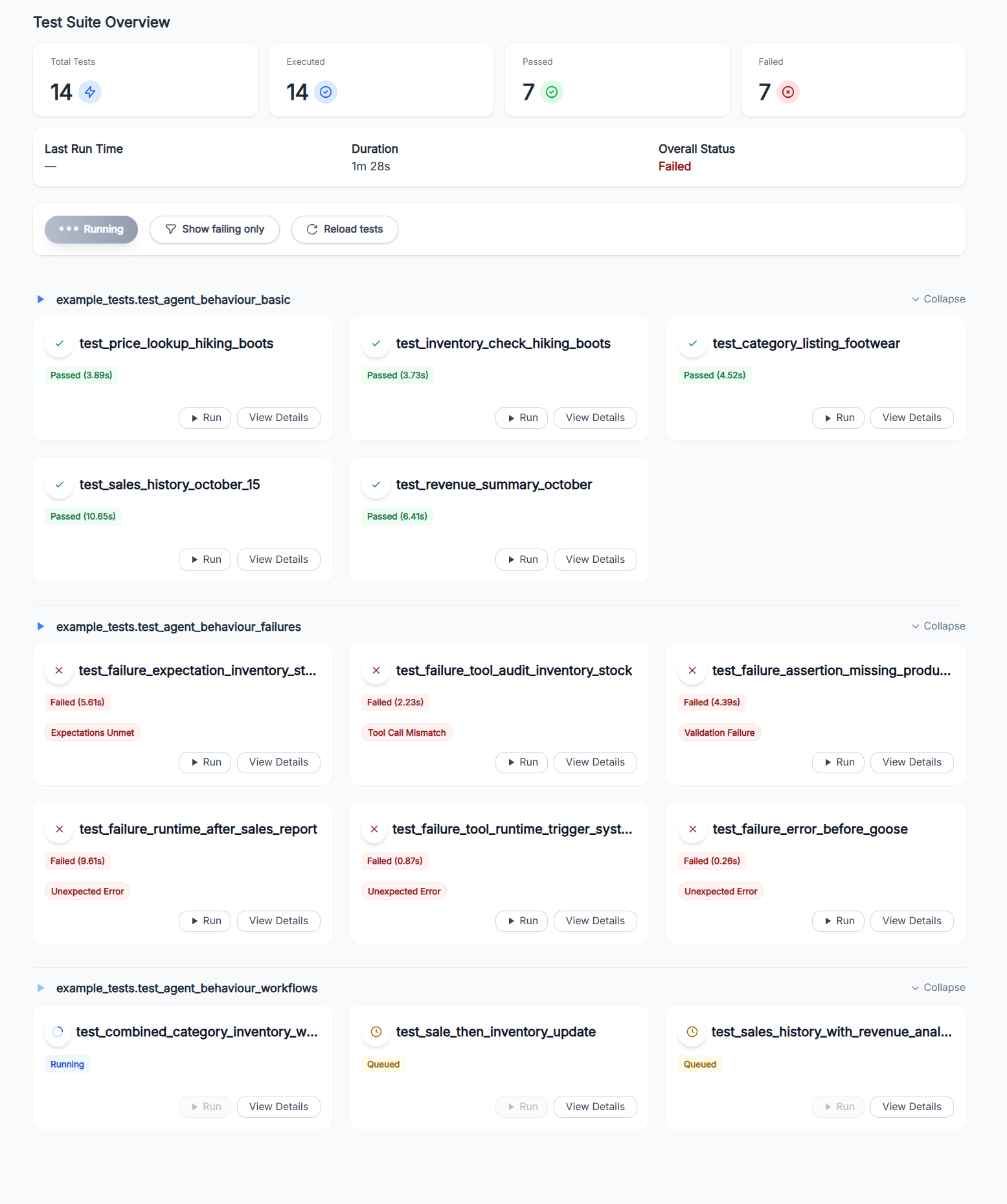
Goose dashboard is a separate web application designed to be run locally that talks to the Goose API.
npm install -g @llm-goose/dashboard-cli

# run the dashboard
goose-dashboard

# or point the dashboard at your jobs API
GOOSE_API_URL="http://localhost:8000" goose-dashboard
Compact grid summarizing every test’s latest status, duration, and quick filters for failures.
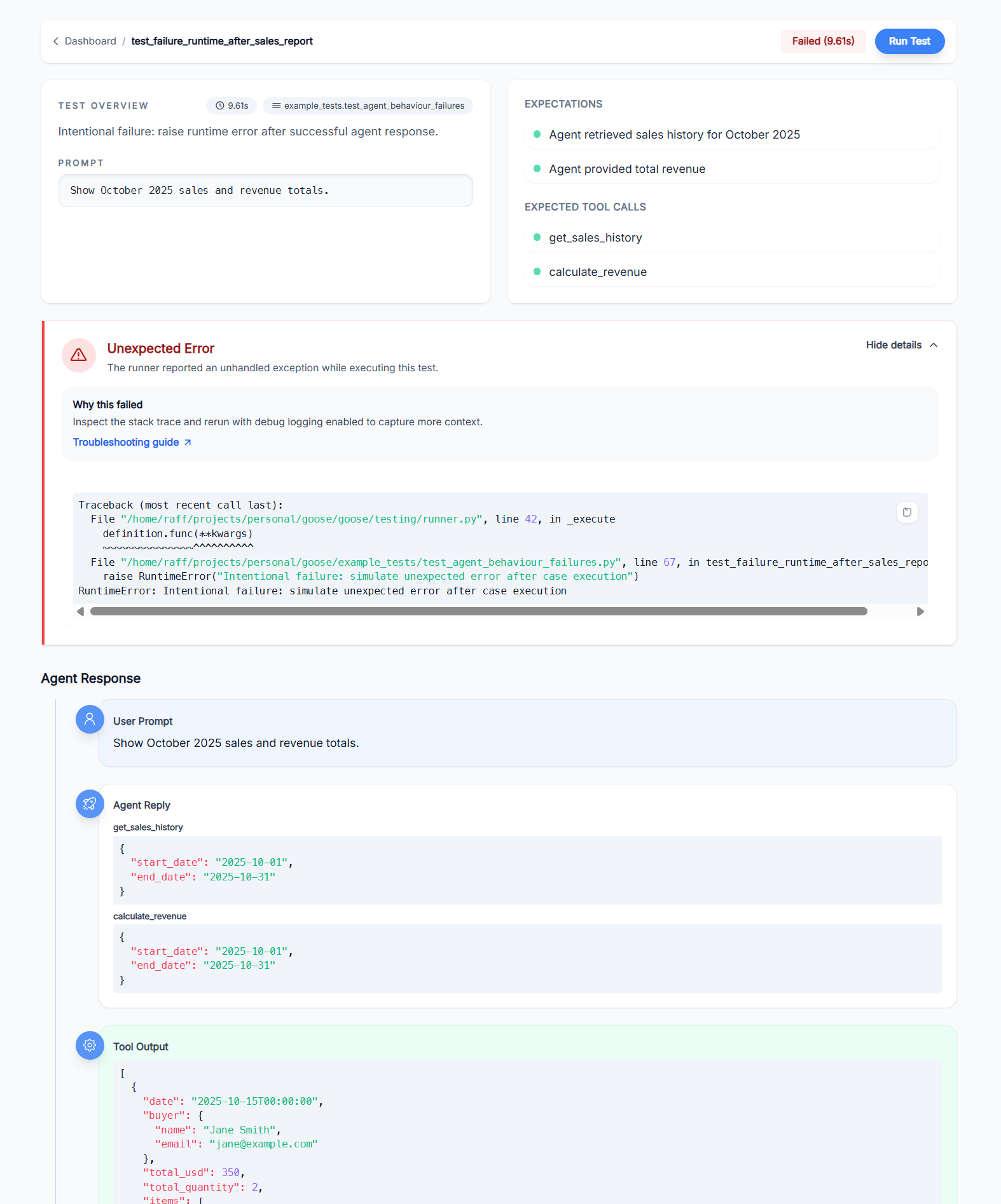
Detailed Run View
Expectation checklist, reasoning, and message timeline for a single test execution.
Writing tests ✅
At its core, Goose lets you describe what a good interaction looks like and then assert that your agent and tools actually behave that way.
Pytest-inspired syntax
Goose cases combine a natural‑language query, human‑readable expectations, and (optionally) the tools
you expect the agent to call. This example is adapted from
example_tests/agent_behaviour_test.py and shows an analytical workflow where the agent both
retrieves data and creates records:
def test_sale_then_inventory_update(goose_fixture: Goose) -> None:
    """Complex workflow: Sell 2 Hiking Boots and report the remaining stock."""

    count_before = Transaction.objects.count()
    inventory = ProductInventory.objects.get(product__name="Hiking Boots")
    assert inventory is not None, "Expected inventory record for Hiking Boots"

    goose_fixture.case(
        query="Sell 2 pairs of Hiking Boots to John Doe and then tell me how many we have left",
        expectations=[
            "Agent created a sale transaction for 2 Hiking Boots to John Doe",
            "Agent then checked remaining inventory after the sale",
            "Response confirmed the sale was processed",
            "Response provided updated stock information",
        ],
        expected_tool_calls=[check_inventory, create_sale],
    )

    count_after = Transaction.objects.count()
    inventory_after = ProductInventory.objects.get(product__name="Hiking Boots")

    assert count_after == count_before + 1, f"Expected 1 new transaction, got {count_after - count_before}"
    assert inventory_after is not None, "Expected inventory record after sale"
    assert inventory_after.stock == inventory.stock - 2, f"Expected stock {inventory.stock - 2}, got {inventory_after.stock}"
Custom lifecycle hooks
You can use existing lifecycle hooks or implement yours to suit your needs. Hooks are invoked before a test starts and after it finishes. This lets you setup your environment and teardown it afterwards.
from goose.testing.hooks import TestLifecycleHook

class MyLifecycleHooks(TestLifecycleHook):
    """Suite and per-test lifecycle hooks invoked around Goose executions."""

    def pre_test(self, definition: TestDefinition) -> None:
        """Hook invoked before a single test executes."""
        setup()

    def post_test(self, definition: TestDefinition) -> None:
        """Hook invoked after a single test completes."""
        teardown()


# tests/conftest.py
from goose.testing import Goose, fixture
from my_agent import query

@fixture()
def goose_fixture() -> Goose:
    """Provide a Goose instance wired up to the sample LangChain agent."""

    model = ChatOpenAI(model="gpt-4o-mini")
    return Goose(
        agent_query_func=query,
        validator_model=model,
        hooks=MyLifecycleHooks()
    )
License
MIT License – see LICENSE for full text.
Release history Release notifications | RSS feed


Download files
Download the file for your platform. If you're not sure which to choose, learn more about installing packages.
Source Distribution
Built Distribution
Filter files by name, interpreter, ABI, and platform.
If you're not sure about the file name format, learn more about wheel file names.
Copy a direct link to the current filters
File details
Details for the file llm_goose-0.1.18.tar.gz.
File metadata
- Download URL: llm_goose-0.1.18.tar.gz
- Upload date:
- Size: 28.4 kB
- Tags: Source
- Uploaded using Trusted Publishing? No
- Uploaded via: twine/6.2.0 CPython/3.13.6
File hashes
| Algorithm | Hash digest | |
|---|---|---|
| SHA256 |
f56bc385667011150985a1bae12dc9298435ad9d98a62c5c414d4ca65d6a8860
|
|
| MD5 |
9fc2a7d3562a742e3d2456b912e733ec
|
|
| BLAKE2b-256 |
3490c7f38f36fb1a0719ba06d970d5bbfc86260e6929f40fba260c2321f1f5fa
|
File details
Details for the file llm_goose-0.1.18-py3-none-any.whl.
File metadata
- Download URL: llm_goose-0.1.18-py3-none-any.whl
- Upload date:
- Size: 32.5 kB
- Tags: Python 3
- Uploaded using Trusted Publishing? No
- Uploaded via: twine/6.2.0 CPython/3.13.6
File hashes
| Algorithm | Hash digest | |
|---|---|---|
| SHA256 |
b4c3d409dd0f3f5e4242e7dcbfbc3d34ff7f74ab307abcd6ca0ff4e03b1f28a8
|
|
| MD5 |
63dae9d9671fbe9be34e2c141aac0e76
|
|
| BLAKE2b-256 |
e79f36e6677583469edc951adcb7d264aacf534dc5327b031815517950670caf
|






