
Maida
Don't let broken agent changes merge.





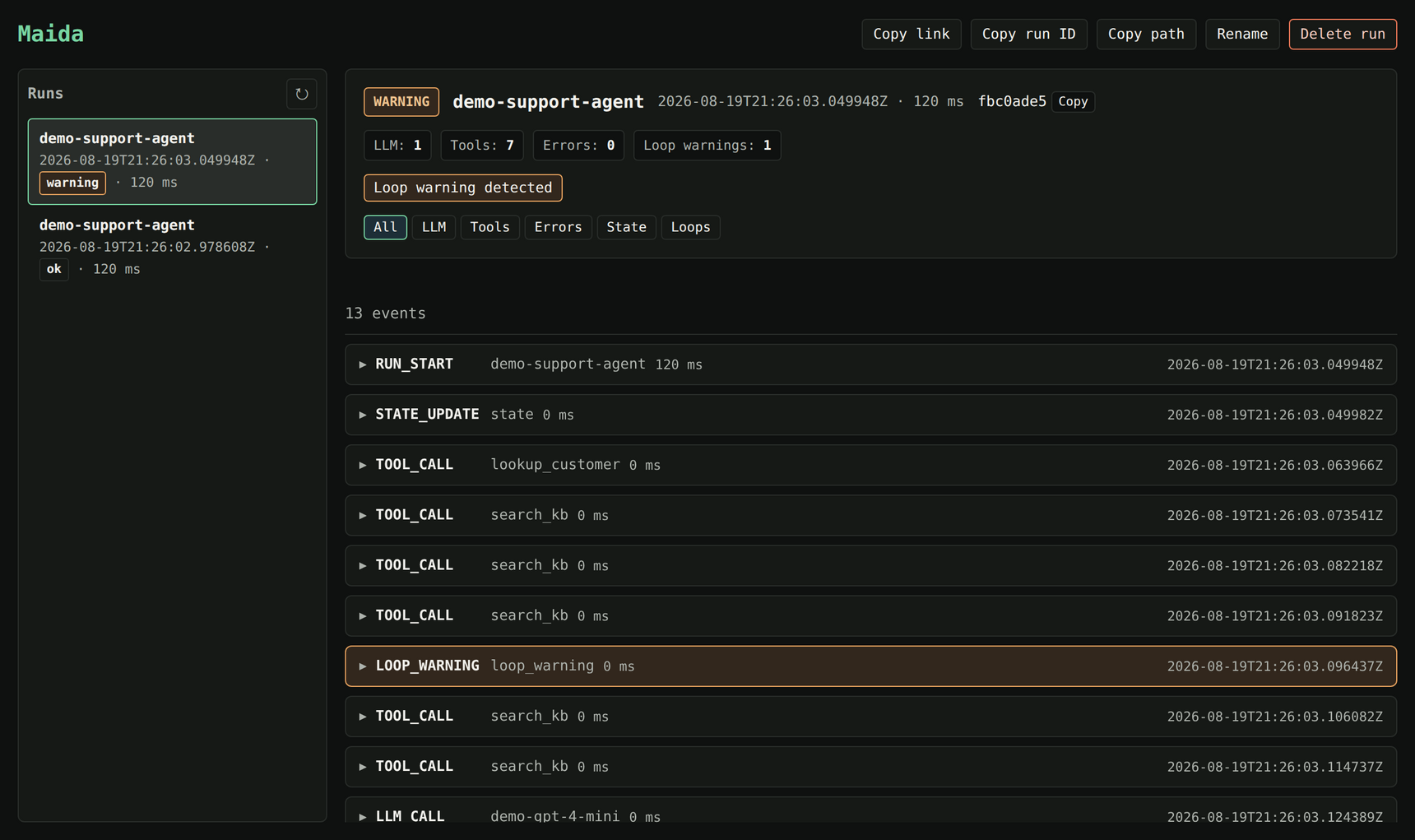
A real run, caught. The agent returned a normal answer -- and looped search_kb five times to get there.
Your agent still returns the right answer -- but now it calls 3x the tools. A retry loop that wasn't there last week. A new tool the baseline has never seen. Output evals pass. Review sees a green diff. It ships.
Maida is the pre-merge behavioral regression gate for AI agents. It compares agent execution traces against checked-in baselines and blocks PRs when structural behavior regresses.
🔒 No cloud. No accounts. No telemetry. Everything stays on your machine, or on your CI runner.
⚡ Try it in 60 seconds
No repo clone, no config file, no API key, no sign-up:
pip install maida-ai     # or: uv tool install "maida-ai>=0.5"
maida demo
maida view
maida demo runs a bundled, simulated customer-support agent -- tool calls, LLM
calls, state updates, automatic secret redaction, all canned data. maida view
opens the timeline at http://127.0.0.1:8712 with every event, input, output,
and timing. Leave it running: new runs appear in the sidebar as you go.
🎬 Watch it catch a regression
One command tells the whole story:
maida demo --regression
Maida baselines a known-good run, then runs a "refactored" agent that swaps in a
cheaper model, loops on a tool, calls a tool the baseline has never seen, and
burns 5x the tokens -- while still exiting with status ok.
── Step 3/3 | Gate the new run against the baseline
   policy: no new tools, no loops, status ok, and cost near baseline

  ✗ step_count   [step_count_exceeded]     11 steps (baseline: 6, tolerance: 50%)
  ✗ tool_calls   [tool_call_count_exceeded] 7 tool calls (baseline: 3, tolerance: 50%)
  ✗ new_tools    [new_tool_path]           unexpected tools used: ['escalate_to_human']
  ✗ no_loops     [loop_detected]           repeated_call x3: TOOL_CALL:search_kb
  ✗ cost_tokens  [cost_envelope_exceeded]  447 tokens (baseline: 90, tolerance: 50%)
  ✓ duration     [no_regression]           120 ms (baseline: 120, tolerance: 500%)
  ✓ expect_status[no_regression]           status is 'ok'

RESULT: FAILED (5 of 7 active checks failed)
And the PR comment your team would see in CI
## ❌ Maida verdict: fail

**5 of 7 checks failed** | run `40ced8d7` vs baseline `9612a7b6`

### Top behavior changes

| Behavior | Baseline | Current | Change |
|---|---|---|---|
| Steps | 6 | 11 | +83% |
| Loops/cycles | 0 | 1 | NEW |
| Cost envelope | 90 tokens | 447 tokens | +397% |
| Tool calls | 3 | 7 | +133% |

**Tool changes:**
- ➕ `escalate_to_human` -- new tool, not in baseline
- ➖ `send_reply` -- no longer called
- 🔁 `search_kb` -- repeated 1 -> 5 calls
The report leads with the verdict, groups failures by stable reason code, and ends with the exact commands to inspect or accept the change. Reruns update the same comment in place.
🧩 How it works
| Step | Command | |
|---|---|---|
| 1️⃣ | Instrument one agent entrypoint | @trace |
| 2️⃣ | Capture known-good trials | maida run --no-fail-fast --json-out ... |
| 3️⃣ | Check in a reviewed baseline | maida baseline --from-report ... |
| 4️⃣ | Declare acceptable behavior | .maida/policy.yaml |
| 5️⃣ | Gate every PR | maida run --baseline ... |
| 6️⃣ | Accept intentional changes, on purpose | maida accept --reason "..." |
Maida compares structural behavior, not answer text: step counts, tool-call counts, tool paths, loop and cycle signatures, guardrail events, stop conditions, and latency/cost envelopes.
Evals ask "was the answer good?" Maida asks "did this PR change how the agent behaves?"
🔧 Instrument your own agent
Three lines in any Python agent:
from maida import trace, record_llm_call, record_tool_call


@trace
def run_agent():
    # ... your existing agent code ...

    record_tool_call(
        name="search_db",
        args={"query": "active users"},
        result={"count": 42},
    )

    record_llm_call(
        model="gpt-4",
        prompt="Summarize the search results.",
        response="There are 42 active users.",
        usage={"prompt_tokens": 12, "completion_tokens": 8, "total_tokens": 20},
    )
Then scaffold the policy and workflow for a real project:
maida init            # writes a starter .maida/policy.yaml
maida init --github   # also writes .github/workflows/maida.yml
📖 SDK reference | Getting started | Policy reference
Gate it locally
# Sample known-good behavior across isolated trials
maida run my_agent.py --trials 25 --no-fail-fast --json-out baseline-report.json
maida baseline --from-report baseline-report.json --out baselines/my_agent.json

# After your next change, gate the candidate against that baseline
maida run my_agent.py \
  --baseline baselines/my_agent.json \
  --policy .maida/policy.yaml \
  --format markdown
🚧 Stop runaway runs while you iterate
Guardrails are opt-in development-time safety rails. They abort a run that starts looping or blows past your budget -- and still write a normal trace you can inspect afterwards.
@trace(
    stop_on_loop=True,
    max_llm_calls=10,
    max_tool_calls=20,
    max_duration_s=30,
)
def run_agent(): ...
Set them in @trace(...), .maida/config.yaml, or env vars like
MAIDA_MAX_LLM_CALLS=50.
📖 Guardrails guide
🚦 Gate your pull requests
The maida-assert Action wraps the
same CLI:
- uses: maida-ai/maida-assert@v5
  with:
    agent-script: my_agent.py
    baseline: .maida/baselines/my_agent.json
    policy: .maida/policy.yaml
Exit code 0 = pass or inconclusive, 1 = fail. Reports come in text, JSON, or
Markdown.
📖 Regression testing guide | CLI reference
For generated-plan gating, see the optional maida-workflows package.
🔌 Integrations
Maida is framework-agnostic at its core -- the SDK works with any Python code. Adapters are optional and import-to-enable; the core package works without any of them installed.
| Integration | Install | Guide |
|---|---|---|
| 🦜 LangChain / LangGraph | maida-ai[langchain] |
Guide |
| 🤖 OpenAI Agents SDK | maida-ai[openai] |
Guide |
| 🛶 CrewAI | maida-ai[crewai] |
Guide |
| 📊 Langfuse import | built in | Guide |
| 🖥️ Claude Code capture | built in | Guide |
| 🧾 Any emitter (no SDK) | built in | Emitter guide |
Systems that write native traces directly can check them with
maida validate-trace before handing them to the gate -- no SDK required.
Langfuse tells you what happened; Maida tells you whether it changed.
📚 Documentation
Full documentation lives at maida.ai/docs.
| 🚀 Getting started | Install, first trace, first baseline |
| 🛡️ Regression testing | The end-to-end gate workflow |
| ⌨️ CLI reference | Every command, option, and exit code |
| 🐍 SDK reference | @trace, recorders, contexts |
| 📜 Policy reference | .maida/policy.yaml, policy v2 |
| 🚧 Guardrails | Stop runaway runs mid-flight |
| 🔍 Viewer | The local timeline UI |
| 🗄️ Trace format | The versioned data contract |
| ⚙️ Configuration | Env vars, YAML precedence, redaction |
| 🏗️ Architecture | Schema, storage, loop detection |
Step-by-step notebooks live in maida-ai/maida-tutorials -- all runnable without API keys.
🔒 Privacy and local-first guarantees
Redaction is on by default: values for keys matching api_key, token,
authorization, cookie, secret, and password are scrubbed before
anything is written to disk, and large fields are truncated.
Runs are plain files you can inspect or delete:
~/.maida/runs/<trace_id>/
├── meta.json     # run metadata (status, counts, timing)
└── spans.jsonl   # append-only OpenTelemetry span records
No prompt, response, tool payload, secret, or environment variable leaves your
machine or CI runner unless you explicitly configure it. Set MAIDA_DATA_DIR to
move storage elsewhere.
🧪 Development
git clone https://github.com/maida-ai/maida.git
cd maida
uv venv && uv sync && uv pip install -e .
uv run pytest
No uv? Use pip instead.
python -m venv .venv && source .venv/bin/activate
pip install -e .
pytest
Contributions welcome -- see CONTRIBUTING.md and SECURITY.md.
📄 License
Apache License 2.0. See LICENSE.
1 maintainer

Release files for maida-ai 0.5.3.post1
For a detailed explanation of source distributions (sdists) and built distributions (wheels), please see the package formats documentation.
Source distribution (sdist)
| File | Size | Uploaded | |
|---|---|---|---|
| maida_ai-0.5.3.post1.tar.gz | 1.0 MB | Details |
Built distribution (wheel)
| File | Interpreter | ABI | Platform | Reset |
|---|---|---|---|---|
| maida_ai-0.5.3.post1-py3-none-any.whl | Python 3 | none | any | Details |
Total release size: 1.2 MB
Release files / maida_ai-0.5.3.post1.tar.gz
| Download URL | maida_ai-0.5.3.post1.tar.gz |
|---|---|
| Size | 1.0 MB |
| Tags | Source |
|
SHA-256 checksum How to use checksums |
e7c320592ad75708fb72358afff7bd61a285813d0a5a327e8e95da9e54dc7ad1
|
|
BLAKE2b-256 checksum How to use checksums |
1133cecaeb4224c04fe178cfb0881136c25ecf482099de901fe62d91bad31f8b
|
| Upload date | |
|
Uploaded using Trusted Publishing? What is trusted publishing? |
No |
| Uploaded via |
twine/7.0.0 CPython/3.13.5
|
Release files / maida_ai-0.5.3.post1-py3-none-any.whl
| Download URL | maida_ai-0.5.3.post1-py3-none-any.whl |
|---|---|
| Size | 202.2 kB |
| Tags | Python 3 |
|
SHA-256 checksum How to use checksums |
53a295410c215e553bf42349118be40c473a4ddcf8ba498791deae7c157fd10e
|
|
BLAKE2b-256 checksum How to use checksums |
a2096e8ddaa3c07fafe362393d8a3d939e9221a8a7deb44813f79a6fbdf3b127
|
| Upload date | |
|
Uploaded using Trusted Publishing? What is trusted publishing? |
No |
| Uploaded via |
twine/7.0.0 CPython/3.13.5
|














