





PyPI · Stable docs · Development docs · 中文
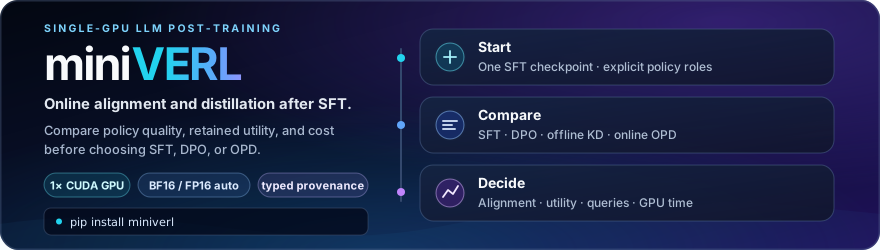
miniVERL is a local, inspectable single-GPU alignment and distillation runtime. It runs native SFT, DPO, KD and strict OPD recipes, preserves assistant-only loss masks and policy-version provenance, and exchanges standard HF/PEFT/Parquet artifacts through a fail-closed bridge to one pinned verl profile.
PyPI v0.7.1 is stable; main is development. miniVERL is independent from
verl. It does not claim arbitrary verl YAML execution, distributed execution,
or full algorithmic compatibility.
Install and verify in about a minute
python -m pip install "miniverl[train]"
miniverl doctor
miniverl demo --fast --output runs/quickstart
miniverl inspect runs/quickstart/trajectories.jsonl
miniverl evidence validate alignment-external-v1
The deterministic demo downloads no model and produces typed trajectories, a
checksummed teacher cache, manifest and report. The evidence command reads
self-contained package data; it works from a wheel without a Git checkout.
For schemas and inspection without the ML stack, install miniverl alone.
Supported hardware and runtime boundary
miniVERL runs one local process on CPU or one NVIDIA CUDA GPU. The CUDA path is
device-name agnostic, but fit depends on model pair, context, kernels and VRAM.
Install the matching CUDA-enabled PyTorch build first, then
miniverl[train,cuda]; that extra does not select a CUDA PyTorch wheel.
Ray, FSDP, Megatron, PPO, GRPO and distributed launch are outside the runtime.
See the single-GPU guide.
verl compatibility summary
The bridge targets official verl v0.8.0 at commit 7aed6b23. Its verified
boundary is checksummed standard artifacts plus pinned config-parse and
model/data-load smoke—not native checkpoint parity or a completed verl job.
Imports fail closed when dataset, environment, teacher, objective or schedule
semantics are unresolved; they never substitute calculator tasks or invent an
unqualified teacher.
Current exports remain launchable: false: the base snapshot is absent, the
reward scaffold fails closed and required mappings remain placeholders. The
entry point is launch.template.sh; readiness, parse/load evidence,
launchability, distributed execution and semantic parity are separate facts.
Read the bridge contract.
One measured systems result
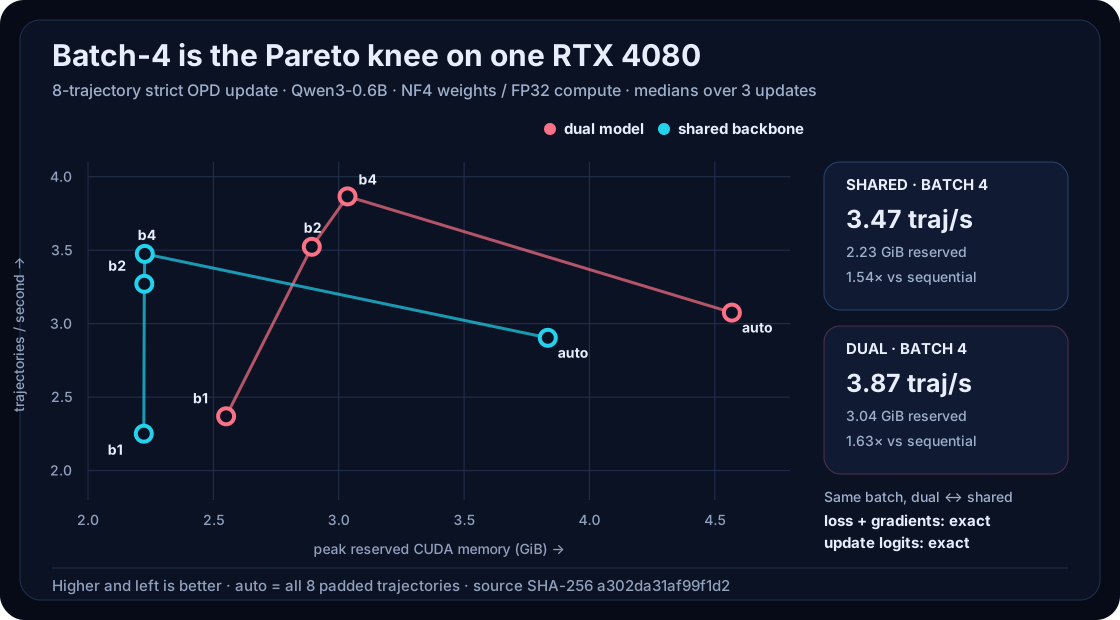
On one RTX 4080 with Qwen3-0.6B and eight fixed SQLite trajectories, physical batch 4 increased dual-model update throughput from 2.369 to 3.866 trajectories/s. Shared-backbone batch 4 used 2.227 GiB peak reserved memory versus 3.035 GiB for dual model while running 10.1% slower. All 12 preregistered equivalence comparisons passed. This is one workload on one machine, not a promise for other GPUs.
Consumer Runtime v1 methods and caveats
Three paths
| Path | Start with | Concrete artifact | Next |
|---|---|---|---|
| Align — use SFT, DPO, KD or OPD only when pilot evidence supports the cost | miniverl pilot recipes/alignment_policy_conditioned_qwen.yaml |
alignment-card.json |
Alignment Lab |
| Distill locally — strict OPD, shared backbones and padded updates on one CUDA GPU | miniverl train recipes/qwen_consumer_gpu_shared.yaml --dry-run |
resolved config and revision-pinned PEFT adapter | Bring your own GPU |
| Scale out — convert Parquet, export standard artifacts and inspect the unsupported boundary | miniverl bridge doctor scaleout-bundle |
provenance/compatibility-report.json |
Verified artifact bridge |
Research notes and preserved negative evidence
v0.7 External Alignment Gate
The preregistered external study stopped before teacher or method training. Both declared starting-policy lineages scored 0/64 retained JSONNav utility for every candidate against the unchanged 20% floor.
| selected checkpoints | qualified teachers | continuation arms | final-test tasks accessed |
|---|---|---|---|
| 0 | 0 | 0 | 0 |
miniverl pilot --builtin-study alignment-external-v1 --json
The result is do_not_continue_this_study and insufficient_evidence, not a
recommendation among SFT/DPO/KD/OPD. Granite Guardian values are unqualified
selection diagnostics; Granite, PairRM and teacher qualification and the
reserved final test did not run. Study and limitations.
Earlier measured alignment case study
Alignment Lab v1 began from an SFT checkpoint already at 100% policy compliance and 100% retained tool utility in all three seeds. No continuation improved the ceiling; continued SFT and both OPD variants retained measured regressions. The two sandbox safety checks tied at zero while utility still regressed. IFEval, XSTest, HarmBench and RewardBench were not executed, and “preference win rate” is a deterministic Minipolicy paired outcome, not human preference. Seed-level evidence.
- RecoveryBench v1: frozen-student KD
beat slower fresh-state OPD on the preregistered primary view; the verifier
gate remained
insufficient_evidence. - Calculator benchmark: both negative controls completed normally at 0%; the ambiguous historical protocol-v1 prompt prevents attributing failure solely to intrinsic teacher behavior.
- Limitations, math, reproducibility and compatibility policy.
New runs establish tokenizer compatibility through structural identity. The legacy behavioral fingerprint is only a migration fallback, not identity proof.
Develop
git clone https://github.com/DaoyuanLi2816/mini-verl.git
cd mini-verl
python -m pip install -e ".[dev]"
pytest -q -m "not gpu and not network"
Apache-2.0 licensed. See CONTRIBUTING.md, SECURITY.md, the changelog and citation. Project records: default GPU recipe, frozen calculator result and license.
1 maintainer

Release files for miniverl 0.7.1
For a detailed explanation of source distributions (sdists) and built distributions (wheels), please see the package formats documentation.
Source distribution (sdist)
| File | Size | Uploaded | |
|---|---|---|---|
| miniverl-0.7.1.tar.gz | 1.3 MB | Details |
Built distribution (wheel)
| File | Interpreter | ABI | Platform | Reset |
|---|---|---|---|---|
| miniverl-0.7.1-py3-none-any.whl | Python 3 | none | any | Details |
Total release size: 1.7 MB
Release files / miniverl-0.7.1.tar.gz
| Download URL | miniverl-0.7.1.tar.gz |
|---|---|
| Size | 1.3 MB |
| Tags | Source |
|
SHA-256 checksum How to use checksums |
8131faee22e8b668bb0ff010f92ffafd9224aa046a017ad6f85fe7774301dea1
|
|
BLAKE2b-256 checksum How to use checksums |
97705828965a44629f12ae510e623b31e2843d92ca34bb26b8b6fd2eca4f90e6
|
| Upload date | |
|
Uploaded using Trusted Publishing? What is trusted publishing? |
Yes |
| Uploaded via |
twine/6.1.0 CPython/3.13.14
|
Provenance
Provenance describes where a file came from. On PyPI, provenance is shared via attestations, which provide a verifiable record of the build or publishing details. View details, limitations and caveats.


PyPI Publish Attestation
PyPI verified that this artifact, at this checksum, originated from the publisher listed below.
Signed by GitHub Actions, verified by PyPI on Aug 12, 2026.
Transparency logRelease files / miniverl-0.7.1-py3-none-any.whl
| Download URL | miniverl-0.7.1-py3-none-any.whl |
|---|---|
| Size | 442.8 kB |
| Tags | Python 3 |
|
SHA-256 checksum How to use checksums |
7d29669eaf53de0fd9b3056f3d00ad1d61c990fbe4f6cc97ccaf8e628c60e785
|
|
BLAKE2b-256 checksum How to use checksums |
652bf012dbff13377dc6fbd1552daf2d6843625562d100e5620f1227365f0887
|
| Upload date | |
|
Uploaded using Trusted Publishing? What is trusted publishing? |
Yes |
| Uploaded via |
twine/6.1.0 CPython/3.13.14
|
Provenance
Provenance describes where a file came from. On PyPI, provenance is shared via attestations, which provide a verifiable record of the build or publishing details. View details, limitations and caveats.
PyPI Publish Attestation
PyPI verified that this artifact, at this checksum, originated from the publisher listed below.
Signed by GitHub Actions, verified by PyPI on Aug 12, 2026.
Transparency log













