
mirpy — ML embeddings for immune repertoires




Get started · Guides · Commands · API · Theory · Examples · Glossary
Turn T- and B-cell receptor tables into clonotype coordinates, sample RFF vectors, or published corpus signatures. PyPI package mirpy-lib, Python import mir. Native alignment and repertoire IO come from seqtree and vdjtools.
Install
pip install mirpy-lib
Optional extras: [parquet] for streaming clonotype Parquet, [ann] for approximate
neighbours, [ml] for Torch codecs, [bench] for evaluation, and [examples] for
marimo notebooks. See installation and first steps.
Native Windows installation uses the same pip install command; WSL is not required.
The Windows workflow builds and installs a wheel,
then checks batched receptor embedding and sample PCA with the native dependencies.
Choose your output
| Command | Output |
|---|---|
mir embed clonotypes |
Clonotype coordinates with sample/clonotype IDs |
mir embed repertoires |
One weighted RFF vector per sample, plus separate channels |
mir pca |
Optional sample PCs from an RFF table |
mir embeddings / mir signature |
Corpus-standardised rsig PCs and pass-through channels |
mir embed clonotypes samples/*.tsv -o clonotypes.tsv
mir embed repertoires samples/*.tsv --save-basis basis -o rff.tsv
mir embed repertoires held_out/*.tsv --basis basis -o held_out_rff.tsv
mir pca rff.tsv --fit rotation.npz --n-components 32 -o pcs.tsv
mir pca held_out_rff.tsv --rotation rotation.npz -o held_out_pcs.tsv
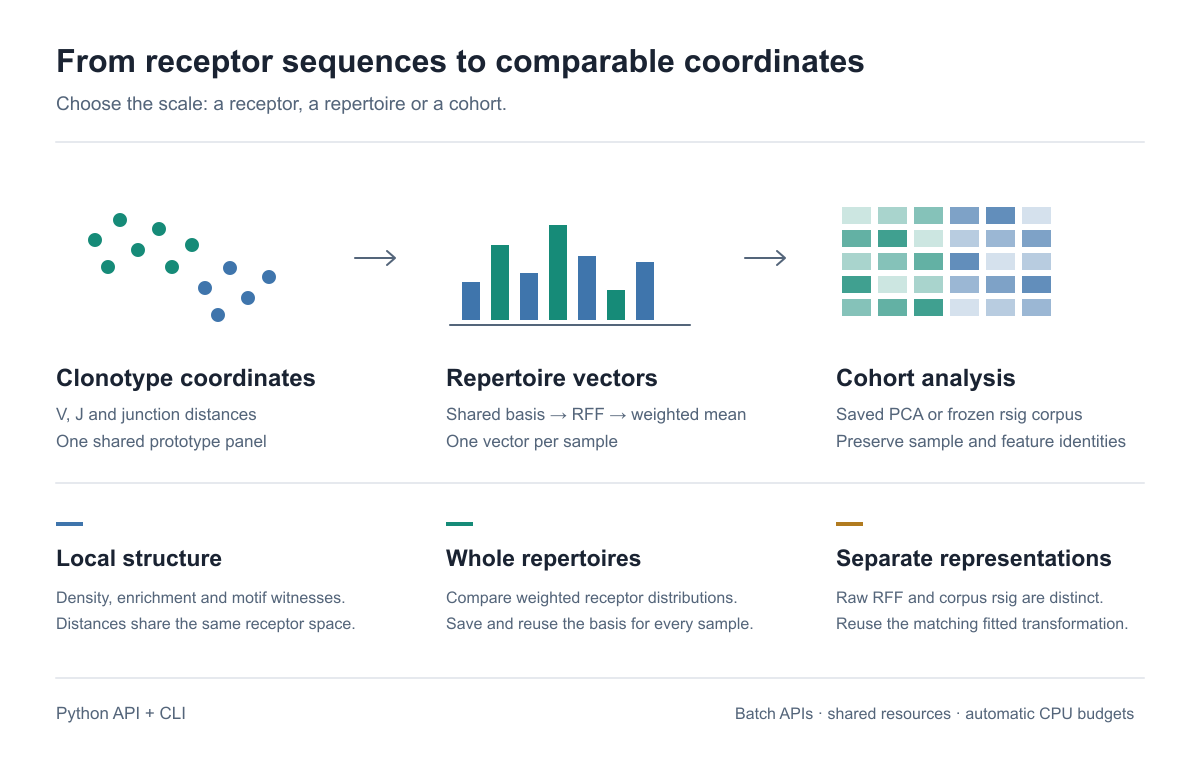
The sample path is clonotype coordinates → shared clonotype basis → RFF → weighted mean → optional sample PCA. Every sample must use the same basis and weighting. Save and reuse the basis and, if fitted, the sample rotation. RFF is applied before averaging. rsig is a different representation; its corpus rotations cannot rotate RFF.
The embedding guide covers fitting
on input rows, compatible control rows or a saved rotation, output columns and
memory limits. Signatures explains
published rsig corpora and joining vdjtools' vsig on sample_id.
Frozen reference bundles, vdjtools models and examples are hosted in
AIRR feature signatures.
Run mir reference rna-blood to print a checksum-verified local bundle directory;
use its matching basis and rotation as described in the embedding guide.
Python quickstart
import mir                       # establish runtime limits before numerical libraries
import polars as pl
from mir.embedding.tcremp import TCREmp

sample = pl.DataFrame({
    "v_call": ["TRBV10-3*01", "TRBV20-1*01"],
    "j_call": ["TRBJ2-7*01", "TRBJ1-2*01"],
    "junction_aa": ["CASSIRSSYEQYF", "CSARVSGYYGYTF"],
})
model = TCREmp.from_defaults("human", "TRB")
coordinates = model.embed(sample)  # interleaved V, J, junction distances per prototype
Find the right page
| Task | Guide |
|---|---|
| RFF tables, shared bases and sample PCA | Embeddings |
| Filtering before embedding | Pre-processing |
| Density, MMD, digital donors, codecs and CPU budgets | User guide |
| Corpus signatures and pass-through channels | Signatures · Channels |
| Functions, flags, examples and terminology | API · Commands · Examples · Glossary |
| Mathematical derivations | Theory |
Resource budgets
Logical CPUs are hardware threads, not physical cores: a 40-logical-CPU node may have 20 physical cores. Automatic sizing uses visible topology and respects affinity, SLURM and container limits; unknown topology falls back to the logical allocation. Explicit positive budgets may use SMT threads within that allocation.
Import mir before numerical libraries in a fresh interpreter. Sample workers use
serial inner kernels and retain one sample each; only compact RFF rows survive.
The final table still grows with cohort size and RFF width, and a deep input sample
can dominate memory. Automatic budgets use the physical cores visible within the CPU allocation and manage inner kernels automatically.
An explicit positive count overrides the automatic budget within your allocation. Known large allocations check container memory.
See the resource contract
and embedding memory guide.
Advanced models and fitted references
Reference bundles can opt into vdjtools' basic or joint statistical features
and their IMGT11/BLOSUM62 motif variants via feature_definition=. The bundle
records the definition and vocabulary for compatible saved-PCA application.
Configured fitting delegates to vdjtools' sparse TablePCA.fit_features, preserving
raw median-impute/StandardScaler coordinates without a dense training table.
Sample workers join before the BLAS phase. Existing rsig and sample RFF behavior
stays unchanged; see the embedding guide.
New synthetic reference/background calls default to vdjtools' isalgo family.
Use olga-legacy (olga alias) for frozen OLGA parameters and reference sampler
streams. learned and arda alias fresh isalgo; old fitted weights require a
pinned previous release. Existing corpus, prototype and embedding artifacts remain
unchanged; changing a default does not refit a saved reference.
Agent skill
The mirpy skill routes embedding, density and signature
workflows to the public APIs and guides. Copy skills/mirpy into your agent’s
skill directory or read it in this checkout.
Development
bash setup.sh --dev-parents --docs --tests
source .venv/bin/activate
python -m pytest tests/ -q -m "not integration and not benchmark"
env -C docs make html
Uses a repo-local uv environment. Public APIs and architecture are documented in the API reference; no private agent files are needed to use the package.
Citing
Method: Kremlyakova et al., TCREMP: A Bioinformatic Pipeline for Efficient Embedding of T-cell Receptor Sequences from Immune Repertoire and Single-cell Sequencing Data, J Mol Biol 437(15) (2025) 169205. PubMed · DOI.
See the mathematical foundations for derivations.
License
ISALGO LAB Academic and Non-Commercial Research License v1.0. See LICENSE.
The classical v1.x/v2 repertoire toolkit — parsing, overlap, diversity, TCRnet,
GLIPH — is frozen on the legacy-v2 branch
(mirpy-lib 2.x); its functionality lives on in
vdjtools and
vdjmatch.


Release files for mirpy-lib 4.10.3
For a detailed explanation of source distributions (sdists) and built distributions (wheels), please see the package formats documentation.
Source distribution (sdist)
| File | Size | Uploaded | Provenance | Actions |
|---|---|---|---|---|
| mirpy_lib-4.10.3.tar.gz | 5.8 MB | With provenance | Details for mirpy_lib-4.10.3.tar.gz |
Built distribution (wheel)
| File | Interpreter | ABI | Platform | Actions Reset |
|---|---|---|---|---|
| mirpy_lib-4.10.3-py3-none-any.whl | Python 3 | none | any | Details for mirpy_lib-4.10.3-py3-none-any.whl |
Total release size: 8.0 MB
Release files / mirpy_lib-4.10.3.tar.gz
| Download URL | mirpy_lib-4.10.3.tar.gz |
|---|---|
| Size | 5.8 MB |
| Tags | Source |
|
SHA-256 checksum How to use checksums |
30d3189d463010bd792e71f9d71bf7550a3861aa68c282c4c7f73d47d7cd9d93
|
|
BLAKE2b-256 checksum How to use checksums |
d2e430ebe9ac6ea46e317c59163752486de44f7bdf8dbb6003cdbc8106cdc0af
|
| Upload date | |
|
Uploaded using Trusted Publishing? What is trusted publishing? |
Yes |
| Uploaded via |
twine/7.0.0 CPython/3.13.16
|
Provenance
Provenance describes where a file came from. On PyPI, provenance is shared via attestations, which provide a verifiable record of the build or publishing details. View details, limitations and caveats.


PyPI Publish Attestation
PyPI verified that this artifact, at this checksum, originated from the publisher listed below.
Signed by GitHub Actions, verified by PyPI on Nov 6, 2026.
Transparency logRelease files / mirpy_lib-4.10.3-py3-none-any.whl
| Download URL | mirpy_lib-4.10.3-py3-none-any.whl |
|---|---|
| Size | 2.1 MB |
| Tags | Python 3 |
|
SHA-256 checksum How to use checksums |
5243c20d57c82446ca8f6e7f357d24ef98c25b5c092553842e571b8f8dddaf1c
|
|
BLAKE2b-256 checksum How to use checksums |
b8cf89b283f9ced30523a2c520754a3e1dad174bd3812f1d4384c9bd218eb850
|
| Upload date | |
|
Uploaded using Trusted Publishing? What is trusted publishing? |
Yes |
| Uploaded via |
twine/7.0.0 CPython/3.13.16
|
Provenance
Provenance describes where a file came from. On PyPI, provenance is shared via attestations, which provide a verifiable record of the build or publishing details. View details, limitations and caveats.
PyPI Publish Attestation
PyPI verified that this artifact, at this checksum, originated from the publisher listed below.
Signed by GitHub Actions, verified by PyPI on Nov 6, 2026.
Transparency logSecurity for mirpy-lib 4.10.3
Provenance
Provenance describes where a file came from. On PyPI, provenance is shared via attestations, which provide a verifiable record of the build or publishing details. View details, limitations and caveats.
Full provenance
Both files in this release have been uploaded with provenance metadata.
Attestation for mirpy_lib-4.10.3.tar.gz
PyPI Publish Attestation
PyPI verified that this artifact, at this checksum, originated from the publisher listed below.
Signed by GitHub Actions, verified by PyPI on Nov 6, 2026.
Transparency logA note on package security
PyPI is a repository for distributing packages, not a service for auditing them. While third-party security researchers and our staff do their best to detect and remove malicious packages, PyPI cannot guarantee the quality, security or suitability of any given package.
To learn more about protecting yourself from malicious actors, visit our package security documentation.














