

DeepSeek's DSpark and z-lab's DFlash speculative decoding — native on Apple Silicon via MLX.
Lossless drafters (same output, just faster) for Gemma-4, Qwen3, Ornith-1.0, Qwen3.6-27B, and Bonsai-27B targets —
plus any matched DSpark / DFlash checkpoint. Run them at the CLI, from Python, serve an OpenAI-compatible API to LM Studio / any local tool,
or drive Claude Code with a model on your own Mac.




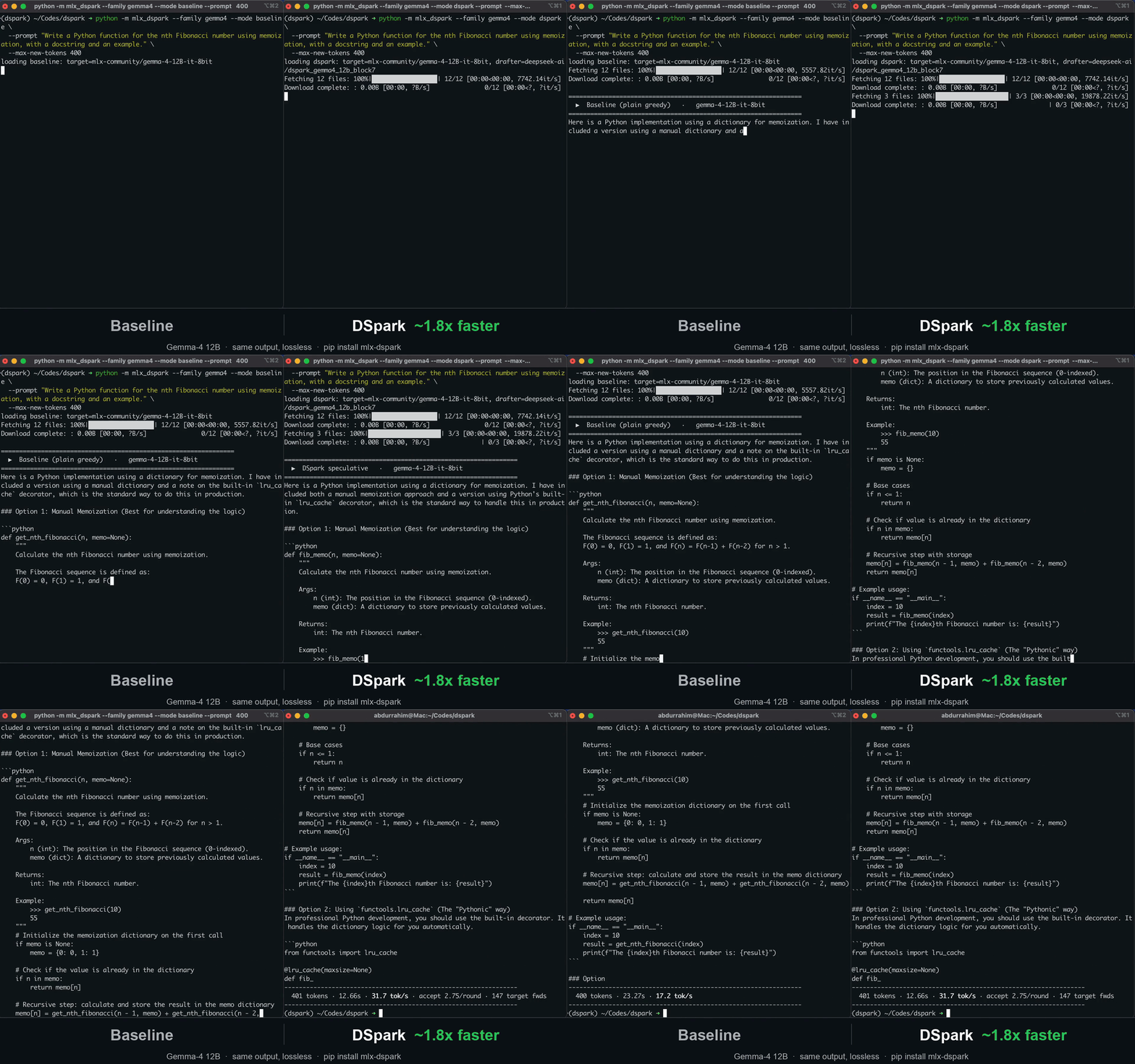
mlx-dspark runs two EAGLE-family speculative-decoding drafters natively on Apple Silicon: DeepSeek's DSpark (semi-autoregressive, from the DeepSpec codebase, used to accelerate DeepSeek-V4) and z-lab's DFlash (block diffusion). Both are lossless — the target verifies every token, so output is identical to normal decoding — and run under one verify loop, so you can serve them, script them, or benchmark them head-to-head.
What this is not: DeepSeek-V4 inference. The targets are consumer-size models (Gemma-4, Qwen3, PrismML's ternary Bonsai-27B) with published DSpark drafters — so this runs the real drafter method on a Mac, but the model producing tokens is Gemma / Qwen / Bonsai, not V4. V4 Flash/Pro (MoE, batched serving) is DSpark's own headline use case.
Supported models
Every row auto-resolves its drafter from --model (any quant of the target matches). Measured warm on
an M4 Pro with mlx-dspark benchmark --trials 3 (median of 3, three prompts — chat/code/math); full
tables, baselines, and method in Results at a glance:
| target | best measured speedup | speed |
|---|---|---|
| Gemma-4 12B (8-bit) | 3.09× math · 2.63× chat · 2.61× code | ~49 tok/s |
| Qwen3.6-27B (8-bit) | 2.67× math · 2.26× chat · 1.96× code | ~19 tok/s |
| Ornith-1.0-9B (8-bit) | 2.53× code · 2.48× math · 2.21× chat | ~64 tok/s |
| Qwen3-14B (8-bit) | 2.36× math · 2.11× code · 1.62× chat | ~31 tok/s |
| Qwen3-8B (8-bit) | 2.29× math · 2.06× code · 1.81× chat | ~58 tok/s |
| Qwen3-4B (8-bit) | 1.98× math · 1.77× chat · 1.70× code | ~92 tok/s |
| Qwen3.6-35B-A3B (4-bit, MoE)⁵ | 1.67× math · 1.24× code · 1.05× chat | ~115 tok/s |
| Ternary-Bonsai-27B (2-bit) | 1.13× code | ~27 tok/s |
This table is the set of pairs we have measured and vouch for, which is also exactly the
auto-resolve registry — that is the only thing the registry is for. It is not the set of models
that work: any DeepSpec-native drafter runs against any compatible target via --drafter, and any
target at all gets drafter-free speculation via --mode auto. See
Bring your own drafter.
⁵ The one row measured with non-default flags:
--confidence-threshold 0.3 --no-lookup-drafts (5 trials, median). It is also the only MoE
row, and the one where the ratio is the least interesting number — it is the fastest model in
this table in absolute terms, because only ~3.8B of its 35B parameters are active per token, and
that same property is what caps the ratio. See
Results at a glance.
Target precision: the quants shown are each model's measured best — ratios are non-monotone in bits and peak at 8-bit on current MLX (full Ornith sweep: 4-bit 1.38× · 8-bit 2.17× · bf16 1.54× on code; bf16 loses in both ratio and absolute speed because MLX's unquantized matmul pays a ~2× cost cliff at verify width 2). Details in Results at a glance.
Copy-heavy code editing goes further: when the model re-emits or refactors code already in its
context (the daily agent/assistant workload), match-scaled lookup drafts reach 4.5× on Gemma-12B
(75 tok/s) and 3.6× on Ornith-9B (93 tok/s). Any model not listed still gets drafter-free
lookup speculation via --mode auto.
Install
pip install mlx-dspark # or: uv pip install mlx-dspark
Apple Silicon + Python ≥ 3.10; installs mlx ≥ 0.32.0 automatically (0.32's quantized-matmul kernels are what current speedup numbers are measured on). Model weights download from the Hugging Face cache on first use (none bundled). No server framework is pulled in — the API server is built on the standard library.
Known upstream incompatibilities (both handled): mlx-vlm 0.6.5 moved an internal rope-utils module, which crashed
import mlx_dsparkon fresh installs of mlx-dspark ≤ 0.4.2 — fixed in 0.4.3 (both module layouts supported), so upgrade mlx-dspark rather than pinning mlx-vlm. Separately, mlx-vlm 0.6.4 × transformers ≥ 5.12 breaks loading the gemma4 target with a misleadingOSError: Can't load video processor …(#4, upstream Blaizzy/mlx-vlm#1578 — fixed in mlx-vlm 0.6.5). mlx-dspark ≥ 0.3.2 shims that one at load time, so any mlx-vlm ≥ 0.6.3 works; the shim self-retires on fixed releases, andmlx-dspark doctorreports when it is active.
Quickstart
You name the target model (--model, an HF repo or local path, exactly like mlx-lm); the matching
drafter is resolved automatically for known targets (see Models), or pass --drafter.
Serve an API (OpenAI and Anthropic on one port)
mlx-dspark serve --model mlx-community/Qwen3-8B-8bit        # → http://127.0.0.1:8080/v1
#   --max-batch 4   continuous batching: up to 4 concurrent requests share each forward
#                   (~2.5× aggregate; a finished request returns immediately, its slot
#                   admits the next one mid-flight)
#   --kv-bits 8     quantized KV cache (long-context bandwidth saver)
#   --mode auto|dspark|dflash|lookup|baseline   ·   --no-thinking   ·   --api-key KEY
--mode auto picks the best available speculation for any target (a known DSpark drafter → else
DFlash → else drafter-free n-gram lookup), so any repo serves with some speedup and no extra flags.
Then point any OpenAI client at it — the speculative speedup is transparent:
from openai import OpenAI
client = OpenAI(base_url="http://127.0.0.1:8080/v1", api_key="not-needed")
print(client.chat.completions.create(
    model="Qwen3-8B-8bit",
    messages=[{"role": "user", "content": "Explain rainbows briefly."}],
).choices[0].message.content)
For LM Studio / other tools: set the OpenAI base URL to http://127.0.0.1:8080/v1.
The server speaks the OpenAI API: POST /v1/chat/completions (streaming and non-streaming,
multi-turn), POST /v1/completions, GET /v1/models, GET /health, GET /metrics. It supports
temperature, top_p, top_k, max_tokens, stop, seed, presence_penalty / frequency_penalty,
logprobs / top_logprobs, tool calling (tools / tool_calls), and a per-request thinking toggle
(enable_thinking). Each response carries an x_mlx_dspark block (accept length + tok/s) so the
spec-decode gain is visible. Continuous batching (--max-batch N) serves concurrent requests in one
batched forward for ~2.5× aggregate throughput (see Concurrent throughput);
prefix caching (on by default) reuses the conversation prefix so multi-turn chat doesn't re-prefill
each turn (~13× faster follow-up turns on a long shared context — see Prefix caching).
Use it from Claude Code
The same server also speaks Anthropic's Messages API, which is the dialect Claude Code talks — so Claude Code can run entirely on a model on your Mac. Start the server, then in another terminal:
mlx-dspark serve --model mlx-community/Qwen3-8B-8bit --no-thinking   # terminal 1
mlx-dspark claude                                                    # terminal 2
That's it — mlx-dspark claude finds the running server, points Claude Code at it, and hands over
the terminal. Anything after -- goes to claude (mlx-dspark claude -- --continue).
It changes nothing outside that one process. The configuration is passed as the launched
process's environment and nowhere else: no shell profile edited, no settings.json written, no login
replaced. Your other Claude Code sessions — open now or started later — keep their normal account,
model, and endpoint, and this one reverts the moment it exits. Your claude.ai login stays saved and
untouched; Claude Code notes at startup that a credential variable takes precedence over it, which is
just that notice. To wire it up yourself instead, mlx-dspark claude --print-env prints the shell
exports and --print-settings prints a project-scoped .claude/settings.local.json block.
Endpoints: POST /v1/messages (streaming and non-streaming), POST /v1/messages/count_tokens.
Tool calling, multi-turn tool_use/tool_result history, stop_sequences, and system prompts are
translated to whatever the loaded model's own chat template expects — including each family's tool
syntax (Hermes JSON, Gemma-4, and the XML <function=> form) — and a reasoning model's <think> or
<|channel>thought output is lifted into proper Anthropic thinking blocks rather than leaking as
prose.
Measured — each of these ran a real Claude Code session that read a buggy file and fixed it with
the Edit tool (M4 Pro, --no-thinking, identical task):
| target | accept length | prefix cache | wall clock |
|---|---|---|---|
mlx-community/Qwen3-8B-8bit |
3.01 | on — 2 of 3 requests, ~26k tokens reused | ~2:20 |
mlx-community/Ornith-1.0-9B-8bit |
5.07 | off — hybrid target, recurrent state can't be reused | ~4:10 |
mlx-community/gemma-4-12B-it-8bit |
3.68 | on, but its sliding window wraps at this prompt size | ~4:10 |
The ranking is the point: Claude Code sends ~18–26k tokens of system prompt and tool schemas on every request, so prefill dominates wall clock and the target that reuses it wins — Qwen3-8B is nearly 2× faster here despite the lowest accept length of the three. Ornith's 5.07 is the highest acceptance this project has measured anywhere (tool-call JSON is very predictable), but it spends the win on re-prefilling. Choose for prefix-cache compatibility first, drafter quality second.
That table was measured on 0.6.0. 0.7.0 changes its premise for the hybrid row: checkpoint
prefix caching (see Prefix caching) gives Ornith reuse under --no-thinking,
which is the setting this table used — so its ~4:10 should improve. Not yet re-measured, so the
numbers above stand as recorded rather than being quietly restated.
Other agent clients
The Anthropic endpoint isn't Claude Code–specific. pi
works out of the box against either API — add a custom provider to ~/.pi/agent/models.json:
{ "providers": { "mlx-dspark": {
    "baseUrl": "http://127.0.0.1:8080", "api": "anthropic-messages", "apiKey": "mlx-dspark",
    "models": [{ "id": "Qwen3-8B-8bit", "contextWindow": 40960, "maxTokens": 8192 }] } } }
then pi --provider mlx-dspark --model Qwen3-8B-8bit. (Swap "api" for "openai-completions"
and "baseUrl" for http://127.0.0.1:8080/v1 to use the OpenAI endpoint instead — both work.)
pi is markedly better suited to a local model than Claude Code, for one reason: its system prompt is ~1.5k tokens against Claude Code's ~18–26k. Since prefill dominates, that lands directly on the clock — the same one-bug fix takes ~6 s instead of ~2:20, and a four-tool task (read, two edits, read, write) finishes in 8.5 s at 24 tok/s on Qwen3-8B. Ornith-1.0-9B runs the same task in 18.8 s. Gemma-4-12B doesn't converge on pi's tool protocol (on either endpoint, so it's the model, not the server) — use it with Claude Code instead.
Practical notes for a local model:
| Use a tool-calling model | These are tool-use agents first. Qwen3-8B and up handle it; smaller models flail. |
| Agent choice moves the clock more than model choice | The client's prompt size is the dominant cost on a local model — a lean agent like pi is an order of magnitude faster on the same hardware and the same task. |
--no-thinking is a speed knob, not a requirement |
Leaving it off works fine — reasoning is streamed as proper thinking blocks either way. It just costs: on Qwen3-8B the same Claude Code task ran 3:17 and 2762 output tokens with thinking vs ~2:20 and 169 without, since the model thinks before every tool call. A client sending thinking: {"type": "disabled"} gets the same effect per-request. Note it's a no-op on Gemma-4, whose template doesn't think by default. |
| Leave prefix caching on | It is doing most of the work (see the table). Expect the first request of a session to be the slow one regardless. |
| Context | An over-long request is refused with the wording Claude Code recognises as a context limit, so it compacts and retries instead of dying. --context-window N lowers the bar deliberately (e.g. to keep the KV cache inside your RAM budget). |
One-shot generation (CLI)
# downloads the drafter + instruct target on first run
mlx-dspark generate --model mlx-community/Qwen3-4B-8bit --prompt "Explain how rainbows form."

# baseline (plain target) vs dspark — same output, faster (record each, stack for a demo)
mlx-dspark generate --model mlx-community/Qwen3-4B-8bit --mode baseline --prompt "..." --max-new-tokens 400
mlx-dspark generate --model mlx-community/Qwen3-4B-8bit --mode dspark   --prompt "..." --max-new-tokens 400

# z-lab DFlash drafter (--max-draft 0 = full 16-block, its native operating point)
mlx-dspark generate --model mlx-community/gemma-4-12B-it-8bit --mode dflash --max-draft 0 --prompt "Write a binary search."

# sampled (not greedy) — lossless w.r.t. the target at temperature T (dspark and dflash)
mlx-dspark generate --model mlx-community/Qwen3-4B-8bit --prompt "Write a short poem." --temperature 1.0 --top-p 0.95 --seed 0
python -m mlx_dspark … works too, and the old flat --prompt … form still maps to generate.
Python
from mlx_dspark import load_pair, speculative_generate

target, tok, drafter, cfg = load_pair("mlx-community/Qwen3-8B-8bit")   # drafter auto-resolved
res = speculative_generate(target, tok, drafter, "Explain how rainbows form.")
print(res.text, res.mean_accept_len, res.tokens_per_sec)
from mlx_dspark import load_dflash_pair, dflash_generate   # z-lab DFlash instead

target, tok, drafter, cfg = load_dflash_pair("mlx-community/gemma-4-12B-it-8bit")
res = dflash_generate(target, tok, drafter, "Write a binary search in Python.")  # max_draft_tokens=None = full block
print(res.text, res.mean_accept_len, res.tokens_per_sec)
Models
Pass any target repo/path to --model; the matched drafter auto-resolves for the targets below
(quantization-agnostic — a -4bit / -8bit / -bf16 of the same model resolves the same drafter). For
anything else, add --drafter <repo>. Run mlx-dspark models to print this table.
target (--model) |
DSpark drafter (--mode dspark) |
DFlash drafter (--mode dflash) |
peak RAM |
|---|---|---|---|
mlx-community/Qwen3-4B-8bit |
deepseek-ai/dspark_qwen3_4b_block7 |
z-lab/Qwen3-4B-DFlash-b16 |
~8 GB |
mlx-community/Qwen3-8B-8bit |
deepseek-ai/dspark_qwen3_8b_block7 |
z-lab/Qwen3-8B-DFlash-b16 |
~11 GB |
mlx-community/gemma-4-12B-it-8bit |
deepseek-ai/dspark_gemma4_12b_block7 |
z-lab/gemma4-12B-it-DFlash |
~15 GB |
prism-ml/Ternary-Bonsai-27B-mlx-2bit |
Rahim/Ternary-Bonsai-27B-dspark |
— | ~12 GB |
mlx-community/Qwen3.6-27B-8bit |
satgeze/Qwen3.6-27B-DSpark (community) |
— | ~32 GB |
mlx-community/Ornith-1.0-9B-8bit |
stanleyphoong/Ornith-1.0-9B-DSpark (community) |
— | ~13 GB |
Peak RAM is measured on an M4 Pro (8-bit target + 4-bit drafter + KV cache); add headroom for macOS.
Rows marked (community) use drafters published by the community, not by DeepSeek — quality varies more
than with the official checkpoints, and it shows up directly as acceptance length (= your speedup).
The Ornith drafter is the strong case: rigorously qualified by its author (17/17 gates, 95% of the
DSpark paper's reference acceptance) and it produces the best chat speedups in this table. The
Qwen3.6-27B drafter is the other strong one: block-15, trained against the bf16 target and
warm-started from z-lab's DFlash head for it. Its row is measured on the 8-bit target; a -4bit
target resolves the same drafter and, by the pattern every other model here follows, should trade
ratio for absolute tok/s — that combination is not measured.
A 4-bit target (--model …-it-4bit) roughly halves the target's share (fits smaller Macs). Use the
matched instruct target the drafter was trained against — a base model drops acceptance sharply. The
legacy --family qwen3|gemma4 flags still work but are deprecated in favor of --model.
--drafter lets you run any other matched z-lab / DeepSpec checkpoint with no code change and no
registry entry — the registry only saves you from having to name the drafter:
# a pair we have measured -> the drafter auto-resolves
mlx-dspark generate --model mlx-community/Qwen3-14B-8bit --prompt "Explain how rainbows form."

# anything else -> name the drafter yourself; identical machinery from here on
mlx-dspark generate --model mlx-community/Qwen3-32B-8bit \
  --drafter deepseek-ai/dspark_qwen3_32b_block7 --prompt "Explain how rainbows form."
Bring your own drafter — what runs and what doesn't
New DSpark/DFlash drafters keep landing on HF in three different packagings; here is the honest compatibility contract (loaders refuse incompatible checkpoints with an error naming the reason, never a silent mis-load):
| checkpoint style | example | status |
|---|---|---|
| DeepSpec-native standalone drafter (qwen3/gemma4 backbone, any size/quant) | deepseek-ai/dspark_qwen3_32b_block7 |
✅ runs via --drafter — no registry entry needed (4B/8B/14B/gemma-12B are measured and registered, so they need no flag; larger sizes should run — reports welcome) |
| z-lab DFlash adapter for a qwen3/gemma4-family target | z-lab/Qwen3-8B-DFlash-b16 |
✅ runs via --mode dflash --drafter |
| PrismML dspark GGUF (Bonsai-27B) | prism-ml/Ternary-Bonsai-27B-gguf → *-dspark-bf16.gguf |
✅ pre-converted repacks auto-resolve (Rahim/*-dspark); any future GGUF-only drop runs via --drafter gguf:<repo>/<file>.gguf (converted locally, once) |
| vLLM "speculators" format | RedHatAI/GLM-5.2-speculator.dspark |
❌ different config schema — not yet (issue?) |
| Full model with embedded drafter | deepseek-ai/DeepSeek-V4-Pro-DSpark (893 GB, MLA+MoE) |
❌ different architecture & packaging — out of scope for consumer Macs |
| DFlash+Markov community hybrids | Hikari07jp/DSpark-Gemma-4-31B-draft |
❌ hybrid head — not yet |
Targets: any dense mlx-lm text model routes automatically; a one-time load probe verifies the
hidden-state tap reproduces the model's own forward and fails loudly if the family needs bespoke
support (drafter-free --mode lookup / --mode auto still work with any target). If you run a
pair we haven't measured, mlx-dspark benchmark --json produces a device-stamped result we can fold
into the table — please share it.
Very small targets are not worth a drafter. Speculation buys time in proportion to what one
target step costs, so below ~4B there is little to win. Measured, so you don't spend the download:
satgeze/Qwen3.5-0.8B-DSpark on
Qwen3.5-0.8B-8bit runs correctly and losslessly but comes out at 0.96× — the target is already
215 tok/s, and a draft round costs nearly as much as the step it skips. Run these models plain.
PrismML Bonsai 27B (ternary / 1-bit Qwen3.6-27B)
Bonsai 27B is PrismML's 1.7-bit ternary (and 1-bit) rebuild of Qwen3.6-27B — a full 27B-class reasoning model in ~8 GB. It ships with a DSpark drafter that PrismML publishes GGUF-only and, per their own docs, accelerates their CUDA path but "not Macs yet". mlx-dspark runs it on a Mac:
mlx-dspark generate --model prism-ml/Ternary-Bonsai-27B-mlx-2bit \
  --max-draft auto --prompt "Implement binary search in Python."
# first run: downloads the target (8.5 GB) + the matched drafter (6.8 GB bf16 safetensors —
# our 1:1 repack of PrismML's GGUF-only drafter, quantized to 4-bit at load)
Measured on an M4 Pro 48 GB (greedy, warm): baseline ~25.5 tok/s; ~1.15× on code/structured content (acceptance ~2.9/round at cap 2), ~break-even on open chat. Output is lossless — byte-identical to plain greedy decoding. Bonsai's backbone is hybrid linear attention (48 of 64 layers carry recurrent state, which can't be rolled back like a KV cache), so mlx-dspark records each verify round's recurrence inputs and, on a partial accept, rebuilds the state at the exact accept point (bit-exact, a few ms) — rejected drafts cost about as little as a dense KV trim. As far as we know this is the first working speculative decoding for this model family on Apple Silicon.
Two honest caveats. The ceiling is the 2-bit quantization itself: extra verify rows on a
2-bit model are compute-bound (they cost the same as on a 4-bit model, measured), while its
plain step is very fast — so chat-level acceptance hovers at break-even instead of the
1.6–2.1× the 8-bit presets reach. --max-draft auto stays the recommended setting: it
picks the cap from this machine's measured curves + live acceptance and can still park
speculation (plain pipelined steps + probe rounds) on content where it would lose. And it
requires mlx ≥ 0.32.0 (older mlx lacks the multi-row 2-bit matmul path that makes
verification affordable at all). Prefix caching and batching remain dense-target-only.
Baseline/--mode lookup also work for any other qwen3_5 (Qwen3.5/3.6-family) checkpoint.
The 1-bit Bonsai-27B-mlx-1bit pack runs on stock MLX as of mlx-vlm 0.6.5 (which
ships a Python-hosted 1-bit kernel; stock mx.quantize still has no 1-bit mode) — but
speculative decoding measures a net loss on it: that kernel re-reads the full weight
stream once per verified token, so verify cost is linear in draft length, and dspark lands at
0.71–0.77× baseline at every cap (M4 Pro, healthy acceptance, losslessness intact). mlx-dspark
therefore keeps the pack unintegrated — plain generation via mlx-vlm ≥ 0.6.5 is the right tool
for it (~35 tok/s on an M4 Pro vs ~25 for the ternary), and load_target refuses it with a
pointer saying so. The ternary 2-bit variant remains the speculative-decoding operating point.
How it works
- DSpark — a parallel backbone (5 layers) consumes the target's hidden states (EAGLE3-style) and proposes a 7-token block at once; a rank-256 Markov head adds a cheap previous-token correction that kills "suffix decay"; a confidence head scores each position (optional adaptive block length).
- DFlash (
--mode dflash) — a block-diffusion drafter that denoises a whole 16-token block in one parallel pass and reuses the target's own embed/lm-head. Different trade-offs (see below). - The target verifies every token, so output is greedy-correct by construction (identical to plain
decoding up to floating-point tie-breaking).
--temperature > 0switches to lossless speculative sampling — an exact sample from the target at temperature T (with--top-p/--top-k).
The drafter loads 1:1 from the HF checkpoint and is 4-bit quantized by default (cheap to run each round; quantization doesn't change acceptance — that's set by the drafter↔target match).
Which target & drafter should I use?
Short answer on current mlx (≥ 0.32): DSpark, everywhere (--mode auto picks it for you). Measured on
an M4 Pro, warm (code prompt unless marked chat):
| target | DSpark (--mode dspark, measured cap) |
DFlash (--mode dflash --max-draft 0) |
pick |
|---|---|---|---|
| Gemma-4 12B | 2.61× code, 2.63× chat (cap 4) | 1.63× code, ~0.7× chat | DSpark |
| Qwen3-8B | 2.06× code (cap 4) | 0.86× full block (1.47× at cap 2) | DSpark |
| Qwen3-4B | 1.70× code (cap 4) | modest | DSpark |
| Ternary-Bonsai-27B | 1.13× code (cap 2) | — | DSpark |
| Qwen3.6-27B (8-bit, hybrid) | 1.86× code · 2.48× math · 2.29× chat (cap 4) | — | DSpark |
| Ornith-1.0-9B (8-bit, hybrid) | 2.53× code · 2.48× math · 2.21× chat (cap 4) | — | DSpark |
DSpark column regenerated 2026-07-22 at each model's measured cap; the DFlash column is the older cap-2-era sweep and was not re-measured, so the real DSpark margin is now wider than the rows suggest — the verdict does not change.
This is a version-dependent verdict worth knowing about: on mlx 0.31, verify cost rose steeply with the
number of tokens verified, which made DFlash's full 16-block the winner on Gemma-12B code/math (~2.1× vs
DSpark's ~1.9× then). mlx 0.32's quantized-matmul kernels made narrow multi-row verify disproportionately
cheaper, and DSpark's short block now wins across the board here. If your mlx/hardware differs,
--max-draft auto re-measures the curves on your machine, and mlx-dspark benchmark settles it empirically.
For target precision: 8-bit is the sweet spot (best acceptance + quality); 4-bit gives the highest absolute throughput and fits smaller Macs but a smaller speedup ratio; bf16 is slower on M-series (verify dominates). The drafter stays 4-bit either way. Full numbers and the reasoning are in Benchmarks & deep dive.
Results at a glance
DSpark vs plain greedy decoding of the same model, each at its own measured cap (M4 Pro 48 GB,
warm, 8-bit instruct target, 4-bit drafter, mlx 0.32.0). Regenerated 2026-07-22 with
mlx-dspark benchmark --trials 3: every number is a median of 3 runs over the harness's three
prompts, and the tok/s columns are the mean across them. Reproduce any row with that command.
The cap column is the headline change. mlx 0.32's quantized-matmul kernels widened the cheap
verify region to width 5 for 8-bit weights, moving the knee from 4 to 6 — so the old hard-coded
cap=2 was leaving 10–35% on the table for every 8-bit target. The cap is now derived from
each machine+model+quant's measured cost curves rather than hard-coded (see Tuning),
which is why Bonsai still sits at 2 while the 8-bit rows moved to 4.
| target | cap | accept len | baseline | mlx-dspark | speedup | chat / code / math |
|---|---|---|---|---|---|---|
| Gemma-4 12B | 4 | 3.95 | 17.8 tok/s | 49.4 tok/s | 2.78× | 2.63× / 2.61× / 3.09× |
| Ornith-1.0-9B (hybrid)² | 4 | 3.64 | 26.7 tok/s | 64.2 tok/s | 2.40× | 2.21× / 2.53× / 2.48× |
| Qwen3.6-27B (8-bit, hybrid)²⁴ | 4 | 3.15 | 8.4 tok/s | 19.2 tok/s | 2.29× | 2.26× / 1.96× / 2.67× |
| Qwen3-8B | 4 | 2.94 | 28.1 tok/s | 57.7 tok/s | 2.05× | 1.81× / 2.06× / 2.29× |
| Qwen3-14B³ | 4 | 2.87 | 15.3 tok/s | 31.0 tok/s | 2.03× | 1.62× / 2.11× / 2.36× |
| Qwen3-4B | 4 | 2.79 | 50.9 tok/s | 92.4 tok/s | 1.82× | 1.77× / 1.70× / 1.98× |
| Qwen3.6-35B-A3B (4-bit, MoE, hybrid)²⁵ | conf | 4.72 | 86.9 tok/s | 114.5 tok/s | 1.32× | 1.05× / 1.24× / 1.67× |
| Ternary-Bonsai-27B (2-bit, hybrid) | 2 | 2.60 | 25.4 tok/s | 27.2 tok/s | 1.07× | 1.01× / 1.13× / 1.07× |
³ Qwen3-14B is not in the auto-resolve registry — pass
--drafter deepseek-ai/dspark_qwen3_14b_block7. ⁴ Qwen3.6-27B is measured on the 8-bit
target; the 4-bit target resolves the same drafter but is not measured. ⁵ Qwen3.6-35B-A3B is
measured with --confidence-threshold 0.3 --no-lookup-drafts over 5 trials (see below); its
shipped-default cap is 3, worth 1.27×.
The MoE row is the interesting one, and its lesson is about the baseline, not the drafter. Qwen3.6-35B-A3B activates ~3.8B of its 35B parameters per token, so plain greedy decoding already runs at 86.9 tok/s — faster than every other target here, including the 4B. The drafter is good: acceptance reaches 7.0 tokens/round on math, the highest this project has measured. It still only converts to 1.32×, because speculation's value scales with what a target step costs, and here a step is only ~11.5 ms while the drafter — 1.53B dense parameters, against a target with 3.8B active — costs ~5.7 ms of every round. Two other things follow from the same fact and are specific to this row:
- Hybrid lookup drafts are a net loss here (1.27× → 1.21×), the only target where the
shipped-on default should be turned off. A free n-gram draft still has to be verified, and
on an MoE every extra verify row pulls in a fresh set of experts to read — so a
low-acceptance free draft is not free at all. Use
--no-lookup-drafts. - The confidence head finally pays (1.27× → 1.32×, and 1.50× → 1.67× on math), reversing
this project's standing result that it reaches higher acceptance at lower throughput. That
result was measured on dense targets with a flat verify region, where a fixed cap wastes
nothing. Here the verify curve rises from the very first extra row and acceptance swings
from 2.8 (chat) to 7.0 (math), so deciding per round how far to draft is worth real time.
--confidence-threshold 0.3(0.5 is within noise of it; 0.7 over-throttles, back to 1.21×).
Drafter quantization was swept for this pair and 4-bit remains right — 3-bit is no cheaper
(the drafter's cost is dominated by a 248K-vocab head, not by weight bytes) and 2-bit and 8-bit
are both slower. Prefill's wide-GEMM lever gives only 1.03× here (905 → 931 tok/s,
bit-identical) rather than the usual 1.07–1.15×, because the MoE expert weights are
SwitchLinear rather than QuantizedLinear and the optimization never sees them. Turn-2 prefix
reuse does not fire: the Qwen3.6 chat template prefills a <think> opener, so the next
turn's prompt misses the checkpoint boundary by 2 tokens (4 with --no-thinking) — the same
per-chat-template contract documented for Qwen3.6-27B, and a miss costs nothing.
Every 8-bit row peaks at cap 4 and falls off sharply at cap 5 — the cliff sits exactly where the measured verify curve leaves its cheap region (width 5 → 6). Bonsai is the counter-example that shows why the cap is not a constant: its 2-bit verify cost climbs from width 2, so it peaks at cap 2 (cap 1 = 1.00×, cap 3 = 1.06×) and there is no wide-draft regime to reach.
² Community-drafter rows. Qwen3.6-27B runs the 8-bit target with
satgeze/Qwen3.6-27B-DSpark — a block-15 head (vs 7 everywhere else) trained against the bf16
target with DeepSpec's online mode and warm-started from z-lab's DFlash head for the same target.
Rule of thumb: match the target's precision to what the drafter was trained against —
Ornith's drafter (bf16-qualified) wants 8-bit, and so does this one. Ornith-1.0-9B (an agentic-coding
qwen3_5 hybrid, drafter qualified against the bf16 verifier) runs the 8-bit house
sweet spot — the first target here with chat above 2× — and its acceptance is so high on code
(p≈0.96/position) that auto-cap drives the cap to the full block of 7. The 4-bit Ornith
target trades the ratio for absolute speed: ~1.4–1.55× but 60–76 tok/s (baseline 49.3) —
pick 4-bit for peak tok/s, 8-bit for quality and the headline ratio; the same drafter
auto-resolves for both. And don't bother with a bf16 target for speculation: we swept it
(Ornith bf16: 1.54× code at cap 3, 22.9 tok/s) — the ratio is non-monotone in bits and
peaks at 8-bit, because MLX's unquantized matmul pays a ~2× cost cliff at verify width 2
where the quantized kernels stay flat. bf16 is slower than 8-bit in both ratio and
absolute speed here.
Baselines are this harness's pipelined greedy loop, which measures at parity with mlx_lm.generate
(the Qwen3-4B baseline is the same 51–52 tok/s either way). All paths produce identical output to
plain decoding — they're just faster. Chat content accepts less than code everywhere; on the 2-bit
Bonsai target chat lands ~break-even (its verify rows are compute-bound), and --max-draft auto
adapts or parks where speculation would lose (see the Bonsai section). Why a Mac can't go much
higher and the cost model are below.
The table is fresh-generation content. On copy-heavy editing — the model re-emitting or refactoring code already in its context — match-scaled lookup drafts (0.5.0, on by default) go well past it: Gemma-12B file re-emission 3.03× → 4.51× (75 tok/s), rename-refactor 4.33×; Ornith-9B rename-refactor 2.79× → 3.57× (93 tok/s), re-emission 2.45× — outputs still bit-identical, chat and fresh code unchanged. See the hybrid-drafting bullet in Flags that matter for how it works. The deep-dive's multi-prompt DSpark-vs-DFlash tables are mlx-0.31.2-era and are kept as the last full sweep — 0.32 shifted that balance toward DSpark (spot-checked; see that section's note).
Prompt processing (prefill)
Everything above measures decode — how fast tokens come out once generation starts. The other half of your wall clock is prefill: reading the prompt. For a chat message that is nothing; for a pasted file, a long conversation, or an agent (Claude Code sends ~18–26k tokens every request) it is most of the time you wait.
Measured on an M4 Pro, ~3.2–3.7k-token prompt, median of 3, default settings:
| target | prefill | a 20k-token prompt takes |
|---|---|---|
| Qwen3.6-35B-A3B (4-bit, MoE) | 960 tok/s | ~21 s |
| Qwen3-4B (8-bit) | 761 tok/s | ~26 s |
| Qwen3-8B (8-bit) | 438 tok/s | ~46 s |
| Gemma-4 12B (8-bit) | 264 tok/s | ~76 s |
| Qwen3.6-27B (8-bit) | 126 tok/s | ~159 s |
The MoE tops this table despite being the largest model in it: prefill is compute-bound, and an A3B model does only ~3.8B parameters' worth of arithmetic per token no matter how many experts it stores.
Since 0.7.0 mlx-dspark skips the prefill logits every caller discards and dequantizes wide weights
once instead of per output tile, which is worth 1.07–1.15× here — bit-identical, no extra
peak RAM, on every target and both model routes. The one exception is that MoE row, where it is
worth only 1.035× (928 → 960 tok/s): the optimization hooks nn.QuantizedLinear, and an MoE
keeps most of its weight in SwitchLinear experts that it never sees. Extending it to the
gather path is open work. Prefill runs at ~85% of this machine's measured
bf16 GEMM peak (and so does attention), so that is close to all there is to take: the remaining
lever is not prefilling at all, which is what prefix caching does — a follow-up
turn that extends the previous one skips straight to decoding.
Concurrent throughput
--max-batch N runs up to N concurrently-queued requests through one batched target forward, so
they share a single weight-read per step — the regime where speculative decoding really shines. For a
local agent swarm (a few agents hitting the server at once) this is a large aggregate win, and single
requests are unaffected: a lone request — or one using penalties / logprobs / temperature > 0 dspark —
takes the serial path, so per-request latency never regresses.
Batching is continuous (dspark): a request is delivered the moment it finishes — it never waits
for the batch's slowest member — and its freed slot admits the next queued or newly-arriving request
mid-flight (measured: a short request joining two long ones returned at 2.3 s while they ran to 8.4 s).
With --max-draft auto, the cap is also calibrated per batch width: at B=4 the measured verify
curve flattens past the qmm knee (the paper's cheap-verify regime), so longer draft blocks pay again
(+5% aggregate at B=4 from the auto-picked cap on an M4 Pro).
Qwen3-4B-8bit, M4 Pro, 4 concurrent requests, mlx-0.31.2-era sweep (aggregate tokens/s vs the greedy baseline run serially; the batched-vs-serial ratios are the durable part — absolute levels are higher on 0.32):
| serving | aggregate tok/s | vs serialized baseline |
|---|---|---|
| greedy baseline (one at a time) | 52 | 1.00× |
batched baseline (--mode baseline --max-batch 4) |
128 | 2.48× |
batched dspark (--mode dspark --max-batch 4) |
130 | 2.51× (1.73× over serialized dspark) |
Both the target verify and the DSpark drafter are batched. Output stays greedy-correct per request; a batched quantized target is not bit-identical to single-sequence decoding (the quantized matmul takes a different numeric path at batch width — the same qmv→qmm knee as the cost model below — flipping ~0.5% of near-tie tokens), which is inherent to any batched quantized server, not spec-specific.
Hybrid targets batch too (since 0.7.0)
Batching used to require a model whose every layer holds a plain KV cache, which excluded every hybrid target — Ornith, Bonsai, Qwen3.6-27B, Qwen3.6-35B-A3B — because most of their layers hold recurrent linear-attention state instead. It turns out that state is the easy case: it is a fixed-size summary, not a per-token buffer, so rows of different prompt lengths merge by plain concatenation, with no padding and no per-row offsets. Only the minority attention layers need the left-aligned per-row cache that already existed.
Aggregate tok/s, 8 varied prompts, 96 tokens each, M4 Pro (batched vs the same prompts run one after another):
| target | B=2 | B=4 | B=8 |
|---|---|---|---|
| Qwen3-4B-8bit (dense) | 1.70× | 3.05× | 4.00× |
| Ornith-1.0-9B-8bit (hybrid) | 1.94× | 3.52× | 3.08× |
| Qwen3.6-35B-A3B-4bit (hybrid MoE) | 1.30× | 1.73× | 2.11× |
The MoE amortizes worst, not best — which is the opposite of the intuition that a sparse model has more to gain. A dense model's batch rows share its entire weight read; an MoE's rows share only the ~2.8B non-expert parameters, and every additional row pulls in a fresh set of routed experts. Sparsity is what makes an MoE fast at batch 1, and it is the same property that leaves it less to amortize at batch N.
Batching and speculation are substitutes here, not complements. Once batching has filled the
machine, extra verify width is no longer cheap: measured verify(width 4)/verify(width 1) rises
from 1.11× at B=1 to 2.10× at B=16 on Qwen3-4B. End to end at B=4 on that model, batched dspark
lands at 0.97× of batched baseline — a wash. Speculation's value is largest for a single
stream; batching's is largest for many. The drafter card's own CUDA numbers show the same shape
(2.9× solo → 1.9× at capacity).
Batched speculative decoding stays dense-only. A spec round rolls each row back by a different amount, which is per-row metadata on a KV cache but has no equivalent for recurrent state — the single-row path rebuilds it by re-running the recurrence, and doing that at a different length per row needs a masked batched re-run that does not exist yet. So a hybrid target batches its baseline and takes the serial path for dspark; nothing silently degrades. Gemma-4 (mlx-vlm, rotating cache) still falls back to serialized entirely.
Prefix caching
The server keeps the target KV cache (and, for DSpark, the drafter context) from the previous turn and reuses the shared conversation prefix instead of re-prefilling it. On a ~750-token shared context this makes follow-up turns ~13× faster (measured: 87 ms vs 1132 ms). It's lossless to the same standard as the rest of the project (a warm turn differs from a cold one only at logit-margin≈0 ties) and invalidates itself on any error so it can't desync.
On by default for --mode dspark / baseline; disabled for DFlash. It runs in one of two modes,
picked automatically — you don't choose:
- Trim (dense targets, e.g. Qwen3): the cache is trimmed back to the shared prefix and the rest re-prefilled. For Gemma-4 (rotating KV cache) this is exact only until the window first wraps.
- Checkpoint (since 0.7.0): the cache is snapshotted at the prompt boundary and reused whole when a later prompt extends it. Because it never trims, it works where trim mode structurally cannot — hybrid targets (Ornith, Bonsai, Qwen3.6-27B), whose recurrent state can't be rolled back, and gemma-4 after its window wraps. Measured 5.5× on turn 2 (Ornith-1.0-9B: 1.15 s vs 6.30 s, 2420 of 2483 tokens reused), output token-identical to a cold run.
Checkpoint reuse is all-or-nothing, so the next prompt has to extend the previous one exactly.
That makes it a property of the model's chat template, not just its cache type: templates that
prefill a <think> opener into the generation prompt don't reproduce it when re-rendering the
finished turn, and miss by those few tokens. Measured — Ornith-1.0-9B reuses under --no-thinking;
Qwen3.6-27B misses either way (by 2 tokens with thinking on, 4 with --no-thinking). A miss costs
nothing: it falls back to a normal prefill (measured 1.00×, identical output).
Flags: --no-prefix-cache, --prefix-cache-slots N (LRU slots so a chat and
an agent don't evict each other, default 2), and --prefix-cache-dir DIR + --prefix-cache-max-ram-mb N
for the optional SSD spill tier on very long contexts.
Benchmarks & deep dive
Everything below is for readers who want the numbers and the why. The sections above are enough to use it.
Reproduce the sweep on your own Mac with mlx-dspark benchmark --model <repo> (warm, device-stamped, --json).
The Apple-Silicon speedup ceiling
Speculative decoding amortizes a memory-bound single-token decode across the K tokens verified in one
forward. On a datacenter GPU that arbitrage is huge (parallel verify is nearly free, so speedup ≈ acceptance
length). On an M-series chip it's weaker — verify cost grows with the number of tokens verified
(multi-token verify leaves the quantized matmul's cheap few-rows path). The cost model is
tok/s ≈ A / (drafter + overhead + slope·C) for accept length A and draft cap C; the slope is a
property of (quantization × mlx version × chip), which is why --max-draft auto measures it on your
machine instead of trusting a constant. On mlx 0.31.2 we measured ≈ +14 ms/token for Gemma-4 12B (a
~2.2× ceiling even with a perfect drafter); mlx 0.32's kernels flattened the curve enough that Gemma-4
now measures 2.11× at cap 2 — past what the old curve allowed. The binding limiter remains acceptance
length (set by the drafter↔target match) — not drafter quantization (4-bit / 8-bit / bf16 give
identical acceptance; 4-bit is simply fastest).
Long context
The speculative speedup holds with context depth — measured flat at ~1.6× out to 12k+ tokens on Qwen3-4B (M4 Pro, mlx 0.31.2; absolute levels are higher on 0.32 — the flatness is the point). (Before v0.3.1 the drafter tiled its GQA/MQA KV cache redundantly every round, which scaled with depth and made speculation go net-negative past a few thousand tokens on cheap-verify targets; that's fixed — the fix is bit-for-bit identical output.) On expensive-verify targets (Gemma-12B) speculation actually gains slightly with depth, since the target slows faster than the cheap drafter.
Two things do still grow with a longer prompt, for every decoder (baseline, mlx-lm, this) — not the
speculative speedup: time-to-first-token (reading an L-token prompt is inherent work) and per-token
decode (attention reads a longer KV cache). Soften both with prefix caching (reuse the conversation prefix
across turns, on by default) and --kv-bits 8 (quantized KV cache — the long-context bandwidth lever).
DSpark vs DFlash (head-to-head)
Three drafters from the same DeepSpec lineage, all EAGLE-family (a tiny drafter that consumes the target's hidden states): EAGLE3 is autoregressive (high quality, draft latency grows with block size); DFlash drafts a whole block in one pass (fast, but later positions collide — "suffix decay"); DSpark = DFlash's parallel backbone + a rank-256 Markov head that reinjects token-to-token dependency, fixing suffix decay for ~0.6 ms/round. This is the first MLX port of DSpark; it also runs z-lab's original DFlash (block diffusion, Chen et al., arXiv:2602.06036, MIT) through the same lossless loop.
mlx-version note: the two multi-prompt tables below are the last full sweep, measured on mlx 0.31.2. On mlx 0.32 the balance shifted toward DSpark — narrow multi-row verify got disproportionately cheaper, so on the same code prompt Gemma-12B now measures DSpark cap-2 at 2.11× vs DFlash full-16 at 1.63×, and the 12B "DFlash wins code/math" pick no longer holds on this M4 Pro (the 8B "full block is a net loss" verdict still does: 0.86×). The per-domain acceptance numbers below are mlx-independent and remain the useful part; re-run
mlx-dspark benchmarkfor current throughput on your setup.
Gemma-4 12B (it-8bit, M4 Pro, warm, greedy, 4 prompts/domain — accept / tok·s; greedy ≈ 17.3 tok/s):
| method | chat | code | math |
|---|---|---|---|
| DSpark (cap 2) | 2.45 / 28.5 | 2.78 / 32.8 | 2.86 / 32.4 |
| DFlash (cap 2) | 2.15 / 24.2 | 2.76 / 31.3 | 2.71 / 29.6 |
| DFlash (full 16) | 2.68 / 16.9 | 5.95 / 36.6 | 6.20 / 36.3 |
They're complementary, matching the paper's framing: DFlash's block-16 wins structured content on both axes (accept ~6.0 on code/math vs DSpark's block-7 ceiling ~2.8; ~2.1× throughput) because high acceptance amortizes the wide verify; DSpark's Markov head wins open chat (2.45 / 1.65×; DFlash's block never fills on unpredictable text — full-16 chat is a slight net loss).
But the winner flips on a smaller, cheap-verify target. Qwen3-8B-8bit (warm, greedy, 3 prompts/domain; greedy ≈ 28.8):
| method | chat | code | math |
|---|---|---|---|
| DSpark (cap 2) | 2.38 / 45.7 | 2.55 / 48.8 | 2.40 / 46.1 |
| DFlash (cap 2) | 1.99 / 33.8 | 2.22 / 37.0 | 2.11 / 35.7 |
| DFlash (full 16) | 2.19 / 21.1 | 2.94 / 27.6 | 2.66 / 25.5 |
Here DSpark wins everywhere (~1.6×) and DFlash's block advantage evaporates — full-16 is a net loss
(~0.9×) because the cheap verify makes the wide block cost more than it returns, and accept never climbs
(~2.9 on code vs 5.95 on the 12B). Cross-checked against z-lab's own optimized runner
dflash-mlx on the identical target+drafter: its baseline matches
ours (29.3 tok/s) and its DFlash is also a net loss / wash at 8B (0.92× code full-block, ~1.08× adaptive) —
even with its hand-written Metal verify kernels. So this is DFlash at this model scale on Apple Silicon,
not an artifact of our verify loop.
The MoE target is the sharpest case of that flip yet, and it separates the two axes cleanly. Qwen3.6-35B-A3B-4bit (M4 Pro, warm, 200 tok, median of 3, baseline ≈ 86.0 tok/s) — same target, same tap layers, DSpark's block-8 head (1.53B, standalone) vs z-lab's block-16 head (386M, reusing the target's embed/lm_head):
| method | chat | code | math | mean |
|---|---|---|---|---|
| DSpark (conf 0.3) | 3.12 / 92.0 | 4.02 / 107.8 | 7.03 / 142.1 | 1.33× |
| DFlash (block 8) | 3.77 / 73.5 | 4.39 / 83.8 | 7.48 / 127.6 | 1.11× |
| DFlash (full 16) | 3.52 / 51.6 | 4.17 / 61.3 | 9.62 / 128.5 | 0.94× |
DFlash out-drafts DSpark on every single prompt — 9.62 accepted tokens per round on math is the highest acceptance this project has ever measured — and still loses on throughput, badly. This target has the steepest verify curve here (cost rises from the very first extra row, because each one pulls in a fresh set of routed experts), so a 16-wide verify is ruinous no matter how much of it gets accepted. It is the "cheap-verify target" rule from the 8B row, sharpened: acceptance is not the objective, acceptance per unit of verify width is. Worth knowing before reaching for a bigger block on any future MoE.
Per the paper (accept length, full block, temp=1.0), DSpark beats DeepSpec's DFlash by +16–18% and EAGLE3 by +27–31%; our greedy exact-match numbers are lower than the paper's temp=1.0 speculative-sampling numbers because greedy is the strictest possible accept rule (not a bug).
Target precision
Since verify dominates, target precision is a speed/quality knob (mlx-0.31.2-era sweep — the 8-bit column is higher on 0.32, see Results at a glance; the qualitative trade-off is unchanged):
| target | 8-bit (default) | 4-bit |
|---|---|---|
| Gemma-4 12B | greedy 17.5 → spec 30 tok/s (1.73×) | greedy 30.6 → spec 34–38 tok/s (1.1–1.25×) |
| Qwen3-4B | greedy 49.8 → spec 73 tok/s (1.45×) | greedy 82 → spec 96–103 tok/s (1.17–1.26×) |
8-bit for the biggest spec benefit + best quality; 4-bit for max absolute throughput or small RAM
(--model …-it-4bit). The drafter stays 4-bit; a bf16 target is not a win (verify roughly doubles).
Tuning
- DSpark — the default cap is measured for your machine, model and quantization, not hard-coded:
with no
--max-draft, mlx-dspark benchmarks this pair's verify/drafter cost curves once (~5 s, cached on disk) and picks the best fixed cap. It has to be measured, because the answer moves a lot — on one M4 Pro under mlx 0.32 the optimum spans cap 2 to 7, and the same model wants cap 2 at 4-bit, 4 at 8-bit and 6 at bf16. Pass--max-draft Nto pin it.--confidence-threshold 0.6truncates the block adaptively via the confidence head instead. For Bonsai-27B use--max-draft auto(see its section). --wired-limit— off by default, and you almost certainly want to leave it that way. It raises MLX's wired-memory ceiling to the recommended working set (~75% of RAM) so weights can't be paged out. Wired pages can't be reclaimed by the OS, so on a machine already holding a large working set this can hang macOS hard enough to need a power cycle — and a 16 GB Mac, where "the model nearly fills RAM" is exactly the situation it was meant to help, is the most likely to wedge. It has also corrupted the verify logits on the gemma-4/mlx-vlm route (garbage logits can commit wrong tokens, not just crash); mlx-lm targets didn't reproduce that. It bought no measurable speed where tested (<1%, inside run-to-run noise). Reach for it only if you actually see paging stalls, and validate a long run before trusting the output.--max-draft auto— measures this machine + model's verify/drafter cost curves once (a few seconds, cached on disk) and picks the cap per round from the curves + live acceptance and observed round times, so it tracks the hardware and the mlx version instead of a hard-codedcap=2. It can also park speculation entirely (plain pipelined steps + periodic probe rounds) on content where speculation would lose — the safety net that makes it the recommended setting for Bonsai. Lossless — the cap only sets how many drafts get verified.- Hybrid n-gram drafting (dspark, on by default) — when the current suffix already occurred earlier in the
context (quoting, code edits, repeats), that free continuation is verified instead of running the drafter
that round, so copy-heavy spans commit several tokens per round. Composes losslessly;
--no-lookup-draftsturns it off.--mode lookupruns the same n-gram speculation with no drafter at all, for any target. Match-scaled long drafts (--lookup-long-draft, default 32): a copy run whose context matches ≥8 tokens deep earns drafts up to ~2× the matched length — verify width 16–32 is a measured plateau on M-series (~2.5× the cost of one step), so verbatim spans commit ~20–30 tokens per forward. Measured (8-bit, M4 Pro, outputs bit-identical): gemma-12B file re-emission 3.0×→4.5× (75 tok/s), Ornith-9B rename-edit 2.8×→3.6× (93 tok/s); chat unchanged. An acceptance gate parks the scaling on insertion-heavy edits (measured neutral there). - DFlash —
--max-draft 0(full 16-block) is its native point and reaches ~6 accepted tokens on code/math; on current mlx that still measures below DSpark cap-2 on this M4 Pro (see the pick table), so treat DFlash as the head-to-head benchmark option rather than the speed pick. Short caps on open chat; the full block never fills there. - Sampling —
--temperature > 0(+--top-p/--top-k) is lossless w.r.t. the target at temperature T (the paper's §2.1 method). On M-series it's ≈ greedy speed (the extra acceptance lives in a tail a short cap never reaches) — it's a sampled-output feature, not a speed lever.
License
MIT — see LICENSE. An independent MLX port of the inference path of DeepSeek's DSpark drafter;
the z-lab DFlash drafter classes are vendored (MIT) with attribution in NOTICE. No model weights
are bundled.
1 maintainer

Download files
Download the file for your platform. If you're not sure which to choose, learn more about installing packages.
Source Distribution
Built Distribution
Filter files by name, interpreter, ABI, and platform.
If you're not sure about the file name format, learn more about wheel file names.
Copy a direct link to the current filters
File details
Details for the file mlx_dspark-0.7.0.tar.gz.
File metadata
- Download URL: mlx_dspark-0.7.0.tar.gz
- Upload date:
- Size: 242.5 kB
- Tags: Source
- Uploaded using Trusted Publishing? No
- Uploaded via:
uv/0.11.32 {"installer":{"name":"uv","version":"0.11.32","subcommand":["publish"]},"python":null,"implementation":{"name":null,"version":null},"distro":{"name":"macOS","version":null,"id":null,"libc":null},"system":{"name":null,"release":null},"cpu":null,"openssl_version":null,"setuptools_version":null,"rustc_version":null,"ci":null}
File hashes
| Algorithm | Hash digest | |
|---|---|---|
| SHA256 |
e904216337404cd582ef7e758b107a8ac8a17efe45d7524a5e49a8122cf12934
|
|
| MD5 |
6f5af0248991163970de97d00610a896
|
|
| BLAKE2b-256 |
aba7cb15dc3b96ba806d8e68fa43f18b906dc00c5f2e6bfa17f03f81006f3d6e
|
File details
Details for the file mlx_dspark-0.7.0-py3-none-any.whl.
File metadata
- Download URL: mlx_dspark-0.7.0-py3-none-any.whl
- Upload date:
- Size: 161.7 kB
- Tags: Python 3
- Uploaded using Trusted Publishing? No
- Uploaded via:
uv/0.11.32 {"installer":{"name":"uv","version":"0.11.32","subcommand":["publish"]},"python":null,"implementation":{"name":null,"version":null},"distro":{"name":"macOS","version":null,"id":null,"libc":null},"system":{"name":null,"release":null},"cpu":null,"openssl_version":null,"setuptools_version":null,"rustc_version":null,"ci":null}
File hashes
| Algorithm | Hash digest | |
|---|---|---|
| SHA256 |
dfce4d4c2ee6892db293d7cd967b9c8e8e9ab4fef1b00d5751a4eb5512ee196e
|
|
| MD5 |
25f32e17a612cf20da151bd1fdb42858
|
|
| BLAKE2b-256 |
047dd7bd72df23e108535291e28add50290b1a170bbf106f3b64b29a30ac677a
|







