
This release is a pre-release and may not be stable for production use.
Mnemo Memory
The problem
Coding agents start fresh sessions with no reliable knowledge of what happened before: what changed, which decision won, which approach failed, which test passed, and what should happen next. Replaying an entire transcript is expensive and noisy. Asking the agent to re-read a dbt project or a raw manifest to understand impact is slow and can still surface stale or irrelevant information.
The practical answer
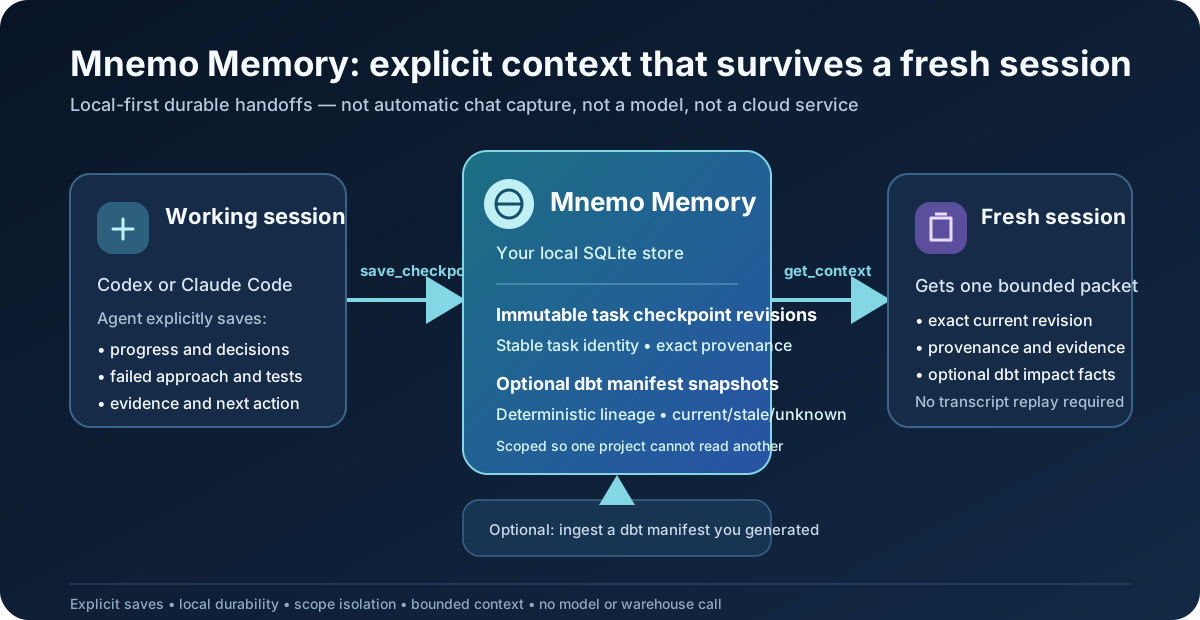
Mnemo Memory is a local context system that lets a coding agent save a compact task handoff now and retrieve it in a later, fresh session. When you opt a supported code project into automatic memory, it also keeps a privacy-preserving static map of that project's modules, imports, declarations, and syntactically explicit calls. It combines the handoff and requested structural facts into one bounded context packet.
The intended workflow is simple:
Work with an agent → Mnemo keeps a compact task handoff → end the session
                                            ↓
Start a fresh Codex/Claude session → retrieve Mnemo context → continue with the exact next action
The saved handoff contains the useful parts of prior work—not a replay of everything:
- objective, current progress, accepted decisions, and why they were made;
- failed approaches, blockers, tests/verification, evidence, and the next action; and
- optional dbt upstream/downstream impact facts from a manifest you choose to ingest.
What the deterministic evidence shows
Mnemo includes model-free, reproducible synthetic benchmarks. They compare what is available to a new session; they do not claim provider-billed savings or prove a model will produce a better answer.
| Synthetic fixture comparison | Context tokens | Result |
|---|---|---|
| Full prior transcript | 2,948 | Baseline historical context. |
| Mnemo checkpoint packet | 499 | 83.1% fewer transcript-context tokens; all required handoff facts, a correction lesson, and provenance available. |
| Full dbt manifest | 2,600 | Baseline structural context. |
| Mnemo structural facts | 686 | 73.6% fewer structural-context tokens; expected lineage facts and provenance available. |
| Transcript + manifest | 5,548 | Combined baseline. |
| Unified Mnemo packet | 1,185 | 78.6% fewer combined-context tokens; checkpoint, correction lesson, lineage, currentness, and provenance gates pass. |
All numbers are deterministic estimates from Mnemo’s local estimator in cold fresh-session fixtures—no model request, API key, provider cache, or output tokens are involved. The fixture requires 100% required checkpoint facts, including the correction lesson, lineage precision/recall, and provenance coverage; it rejects stale decisions presented as current. See the fresh-session benchmark and unified-context benchmark for methodology and limits.
Does “499 tokens” mean Mnemo uses 499 tokens all the time? No. It is the estimated size of one compact context packet in this synthetic fixture. Those tokens are added only when a client actually asks Mnemo for that checkpoint context—for example at the beginning of a fresh task session. Mnemo has no continuous token use while you work, and a different checkpoint or selected structure map will have a different bounded size.
What Mnemo remembers—and what it does not
It is not a general memory of everything you type. Mnemo does not capture chats, terminal output, or source text, and it does not call a model. Opting a repository into automatic memory is an explicit local action: Mnemo then reads supported-language syntax only to refresh a bounded structure map. At each user-prompt boundary it may use at most 512 characters of that prompt transiently to select already-saved, same-project memory; the prompt is never written to Mnemo's database or hook state. A client lifecycle hook also requires the agent to write a bounded handoff through Mnemo's MCP tool before an edited task stops, and verifies that the scoped durable revision actually changed before accepting the handoff.
- a task checkpoint: objective, progress, decisions, a failed approach, evidence, tests run, and the next action; and
- an optional source-structure snapshot: relative module paths, imports, declarations, and syntactically explicit calls for an enabled Python, JavaScript/JSX, TypeScript/TSX, Go, Rust, C, C++, C#, Java, or PHP project—plus bounded “what statically depends on this?” impact candidates, never a copy of source text; and
- optionally, a dbt manifest snapshot: verified upstream/downstream model relationships from
a
manifest.jsonMnemo can ingest after you enable that dbt project once.
That distinction matters. A new agent session can retrieve a saved checkpoint and its current dbt facts, but it cannot recover an earlier conversation that was never saved.
What “long-term memory” means here
Imagine you ask an agent to change an orders model. Before stopping, the agent explicitly calls
Mnemo’s save_checkpoint tool with something like: “the staging model is done; the previous join
approach failed; tests passed; next update the downstream mart.” Mnemo stores that as an immutable
revision in its local SQLite database.
Later—after closing the terminal, restarting Codex or Claude Code, or starting a new MCP
process—the agent can call get_context against the same Mnemo data directory and same scope.
Mnemo returns that checkpoint, not a guessed summary or a full transcript. Later revisions retain
the same logical checkpoint identity and preserve earlier evidence.
When an agent corrects a reasoning mistake, it can save a compact lesson too: what triggered the mistake, the mistaken assumption, the evidence-backed correction, and the prevention step. A later session then receives the lesson—not merely a vague “test failed” note—so it can avoid the same bad line of analysis. Mnemo does not claim to infer a model's private reasoning from an edit or test output; the agent records a lesson explicitly with its checkpoint.
If the correction is discovered after the checkpoint was already saved, the agent can use
save_checkpoint with operation: "record_lesson". That appends the single correction to the
current handoff without making it reconstruct the whole checkpoint; Mnemo keeps the original
progress and evidence, checks the current revision atomically, and enforces the same 600-token
checkpoint budget. See the local MCP guide.
If a later checkpoint revision concentrates on new progress and leaves out an older lesson, Mnemo still brings that bounded lesson back as historical, evidence-cited context. It is presented as historical task evidence—not as a claim about the current repository—so the agent can apply the prevention step while checking current structure separately.
Decisions and failed approaches that are worth keeping
A checkpoint is the main handoff. Sometimes there is also one small fact worth retaining without
rewriting the handoff: for example, “the Finance seed was stale,” “use business-date grain,” or
“the validation command passed.” The existing save_checkpoint MCP tool can record one of these
as an explicit decision, failure, or tool_outcome, with evidence and a stable source key.
Mnemo returns it only when get_context explicitly asks for approved episodic facts. When Codex
or Claude Code is connected with --auto-memory, Mnemo automatically includes a small recent
work ledger in the private session-start attachment: checkpoint revisions in their actual order,
prior lessons, and these bounded verified facts. It tells the agent what was saved or verified
and cites the exact revision or evidence. The checkpoint remains the place that explains why;
Mnemo never guesses a reason from a filename or test result. Mnemo does not record your chat
automatically; it only attaches facts that were explicitly saved with evidence.
If an enabled client changes a project and reaches a stop or compaction boundary without saving a
complete checkpoint, Mnemo keeps a tiny local handoff needed marker for that project. The next
fresh session is reminded to review the cited recent-work context and save an actual handoff. The
marker contains only a hashed local scope and a boolean—never a prompt, transcript, terminal
output, source body, or inferred explanation—and only a repository-verified checkpoint
create/revise/terminal save clears it. Merely reporting that the tool was called does not clear the
marker. A standalone record_event or record_lesson deliberately does not clear it,
because neither is a complete task handoff.
The automatic attachment has a 1,750-token total budget and happens only at a fresh supported
client session, not continuously while you work.
This is intentionally not automatic conversation capture. Mnemo never turns a terminal log, model reasoning trace, SQL query, environment, or source body into memory. The agent or user must state the bounded fact and provide evidence, which means a later agent can see what is known and where it came from without treating a private transcript as truth. The local MCP guide has the exact request shape.
Running mnemo-memory init does not make the current directory memorable. It only creates or
opens the local Mnemo store. From the repository you want remembered, run one connection command
with --auto-memory; it creates a private project binding, records the first supported-language
structure snapshot, and installs lifecycle reminders for that client. The hook refreshes the structure map
at a later session start, when the agent saves its checkpoint, or at an unsaved task stop, then
prompts the agent to save a bounded checkpoint at a task stop or compaction. It never captures
transcripts or conversations. An optional dbt command wrapper can
refresh a configured project's manifest snapshot after a successful dbt command; it is described
in the dbt command wrapper guide.
Mnemo stores no source-text copy and makes no network or model call. Its current local parsers cover
Python, JavaScript/JSX, TypeScript/TSX, Go, Rust, C, C++, C#, Java, and PHP. JavaScript and
TypeScript also recognize direct top-level literal CommonJS require("./local") bindings and a
deliberately narrow default-import form: import local from "./module" only when that module
explicitly declares one named export default function Name or export default class Name.
They also index a direct top-level const name = () => … or const name = function … binding, so
the common export const handler = … style can participate in proven local call links. Mutable,
conditional, and nested variable bindings remain unresolved.
For an enabled Git repository, Mnemo also records the local commit ID, parent commit ID when one
exists, and whether Git reported the working tree as clean or dirty at the time of a structural
snapshot. On a later session it can show that safe state beside a source transition. It does not
store a diff, commit message, remote URL, branch name, source body, or explanation of intent. A
checkpoint, lesson, or approved fact remains the evidence for why a change was made.
It also follows an exact local named barrel export such as
export { validate as check } from "./helpers", and a local export * from "./helpers" only
when the requested non-default name has exactly one proven local declaration. Anonymous defaults,
ambiguous/indirect re-exports, and export default existingName remain unresolved rather than guessed.
For a default class, Mnemo follows Class.staticMethod() only when that method is explicitly
declared static; it never pretends an instance method is a class call. These forms sit alongside
ES-module imports, while Python recognizes direct local from .module import member and parent-package
relative imports that remain inside the registered project. A Python package initializer can also
publish one exact local member, such as from .core import validate as check, for later
from package import check calls; wildcard package exports stay unresolved. Rust recognizes an explicit
use crate::path::member as local_name spelling and flat use crate::path::{member as local_name, member} lists, and C# recognizes an explicit
using Local = Namespace.Type spelling. Java recognizes direct
import static package.Type.member imports. They record explicit syntactic calls separately from imports and can follow only proven internal links to show a
bounded dependency/impact candidate. It does not guess runtime dispatch or claim a complete call
graph. That includes exact local C++ namespace calls, C# using Namespace.Type and
using static Namespace.Type calls, and PHP
use Namespace\\Type, use Namespace\\Type as Alias, explicit use function Namespace\\member,
and flat grouped PHP imports such as use Namespace\\{Type as Alias} calls when one saved target
matches.
Namespace-only imports, aliases that do not name one unique target, computed/dynamic require calls,
relative imports that escape the registered project, and duplicate
candidates stay unresolved. The storage and
context contracts are language-neutral, so more language adapters and semantic resolution can be
added without changing saved memory. The
practical user guide shows exactly how to use Mnemo on a repository such as
this one.
For common unparsed project files—including JSON/XML/INI configuration, dependency lockfiles, Dockerfile/Makefile-style build files, CSS, HTML, GraphQL, TOML, and dbt SQL/YAML—Mnemo still records only the relative path and immutable content digest. This makes a later configuration or dependency-manifest change visible without saving the file contents or claiming that Mnemo understands its symbols or dependencies.
Mnemo also fingerprints common source files it does not parse yet—including dbt .sql models,
dbt schema.yml/schema.yaml files, dbt .csv/.tsv seed files, and Swift, Kotlin, Ruby, Scala,
Elixir, Lua, Dart, and similar source extensions. That means later
memory can truthfully say that models/orders.sql changed, with no SQL body stored or replayed. It
does not pretend to know SQL dependencies or calls from that file until a dedicated safe parser
or authoritative dbt manifest provides them.
For example, if Finance updates a dbt seed, Mnemo can record that seeds/finance_orders.csv
changed between two saved snapshots. It stores only the relative path and a SHA-256 fingerprint—not
the financial values—so an agent has a durable cue to investigate the current seed and its verified
dbt impact without treating the old file body as memory.
For an enabled dbt project, the authoritative manifest closes that gap: an agent can request
dbt_lineage with relative_path: "models/marts/fct_orders.sql", and Mnemo resolves it only when
exactly one scoped manifest node owns that file. It then returns normal bounded upstream/downstream
facts with citations—without reading SQL or guessing dependencies.
The same existing get_context tool accepts dbt_test_coverage for one exact dbt resource or
manifest file. It returns directly attached enabled tests and their latest persisted run status
when available, without treating missing execution data as a pass.
For a small manifest inventory, dbt_selector intersects exact resource-type, package, and tag
fields and returns a bounded cited list of enabled nodes. It is intentionally structured and does
not execute dbt selector-string syntax.
dbt_changes compares the latest explicitly recorded manifest activation transition, or an
explicit before_snapshot_id/after_snapshot_id pair. It returns bounded added, modified, and
removed node identities plus downstream refresh candidates derived from manifest edges. Activation
order is recorded separately; Mnemo never sorts snapshot UUIDs or timestamps to invent history.
An exact dbt_lineage request may set include_code_excerpt: true to add a small current local
excerpt for the resolved starting node. Optional excerpt_start_line and
excerpt_maximum_lines select at most 40 lines from a registered .sql, .yml, or .yaml file.
The excerpt is untrusted convenience evidence—not lineage—and is omitted on unsafe paths, secret
matches, unsupported or oversized files, binding failure, or token pressure.
From an enabled repository, you can also inspect a bounded static impact candidate directly:
mnemo-memory memory impact package.module_name
mnemo-memory memory impact --path src/billing/reconcile.py
mnemo-memory memory history
mnemo-memory memory changes
mnemo-memory memory changes --path models/orders.sql --history-limit 4
mnemo-memory memory refresh
memory changes uses the latest two recorded structural refreshes. The explicit
--from SNAPSHOT_ID --to SNAPSHOT_ID form remains available for an advanced historical audit.
memory history lists recent snapshots when you need to select an older pair. An agent can ask
get_context for a bounded source_changes history for one relative path such as
models/orders.sql; Mnemo returns only saved file/declaration/relationship identities for that
path, newest transition first, with snapshot citations. It never returns the SQL or source body.
When one removed and one added relative path have the same unique saved SHA-256 fingerprint, Mnemo
labels that as a rename instead of pretending that unrelated files were deleted and created.
Copied or ambiguous content stays reported as ordinary add/remove evidence.
For an enabled dbt project, Mnemo uses the new path of a digest-proven renamed .sql model for its
normal exact manifest lookup; it still never infers dbt lineage from SQL.
You can inspect the same bounded history yourself with memory changes --path ... --history-limit.
Use memory impact --path RELATIVE_PATH when the question is “what proven static code depends on
this exact file?” It includes all saved declarations in that file and never substitutes a similarly
named path.
An agent can also request an exact file identity through get_context with source_query, such
as package.json, uv.lock, or Dockerfile. Mnemo returns only the relative path, immutable
snapshot, and citation—not the file contents—and does not invent symbols or dependencies for a
file it has not parsed.
Mnemo is local-first. It does not proxy your provider, execute dbt, run SQL, render Jinja, contact a warehouse, or send the local database anywhere.
For a JavaScript or TypeScript monorepo, Mnemo can also retain one narrow, useful kind of package
relationship: a local workspace package declaring a runtime dependency on another local workspace
package with "workspace:". That means a later impact query can say that a saved local package
depends on another saved local package. It does not run npm/pnpm/Yarn, read lockfiles, infer
runtime resolution, or treat external, development, optional, or peer dependencies as proven
relationships.
When an agent does not yet know the exact file or symbol, it can use Mnemo's existing
source_query field with a few literal words, such as reconcile orders. Mnemo ranks exact saved
names first, then prefixes, then identities containing every supplied word. It searches only the
current scoped structural snapshot—not source bodies, comments, embeddings, or another project—so
the result is a small cited starting point for a later proven impact query.
Rust repositories receive the same limited package-level help for an exact local Cargo path
dependency. Mnemo accepts only a runtime [dependencies] name = { path = "..." } declaration
whose normalized local path and package name both match another parsed local library crate. It does
not run Cargo, read Cargo.lock, or infer version, feature, build, development, optional, renamed,
or workspace-inherited dependencies.
Status:
0.1.0a3is an early alpha. It is useful for the documented local workflow, but the project intentionally does not yet provide automatic transcript capture, semantic cross-language call graphs, or team workspaces.The multi-language source-structure work described below is currently in this development branch; it is not retroactively part of the immutable
0.1.0a2PyPI release.
Install
The PyPI distribution is mnemo-unified-context. The import package remains mnemo_memory, and
the command is deliberately mnemo-memory.
uv tool install mnemo-unified-context==0.1.0a3
mnemo-memory --help
mnemo-memory is a separate executable. It neither replaces nor shadows an existing mnemo
command on your machine.
For a local wheel, use uv tool install /path/to/mnemo_unified_context-0.1.0a3-py3-none-any.whl.
For development in this checkout:
uv sync --locked
uv run mnemo-memory --help
Upgrade or remove a uv- or pipx-owned installation with Mnemo's lifecycle commands:
mnemo-memory upgrade
mnemo-memory uninstall --yes
Uninstall stops the local service, removes only exact Mnemo-owned Codex and Claude Code
registrations and hooks, and preserves the configured data directory, including backups. To
permanently remove that recognized directory too, use the deliberately separate destructive form
mnemo-memory uninstall --delete-data --yes.
Start here: let Mnemo explain the setup
If you do not want to learn configuration terms first, run:
mnemo-memory agent
It is a local, deterministic setup guide—not another AI agent. It explains what Mnemo remembers, offers to initialize the local store, and shows how to connect Claude Code, Codex, or both. The complete user walkthrough is Mnemo Memory: a practical guide.
A simple first use
1. Initialize one local Mnemo store
mnemo-memory init
mnemo-memory status
Start the loopback service and open http://127.0.0.1:8765/ for the local onboarding and health
dashboard:
mnemo-memory start
The dashboard loads only packaged local assets. Its health response shows connection/project
readiness, bounded index counts, honest freshness and last-sync state, and content-free event-job
counts without memory content, absolute project paths, scope or job IDs, credentials, or command
output. Retry failed explicitly requeues at most 100 failed jobs for only the current project;
it preserves attempt counts and never claims that a handler succeeded. The Approved Memory section explicitly displays bounded
decision/failure/tool-outcome facts for the current registered project task, including retained
evidence and correction/retraction lineage; it never retrieves another project. Confirmed
same-origin controls can append an evidence-backed correction or erase an active fact's retained
payload while preserving its minimal tombstone. They can also pin an active fact so it is selected
before unpinned recency within the same bounded project-task retrieval; correction transfers that
pin and erasure removes it. An explicit same-origin Export JSON action downloads every record
in that exact task scope with full evidence and governance serialization, current pin state, and a
canonical content digest; Mnemo does not retain another server-side copy of the download. Its
Settings section controls repository-note
auto-sync, explicit approved-event capture, optional model routing metadata, retention defaults,
and packet budgets. On automatic-memory session start, active checkpoints older than the configured
period since their last canonical write are expired from current retrieval while their audit
history remains; reads do not renew them. It never accepts an API key. Changes apply to new MCP
processes and automatic hooks; existing extracted-memory schedules are not silently rewritten. Stop it with
mnemo-memory stop.
Create an integrity-checked recovery point before any manual installation change:
mnemo-memory backup
The command uses SQLite's coherent backup operation and writes one mode-0600 database under the
private backups directory. Its filename records the schema version, UTC creation time, and full
SHA-256 digest. Mnemo validates database integrity and foreign keys before publishing the file and
never overwrites an existing artifact. The backup contains the same private data as the live store;
keep it protected and remove it explicitly when no longer needed. Automatic invocation by the
one-command upgrade workflow is available when the running Mnemo executable is owned by uv or
pipx:
mnemo-memory upgrade
The wrapper verifies the owning isolated environment, creates the backup first, stops a running local service, invokes only that manager's package-specific upgrade, validates migrations through the upgraded CLI, and restores the prior running or stopped state. Installer output is suppressed so it cannot enter logs or terminal capture. If a post-backup step fails, the bounded JSON result identifies the recovery artifact. Mnemo does not automatically downgrade the package or replace the live database on failure.
Create a private support artifact without exporting memories or logs:
mnemo-memory diagnostics
The resulting mode-0600 ZIP contains one closed JSON manifest with runtime versions, bounded lifecycle and SQLite health, settings availability, current-project registration, and client availability/ownership status. It contains no memory, checkpoint, note, source, evidence, query, job, identifier, path, environment, credential, subprocess output, exception detail, or durable log. The filename and result include SHA-256 integrity digests.
This creates a local database, normally outside your repository:
- macOS:
~/Library/Application Support/Mnemo - Linux:
${XDG_DATA_HOME:-~/.local/share}/mnemo - Windows:
%LOCALAPPDATA%\Mnemo
Use an absolute --data-dir /absolute/path/to/mnemo-data or MNEMO_DATA_DIR only when you want a
separate store, for example in a test or CI job. An explicit bad location fails safely; Mnemo does
not silently create a different empty database.
2. Make the MCP tools available to your client
mnemo-memory connect codex --auto-memory
mnemo-memory connect claude-code --auto-memory
You may run both commands. They are independent registrations:
| Command | What it connects | Can it coexist with the other? |
|---|---|---|
mnemo-memory connect codex |
Codex’s MCP configuration | Yes. |
mnemo-memory connect claude-code |
Claude Code’s MCP configuration | Yes. |
mnemo-memory connect by itself does not connect anything; it shows the available client-specific
subcommands. --auto-memory is the recommended one-time project opt-in. After registering,
restart the relevant client. Each client sees exactly the same five Mnemo MCP tools:
get_context, list_skills, get_skill, explain_context, and save_checkpoint.
Inside the enabled repository, those tools resolve its private generated scope automatically. You do not copy UUIDs into prompts or environment variables, and an agent must not invent friendly labels in their place. Explicit UUID scope remains available only for advanced isolated calls.
Both clients start the same installed mnemo-memory launcher and therefore share memory when
they use the same Mnemo data directory and the same scope. If you set different MNEMO_DATA_DIR
values, you have deliberately created isolated stores. Registration does not change model
selection, credentials, provider settings, or network permissions.
To inspect or remove one registration without affecting the other:
mnemo-memory connect codex --check
mnemo-memory disconnect codex
mnemo-memory disconnect claude-code
3. Use it deliberately during work
In a compatible client session, work normally. The opt-in lifecycle hook asks the agent to retrieve
context when a session starts and to save a handoff before it stops or compacts. The agent uses
get_context and save_checkpoint; it can use explain_context to inspect selection metadata.
There is no separate “remember this directory” command after the one-time
--auto-memory opt-in. For a local terminal walkthrough, run mnemo-memory agent (or its
mnemo-memory guide alias).
For the memory to be available later, the new session must use the same Mnemo data directory and the same task/project scope. This is intentional: a checkpoint from one project is not disclosed to another project merely because both run on the same machine.
Questions people reasonably ask first
Does mnemo-memory init remember my current repository? No. It initializes one local Mnemo
database; it does not inspect or bind the current directory.
What is remembered long term? Explicit checkpoint revisions, and—after you opt a repository into automatic memory—a static structure snapshot of its supported-language files plus bounded Markdown knowledge already inside that enabled repository. Mnemo currently supports Python, JavaScript/JSX, TypeScript/TSX, Go, Rust, C, C++, C#, Java, and PHP. It stores declarations plus explicit imports and calls, resolving a relationship only when exactly one saved target matches. If two files or languages define the same candidate name, Mnemo leaves the link unresolved rather than guessing. If you enable dbt, Mnemo also keeps its manifest projection. A checkpoint is a compact handoff record for one task—not a copy of your files, terminal history, or every chat message.
Markdown notes are treated differently from code structure. Mnemo stores approved, bounded note sections as untrusted evidence with their relative path, heading, digest, and immutable revision. It never executes a note, follows a note link, or treats a note as an instruction. The automatic hook refreshes the enabled repository's Markdown at session and work boundaries; a later context request selects only matching cited sections rather than injecting an entire notes folder.
For local personal-scale search, Mnemo maintains a rebuildable SQLite full-text index of only the current scoped note sections. Old revisions and deleted note bodies are removed from that search projection. It is literal word search—not an embedding or model judgment—so it remains local, predictable, and cited.
If literal words are not enough, you can opt in to local-only semantic note search. This is not part of ordinary setup and it does not send notes, prompts, or queries to a hosted AI provider:
# once, after enabling this repository's automatic memory
uv tool install "mnemo-unified-context[semantic]"
mnemo-memory memory semantic index

# optional local inspection with different wording than the note itself
mnemo-memory memory semantic search "why did billing totals drift?"
The first explicit index may download the public local embedding-model weights into Mnemo's data
directory. Afterwards both indexing and querying run on-device. Mnemo stores only vectors tied to
the current, cited note revision; it never stores a second text copy, and it removes vectors when
the note is deleted. Agents can request this same bounded evidence through get_context with
semantic_knowledge_query; literal knowledge_query remains available and unchanged.
When two notes disagree, Mnemo does not decide from prose. Update the corrected note so the old
revision is no longer current, or declare one explicit same-project counterpart with
mnemo_conflicts_with: docs/other-note.md in Markdown frontmatter. A retrieval then preserves both
cited notes as an unresolved conflict; it never lets a note override verified source or dbt facts.
If two note sections have the same literal search score, a checked-in repository Markdown note is shown before an opted-in Obsidian note. That is only a predictable tie-breaker: Mnemo does not silently overwrite one note with another or present either as verified current code structure.
At a new supported Codex or Claude Code session, Mnemo also tells the agent—without showing note
text—how many current scoped knowledge documents are available and to use a short knowledge_query
when the task needs a documented decision, architecture note, or policy. You do not need to keep a
separate reminder in every CLAUDE.md or AGENTS.md.
Reusable project procedures (an opt-in playbook)
If your project has a repeated workflow—for example, investigating a reconciliation mismatch—put the short playbook in normal, version-controlled Markdown. After automatic memory has synced the repository, an agent can request it by a literal tag rather than rereading every note:
---
mnemo_kind: procedure
mnemo_tags: reconciliation, dbt
mnemo_mandatory: true
---

# Reconciliation workflow

1. Confirm the business-date grain in the cited Finance input.
2. Compare the current dbt manifest impact before changing a model.
3. Record the verified outcome in the task checkpoint.
The matching get_context request uses "procedure_tags":["reconciliation"]. Mnemo returns
only matching checked-in Markdown revisions in the packet’s procedures section, with the relative
path, immutable revision ID, digest, and evidence. It does not scan every note, execute the
Markdown, infer tags from the agent's prompt, or let the procedure override system/user rules or
verified current dbt/source facts. mnemo_mandatory: true means “prioritize this project playbook
over an optional project playbook”; it is not a security permission.
Make a playbook automatic for Codex and Claude Code
If you enabled automatic memory for this repository, you do not need to remember to tell the agent these tags every session. Add one small checked-in client profile, alongside the playbook:
---
mnemo_kind: agent_profile
mnemo_client: any
mnemo_procedure_tags: reconciliation, dbt
---

# Default project workflow
At the next fresh supported-client session, Mnemo attaches matching procedures automatically with
their exact procedure and profile revisions as provenance. Use mnemo_client: codex or
mnemo_client: claude-code when the two clients need different playbooks; any applies to both.
Keep at most one matching profile for a client. If two match, Mnemo safely attaches neither rather
than guessing which file wins. This is how a project can make a reconciliation workflow available
to its normal coding agent without a repeated prompt or an extra CLAUDE.md/AGENTS.md reminder.
Versioned skills and named agents
For an on-demand workflow rather than a mandatory/automatic procedure, use strict skill frontmatter:
---
mnemo_kind: skill
mnemo_name: reconciliation-review
mnemo_version: 1.2.0
mnemo_tags: dbt, reconciliation
mnemo_clients: codex, claude-code
mnemo_trust: checked_in
---

# Reconciliation review

Compare the documented grain before approving a reconciliation change.
An optional named agent can select those exact tags without copying skill content:
---
mnemo_kind: agent
mnemo_name: reconciliation-agent
mnemo_version: 2.0.1
mnemo_client: any
mnemo_skill_tags: reconciliation, dbt
---
After the normal repository Markdown sync, list_skills returns compatible metadata and
get_skill returns one exact current skill as cited untrusted evidence. get_context accepts
either skill_tags plus skill_client, or skill_agent_name plus skill_client. It loads only
applicable compatible skills, never every skill, and a mandatory checked-in procedure retains
budget priority. Updating a file creates a new current immutable revision while retaining its
predecessor; Mnemo does not rewrite imported skill or agent files.
When the durable checkpoint already names relevant files, the small automatic session packet also
looks up current same-project notes using those file stems (for example, reconciliation from
models/reconciliation.sql). That gives a fresh agent a cited note about the file it is resuming
without replaying every note. On later user turns, Mnemo may transiently use a bounded prompt to
select relevant saved notes and the active checkpoint into a packet capped at 1,300 estimated
tokens. The prompt itself is not stored, logged, or returned. Selection is scope-first, so another
project's note cannot be included. For a different topic, the agent can still use an explicit short
knowledge_query.
When does it get saved? In automatic mode, Mnemo asks the connected agent to call
save_checkpoint at a stop or compaction boundary. You can still ask explicitly at any point.
The code structure refresh happens locally at session start, checkpoint save, and an unsaved stop;
task handoffs remain deliberately bounded rather than being raw transcript capture. Structural impact requests use the active
snapshot by default, or can name an immutable snapshot when an agent needs to reason about a
specific earlier state. A source map is called current only when its exact fresh source digest
matches; “active” alone is never treated as proof that files have not changed.
When an enabled project saves a checkpoint, Mnemo may also record the exact source snapshot it observed immediately afterward. This is a useful, cited answer to “which saved structure was the agent looking at when it handed work off?” It is not a claim that the snapshot caused the change or explains the decision: the checkpoint’s explicit evidence and lessons remain the source for why work was done.
When Mnemo observes a supported structural change between snapshots, it gives the connected agent a short factual summary of added/removed/modified relative files, declarations, and proven relationships in the automatically attached fresh-session context. A body-only edit is therefore visible even when a file keeps the same functions—without requiring the agent to remember to make a second query. Mnemo stores a SHA-256 fingerprint for that purpose—not source bodies—and still does not guess why it changed: the agent records that decision, failed approach, and verification in the checkpoint it saves.
Even when there is no recent change, a fresh enabled session receives a tiny source overview: the exact immutable source-snapshot ID, file/symbol/relationship counts, and a deterministic sample of saved relative file, module, and declaration identities. This is the agent's starting map of the repository—not a replay of the checkout. Every included item is cited; source bodies, prompts, terminal output, and absolute local paths remain out of the packet. When the map is too large for the automatic-session budget, Mnemo records a structured omission instead of silently trimming an identifier or pretending the rest was read. Its summary also states the counts outside the chosen file/module/declaration sample, so a small map is never mistaken for the full repository.
At automatic session start, Mnemo has just rebuilt that snapshot. Its attached overview and transition facts therefore carry the matching snapshot digest and are labeled current for that captured state. A later manual query still needs comparable digest evidence; an active saved snapshot is never silently treated as current merely because it is active.
After an agent changes a project file, Mnemo batches that work and refreshes at the next user-turn boundary, not after every keystroke. The agent therefore receives the same small change and impact cue while it is still working, before it needs to make another historical claim.
For a changed file in a supported parsed language, Mnemo also includes a very small list of static dependent candidates from that exact file. The cue names the immutable source snapshot that proves them, so the agent can request or compare that exact structural evidence. This saves the agent from first asking “what could be affected?” after a fresh session. They are syntax-derived, bounded, and cited—not proof of runtime behavior, and not a substitute for tests or current verification.
When a saved checkpoint names supported relative files in relevant_files, the next automatic
handoff starts from up to two matching files in that checkpoint order and includes tiny, cited
lists of their proven static dependents. In practical terms, a checkpoint that says “I changed
core.py and worker.py” can bring the agent the bounded answer to “what saved code statically
depends on these?” without a second request. The checkpoint chooses only the topic; the source
snapshot remains the authority for every relationship. If a file is not indexed, ambiguous, or
the compact budget is full, Mnemo omits the impact rather than inventing it.
For a changed dbt .sql model with an active manifest, the same cue includes bounded downstream
model identities from that manifest. Those are authoritative structural facts for that artifact,
but the cue treats their currentness as unknown until the agent supplies matching manifest or
source-state evidence. It names the exact immutable manifest snapshot, and Mnemo never treats an
older active manifest as proof that the project has not changed.
When an agent needs the durable version of that question in a later session, it can ask for
source_changes with get_context. Mnemo compares the two most recently recorded structural
snapshots in their actual activation order and returns a bounded list of added/removed/modified
relative-file, declaration, and relationship identities, with evidence for both snapshots. It never
guesses chronology from a snapshot UUID and never returns source text. The result is labeled
current, stale, or unknown only from an exact supplied source digest; “active” alone is not
called current.
For static code impact, an agent can name either a saved declaration or an exact relative file
path. A file-path request starts from declarations in that exact file only; Mnemo will not guess
from a similarly named file elsewhere. For dbt models, use the same relative_path concept under
dbt_lineage; Mnemo resolves the single manifest node and follows manifest-authoritative edges.
Must I teach every agent to use Mnemo? Not for the supported --auto-memory setup. Mnemo
injects a session-start instruction telling Codex or Claude Code to check context before claiming
knowledge of earlier work or impact, and how to request saved structure for a named symbol/file.
After the agent changes a project file, Mnemo also adds one short reminder before the next user
turn. With the explicit --auto-memory opt-in, it may use a bounded submitted prompt transiently
to select already-saved same-project context, but it never persists the prompt or reads a model's
private reasoning. This is timely guidance—not surveillance or a hidden transcript recorder.
Will it read every Markdown file on my computer? No. The --auto-memory consent applies only
to the repository you enabled. Mnemo reads bounded .md files under that project root, skips
symlinked files and common cache/config directories, and never leaves that root. An unregistered
repository is not scanned. Clear credential-like values are rejected before storage; Mnemo does not
claim that this deterministic safeguard can recognize every possible secret.
What if my notes live in an Obsidian vault outside the repository? Opt that vault in separately for the already-enabled project:
mnemo-memory memory vault enable "/path/to/My Obsidian Vault"
Mnemo checks for the vault's local .obsidian marker, assigns it a generated local source identity,
and keeps its Markdown separate from same-named repository notes. It does not reveal the vault path
through MCP context. Use mnemo-memory memory vault status to check the binding, or
mnemo-memory memory vault disable to stop syncing it and remove its retained note payloads.
How does a new agent get it? The new agent connects to the same Mnemo store and calls
get_context for the same scope. It receives the latest active checkpoint and any requested dbt
facts, with provenance. If no checkpoint was saved, it receives no hidden history.
Does changing directories create a different memory? No. The data directory selects the
database and scope selects which project/task can be read. --auto-memory creates an explicit
machine-local binding for the repository you enabled; another directory stays unbound until you
choose to enable it. Mnemo never guesses that two filesystem paths are the same project.
Optional: keep dbt lineage current automatically
This is optional. It adds verified dbt upstream/downstream facts to an agent’s context; it does not change how task checkpoints work.
From the dbt repository, run this once:
cd /path/to/your-dbt-project
mnemo-memory dbt enable
Mnemo finds dbt_project.yml, initializes its personal profile when needed, creates private
stable identities, binds this one repository locally, and ingests target/manifest.json if a
valid one already exists. Supported sibling catalog.json, run_results.json, and sources.json
artifacts are
minimized and attached to that exact snapshot. You do not need to generate, copy, or remember UUIDs. Mnemo does not
write dbt_project.yml, profiles.yml, warehouse credentials, or any shell profile.
If you have already enabled automatic task memory for this same repository, dbt enablement reuses
that project identity. A later get_context request can therefore put the task handoff (the
why) beside dbt lineage (the verified what is affected) without you having to pass IDs or
match scopes yourself.
To make normal dbt commands use the wrapper, opt your interactive shell in once per machine:
eval "$(mnemo-memory dbt shell-hook zsh)"
It defines a dbt() function only in your current shell. To make it persist, add that same line to
your own ~/.zshrc; use the bash or fish equivalent for those shells. Mnemo never edits those
files for you. After the one-time shell setup and one-time project enablement, your everyday
command stays exactly the command you already know:
dbt run --select model_name
For CI, Codex, Claude Code, or a shell where you do not want the function, use the explicit
equivalent: mnemo-memory dbt exec -- run --select model_name. Remove the profile line or run
mnemo-memory dbt disable to stop wrapping a project; neither action deletes prior snapshots.
If you run dbt in a repository that has not been enabled, dbt still runs normally. Mnemo prints one
short reminder to run mnemo-memory dbt enable and skips ingestion.
mnemo-memory dbt status shows whether the enabled project has an active snapshot. Re-ingesting
the same manifest is safe and idempotent. A changed manifest becomes a new immutable snapshot and
atomically becomes active; older snapshots remain available for provenance. Mnemo stores a bounded
structural projection, not raw SQL, compiled SQL, macro bodies, credentials, or the full manifest.
get_context lineage results may add bounded matching relation columns and node run status, each
with exact supplemental-artifact evidence and within the existing structural token budget.
What the MCP tools do
Mnemo exposes exactly five local stdio MCP tools:
save_checkpointcreates, revises, completes, or abandons an explicit task checkpoint.get_contextreturns a bounded packet, optionally including a structured dbt upstream, downstream, or directed shortest-path request. In an auto-memory-enabled repository the retrieval and checkpoint tools use the registered project/task scope when all UUID fields are omitted; advanced callers may supply the complete explicit scope. Its optional transientquerydeterministically selects existing scoped lexical memory, knowledge, and source-identity retrieval without being persisted or implicitly enabling semantic search.explain_contextvalidates a packet returned byget_contextand reports its sources, ranks, omissions, conflicts, staleness, and token accounting without repeating retrieved content.list_skillsreturns bounded metadata for current checked-in skills compatible with Codex or Claude Code in the resolved project scope; it does not return Markdown bodies.get_skillreturns one exact compatible checked-in skill with immutable revision/digest provenance and labels its Markdown as untrusted evidence.
get_context returns the canonical structured packet by default. Its optional render_for value
(codex or claude-code) returns that unchanged packet beside deterministic, client-labeled line
records. Automatic-memory hooks choose the matching renderer themselves. Dynamic values are
JSON-quoted under a fixed trust boundary; rendering cannot retrieve, rerank, persist, authorize, or
change the packet.
Before return, the context engine removes only exact same-source duplicates, limits non-conflicting episodic and knowledge results to two per evidence-source set, and records every removal as an omission. Checkpoints, mandatory procedures, and conflict participants are retained. If one source reference appears with different digests, both versions remain visible as an unresolved source-integrity conflict; Mnemo does not guess which prose is correct.
A checkpoint has a stable logical ID and immutable revisions. Revision, completion, and abandonment requests include the current revision ID, so two clients cannot silently overwrite one another. Completed and abandoned checkpoints are excluded from automatic active selection.
Every saved revision must include evidence/provenance supplied by the caller. Mnemo does not invent evidence, silently truncate stored checkpoint text, or replay a full transcript. The active checkpoint section defaults to 600 estimated tokens; the entire context packet has a hard budget with structured omissions when needed.
Command map
| Command | Plain-language purpose |
|---|---|
mnemo-memory init |
Create/open the local Mnemo database. It does not inspect the current repository or save a checkpoint. |
mnemo-memory status |
Show whether that local store is initialized and usable. |
mnemo-memory connect codex |
Make Mnemo’s three MCP tools available to Codex. |
mnemo-memory connect claude-code |
Make the same three MCP tools available to Claude Code. |
mnemo-memory agent |
Run a deterministic interactive setup guide; it does not use a model or change a client registration. |
mnemo-memory dbt enable |
Enable Mnemo for the dbt project in this directory. It creates private local IDs for you. |
mnemo-memory dbt status |
Show whether this enabled dbt project has an active saved snapshot. |
mnemo-memory dbt disable |
Stop Mnemo wrapping this dbt project without deleting saved snapshots. |
mnemo-memory dbt exec -- … |
Run dbt explicitly with Mnemo’s optional pre/post manifest handling. |
mnemo-memory mcp serve --stdio |
Start the MCP server directly; client registration normally starts it for you. |
Understanding dbt context and freshness
Mnemo supports dbt manifest.json schema v12. Dependencies come from the manifest’s declared
depends_on.nodes relationships; parent_map and child_map are consistency checks. It can
return direct or transitive upstream/downstream facts in a deterministic order, including the
artifact snapshot and evidence for every fact.
An active snapshot is the latest successfully ingested one. That alone does not prove it still matches your files:
- current means supplied comparable digest/fingerprint evidence exactly matches;
- stale means comparable evidence differs;
- unknown means there is not enough comparable evidence.
After a successful wrapped dbt command, Mnemo records a bounded local state observation with the
full Git HEAD ID, dirty state, a SHA-256 fingerprint of changed/deleted/untracked paths and their
current content digests, and an explicit --target when supplied. Paths and bodies are not stored.
Missing Git, unsafe paths, oversized changes, or observation failure leave state unknown and never
make dbt fail. A different explicit target is stale even when the Git tree otherwise matches.
For dbt structural requests, a fresh MCP process resolves the exact registered project only after
scope validation and compares a new bounded observation automatically. Callers cannot provide raw
fingerprint evidence; missing, ambiguous, or invalid local bindings leave currentness unknown.
Verified current manifest structure outranks an older checkpoint’s recollection of repository structure. Mnemo preserves such a disagreement as evidence rather than asking a model to resolve it.
An exact dbt_freshness request returns one persisted observation from sources.json v3 for a
manifest source. The result includes its observed status, timestamps, age, thresholds, and
execution time with evidence. Mnemo does not contact the warehouse, recompute the status, or treat
manifest configuration as proof of freshness. Adapter responses, database errors, filters,
environment values, and timing details are discarded before persistence.
Reliability, privacy, and recovery
Checkpoint revisions and dbt snapshots are immutable and scoped. SQLite writes use transactions, expected-revision/expected-active comparisons, foreign keys, and integrity checks. A new Mnemo process using the same data directory can retrieve acknowledged writes after a restart.
Back up the data directory before upgrading: migrations are forward-only. A corrupt, unavailable, or unsupported-newer database fails safely rather than switching to an empty store. Tool errors are sanitized and do not include SQL, stack traces, unrelated scope data, or private paths.
More detail
- Local MCP guide — tool lifecycle, revision conflicts, and recovery.
- Codex and Claude Code MCP guide — complete client setup, cross-client sharing, prompts to use during work, and troubleshooting.
- dbt manifest guide — schema support, deterministic lineage, evidence, and parser safety.
- dbt command wrapper guide — one-time binding, automatic post-run manifest activation, shell setup, and failure behavior.
- Command wrapper hooks — the generic safe wrapper kernel, trust boundary, and failure semantics behind the optional dbt integration.
- Implementation status — completed vertical slice and deferred milestones.
Advanced/manual dbt ingestion and explicit scope overrides remain available for controlled automation; they are intentionally not part of the personal setup path.
Development verification
npm ci
npm run check
uv build --no-sources
The verified package target is Python 3.12 on macOS and Linux. Built-artifact verification runs
outside the source checkout so migrations and schemas are proven to load from the installed
mnemo_memory package.
The aggregate check also builds source-independent archives, performs an isolated
uv tool install --reinstall from the wheel, connects a sample project with automatic memory,
and calls get_context without UUID arguments through two fresh registered MCP processes.
The manual, environment-gated TestPyPI and PyPI workflows build and verify the wheel and source distribution once, bind them to a SHA-256 checksum bundle, and publish only those two artifacts through PyPI Trusted Publishing. The publishing action is pinned to an exact reviewed commit and requests a Sigstore-backed PyPI publish attestation for each artifact. After upload, the workflow requires PyPI's Integrity API to expose registry-accepted provenance whose subject digest, repository, and workflow match the staged release before the release verification can pass. No long-lived package-index token is stored in the workflow.
1 maintainer

Metadata
1 maintainer
Release files for mnemo-unified-context 0.1.0a3
For a detailed explanation of source distributions (sdists) and built distributions (wheels), please see the package formats documentation.
Source distribution (sdist)
| File | Size | Uploaded | |
|---|---|---|---|
| mnemo_unified_context-0.1.0a3.tar.gz | 492.3 kB | Details |
Built distribution (wheel)
| File | Interpreter | ABI | Platform | Reset |
|---|---|---|---|---|
| mnemo_unified_context-0.1.0a3-py3-none-any.whl | Python 3 | none | any | Details |
Total release size: 1.1 MB
Release files / mnemo_unified_context-0.1.0a3.tar.gz
| Download URL | mnemo_unified_context-0.1.0a3.tar.gz |
|---|---|
| Size | 492.3 kB |
| Tags | Source |
|
SHA-256 checksum How to use checksums |
966e119d3749e02212014e156a88e35d4c0c20b14f5f833a4bc1b696be6dd94e
|
|
BLAKE2b-256 checksum How to use checksums |
927cb5080f2289a5a4639db663eb98c03c65acd49cbf1d71dfc1c41c9aa8c6f9
|
| Upload date | |
|
Uploaded using Trusted Publishing? What is trusted publishing? |
Yes |
| Uploaded via |
twine/6.1.0 CPython/3.13.13
|
Provenance
Provenance describes where a file came from. On PyPI, provenance is shared via attestations, which provide a verifiable record of the build or publishing details. View details, limitations and caveats.


PyPI Publish Attestation
PyPI verified that this artifact, at this checksum, originated from the publisher listed below.
Signed by GitHub Actions, verified by PyPI on Aug 6, 2026.
Transparency logRelease files / mnemo_unified_context-0.1.0a3-py3-none-any.whl
| Download URL | mnemo_unified_context-0.1.0a3-py3-none-any.whl |
|---|---|
| Size | 598.8 kB |
| Tags | Python 3 |
|
SHA-256 checksum How to use checksums |
d044ca20212cb90ed89a76b0bc89ab5cb06a9d53874248049f9269ef79101282
|
|
BLAKE2b-256 checksum How to use checksums |
e5ad8cfbba405c4c1693bac38253e6d3120b86de9d082d54b5246bd669ab9f30
|
| Upload date | |
|
Uploaded using Trusted Publishing? What is trusted publishing? |
Yes |
| Uploaded via |
twine/6.1.0 CPython/3.13.13
|
Provenance
Provenance describes where a file came from. On PyPI, provenance is shared via attestations, which provide a verifiable record of the build or publishing details. View details, limitations and caveats.
PyPI Publish Attestation
PyPI verified that this artifact, at this checksum, originated from the publisher listed below.
Signed by GitHub Actions, verified by PyPI on Aug 6, 2026.
Transparency log













