
A domain-specific language for Mixture-of-Experts scheduling policies

Project description
MoE-PolicyLang
A scheduling language for Mixture-of-Experts models.
Author: Jesse Pokora · License: MIT
What Is This?
Large language models like Mixtral, DeepSeek, and Qwen use Mixture-of-Experts (MoE) — instead of one giant network, they have dozens of smaller "expert" networks and a router that picks which ones to use for each token. By design, only a fraction of experts are active at any time, so the rest are offloaded to CPU memory — this is intentional, not a limitation.
But managing that offloading is complex. Which experts to keep on GPU? When to prefetch the next ones? Where to run cache misses — wait for the GPU transfer, or fall back to CPU? And how to adapt as the workload shifts?
Every existing system hardcodes these decisions in hundreds of lines of C++/CUDA. MoE-PolicyLang replaces all of that with a small, declarative language.
The Language
A MoE-PolicyLang policy is a .moe file with four composable blocks:
policy balanced {
    cache {
        capacity = 16
        eviction = lfu
        frequency_decay = 0.9
    }
    prefetch {
        strategy = history
        budget = 4
    }
    schedule { mode = hybrid }
    adapt {
        when hit_rate < 0.4 for 100 accesses
            { eviction = lru }
    }
}
| Block | Controls | Options |
|---|---|---|
| cache | Which experts stay on GPU | LRU, LFU, score-based, frequency-threshold |
| prefetch | Proactive loading | History, affinity, lookahead |
| schedule | Where to run cache misses | GPU-only, CPU-fallback, hybrid |
| adapt | Runtime self-tuning | Conditional rules that hot-swap components |
Switching from LRU to LFU? Change one word. Adding prefetching? Two lines.
Two Lines to Attach
import moe_policylang
from transformers import AutoModelForCausalLM

model = AutoModelForCausalLM.from_pretrained("allenai/OLMoE-1B-7B-0924")

# Auto-generate a tuned policy from your model + GPU, attach it
mgr = moe_policylang.auto_attach(model)
output = model.generate(...)
print(mgr.get_stats())  # hit rate, transfers, evictions
Or write a policy explicitly:
mgr = moe_policylang.attach(model, """
    policy aggressive {
        cache { capacity = 8  eviction = lru }
    }
""")
Or load a .moe file:
mgr = moe_policylang.attach(model, open("my_policy.moe").read())
Why a Language?
Python dicts could configure this. The DSL adds three things they can't:
- Static validation — 20 semantic rules catch bad policies at parse time, not mid-inference
- Portability —
.moefiles are shareable, diffable, and tool-agnostic - Constraint — you can't write arbitrary code in a scheduling policy; the grammar limits you to what makes sense
Results
The abstraction is effectively free
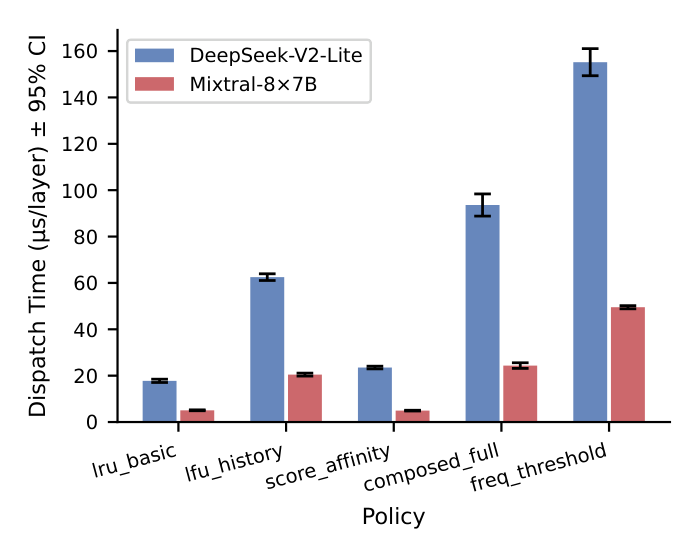
All policies add < 3.2% overhead on A100 (6–47 µs/layer vs. 1,459 µs for MoE forward pass).
14–40× less code than published systems
| System | Their LOC | MoE-PolicyLang | Reduction |
|---|---|---|---|
| Fiddler | 280 | 7 lines | 40× |
| HybriMoE | ~500 | 14 lines | 36× |
| MoE-Infinity | 520 | 16 lines | 33× |
| vLLM | 300 | 12 lines | 25× |
| ExpertFlow | ~400 | 16 lines | 25× |
| FineMoE | ~350 | 25 lines | 14× |
Bold LOC counts are measured from open-source repos (primary
expert-management function or module — e.g., Fiddler's set_expert_loc()
in src/fiddler/mixtral.py); others estimated from paper descriptions.
Policy selection produces measurable differences
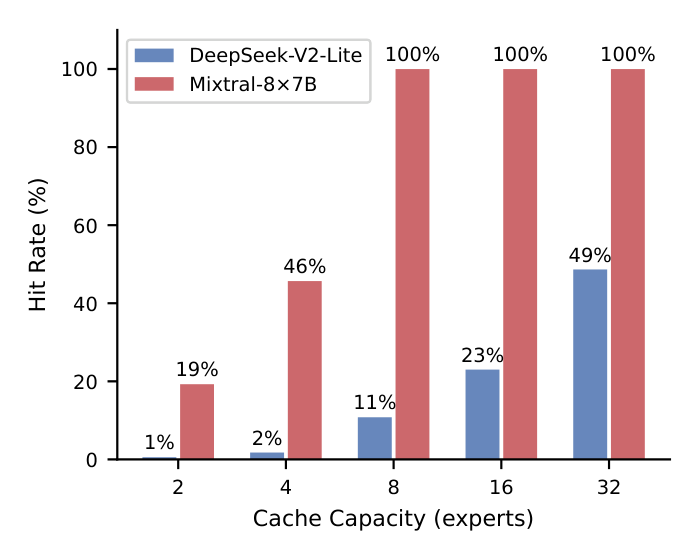
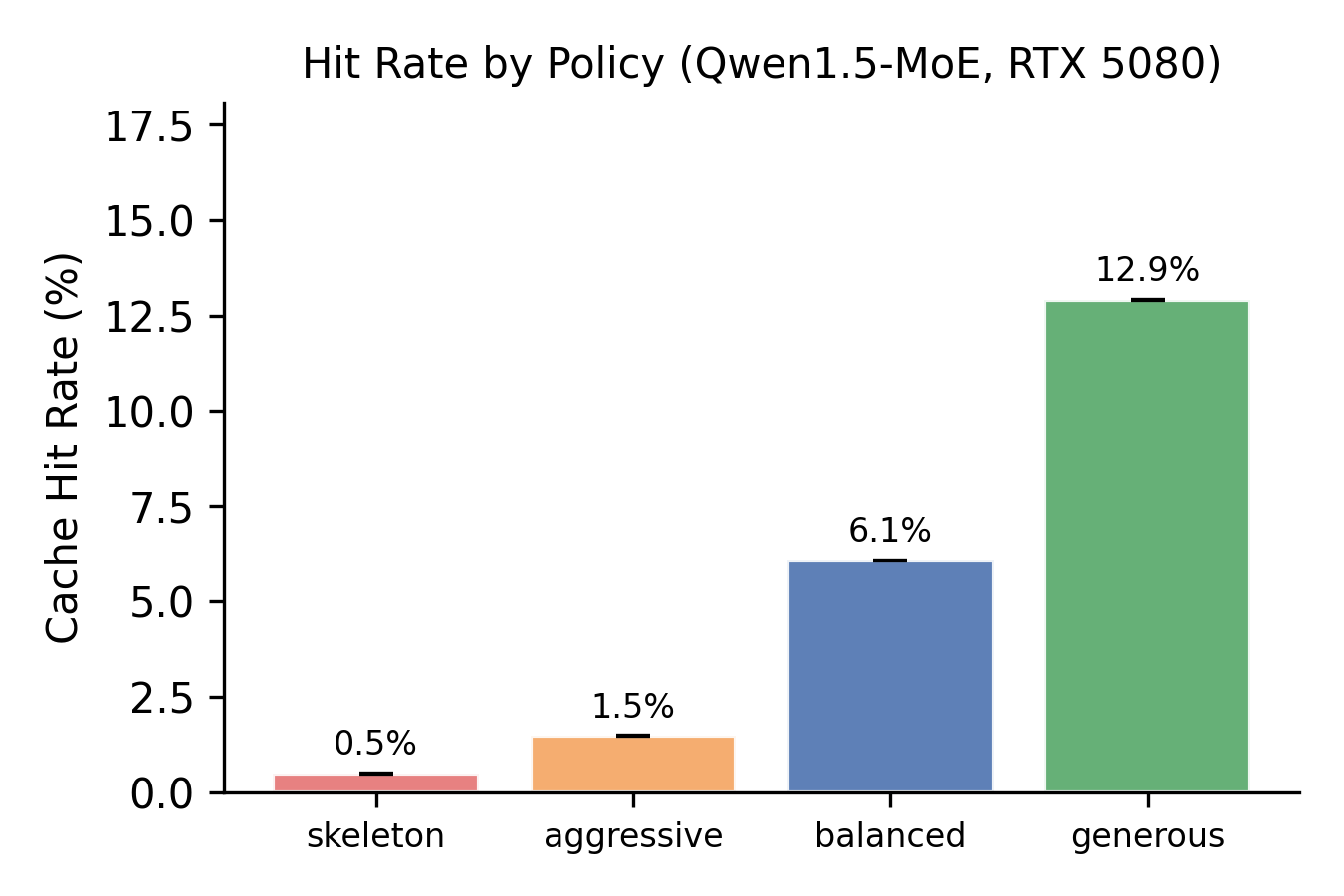
Different policies → different real performance. Mixtral saturates quickly (8 experts); DeepSeek (64 experts) needs smarter strategies.
EPCB: Per-layer cache budgeting (with an honest negative result)
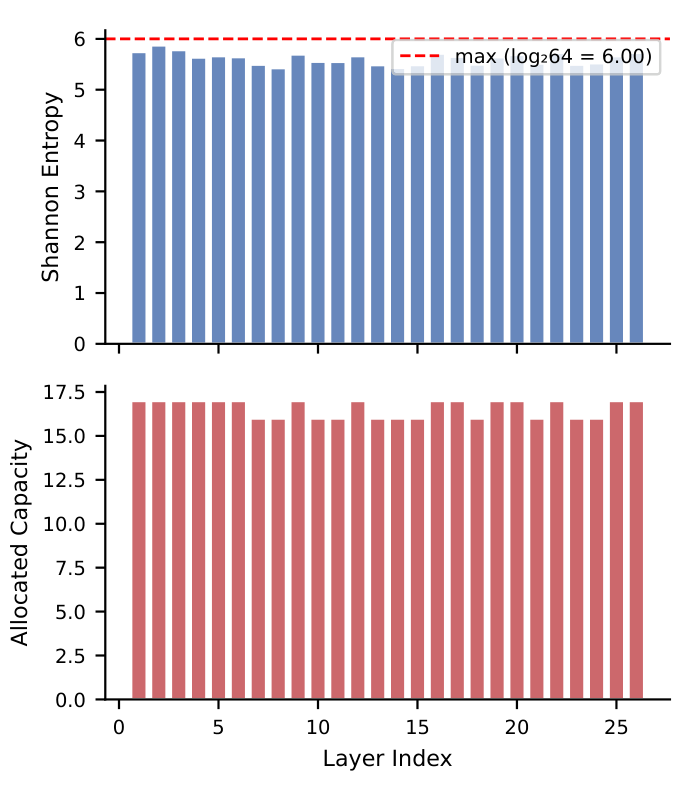
Not all layers see the same routing pattern — some concentrate on a few experts, others spread across many. Empirical Per-layer Cache Budgeting (EPCB) has two parts:
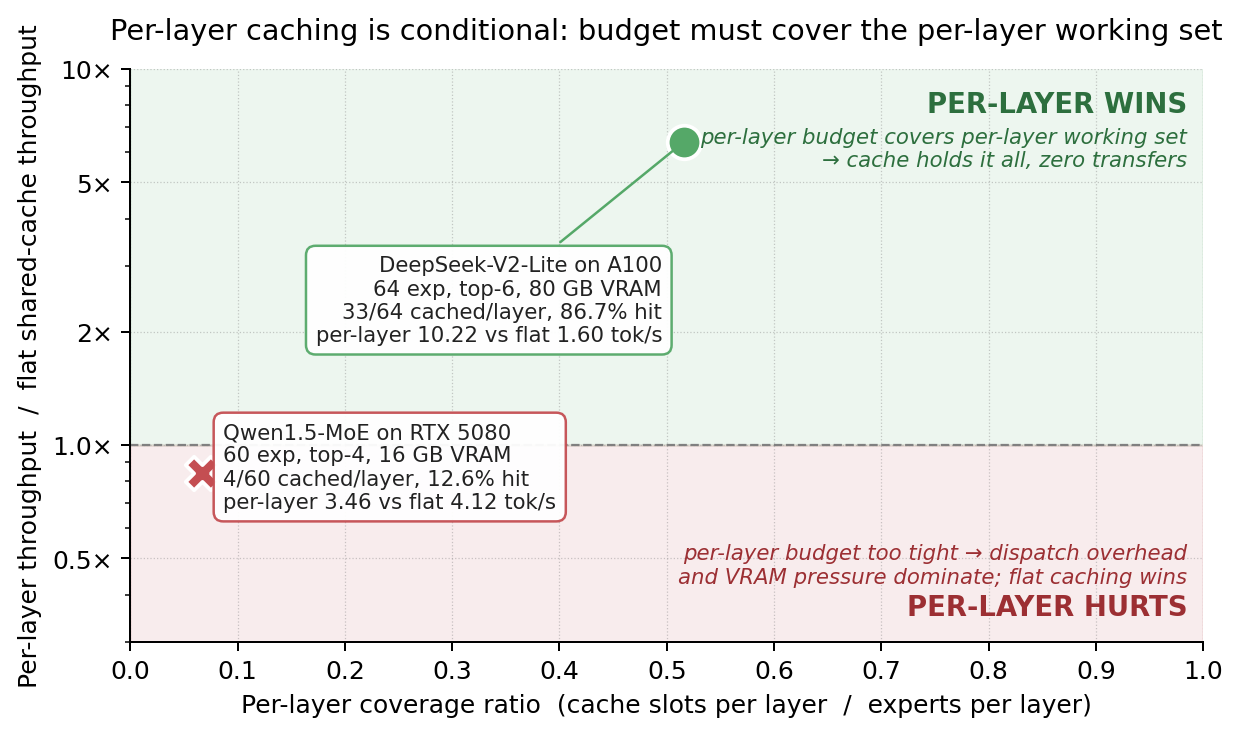
- Per-layer cache structure is the load-bearing lever: replacing a single shared cache with per-layer caches at the same total budget yields +14.7pp hit rate on DeepSeek-V2-Lite in trace replay, and +540% wall-clock on A100 end-to-end (1.60 → 10.22 tok/s, eliminating all CPU↔GPU transfers in steady state). Bit-identical output verified against fully-resident baseline.
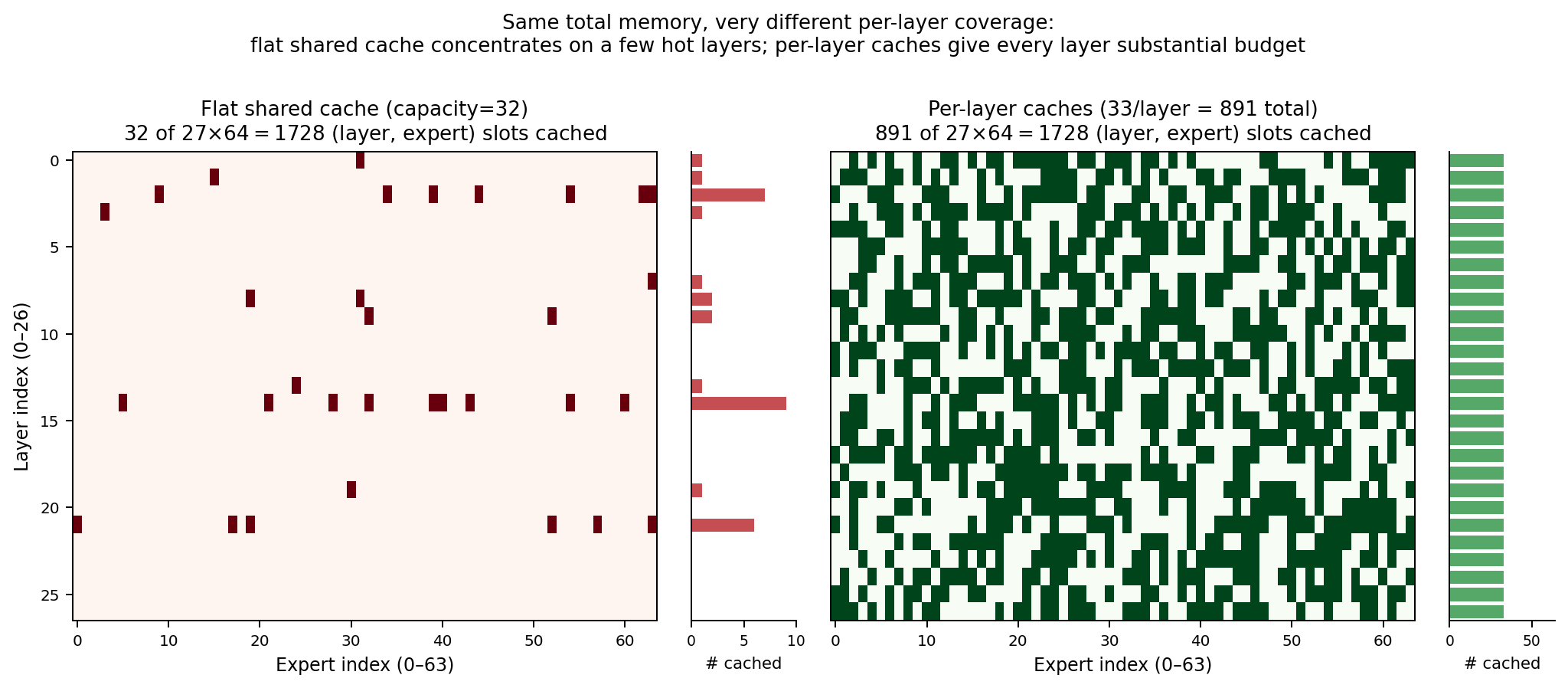
- The allocation signal does not matter. We tested six signals (Shannon entropy, inverse top-k mass, inverse variance, inverse KL, inverse Gini, uniform) and none differentiates from uniform allocation by more than 2.5pp in hit rate at any budget, and all six collapse to within noise of uniform in wall-clock on two models tested end-to-end. We retain Shannon entropy as the default allocator for principled reasons, but recommend uniform allocation for simplicity in practice.
| Strategy | Hit Rate | Δ vs shared | Wall-clock (A100) |
|---|---|---|---|
| Shared cache (32 slots) | 48.6% | baseline | 1.60 tok/s |
| Per-layer uniform (864 slots) | 63.3% | +14.7pp | 10.22 tok/s (+540%) |
| Per-layer Shannon entropy (864 slots) | 65.5% | +16.9pp | 10.17 tok/s (≈ uniform) |
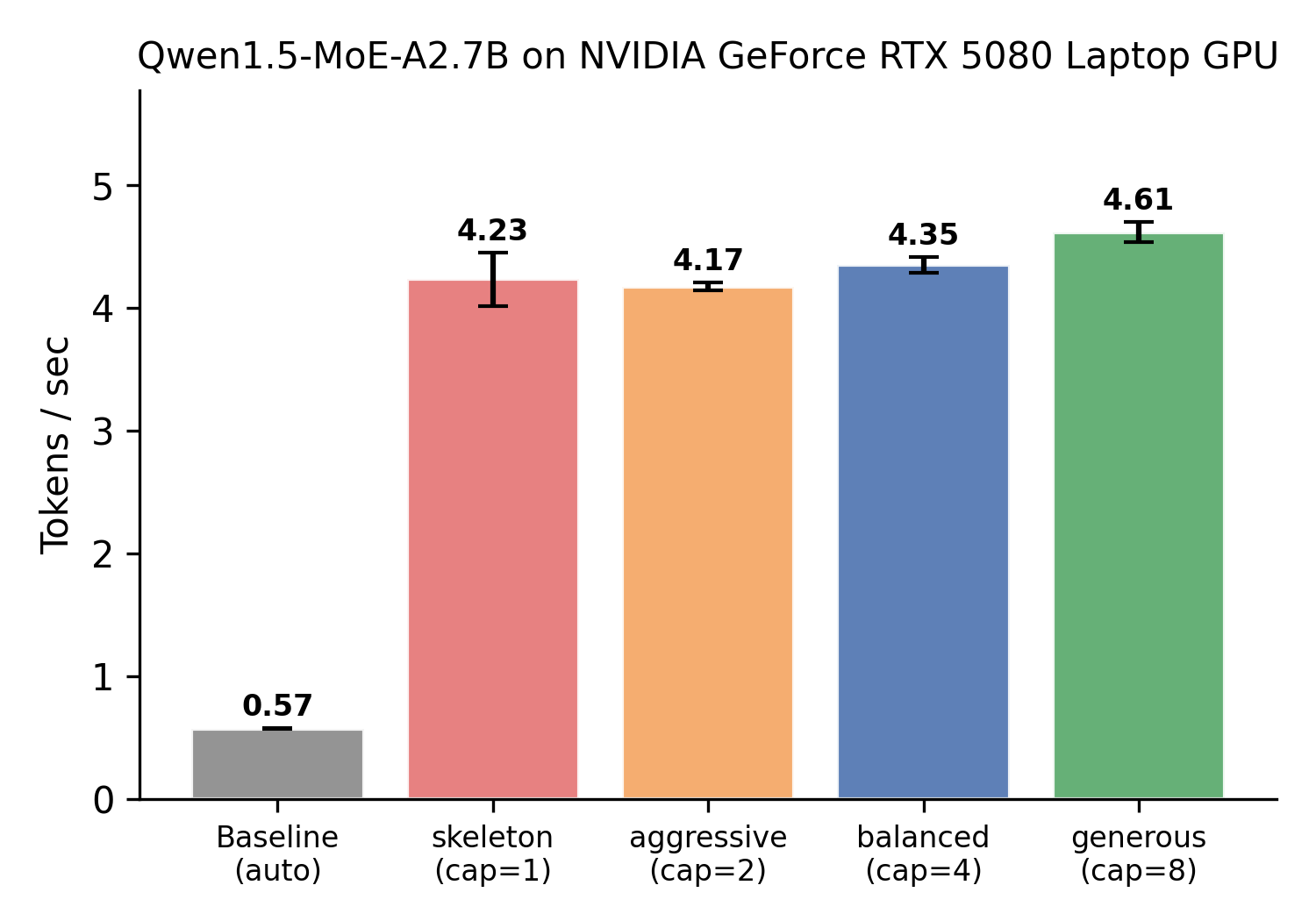
Regime caveat: per-layer caching only helps when the per-layer budget covers each layer's active working set. On 16 GB consumer hardware where the budget is tight (Qwen on RTX 5080), per-layer caching hurts throughput by 16%; flat shared caching is the better default in that regime.
Live inference on consumer GPU
OLMoE-1B-7B on RTX 5080 Laptop (16 GB VRAM):
| Policy | Cap | Hit Rate | tok/s |
|---|---|---|---|
| Vanilla (no hooks) | — | — | 39.2 |
| Naive LRU | 4 | 2.4% | 34.6 |
| LRU | 16 | 26.3% | 34.7 |
| LFU+History | 16 | 27.1% | 33.8 |
| EPCB | 16 | 47.3% | 33.6 |
Installation
From PyPI:
pip install moe-policylang           # DSL only (no GPU deps)
pip install moe-policylang[gpu]      # + torch, transformers, accelerate
pip install moe-policylang[all]      # everything
From source (development):
git clone https://github.com/jesse-pokora/MoE-PolicyLang.git
cd MoE-PolicyLang
pip install -e ".[dev,gpu]"
Cython fast path (< 10 µs/layer):
pip install moe-policylang[cython]
python setup_cython.py build_ext --inplace
Tested Models
MoE-PolicyLang auto-detects MoE structure from any HuggingFace model — no model-specific code required. We have evaluated on:
| Model | Experts × Layers | Routing | Hardware |
|---|---|---|---|
| Mixtral-8×7B-Instruct | 8 × 32 | top-2 | A100-80 GB |
| DeepSeek-V2-Lite | 64 × 27 | top-6 | A100-80 GB |
| Qwen1.5-MoE-A2.7B | 60 × 24 | top-4 | RTX 5080 (16 GB) |
| OLMoE-1B-7B | 64 × 16 | top-8 | RTX 5080 (16 GB) |
Project Structure
moe_policylang/
├── grammar.lark           # Lark LALR grammar (62 productions)
├── parser.py              # Grammar → PolicyIR
├── ir.py                  # Intermediate representation
├── validator.py           # 20 semantic validation rules
├── compiler.py            # IR → CompiledPolicy
├── auto.py                # Auto-generate policies from model + GPU
├── dsl.py                 # Python eDSL (@sched.policy decorator)
├── adaptive.py            # Adaptive policies (adapt blocks)
├── autotuner.py           # Grid-search policy optimizer
├── cli.py                 # CLI: validate, compile, run
├── runtime/
│   ├── hooks.py           # 5-step per-layer dispatch protocol
│   ├── cache.py           # LRU / LFU / Score / FreqThreshold
│   ├── prefetch.py        # Affinity / History / Lookahead
│   ├── scheduler.py       # GPU-only / CPU-fallback / Hybrid
│   ├── per_layer.py       # EPCB — entropy-proportional caching
│   ├── triggers.py        # Memory-pressure & TTL eviction
│   └── _fast/             # Cython-accelerated paths
└── integrations/
    ├── __init__.py         # attach() — main user API
    ├── huggingface.py      # HuggingFace Transformers hooks
    ├── weight_placement.py # Expert offloading manager
    └── async_transfer.py   # CUDA stream async transfers
Running Experiments
# Offline trace replay (no GPU needed)
python scripts/run_eval.py
python scripts/run_sweep.py

# Live inference on consumer GPU
python scripts/run_dsl_demo.py
python scripts/run_constrained_e2e.py

# Generate all paper figures
python scripts/generate_figures.py

# Benchmarks & evaluations (requires CUDA GPU + model weights)
python scripts/bench_qwen_multirun.py   # Qwen throughput (Table 4)
python scripts/bench_coldstart.py       # Cold-start throughput analysis
python scripts/bench_power.py           # Power/energy measurement
python scripts/eval_quality.py          # Perplexity evaluation (wikitext-2)
python scripts/ablation_epcb_sensitivity.py  # EPCB hyperparameter sweep
python scripts/plot_coldstart.py        # Generate cold-start figure
Tests
python -m pytest tests/ -q
398+ tests covering parsing, validation, compilation, runtime dispatch, adaptive policies, per-layer EPCB, and integration hooks.
Documentation
See docs/MANUAL.md for the full language reference,
runtime API, and policy authoring guide.
Citation
@misc{pokora2026moepolicylang,
  title={MoE-PolicyLang: A Domain-Specific Language for Mixture-of-Experts Scheduling Policies},
  author={Pokora, Jesse},
  year={2026},
  url={https://github.com/jesse-pokora/MoE-PolicyLang}
}
License
MIT License — Copyright (c) 2026 Jesse Pokora
Release history Release notifications | RSS feed


Download files
Download the file for your platform. If you're not sure which to choose, learn more about installing packages.
Source Distribution
Built Distribution
Filter files by name, interpreter, ABI, and platform.
If you're not sure about the file name format, learn more about wheel file names.
Copy a direct link to the current filters
File details
Details for the file moe_policylang-1.1.2.tar.gz.
File metadata
- Download URL: moe_policylang-1.1.2.tar.gz
- Upload date:
- Size: 78.5 kB
- Tags: Source
- Uploaded using Trusted Publishing? No
- Uploaded via: twine/6.2.0 CPython/3.10.11
File hashes
| Algorithm | Hash digest | |
|---|---|---|
| SHA256 |
6acc06c4d7db09b351fc80e6673099d09716183edf3eae1ecd50956c9a0dea71
|
|
| MD5 |
e24059d842da8d3e1f60b76626072c85
|
|
| BLAKE2b-256 |
61cdaa092e941d116261642a2ad0de6606d32f1a6d15edf6cbd4b1f6a3e6450f
|
File details
Details for the file moe_policylang-1.1.2-py3-none-any.whl.
File metadata
- Download URL: moe_policylang-1.1.2-py3-none-any.whl
- Upload date:
- Size: 91.1 kB
- Tags: Python 3
- Uploaded using Trusted Publishing? No
- Uploaded via: twine/6.2.0 CPython/3.10.11
File hashes
| Algorithm | Hash digest | |
|---|---|---|
| SHA256 |
8417eca0cd620801df0e968443add4eb1638d8ae83d2782d3579c3d4b82880ad
|
|
| MD5 |
281d1874dfd695cd67d951ccc5d6d73c
|
|
| BLAKE2b-256 |
116a98cbb36506fe347e3d6a4434952cfde4394f104e77b05e9ac094c2213156
|






