
A domain-specific language for Mixture-of-Experts scheduling policies

Project description
MoE-PolicyLang
A scheduling language for Mixture-of-Experts models.
Author: Jesse Pokora · License: MIT
TL;DR
MoE models pack a lot of weights into "experts" but only fire a few per token. The rest can live in CPU RAM and get pulled to the GPU on demand. Which experts to keep, when to prefetch them, and what to do on a miss is a policy question, and every existing MoE serving system hardcodes its answer inside the runtime.
MoE-PolicyLang is a small declarative language for that policy. Swapping LRU for LFU is a one-word change; nothing else has to move.
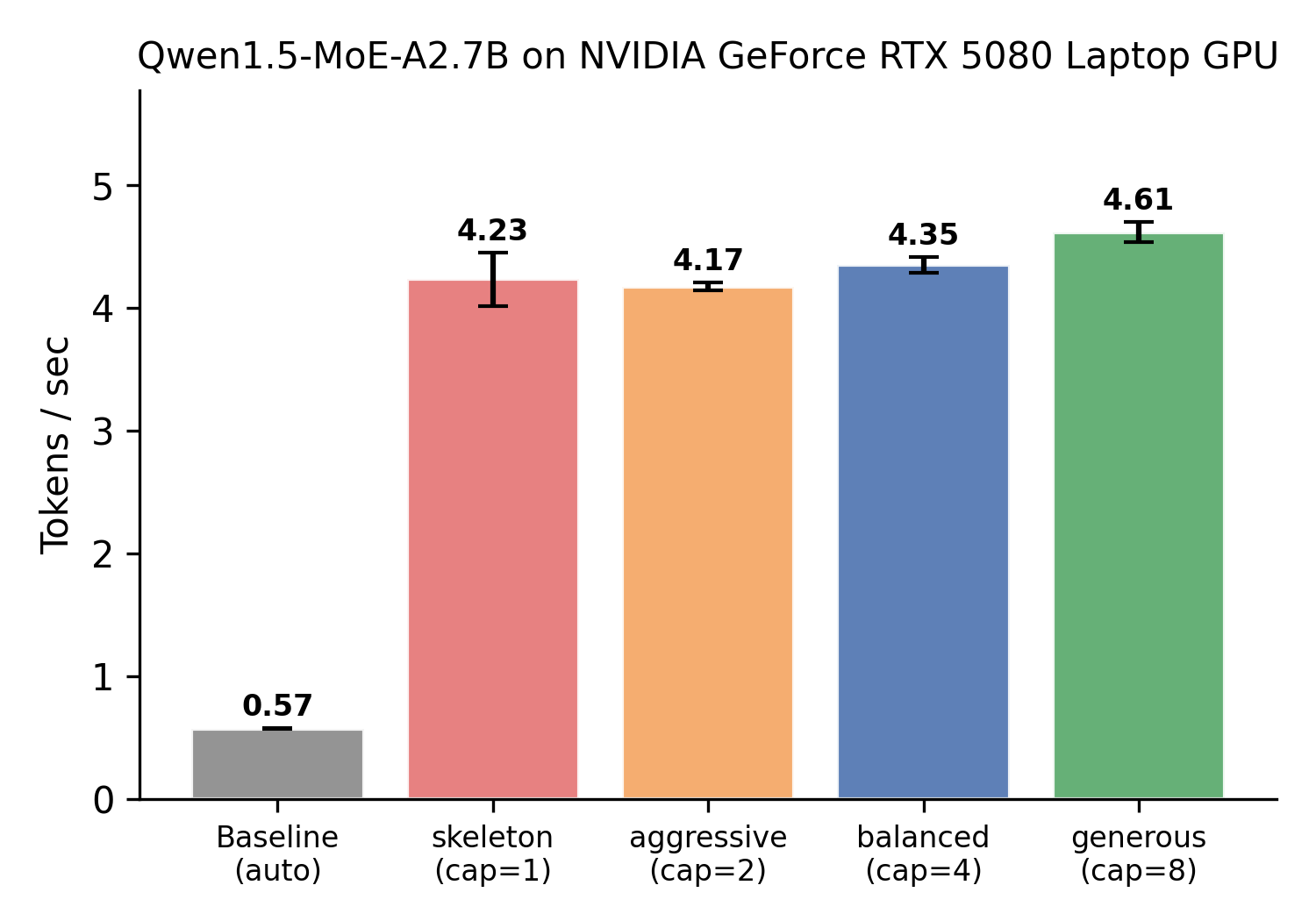
On an RTX 5080 (16 GB), it runs Qwen1.5-MoE (28.6 GB fp16) at
4.61 tok/s — 8.1x faster than HuggingFace's device_map="auto" —
with bit-identical output.
The problem
A Mixture-of-Experts layer replaces a single feed-forward block with N "experts" plus a small router. For each token the router picks the top-k experts (typically k=2 to k=8) and only those fire. Mixtral uses 8 experts per layer (top-2), Qwen1.5-MoE uses 60 (top-4), DeepSeek-V2-Lite uses 64 (top-6). Most experts sit idle on any given token, but the weights still have to be reachable in case the router picks them.
For a 28 GB MoE model on a 16 GB GPU, that means offloading: keep
some expert weights on GPU, the rest in CPU RAM, and move weights
across the PCIe bus when the router asks for one that isn't
resident. PCIe is much slower than reading from GPU memory, so if
every router pick is a miss you're stuck — HuggingFace's
device_map="auto" runs Qwen1.5-MoE on a 5080 at 0.57 tok/s.
There are four interlocking decisions to make:
| Decision | Question | Example strategies |
|---|---|---|
| Cache | Which experts stay on GPU? | LRU (drop least-recently-used), LFU (drop least-frequently-used), score-based |
| Prefetch | Which to load before they're requested? | Affinity (layer L → L+1 patterns), history, lookahead |
| Schedule | What to do on a cache miss? | Wait for the GPU transfer, run on CPU, decide per-call |
| Adapt | When to change strategy? | Conditional rules on runtime metrics |
Every existing MoE serving system (ExpertFlow, Fiddler, MoE-Infinity, HybriMoE, ProMoE, FineMoE) hardcodes these four decisions inside its runtime. Changing any one strategy means reading and modifying the system's expert-management module: roughly 200 to 2,000 LOC depending on the system.
MoE-PolicyLang lets you write the policy as a short .moe file and
attach it to a HuggingFace or vLLM model. The runtime hooks that
consume the policy stay the same; only the policy text changes.
The Language
A MoE-PolicyLang policy is a .moe file with four composable blocks:
policy balanced {
    cache {
        capacity = 16
        eviction = lfu
        frequency_decay = 0.9
    }
    prefetch {
        strategy = history
        budget = 4
    }
    schedule { mode = hybrid }
    adapt {
        when hit_rate < 0.4 for 100 accesses
            { eviction = lru }
    }
}
| Block | Controls | Strategies |
|---|---|---|
| cache | Which experts stay on GPU | LRU drops the least-recently-used; LFU drops the least-frequently-used with decay; score ranks by router gate value; freq-threshold keeps anything above a frequency cutoff |
| prefetch | Experts loaded before they're requested | History uses a running co-occurrence matrix; affinity uses layer L → L+1 patterns; lookahead peeks ahead in the router output |
| schedule | What happens on a cache miss | gpu-only waits for the transfer; cpu-fallback runs the missed expert on CPU; hybrid decides per-call based on estimated latency |
| adapt | Self-tuning at runtime | Conditional rules of the form when <metric> <op> <value> for <window> { <override> } |
Switching from LRU to LFU is a one-word change. Adding prefetching is two lines.
Attaching to a model
import moe_policylang
from transformers import AutoModelForCausalLM

model = AutoModelForCausalLM.from_pretrained("allenai/OLMoE-1B-7B-0924")

# Auto-generate a tuned policy from the model + GPU, attach it
mgr = moe_policylang.auto_attach(model)
output = model.generate(...)
print(mgr.get_stats())  # hit rate, transfers, evictions
Or write a policy explicitly:
mgr = moe_policylang.attach(model, """
    policy aggressive {
        cache { capacity = 8  eviction = lru }
    }
""")
Or load a .moe file:
mgr = moe_policylang.attach(model, open("my_policy.moe").read())
attach() parses the policy, runs the validator, compiles it to a
PolicyHook, and registers forward hooks on every MoE layer of the
model. From that point on, normal model.generate() calls trigger
the hooks.
How a policy runs at runtime
On each MoE layer, after the router picks its top-k experts:
- Look up each picked expert in the GPU cache (hit or miss).
- For misses, decide whether to wait for a CPU→GPU transfer or
run that expert on CPU. The
scheduleblock picks the policy. - Insert newly loaded experts into the cache. If full, the eviction rule drops something.
- Prefetch experts the next few layers are likely to want.
- Run memory-pressure and TTL eviction triggers.
The hook is plain Python. It adds 6 µs/layer (simple LRU) to 47 µs/layer (composed policy with triggers), against an MoE forward-pass baseline of about 1,500 µs on A100 — under 3.2% of layer time.
The five steps above are the always-on layer of dynamism: cache
contents change on every dispatch. PLCB adds a second, opt-in
layer — set rebalance_interval > 0 in a per_layer block and
the per-layer budget itself drifts at runtime based on observed
routing entropy. adapt blocks add a third, opt-in layer — a
threshold like when hit_rate < 0.4 rewrites the policy in place
(deep-copy IR, validate, recompile, hot-swap the hook) without
pausing inference. You pick how much dynamism you want; uniform
allocation with no adapt rules is the static default.
Why a Language, Not YAML?
The cache, prefetch, and schedule blocks are key-value config
and you could handle them with a JSON schema. The reason the
grammar pays off is PLCB and the adapt block.
PLCB describes a per-layer cache layout, not a single cache:
per_layer {
    allocation         = uniform
    total_budget       = 864
    rebalance_interval = 500
    min_capacity       = 4
    max_capacity       = 48
}
"27 separate caches at total budget 864 with optional entropy allocation" is awkward to write as flat key-value pairs. The DSL gives it a block.
adapt is the other one. Hot-swap rules monitor metrics and
rewrite the policy at runtime:
adapt {
    when hit_rate < 0.4 for 100 accesses { eviction = lru }
}
That's a conditional, not a config value. The grammar constrains what you can write (no arbitrary code in a scheduling policy), and 20 semantic rules catch bad policies at parse time instead of mid-inference.
A Python eDSL (@sched.policy decorator) and an auto_attach API
are also available for programmatic construction and zero-config
deployment.
Results
Live inference on consumer GPU
When the model doesn't fit: Qwen1.5-MoE-A2.7B (~28.6 GB fp16) on
RTX 5080 (16 GB VRAM). Without MoE-PolicyLang, the only option is
device_map="auto" at 0.57 tok/s. With a 4-line DSL policy:
| Config | Strategy | Cap | VRAM | tok/s | 95% CI |
|---|---|---|---|---|---|
Baseline (auto) |
— | — | 12.0 GB | 0.57±0.00 | — |
| Skeleton | LRU (cap=1) | 1 | 4.7 GB | 4.23±0.22 | [4.04, 4.42] |
| Aggressive | LRU | 2 | 5.2 GB | 4.17±0.03 | [4.14, 4.20] |
| Balanced | LFU+hist. | 4 | 7.3 GB | 4.35±0.06 | [4.30, 4.40] |
| Generous | LFU+hist. | 8 | 10.1 GB | 4.61±0.08 | [4.54, 4.68] |
Cost-performance: 4.61 tok/s on a $1k consumer GPU is comparable in absolute throughput to Fiddler's 4.17 tok/s on a $15k A100, though the models are different and the numbers are not directly comparable.
Decomposition: roughly 92% of the 8.1x speedup comes from
expert-aware loading (skeleton on GPU, experts on CPU). Even a
capacity-1 "every dispatch is a miss" config reaches 4.23 tok/s
(7.4x). Caching adds the remaining +0.38 tok/s. The DSL's
contribution is not the loading mechanism (any system could
implement that) but the remaining 8%: the policy layer that
decides what to cache, evict, and prefetch, accessible without
runtime modification and adaptable at runtime via adapt rules
that no static config expresses. On models with more experts, the
policy layer's share grows. On DeepSeek (A100), matched-budget
per-layer allocation gains +14.7pp hit rate over flat caching at
the same total slot count, a pure policy-structure effect with no
capacity confound.
n=5, bootstrap 95% CIs. For output correctness: greedy decoding
(do_sample=False) produces bit-identical token sequences across
all policy configs vs device_map="auto" baseline (4 prompts x 3
policies = 12 comparisons); perplexity on wikitext-2 matches within
0.024%.
When the model fits (overhead measurement): OLMoE-1B-7B (~14 GB) fits entirely on 16 GB VRAM. There vanilla (no hooks) is fastest at 39.2 tok/s, with the policy hooks adding 12-14% overhead. This is not the target scenario; it measures overhead when there is nothing to offload. MoE-PolicyLang is for models that don't fit.
PLCB: Per-Layer Cache Budgeting (with a negative result)
A flat cache holds, say, 32 expert weights total, shared across all 27 MoE layers of DeepSeek-V2-Lite. If layer 0 is hot, LFU keeps its experts, and layers that haven't appeared recently get evicted. In steady state, a flat cap=32 cache on DeepSeek covers only ~11 of the 27 layers — the other 16 have zero experts cached and miss every dispatch.
A per-layer cache splits the same total budget (864 = 27×32 slots) into one cache per layer. Each layer keeps its own hot experts.
There's a positive result and a caveat.
The caveat first: per-layer caching only helps when each layer's budget covers that layer's working set. On 16 GB consumer hardware the per-layer budgets are too small for that, and the aggregated cache pushes the CUDA allocator to the VRAM ceiling — throughput drops by about 16%. Flat shared caching is the default for memory-constrained deployments. Per-layer wins with VRAM headroom and high expert counts (DeepSeek-V2-Lite on A100, below).
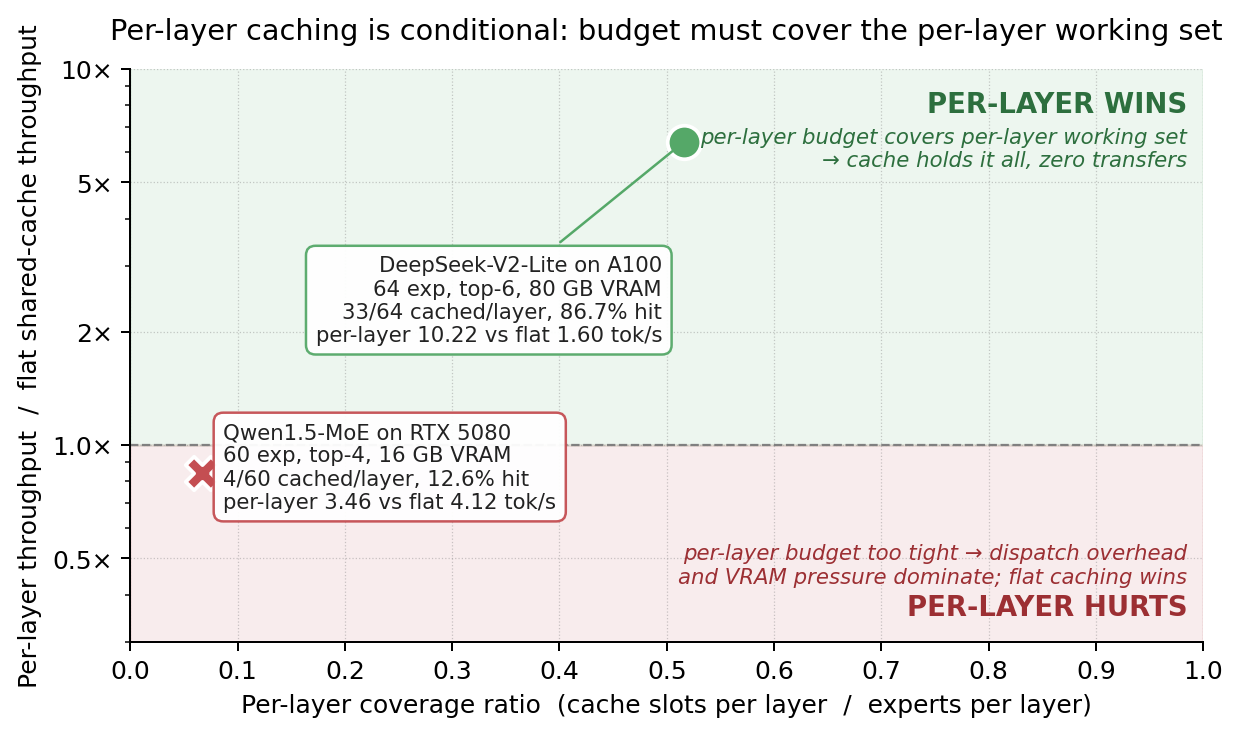
- When the regime permits, per-layer cache structure is what matters. At matched total budget on DeepSeek-V2-Lite (A100-80GB), replacing a shared cache with per-layer caches gives +14.7pp hit rate in offline trace replay and eliminates all CPU/GPU transfers in steady state. Output is bit-identical to the fully-resident baseline.
The headline throughput gain (1.60 to 10.22 tok/s, +540%) compares shared-32 to per-layer-864, which is 27x more total slots. The matched-budget +14.7pp hit rate and transfer elimination are the core findings; the 540% wall-clock number folds in the capacity expansion.
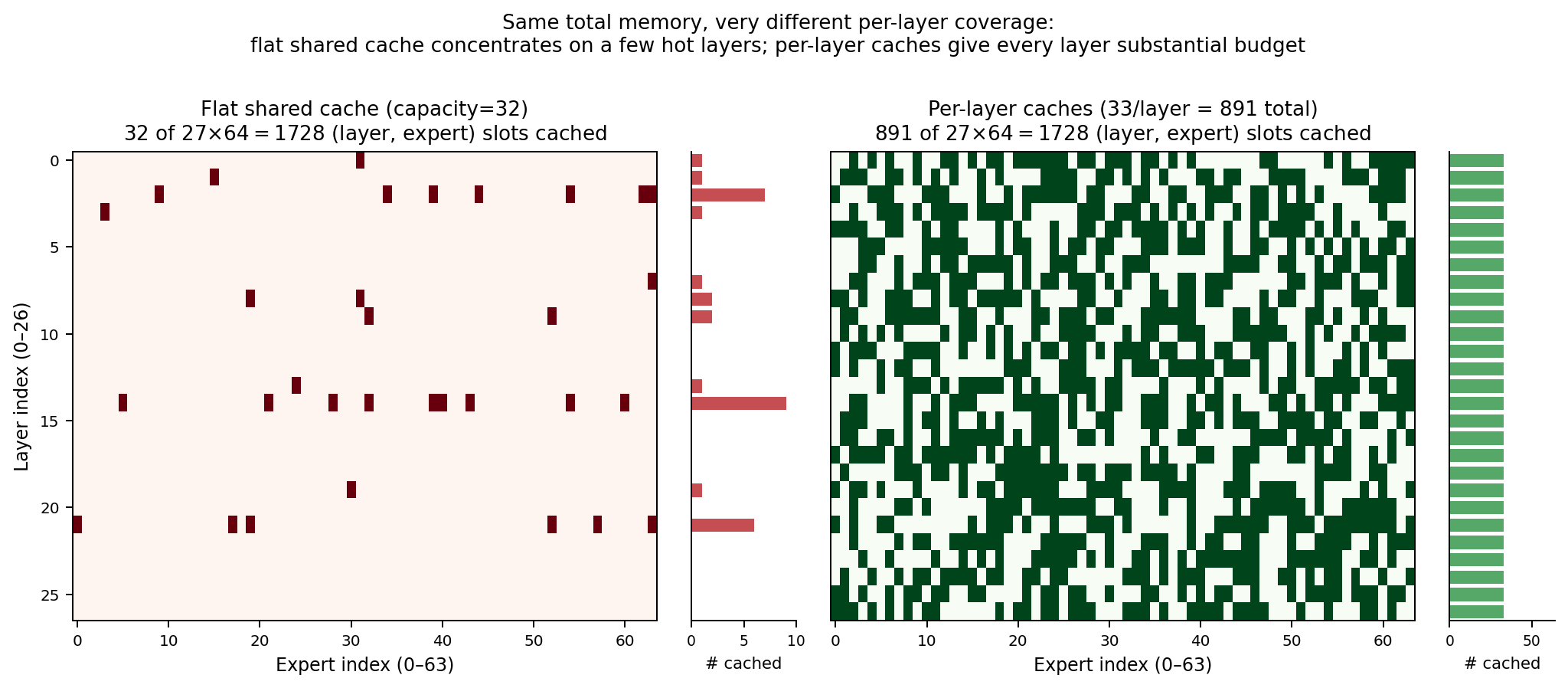
This structural difference maps directly onto MoE-aware baselines. Fiddler's expert placement is a hardcoded global popularity ranking, which is structurally equivalent to the flat cache on the left. On an A100-80GB where 85% of Mixtral's experts fit on-device (217/256), the ranking barely matters because almost everything is resident. On a constrained GPU where only a fraction of experts fit, a global ranking starves cold layers (left heatmap), while a per-layer policy maintains coverage at every layer (right heatmap). Per-layer caching enables topologies that a flat global ranking cannot express. The mechanical payoff is PCIe stall elimination: expert offloading is memory-bandwidth-bound, so every cache miss costs a CPU-to-GPU transfer. When per-layer caches cover each layer's working set, steady-state misses drop to zero, which is why a hit-rate improvement turns into a 6.4x wall-clock gain (10.22 vs 1.60 tok/s on DeepSeek-V2-Lite at matched total budget).
- The allocation signal does not matter. We tested six signals (Shannon entropy, inverse top-k mass, inverse variance, inverse KL, inverse Gini, uniform). None differentiates from uniform by more than 2.5pp in hit rate, and all six collapse to within noise of uniform in wall-clock on two models. Uniform is the default. Shannon entropy is opt-in for models with high inter-layer entropy spread (ΔH around 1 nat or more), but it was within noise of uniform on every model tested end-to-end.
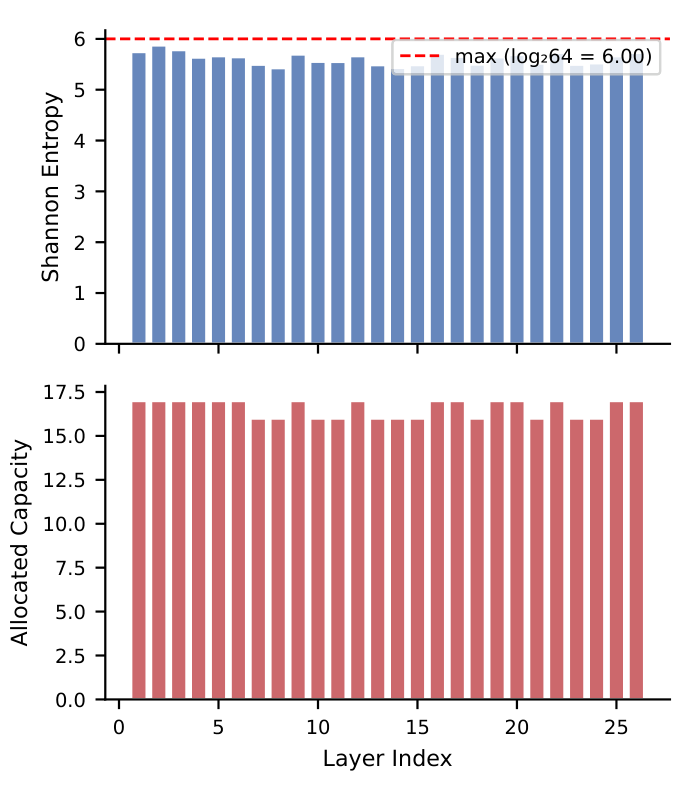
| Strategy | Total slots | Hit Rate | Δ vs shared | Wall-clock (A100) |
|---|---|---|---|---|
| Shared cache | 32 | 48.6% | baseline | 1.60 tok/s |
| Per-layer uniform | 864 (27x) | 63.3% | +14.7pp | 10.22 tok/s |
| Per-layer entropy | 864 (27x) | 65.5% | +16.9pp | 10.17 tok/s (~ uniform) |
Mechanism vs policy: Fiddler head-to-head (A100-80GB, Mixtral-8x7B)
Fiddler and MoE-PolicyLang on the same hardware, model, prompt, and methodology (n=5, greedy decoding, 64 tokens):
| Config | tok/s (±σ) | 95% CI | GPU Peak | Hit Rate | Transfers |
|---|---|---|---|---|---|
| Fiddler | 4.17 ± 0.02 | [4.16, 4.18] | 80.6 GB | 88.3% | — |
| MPL fiddler_equiv (cap=2) | 0.18 ± 0.00 | [0.18, 0.18] | 6.4 GB | 19.5% | 4,283 |
| MPL balanced (cap=4) | 0.29 ± 0.00 | [0.29, 0.29] | 39.5 GB | 46.4% | 2,665 |
| MPL generous (cap=6) | 0.45 ± 0.00 | [0.45, 0.45] | 61.7 GB | 71.0% | 1,726 |
All MPL configs produce bit-identical output. Fiddler is 9-23x faster.
The gap is mechanism, not policy. Fiddler uses an optimized
C++/CUDA transfer pipeline with pre-allocated GPU memory slots and
direct DMA. MoE-PolicyLang dispatches through Python-level
Tensor.to() calls in the HuggingFace forward pass. At Fiddler's
85% GPU residency (217/256 experts on-device), placement strategy
isn't doing the work; the model mostly fits.
MoE-PolicyLang is a policy specification layer, not a serving system. It specifies which experts to cache, evict, and prefetch, but does not implement the physical mechanism that moves expert tensors between devices.
vLLM backend: same policy, different mechanism
A second backend integrates with vLLM
for production-grade quantized MoE inference. VLLMPolicyRunner
instruments vLLM's router layers to capture expert routing
decisions and feeds them through the same DSL, compiler, and
hooks that the HuggingFace backend uses.
from moe_policylang.integrations.vllm_backend import VLLMPolicyRunner

runner = VLLMPolicyRunner(
    model="Qwen/Qwen1.5-MoE-A2.7B-Chat-GPTQ-Int4",
    policy_dsl='''
        policy demo {
            cache { capacity = 8  eviction = lru }
            prefetch { strategy = lookahead  lookahead = 1 }
            schedule { mode = gpu_only }
        }
    ''',
    quantization="gptq",
)

results = runner.generate(["What is expert routing?"], max_tokens=30)
print(results["text"])          # generated text
print(results["policy_stats"])  # cache hits, prefetch accuracy, etc.
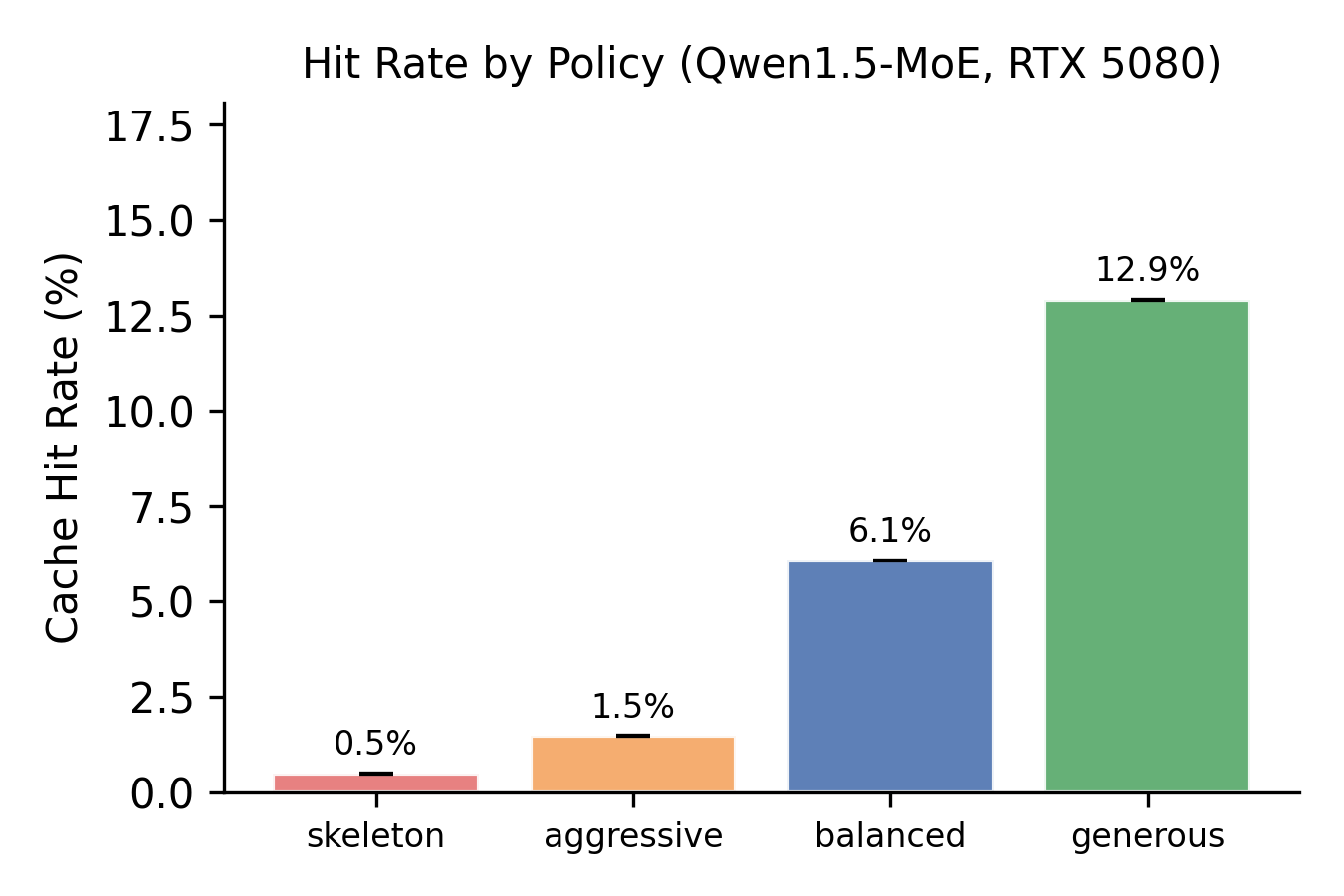
Verified on RTX 5080 (16 GB), vLLM 0.21, GPTQ-Int4 quantization. Captures 744 routing events across 24 layers × 60 experts, with a 14.7% cache hit rate and 72% prefetch accuracy from a minimal 8-slot LRU policy.
The same .moe policy text runs on both backends; only the
mechanism layer (HF eager Python vs vLLM optimized kernels)
differs. Combined with the Fiddler head-to-head above, this is
the empirical case for the policy/mechanism separation — the
abstraction holds across two production mechanism layers, not
just structurally.
Cache hit rates: capacity sweeps
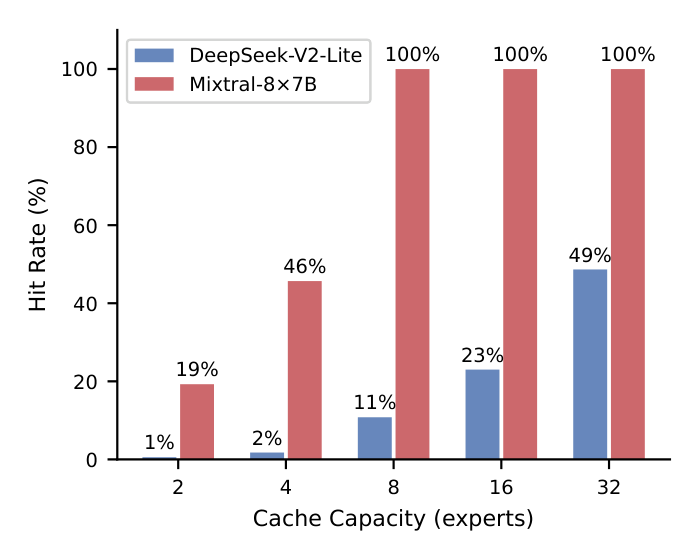
Capacity sweeps on offline traces:
- Mixtral-8x7B (8 experts, top-2) saturates at cap=8 with around 100% hit rate, since all experts fit. Policy choice barely matters here.
- DeepSeek-V2-Lite (64 experts, top-6) reaches only 51% hit rate at cap=32 (half the experts). LFU consistently beats LRU across budgets because DeepSeek has significant frequency skew (some experts activated 3-5x more often). This is the regime where policy selection and per-layer budgeting make a measurable difference.
Policy authoring effort
To add a new policy variant to one of these systems, a developer
needs to read and modify the system's expert-management module.
MoE-PolicyLang replaces that with a short .moe file. The 14–40x
numbers below count lines a user writes to express a policy; they
do not include MoE-PolicyLang's own runtime, which is around 4,300
LOC.
| System | Expert-mgmt module | DSL equivalent | Authoring reduction |
|---|---|---|---|
| Fiddler | 280 LOC | 7 lines | 40x |
| HybriMoE | ~500 LOC | 14 lines | 36x |
| MoE-Infinity | 520 LOC | 16 lines | 33x |
| vLLM | 300 LOC | 12 lines | 25x |
| ExpertFlow | ~400 LOC | 16 lines | 25x |
| FineMoE | ~350 LOC | 25 lines | 14x |
Methodology: non-blank, non-comment lines in the primary
expert-management module. Measured sources: Fiddler from
set_expert_loc() + execute_fiddler() in src/fiddler/mixtral.py
(280 LOC); MoE-Infinity from expert_prefetcher.py +
expert_cache.py (520 LOC); vLLM from MixtralMoE expert dispatch
in vllm/model_executor/ (300 LOC). Counts marked ~ are estimated
from paper descriptions of closed-source systems. Switching between
strategies (LRU to LFU) is a one-word change in the DSL versus
rewriting cache data structures in the hand-coded version.
Dispatch overhead
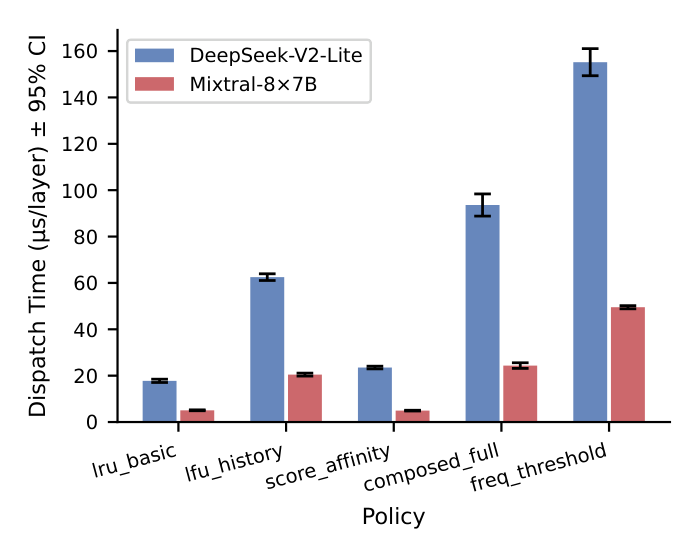
Per-layer dispatch (the Python hook that decides cache/evict/prefetch) adds under 3.2% of MoE forward-pass time on A100: 6–47 µs/layer against a 1,459 µs baseline. This is the policy decision overhead; cache misses and weight transfers are accounted for separately and depend on the policy and workload.
Installation
From PyPI:
pip install moe-policylang           # DSL only (no GPU deps)
pip install moe-policylang[gpu]      # + torch, transformers, accelerate
pip install moe-policylang[vllm]     # + vLLM (GPTQ/AWQ quantized inference)
pip install moe-policylang[all]      # everything
For quantized models, use the [vllm] extra. vLLM handles GPTQ
and AWQ quantization with optimized kernels; MoE-PolicyLang
observes routing decisions and applies policy logic without
managing the tensors directly.
For Blackwell GPUs (RTX 5080/5090), set these env vars before running vLLM:
export VLLM_USE_FLASHINFER_SAMPLER=0
export VLLM_ATTENTION_BACKEND=FLASH_ATTN
export VLLM_FLASH_ATTN_VERSION=2
From source (development):
git clone https://github.com/jesse-pokora/MoE-PolicyLang.git
cd MoE-PolicyLang
pip install -e ".[dev,gpu]"
Cython fast path (for complex policies):
pip install moe-policylang[cython]
python setup_cython.py build_ext --inplace
Python dispatch ranges from 6 µs/layer (simple LRU) to 47 µs/layer
(composed policies with triggers). The Cython path targets the
high end: freq_threshold and composed_full drop from 28-47 µs
to under 10 µs/layer. Simple policies like lru_basic (6 µs) see
no benefit.
Tested Models
MoE-PolicyLang auto-detects MoE structure from any HuggingFace model with no model-specific code required. Evaluated on:
| Model | Experts x Layers | Routing | Hardware | Backend |
|---|---|---|---|---|
| Mixtral-8x7B-Instruct | 8 x 32 | top-2 | A100-80 GB | HF Transformers |
| DeepSeek-V2-Lite | 64 x 27 | top-6 | A100-80 GB | HF Transformers |
| Qwen1.5-MoE-A2.7B | 60 x 24 | top-4 | RTX 5080 (16 GB) | HF Transformers |
| Qwen1.5-MoE-A2.7B-Chat-GPTQ-Int4 | 60 x 24 | top-4 | RTX 5080 (16 GB) | vLLM |
| OLMoE-1B-7B | 64 x 16 | top-8 | RTX 5080 (16 GB) | HF Transformers |
Project Structure
moe_policylang/
├── grammar.lark           # Lark LALR grammar (62 productions)
├── parser.py              # Grammar → PolicyIR
├── ir.py                  # Intermediate representation
├── validator.py           # 20 semantic validation rules
├── compiler.py            # IR → CompiledPolicy
├── auto.py                # Auto-generate policies from model + GPU
├── dsl.py                 # Python eDSL (@sched.policy decorator)
├── adaptive.py            # Adaptive policies (adapt blocks)
├── autotuner.py           # Grid-search policy optimizer
├── cli.py                 # CLI: validate, compile, run
├── runtime/
│   ├── hooks.py           # 5-step per-layer dispatch protocol
│   ├── cache.py           # LRU / LFU / Score / FreqThreshold
│   ├── prefetch.py        # Affinity / History / Lookahead
│   ├── scheduler.py       # GPU-only / CPU-fallback / Hybrid
│   ├── per_layer.py       # PLCB — per-layer cache budgeting
│   ├── triggers.py        # Memory-pressure & TTL eviction
│   └── _fast/             # Cython-accelerated paths
└── integrations/
    ├── __init__.py         # attach() — main user API
    ├── huggingface.py      # HuggingFace Transformers hooks
    ├── vllm_backend.py     # vLLM integration (routing trace + policy replay)
    ├── weight_placement.py # Expert offloading manager
    └── async_transfer.py   # CUDA stream async transfers
Running Experiments
# Offline trace replay (no GPU needed)
python scripts/run_eval.py
python scripts/run_sweep.py

# Live inference on consumer GPU
python scripts/run_dsl_demo.py
python scripts/run_constrained_e2e.py

# Generate all paper figures
python scripts/generate_figures.py

# Benchmarks & evaluations (requires CUDA GPU + model weights)
python scripts/bench_qwen_multirun.py   # Qwen throughput (Table 4)
python scripts/bench_coldstart.py       # Cold-start throughput analysis
python scripts/bench_power.py           # Power/energy measurement
python scripts/eval_quality.py          # Perplexity evaluation (wikitext-2)
python scripts/ablation_plcb_sensitivity.py  # PLCB hyperparameter sweep
python scripts/plot_coldstart.py        # Generate cold-start figure
Tests
python -m pytest tests/ -q
453+ tests covering parsing, validation, compilation, runtime dispatch, adaptive policies, per-layer PLCB, and integration hooks.
Documentation
See docs/MANUAL.md for the full language reference,
runtime API, and policy authoring guide.
Glossary
- MoE (Mixture-of-Experts). A Transformer layer that replaces a single feed-forward block with N expert networks plus a small router that picks the top-k experts per token.
- Expert. One feed-forward sub-network inside an MoE layer. Mixtral has 8 per layer, Qwen1.5-MoE has 60, DeepSeek-V2-Lite has 64.
- Router / top-k routing. The small classifier inside each MoE layer that scores experts and picks the k highest per token.
- Offloading. Keeping some weights in CPU RAM and moving them to GPU on demand. The cost is the PCIe transfer.
- PCIe. The bus between CPU memory and the GPU. Roughly two orders of magnitude slower than reading from GPU HBM/GDDR, so cache misses are expensive.
- Skeleton. Everything in the model that isn't an expert: embeddings, attention, layer norms, LM head. MoE-PolicyLang pins the skeleton on GPU (≈3.7 GB for Qwen1.5-MoE) and only the expert weights move.
- Cache hit / miss. A hit means the expert the router picked
is already on GPU. A miss means we have to fetch it (or run it on
CPU, if
schedule = cpu_fallback). - LRU / LFU. Least-Recently-Used and Least-Frequently-Used cache eviction. LRU drops whatever hasn't been touched lately; LFU drops whatever has the lowest activation count (with a decay factor so old hot experts age out).
- fp16 / GPTQ / AWQ. Weight precisions. fp16 is the standard half-precision format used in this paper's experiments. GPTQ and AWQ are 4-bit quantization formats that vLLM consumes; they trade a small amount of perplexity for a large VRAM reduction.
- KV-cache. The cache of attention keys/values from previous tokens during generation. It grows with sequence length and competes with expert weights for VRAM.
- pp (percentage points). Used for hit-rate deltas: +14.7 pp means 48.6% → 63.3%, not a 14.7% relative change.
- PLCB. Per-Layer Cache Budgeting. See the section above; the load-bearing part is the per-layer cache structure, not the entropy allocator that gave the technique its name.
Citation
@misc{pokora2026moepolicylang,
  title={MoE-PolicyLang: A Domain-Specific Language for Mixture-of-Experts Scheduling Policies},
  author={Pokora, Jesse},
  year={2026},
  url={https://github.com/jesse-pokora/MoE-PolicyLang}
}
License
MIT License — Copyright (c) 2026 Jesse Pokora
Release history Release notifications | RSS feed


Download files
Download the file for your platform. If you're not sure which to choose, learn more about installing packages.
Source Distribution
Built Distribution
Filter files by name, interpreter, ABI, and platform.
If you're not sure about the file name format, learn more about wheel file names.
Copy a direct link to the current filters
File details
Details for the file moe_policylang-1.4.2.tar.gz.
File metadata
- Download URL: moe_policylang-1.4.2.tar.gz
- Upload date:
- Size: 99.6 kB
- Tags: Source
- Uploaded using Trusted Publishing? No
- Uploaded via: twine/6.2.0 CPython/3.10.11
File hashes
| Algorithm | Hash digest | |
|---|---|---|
| SHA256 |
29aa69b13d0de2af16cc27b28cf5148249d124f0c5a6ccfa690da18bd9cc9c22
|
|
| MD5 |
825b1a815d37216ebe54a09da4b14bfb
|
|
| BLAKE2b-256 |
77be1ad6f2d39f8da06435f5f6d27e0addbb49c5cd343ea2c6fefa43a46e17b6
|
File details
Details for the file moe_policylang-1.4.2-py3-none-any.whl.
File metadata
- Download URL: moe_policylang-1.4.2-py3-none-any.whl
- Upload date:
- Size: 107.4 kB
- Tags: Python 3
- Uploaded using Trusted Publishing? No
- Uploaded via: twine/6.2.0 CPython/3.10.11
File hashes
| Algorithm | Hash digest | |
|---|---|---|
| SHA256 |
2df1fdef355f67ca6dea8422d175f58641bc7ffef090008e80f57cbd3e8f52c9
|
|
| MD5 |
7fc2b4604d22df4a59cac0b89b11cc0d
|
|
| BLAKE2b-256 |
0e3a63da68eaab23a495f27abb2ce0b1e5a0fe5fb45ae49ca9c5c5e2579ff798
|






