


MS²PIP: MS2 Peak Intensity Prediction - Fast and accurate peptide fragmentation spectrum prediction for multiple fragmentation methods, instruments and labeling techniques.
About
MS²PIP is a tool to predict MS2 peak intensities from peptide sequences. The result is a predicted peptide fragmentation spectrum that accurately resembles its observed equivalent. These predictions can be used to validate peptide identifications, generate proteome-wide spectral libraries, or to select discriminative transitions for targeted proteomics. MS²PIP employs the XGBoost machine learning algorithm and is written in Python, with helper functions in Rust (ms2rescore-rs).
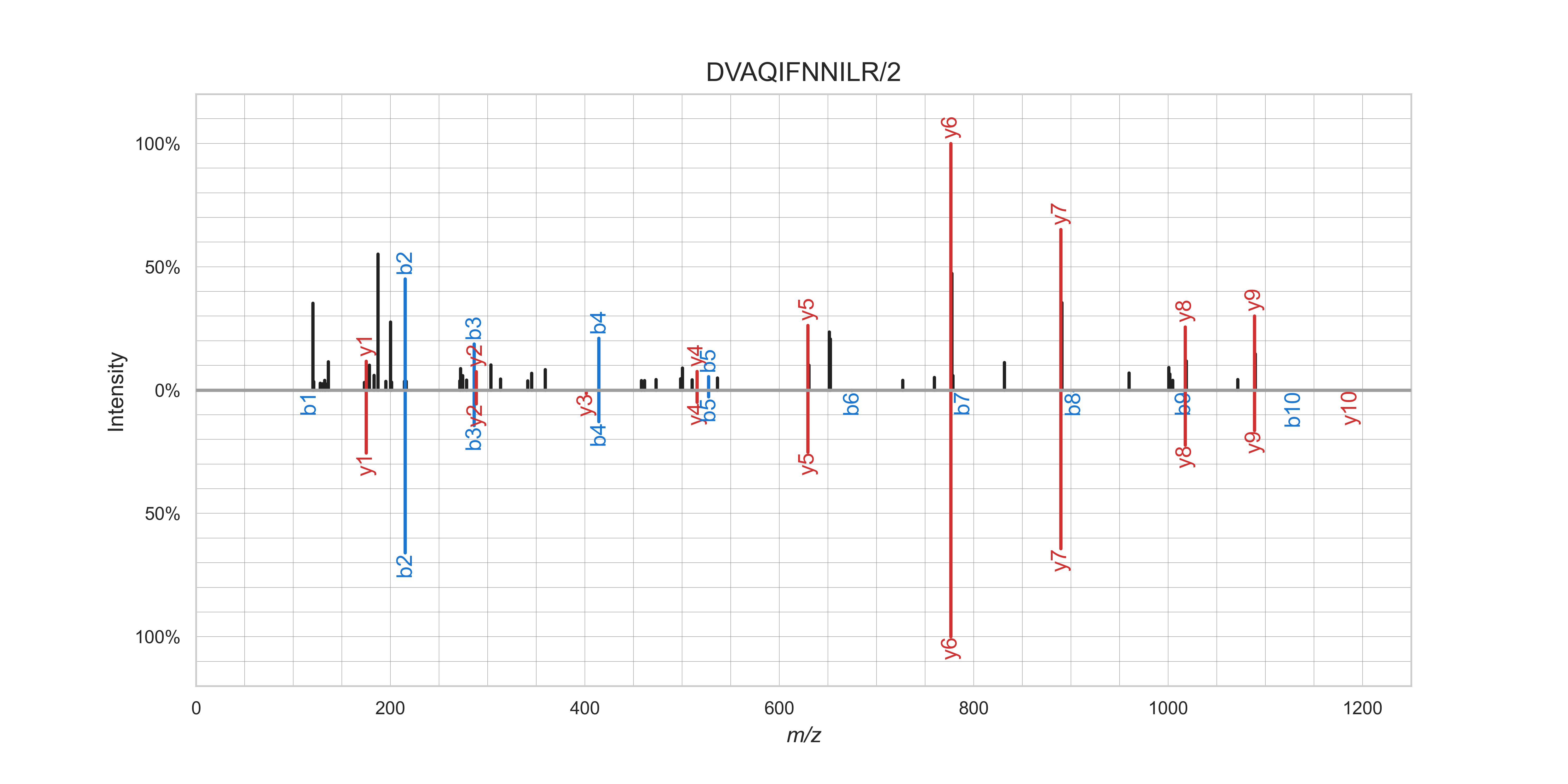
Mirror plot of an observed (top) and MS²PIP-predicted (bottom) spectrum for the peptide DVAQIFNNILR/2.
You can install MS²PIP on your machine by following the installation instructions. For a more user-friendly experience, go to the MS²PIP web server. There, you can easily upload a list of peptide sequences, after which the corresponding predicted MS2 spectra can be downloaded in multiple file formats. The web server can also be contacted through the RESTful API.
The MS³PIP Python application can perform the following tasks:
predict-single: Predict fragmentation spectrum for a single peptide and optionally visualize the spectrum.
predict-batch: Predict fragmentation spectra for a batch of peptides.
predict-library: Predict a spectral library from protein FASTA file.
correlate: Compare predicted and observed intensities and optionally compute correlations.
correlate-single: Compare predicted and observed intensities for a single peptide spectrum.
get-training-data: Extract feature vectors and target intensities from observed spectra for training.
annotate-spectra: Annotate peaks in observed spectra.
MS²PIP supports a wide range of PSM input formats and spectrum output formats, and includes pre-trained models for multiple fragmentation methods, instruments and labeling techniques. See Usage for more information.
Citations
If you use MS²PIP for your research, please cite the following publication:
Declercq, A., Bouwmeester, R., Chiva, C., Sabidó, E., Hirschler, A., Carapito, C., Martens, L., Degroeve, S., Gabriels, R. (2023). Updated MS²PIP web server supports cutting-edge proteomics applications. Nucleic Acids Research doi:10.1093/nar/gkad335
Prior MS²PIP publications:
Gabriels, R., Martens, L., & Degroeve, S. (2019). Updated MS²PIP web server delivers fast and accurate MS2 peak intensity prediction for multiple fragmentation methods, instruments and labeling techniques. Nucleic Acids Research doi:10.1093/nar/gkz299
Degroeve, S., Maddelein, D., & Martens, L. (2015). MS²PIP prediction server: compute and visualize MS2 peak intensity predictions for CID and HCD fragmentation. _Nucleic Acids Research, 43(W1), W326–W330. doi:10.1093/nar/gkv542
Degroeve, S., & Martens, L. (2013). MS²PIP: a tool for MS/MS peak intensity prediction. Bioinformatics (Oxford, England), 29(24), 3199–203. doi:10.1093/bioinformatics/btt544
Please also take note of, and mention, the MS²PIP version you used.
Full documentation
The full documentation, including installation instructions, usage examples, and the command-line and Python API reference, can be found at ms2pip.readthedocs.io.
Contributing
Bugs, questions or suggestions? Feel free to post an issue in the issue tracker or to make a pull request. Any contribution, small or large, is welcome!
3 maintainers


Metadata
3 maintainers
Release files for ms2pip 4.2.0
For a detailed explanation of source distributions (sdists) and built distributions (wheels), please see the package formats documentation.
Source distribution (sdist)
| File | Size | Uploaded | Provenance | Actions |
|---|---|---|---|---|
| ms2pip-4.2.0.tar.gz | 56.8 kB | With provenance | Details for ms2pip-4.2.0.tar.gz |
Built distribution (wheel)
| File | Interpreter | ABI | Platform | Actions Reset |
|---|---|---|---|---|
| ms2pip-4.2.0-py3-none-any.whl | Python 3 | none | any | Details for ms2pip-4.2.0-py3-none-any.whl |
Total release size: 108.5 kB
Release files / ms2pip-4.2.0.tar.gz
| Download URL | ms2pip-4.2.0.tar.gz |
|---|---|
| Size | 56.8 kB |
| Tags | Source |
|
SHA-256 checksum How to use checksums |
9b05d605a8bac2f9bfb336893c95380fe45105015060884f7a3bbafe16afa747
|
|
BLAKE2b-256 checksum How to use checksums |
3675ee0417d05419d9e822af96a29b21b2ccc9631753f5ffb5f71851e8da6e6b
|
| Upload date | |
|
Uploaded using Trusted Publishing? What is trusted publishing? |
Yes |
| Uploaded via |
twine/6.1.0 CPython/3.13.12
|
Provenance
Provenance describes where a file came from. On PyPI, provenance is shared via attestations, which provide a verifiable record of the build or publishing details. View details, limitations and caveats.


PyPI Publish Attestation
PyPI verified that this artifact, at this checksum, originated from the publisher listed below.
Signed by GitHub Actions, verified by PyPI on Jul 13, 2026.
Transparency logRelease files / ms2pip-4.2.0-py3-none-any.whl
| Download URL | ms2pip-4.2.0-py3-none-any.whl |
|---|---|
| Size | 51.7 kB |
| Tags | Python 3 |
|
SHA-256 checksum How to use checksums |
490615838e6310948ef9290d2ea9e1f1d0bf6c1ccdb32ace5661f87fbbbbae10
|
|
BLAKE2b-256 checksum How to use checksums |
82ddc950f3d7f3c9e266223152aa08fac32ee461017aaba3457cd41d18073892
|
| Upload date | |
|
Uploaded using Trusted Publishing? What is trusted publishing? |
Yes |
| Uploaded via |
twine/6.1.0 CPython/3.13.12
|
Provenance
Provenance describes where a file came from. On PyPI, provenance is shared via attestations, which provide a verifiable record of the build or publishing details. View details, limitations and caveats.
PyPI Publish Attestation
PyPI verified that this artifact, at this checksum, originated from the publisher listed below.
Signed by GitHub Actions, verified by PyPI on Jul 13, 2026.
Transparency logSecurity for ms2pip 4.2.0
Provenance
Provenance describes where a file came from. On PyPI, provenance is shared via attestations, which provide a verifiable record of the build or publishing details. View details, limitations and caveats.
Full provenance
All 2 files in this release have been uploaded with provenance metadata.
Attestation for ms2pip-4.2.0.tar.gz
PyPI Publish Attestation
PyPI verified that this artifact, at this checksum, originated from the publisher listed below.
Signed by GitHub Actions, verified by PyPI on Jul 13, 2026.
Transparency logA note on package security
PyPI is a repository for distributing packages, not a service for auditing them. While third-party security researchers and our staff do their best to detect and remove malicious packages, PyPI cannot guarantee the quality, security or suitability of any given package.
To learn more about protecting yourself from malicious actors, visit our package security documentation.














