
Convert MusicXML files into clean, analyzable PNG visualizations

Project description
musicxml-to-png
Visualize and analyze MusicXML scores for humans, classrooms, and AI workflows
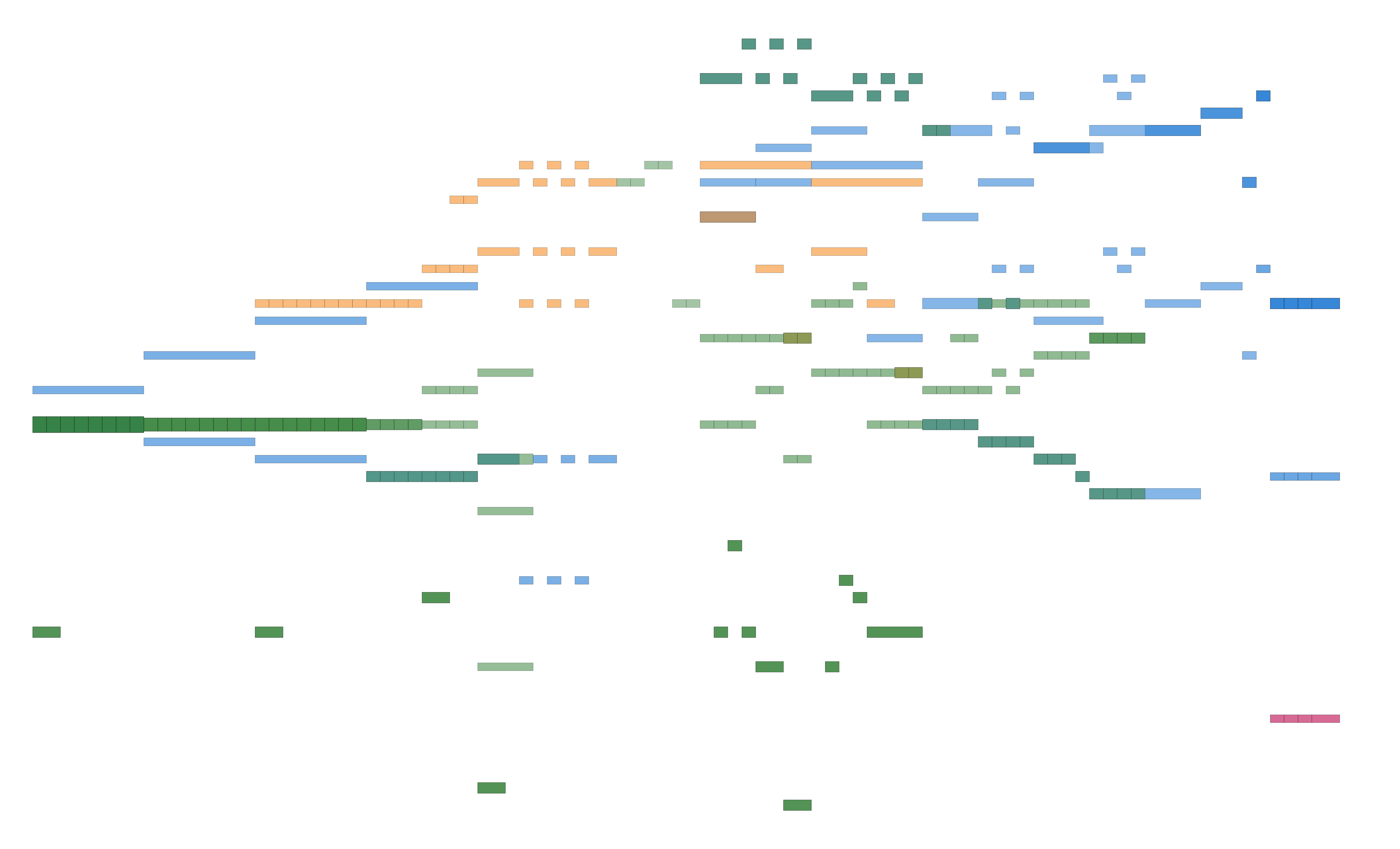
MusicXML is rich and expressive for human-facing notation software, but challenging to scan at a glance or share with AI systems. This tool converts MusicXML into clear visual timelines and pitch maps for score study, arrangement review, education, and pipeline integration—while still making it easy for humans and AI to explore music side by side.
Quick Start
Requirements: Python 3.12 or higher
# Install from PyPI
pip install musicxml-to-png

# Convert a MusicXML file
musicxml-to-png your-score.mxl

# With options
musicxml-to-png your-score.mxl --ensemble bigband --minimal -o output.png
See Installation for development setup.
Features
Convert MusicXML files into clean, analyzable PNG visualizations showing temporal flow (horizontal axis = time), pitch range (vertical axis = low to high), note duration (length of visual bars), and instrument identities (color-coded per instrument by default or by ensemble family when requested).
Use cases: Human-AI collaboration on musical analysis, visual comparison of arrangements, AI pipeline integration for score processing, and educational visualization of orchestration principles.
- Parse MusicXML files (.xml, .musicxml, .mxl)
- Extract note events (pitch, duration, start time, instrument)
- High-resolution 2D visualization (time × pitch) with grid/labels toggles
- Multiple ensemble types:
- Ungrouped (default): every part gets its own color, even if multiple of the same instrument appear
- Orchestra: strings, winds, brass, percussion
- Bigband: trumpets, trombones, saxophones, rhythm section
- (More ensemble types coming - jazzcombo, chamber, etc.)
- Color-coded instruments or families (per-instrument by default, ensemble palettes when requested)
- Customizable visualization:
- Grid lines (enabled by default, disable with
--no-grid) - Minimal mode (remove all labels, legend, title, borders,
--minimal) - Custom titles (
-t "Custom Title") - Width controls:
--time-stretchor--fig-width - Output DPI control:
--dpi(default 150) - No-output mode for smoke tests:
--no-output - Verbose mode for debugging (
-v/--verbose)
- Grid lines (enabled by default, disable with
- Export as high-resolution PNG with user-settable DPI, defaulting to 150 (
--dpi 72)
Getting Your Music into MusicXML
Most modern notation software can export to MusicXML format. Here are some popular options:
Desktop Software:
- Dorico - File → Export → MusicXML (or use compressed .mxl format)
- Finale - File → Export → MusicXML
- LilyPond - Can export via
lilypond --formats=xml - MuseScore (Free, open source) - File → Export → MusicXML
- Notion - File → Export → MusicXML
- Overture - File → Export → MusicXML
- Sibelius - File → Export → MusicXML
Web-Based:
- Flat.io - File → Export → MusicXML
- Noteflight - File → Export → MusicXML
For detailed export instructions, please refer to your notation software's documentation. Most software supports both uncompressed .mxl and compressed .xml formats - this tool handles both!
Installation
For End Users
Simply install from PyPI:
pip install musicxml-to-png
Note: Requires Python 3.12 or higher. If you don't have Python 3.12, pip will show an error with installation instructions.
For Developers
If you want to contribute or develop locally:
-
Python Version: This project requires Python 3.12. The
.python-versionfile will automatically set this if you usepyenv,asdf, or similar version managers.Using pyenv:
pyenv install 3.12  # If not already installed
python --version    # Verify it shows Python 3.12.x
-
Clone the repository:
git clone <repository-url>
cd musicxml-to-png
-
Set up Python environment:
# Create and activate virtual environment
python -m venv venv
source venv/bin/activate  # On Windows: venv\Scripts\activate

# Install dependencies
pip install -r requirements.txt

# Install package in development mode
pip install -e .
Note: Activate the virtual environment (source venv/bin/activate) each time you work on the project. You'll see (venv) in your prompt when active.
Usage
Command Line Interface
Convert a MusicXML file to PNG:
musicxml-to-png input.xml
This creates input.png in the same directory. Supports both .xml and .mxl (compressed) MusicXML files.
Basic Options:
# Specify custom output file
musicxml-to-png input.xml -o output.png

# Add custom title
musicxml-to-png input.xml --title "My Composition"

# Disable grid lines
musicxml-to-png input.xml --no-grid

# Minimal mode (no labels, legend, title, or borders)
musicxml-to-png input.xml --minimal

# Show music21 warnings and diagnostics
musicxml-to-png input.xml --verbose
# or
musicxml-to-png input.xml -v
Ensemble Types:
Select the instrument categorization scheme:
# Ungrouped (default) - every instrument gets its own color
musicxml-to-png input.xml

# Group by orchestra families
musicxml-to-png input.xml --ensemble orchestra

# Group by bigband families
musicxml-to-png input.xml --ensemble bigband
Combining Options:
musicxml-to-png input.xml --ensemble bigband --minimal --no-grid -o output.png
Python Library
Use as a library in your Python code:
from musicxml_to_png import convert_musicxml_to_png
from pathlib import Path

# Basic conversion
output_path = convert_musicxml_to_png(
    input_path=Path("input.xml"),
    output_path=Path("output.png"),  # Optional
    title="My Composition"  # Optional
)

# With all options
output_path = convert_musicxml_to_png(
    input_path=Path("input.xml"),
    output_path=Path("output.png"),
    title="My Composition",
    show_grid=False,           # Disable grid lines
    minimal=True,              # Remove all labels/borders
    ensemble="bigband"         # Use bigband categorization
)
Contributing
See Roadmap for planned features.
This project emerged from human-AI collaborative exploration of musical structure. Contributions, ideas, and feedback are welcome!
Philosophy: This tool exists to enable human-AI collaboration, not to replace human musical intuition. The goal is to create shared visual language that helps both humans and AI systems understand musical architecture more deeply.
License
This project is licensed under the MIT License - see the LICENSE file for details.
Acknowledgments
Built through collaborative iteration between human musical expertise and AI technical assistance. Created to bridge the gap between MusicXML (machine-readable but visually dense) and visual analysis (human-friendly and AI-parseable).
Special thanks to: The music21 project for their excellent MusicXML parsing library.
Release history Release notifications | RSS feed


Download files
Download the file for your platform. If you're not sure which to choose, learn more about installing packages.
Source Distribution
Built Distribution
Filter files by name, interpreter, ABI, and platform.
If you're not sure about the file name format, learn more about wheel file names.
Copy a direct link to the current filters
File details
Details for the file musicxml_to_png-0.4.0.tar.gz.
File metadata
- Download URL: musicxml_to_png-0.4.0.tar.gz
- Upload date:
- Size: 33.5 kB
- Tags: Source
- Uploaded using Trusted Publishing? No
- Uploaded via: twine/6.2.0 CPython/3.12.12
File hashes
| Algorithm | Hash digest | |
|---|---|---|
| SHA256 |
fd7e2bdae7fa617f6754529a6af82208414fe145141f2c3d8d0eedb2e8c73ddd
|
|
| MD5 |
68c824bce6638f8e97baf3640ac47c9e
|
|
| BLAKE2b-256 |
d3136ab25e49e7f93ec4230ea9a1e80d690adabe39d137b263b0a84f57591ad9
|
File details
Details for the file musicxml_to_png-0.4.0-py3-none-any.whl.
File metadata
- Download URL: musicxml_to_png-0.4.0-py3-none-any.whl
- Upload date:
- Size: 23.5 kB
- Tags: Python 3
- Uploaded using Trusted Publishing? No
- Uploaded via: twine/6.2.0 CPython/3.12.12
File hashes
| Algorithm | Hash digest | |
|---|---|---|
| SHA256 |
8206f111370f4f178a2d4d0b2e32698097de3b2415ad86f50697616cae2b5140
|
|
| MD5 |
8c42ae022232ed945c1461547f9433d1
|
|
| BLAKE2b-256 |
738419eb643ea2d2dc79a783d14a9eb5b22011e4d6ce0d052a190fb1bfba07b2
|






