
nahiarhdlog




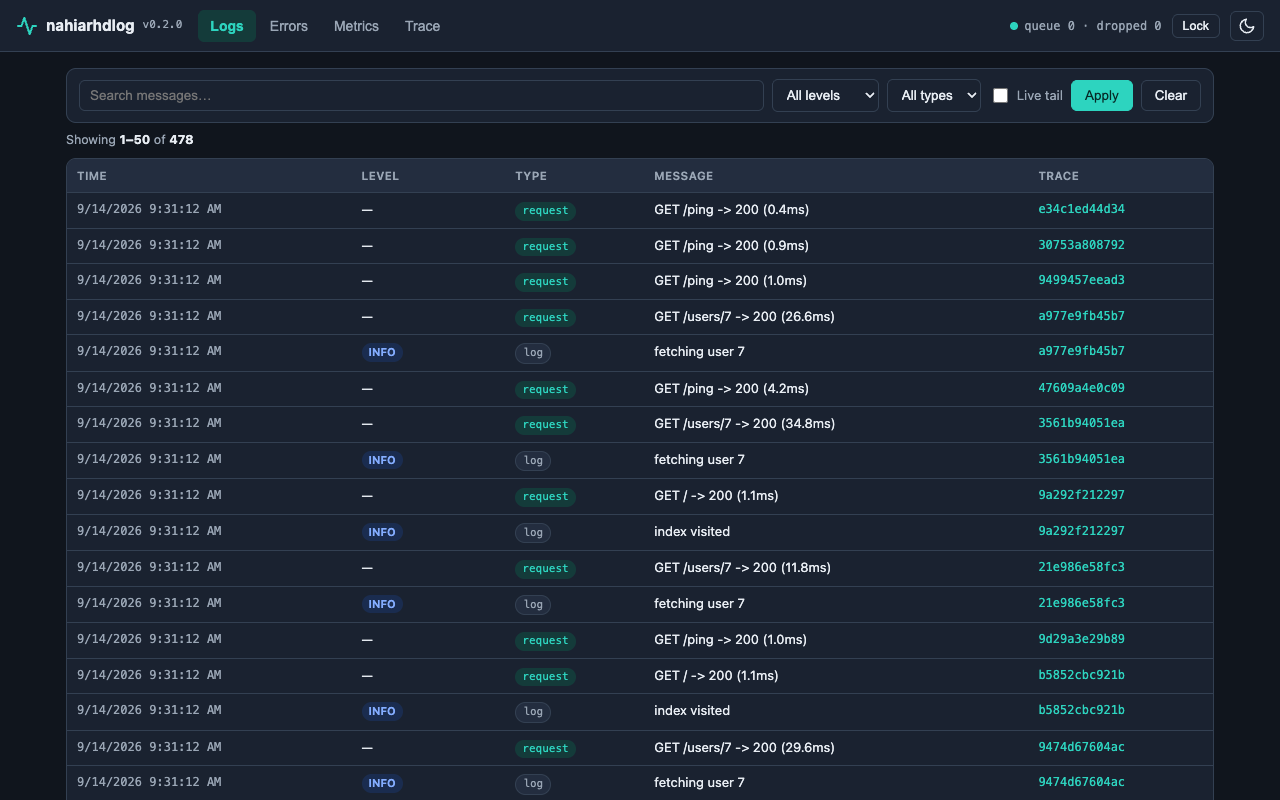
Embedded observability for FastAPI — searchable logs, error tracking, alerts, metrics, tracing, and a token-locked dashboard. Zero infrastructure: everything lives in one SQLite file.
Why nahiarhdlog?
- No infrastructure. No ELK, no agents, no SaaS —
pip installand you have history, search, and a UI. - Embedded dashboard. Your logs live at
/nahiarhdloginside your own app, behind your own token. - Negligible overhead. Requests enqueue a small dict (p95 ~0.04 ms); SQLite writes happen in batches on a background thread. The queue is bounded — when full, events drop with a visible counter instead of ever blocking a request.
- Framework-agnostic core. FastAPI first; the core imports no web framework, so Flask/Django adapters can follow without changing it.
Install
pip install nahiarhdlog
# or: uv add nahiarhdlog
Requires Python ≥ 3.10. Events are stored in .nahiarhdlog/nahiarhdlog.db (SQLite, WAL mode, FTS5 search).
Quickstart
from fastapi import FastAPI
from nahiarhdLOG import observe

app = FastAPI()
observe(app, dashboard_token="secret")  # logs + errors + metrics + dashboard
That's it. Every request, every stdlib log record, and every uncaught exception is now captured. Open /nahiarhdlog/ and enter the token on the lock screen.
Forgot dashboard_token? No 404: observe() logs a startup warning and the URL serves a setup page telling you how to enable the dashboard. Collection keeps running either way — only the dashboard is gated.
Features
| Area | What you get |
|---|---|
| Logs | Auto-captured stdlib records + requests; full-text search (FTS5), level/type/time/trace filters, pagination |
| Errors | Grouped by ExcType@file.py:line, full tracebacks, top-errors ranking |
| Alerts | Threshold rules (N events in M seconds) + cooldown; webhook, Telegram, and SMTP sinks |
| Metrics | RPS, error rate, latency p50/p95, time-bucketed series — computed from the same request events |
| Tracing | One trace_id per request shared by logs and errors; timeline view; optional OpenTelemetry export |
| Dashboard | Embedded at /nahiarhdlog, token-locked, dark/light mode, mobile-friendly, live tail |
Configuration — all arguments and .env wiring
observe() takes explicit arguments and never reads your environment or .env file itself — each app owns its config, so the same package works unchanged across projects:
| Argument | Default | Meaning |
|---|---|---|
db_path |
".nahiarhdlog/nahiarhdlog.db" |
SQLite file for events (parent dirs auto-created) |
dashboard_token |
None (setup page) |
Token for the dashboard; unset = setup page, data stays off |
dashboard_prefix |
"/nahiarhdlog" |
Where the dashboard lives |
retention_days |
7 |
How long events are kept |
sample_rate |
1.0 |
1.0 = every request; 500s are always kept |
level |
logging.INFO |
Minimum stdlib level captured |
skip_paths |
[] |
Extra paths the middleware ignores (dashboard prefix is always excluded) |
Typical .env-based wiring in your app:
# .env (never commit this file)
NAHILOG_DB=/var/lib/myapp/nahiarhdlog.db
NAHILOG_TOKEN=long-random-secret
import os
from fastapi import FastAPI
from nahiarhdLOG import observe

app = FastAPI()
observe(
    app,
    db_path=os.environ.get("NAHILOG_DB", ".nahiarhdlog/nahiarhdlog.db"),
    dashboard_token=os.environ.get("NAHILOG_TOKEN"),  # None = setup page, data stays off
)
If your app loads
.envviadotenv_values(read-only dict) instead ofload_dotenv,os.environwon't see those values — pass them through your env helper instead.
Alerts & OpenTelemetry — rules, sinks, trace export
from nahiarhdLOG.alerter import Rule, SmtpSink, TelegramSink, WebhookSink

observe(
    app,
    rules=[Rule("api-errors", count=10, window_seconds=600, cooldown_seconds=1800)],
    sinks=[
        WebhookSink("https://hooks.example/deploy"),          # POSTs {"subject","body"} as JSON
        TelegramSink(bot_token="123:ABC", chat_id="-100..."),  # Bot API sendMessage
        SmtpSink("smtp.example.com", ["ops@example.com"], username="bot", password="..."),
    ],
    dashboard_token="secret",
)
Rules evaluate in a background thread; a failing sink never blocks the others.
pip install "nahiarhdlog[otel]"
from nahiarhdLOG.otel import export_trace
from nahiarhdLOG.query import get_trace

export_trace(get_trace(collector.storage, trace_id))  # keeps the original trace id
Example app
# terminal 1: run the demo
uv run python examples/basic_app.py serve

# terminal 2: generate traffic
uv run python examples/basic_app.py traffic --n 300
Open http://127.0.0.1:8000/nahiarhdlog/ with token demo-token.
FAQ
Which Python versions? 3.10+ (3.10, 3.11, 3.12 tested in CI).
Where is data stored? One SQLite file (.nahiarhdlog/nahiarhdlog.db by default), WAL mode, FTS5 index for search. Delete the directory to wipe everything. Set retention_days for automatic purging.
Is the dashboard secure? Data is served only when dashboard_token is configured, and every page + API call requires presenting the token (cookie set at login; old ?token= links migrate). Open the URL without the token and you get a lock screen (401). Skip dashboard_token entirely and you get a setup page instead of data. Use a long random token and HTTPS in production.
Why don't I see the dashboard's own requests in the logs? By design: the dashboard prefix is auto-excluded so its polling doesn't drown your signal. Add more with skip_paths.
What's the overhead? Requests only enqueue a small dict; SQLite writes happen in batches on a background thread. Run python scripts/probe_perf.py to measure on your machine.
Flask / Django / plain scripts? On the roadmap. The core (collector, storage, query, alerter, metrics) imports no web framework — only the thin adapters/ layer does, enforced by an automated boundary test.
How do I disable the dashboard? Omit dashboard_token (default): events are still collected, but the dashboard URL serves a setup notice instead of data.
Roadmap
- Core logging, SQLite+FTS5 storage, search API
- Error tracker + webhook alerts
- Metrics + tracing (+ optional OpenTelemetry export)
- Embedded dashboard UI
Non-goals for now: Flask/Django adapters and a Postgres backend. The core stays framework-agnostic and SQLite keeps the zero-infrastructure promise — those get revisited only if real demand shows up.
Custom storage backends
SQLite is the default and stays zero-infrastructure. But storage is a small duck-typed interface — if you ever outgrow SQLite (multi-host shared history, extreme write concurrency), plug your own backend without forking:
from nahiarhdLOG.collector import Collector

collector = Collector(storage=PostgresStorage(dsn))  # your class, your infra
Implement these 9 members (mirror SQLiteStorage in storage.py):
| Member | Role |
|---|---|
insert_many(events) -> int |
Persist a batch; called from the writer thread |
search(...) -> list[dict] |
Newest-first events with text/level/type/trace/signature/time filters + limit/offset |
count(...) -> int |
Same filters, returns the match count |
top_signatures(since, limit) -> list |
[{signature, count, last_ts}] for the Errors tab |
fetch_requests(since, until) -> list |
Lightweight [{ts, status, duration_ms}] rows for metrics |
get(event_id) -> dict | None |
One event by id |
purge() -> int |
Delete events older than retention; returns rows removed |
close() -> None |
Release resources |
fts_available -> bool |
Whether full-text search is active |
Event dicts look like {id, ts, type, level, message, trace_id, data}. Implementations must be thread-safe: writes come from one background thread, reads from request threads.
Development
uv pip install -e ".[dev,otel]"
uv run --no-sync python -m pytest
uv run --no-sync python scripts/probe_perf.py --n 10000
Changelog
- 0.3.2 — The bare prefix redirects to the slashed dashboard URL (307, query preserved) instead of serving the page twice:
index.htmluses relative asset URLs, so only the slashed page renders correctly. Users only need to know/nahiarhdlog. - 0.3.1 — The dashboard page is served with and without the trailing slash, so
redirect_slashes=Falseapps don't 404 the bare prefix. (Superseded by 0.3.2: the bare URL served a page with broken CSS/JS.) - 0.3.0 — Dashboard default moved from
/admin/logsto/nahiarhdlog(passdashboard_prefix="/admin/logs"to keep the old URL). Nodashboard_tokenno longer 404s:observe()logs a startup warning and serves a setup page explaining how to enable the dashboard. - 0.2.0 — Default database moved to
.nahiarhdlog/nahiarhdlog.db(a dot-directory keeps project roots clean; missing parent dirs are auto-created). Note: apps on the old default start a fresh database here — the oldnahiarhdlog.dbis left untouched. - 0.1.3 — Dashboard login persists via cookie: refresh and new tabs stay signed in; lock screen signs in without putting the token in the URL; old
?token=bookmarks keep working and migrate to a cookie. Added Lock button. Shutdown hook moved to lifespan composition (works alongside user-defined lifespans, Starlette 0.52–1.x). - 0.1.2 — Requests capture client IP + user agent; detail dialog rebuilt (no empty rows, status chips, "view full trace" jump); log rows keyboard-accessible (Tab + Enter).
- 0.1.1 —
NahiarhdHandlerno longer appends a second traceback when the message already contains one (loguru-style pre-formatted records, manually formatted tracebacks). - 0.1.0 — Initial release: searchable logs, error tracker + alerts, metrics, tracing, embedded dashboard.
License
MIT — see LICENSE.
By Raihan Hidayatullah Djunaedi · nahiarhd.com · PyPI @nahiarhd
1 maintainer

Metadata
1 maintainer
Release files for nahiarhdlog 0.3.2
For a detailed explanation of source distributions (sdists) and built distributions (wheels), please see the package formats documentation.
Source distribution (sdist)
| File | Size | Uploaded | |
|---|---|---|---|
| nahiarhdlog-0.3.2.tar.gz | 46.4 kB | Details |
Built distribution (wheel)
| File | Interpreter | ABI | Platform | Reset |
|---|---|---|---|---|
| nahiarhdlog-0.3.2-py3-none-any.whl | Python 3 | none | any | Details |
Total release size: 84.8 kB
Release files / nahiarhdlog-0.3.2.tar.gz
| Download URL | nahiarhdlog-0.3.2.tar.gz |
|---|---|
| Size | 46.4 kB |
| Tags | Source |
|
SHA-256 checksum How to use checksums |
2c06e0460e9d89676ab4a53db158edaadd3cf9f36133b0ffad55d1ca805f7805
|
|
BLAKE2b-256 checksum How to use checksums |
720041ad12037f905b16531e14d668f1eb1d255a9c462f2bacee182f26c60097
|
| Upload date | |
|
Uploaded using Trusted Publishing? What is trusted publishing? |
No |
| Uploaded via |
twine/7.0.0 CPython/3.10.20
|
Release files / nahiarhdlog-0.3.2-py3-none-any.whl
| Download URL | nahiarhdlog-0.3.2-py3-none-any.whl |
|---|---|
| Size | 38.4 kB |
| Tags | Python 3 |
|
SHA-256 checksum How to use checksums |
b367006f58cfd37331ac724d5245ab932688d5a27d2b7aecbfa281cd05e6a976
|
|
BLAKE2b-256 checksum How to use checksums |
c0de703e7c3bfc612c4e6d9565d954577db88e74f04b23a3d2579f3eee38e18d
|
| Upload date | |
|
Uploaded using Trusted Publishing? What is trusted publishing? |
No |
| Uploaded via |
twine/7.0.0 CPython/3.10.20
|














